Run the same term through four tools and you get four answers. That is the thing nobody tells you when they recommend a keyword difficulty tool: the score is not a measurement, it is each vendor’s opinion, computed from whatever data they happen to have. Here is what that looks like in practice, why the gaps appear, and the manual check we run before committing a quarter of writing time to a keyword list.
The same three keywords, four scores
The keywords below are real terms and the spread between the tools is the kind of gap you run into constantly. Treat the exact figures as illustrative rather than a live reading: every tool rescores as it recrawls, so pull your own before you act on them. The point is the size of the disagreement, not the individual numbers.
| Keyword | Ahrefs KD | Semrush KD | Moz KD | KWFinder KD |
|---|---|---|---|---|
| seo reporting dashboard | 9 | 44 | 31 | 28 |
| sitemap checker | 26 | 61 | 38 | 35 |
| how many keywords per page | 1 | 39 | 22 | 19 |
A 1 and a 39 for the same term. Neither is wrong, because they are not answering the same question. Ahrefs KD is built mostly around how many referring domains the current top 10 have. Semrush blends link metrics with SERP competition signals and produces a stricter, higher number. Moz weights its own authority model. KWFinder sits somewhere in the middle with a smaller index behind it.
The practical rule: never compare a score from one keyword difficulty tool against a score from another. Pick one, learn what its numbers mean on keywords you have already ranked for, and treat that as your baseline.
What each keyword difficulty tool is actually counting
A link-based keyword difficulty tool
Ahrefs KD is the clearest example. It looks at the referring domain counts of the pages ranking in the top 10 and maps that onto a 0 to 100 curve. That makes it very good at spotting terms where the incumbents have almost no links, and blind to everything else. A term where the top 10 is Reddit, YouTube and three forum threads with zero links will score near zero, and you still will not rank, because Google is choosing discussion results for that query.
A blended keyword difficulty tool
Semrush KD adds SERP feature density, the presence of big brands, and query competitiveness. It is harsher, and it is usually closer to how hard the term feels once you actually publish. The cost is that a low Semrush score is rarer, so you get fewer green lights and have to judge more borderline terms yourself.
Authority-model scores
Moz builds its number from Page Authority and Domain Authority of the ranking pages. At the time of writing, the free tier of Moz Keyword Explorer runs on credits that a group-buy account will usually have exhausted, so treat it as a second opinion rather than your daily driver.
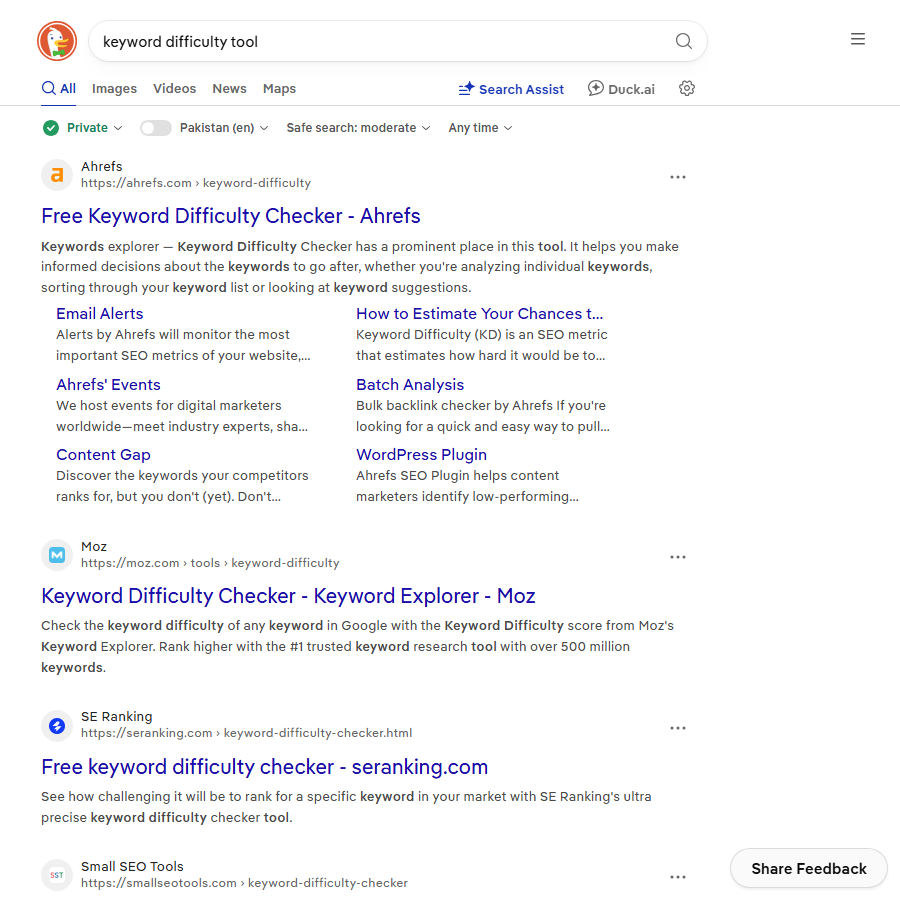
If you are choosing between the platforms themselves rather than just the scores, our Ahrefs versus Semrush comparison and the wider keyword research tools roundup cover the rest of the feature set.
The manual check that beats any keyword difficulty tool score
This takes four minutes per keyword and it has saved us from more bad bets than any score has. Open the SERP and count.
- How many results in the top 10 are not commercial pages? Reddit, Quora, YouTube, a forum, a government page. Every one of those is a slot you probably cannot take with a blog post, because Google has decided that query wants discussion or video.
- How many are weak pages on strong sites? A thin 2019 post on a DR 80 domain is beatable. A thorough 2026 guide on a DR 40 domain often is not.
- Does the page type match what you can build? If the top 10 is ten free tools, a blog post will not rank no matter how good it is. Build the tool or skip the keyword.
- Is the intent stable? If half the results are definitions and half are software listings, the query is split and the click-through will be worse than the volume suggests.
- Read the titles. If every one of them answers a slightly different question, nobody has nailed it yet. That is the best signal on this list.
Score the keyword out of five on that count, and if a keyword difficulty tool disagrees with your count, trust the count. On a query like “how many keywords per page” the count is what tells you the term is open: forum threads and thin old posts in the top 10 mean nobody has answered it properly yet, and that is worth more than any badge.
Which tool for which job
| Job | Best option | Why |
|---|---|---|
| Finding under-linked terms at scale | Ahrefs KD | Its link-count basis is exactly what this job needs, and the filter is fast |
| Sanity-checking a shortlist before committing budget | Semrush KD | Stricter scoring surfaces the terms that look easy and are not |
| Working with zero budget | The manual SERP count | Free, and better than any score on split-intent queries |
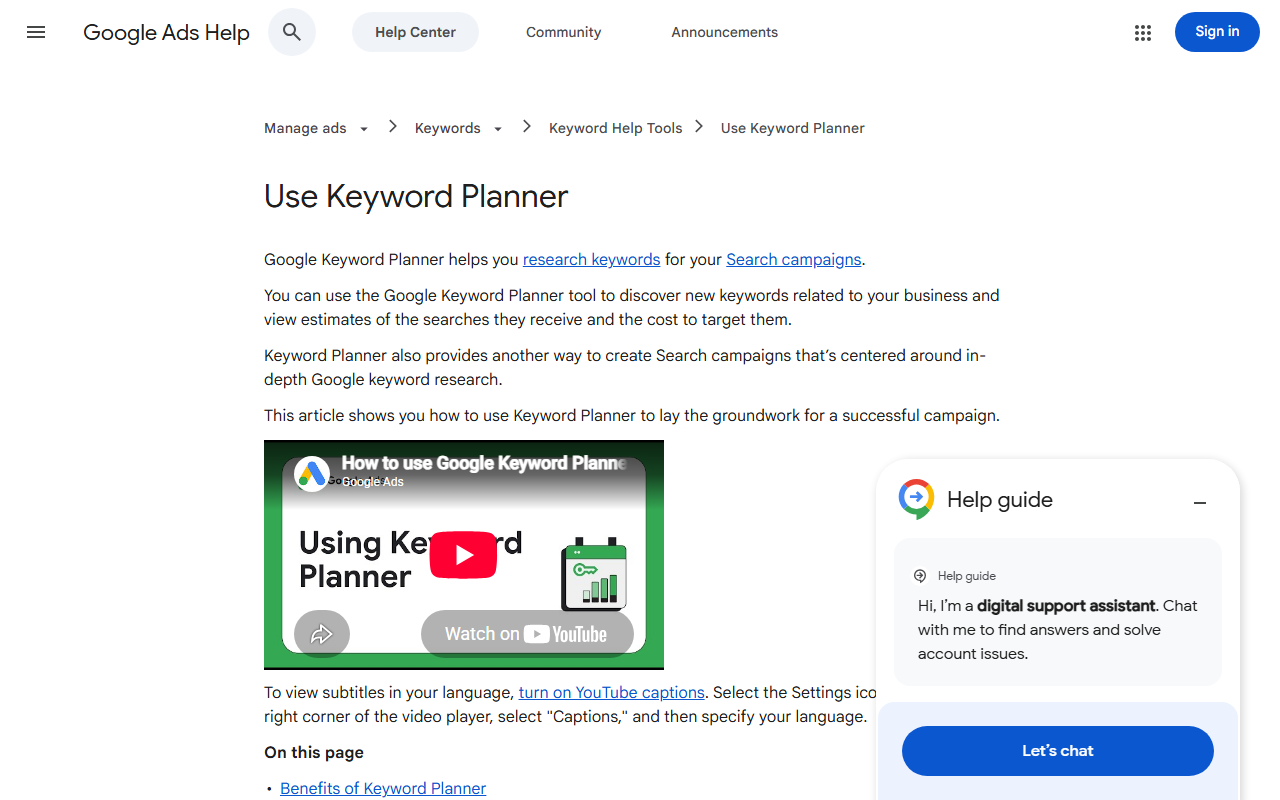
| Checking volume without a subscription | Google Keyword Planner | Ranged volumes, but they come from the source |
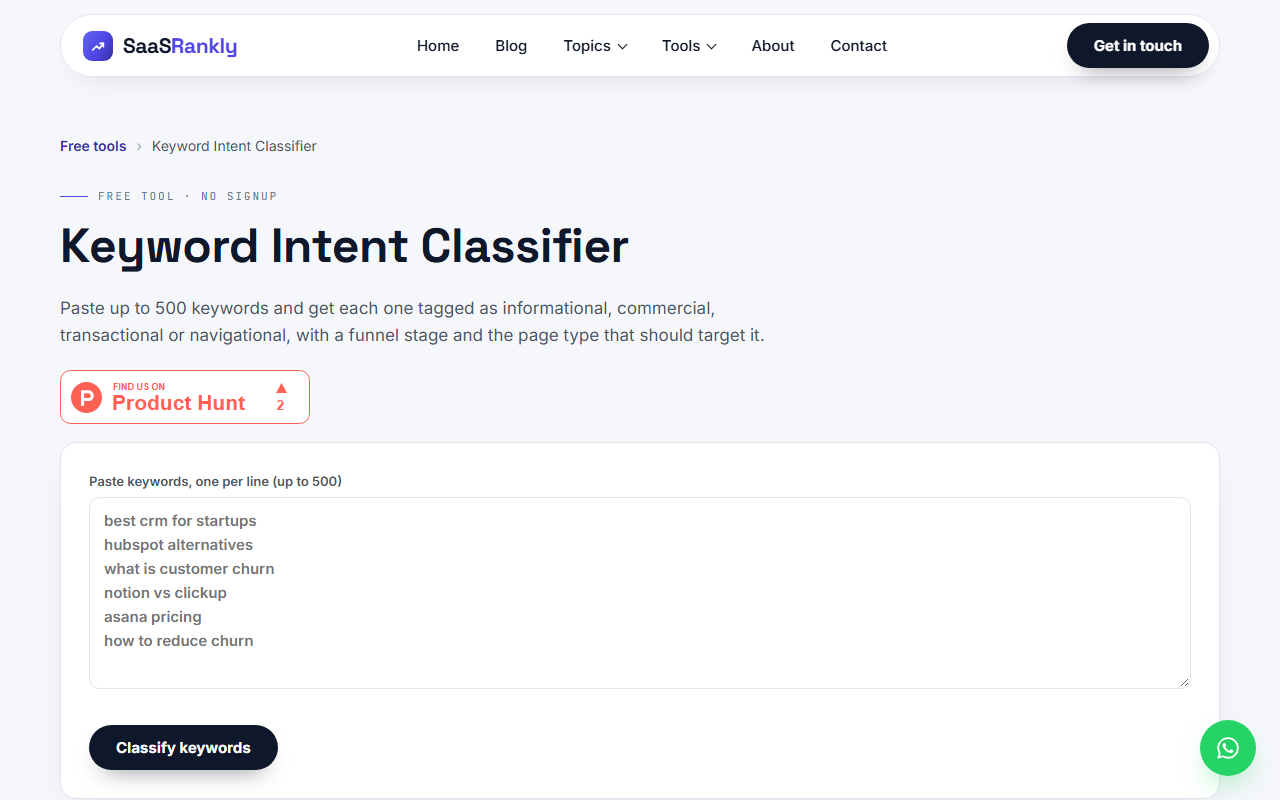
| Sorting a 500-row list before scoring anything | Intent classification | Difficulty on a term you would never write for is wasted effort |
A worked example: picking three keywords from thirty
Here is a worked example. The numbers are illustrative, the decision logic is the part worth copying. Take a project management SaaS with 30 candidate terms and difficulty scores running from 22 to 71. The naive move is to let the keyword difficulty tool pick, take the six lowest and write them. This is what the shortlist looks like once you apply intent and the manual count instead.
| Keyword | Volume | Semrush KD | Manual count | Call |
|---|---|---|---|---|
| gantt chart software | 8,100 | 68 | 10 commercial, all strong | Skip for now |
| project timeline template | 4,400 | 34 | 6 template galleries, 2 thin posts | Write, with a real template |
| what is a burndown chart | 2,900 | 22 | 4 thin posts, 1 forum, intent stable | Write |
| agile vs waterfall | 6,600 | 29 | Wikipedia, 3 universities, intent informational | Skip, no commercial return |
| asana alternatives | 1,900 | 41 | 7 listicles, most from 2024 | Write, highest intent on the list |
The winner on that table has the second-highest difficulty score. “Asana alternatives” is worth more than four low-KD informational terms combined, because the person searching it is actively leaving a product. That trade-off is the whole reason we never sort a keyword list by what a keyword difficulty tool says. The reasoning behind it is in high-intent keywords, and the process for building the candidate list in the first place is in SaaS keyword research.
Where a keyword difficulty tool misleads you most
- Zero-difficulty terms owned by Reddit. The score says free, the SERP says Google wants opinions.
- Terms where the top 10 is all tools. No amount of writing wins a tool SERP.
- Branded terms for other companies. Low competition, no chance, and “alternatives” is the only angle that works.
- Newly trending terms. The top 10 has not settled, so the score is computed from placeholder results and will change in a month.
- Local or geo-modified terms. Difficulty models rarely handle the local pack, which takes most of the clicks anyway.
Every one of those is a case where the number is technically correct and the decision it implies is wrong. If you are shopping for a cheaper subscription to run these checks, we listed the working ones in Semrush alternatives, and the free intent sorting step is at our keyword intent classifier.
Quick recap: keyword difficulty tool
- Scores are vendor opinions computed on different inputs, so a KD 9 and a KD 44 can describe the same keyword.
- Never mix scores from two tools in one table without labelling which tool produced each row.
- Ahrefs KD is link-count based, Semrush KD blends SERP signals and runs stricter, Moz uses its authority model.
- The four-minute manual SERP count beats every score on split-intent and discussion-heavy queries.
- Sort by intent first, then apply difficulty only to the terms you would actually write for.
- A higher-difficulty commercial term often beats four easy informational ones on return.
FAQ
What is a good keyword difficulty score to target?
For a site under a year old, under 20 on Ahrefs or under 35 on Semrush is a reasonable starting band. Those two bands describe roughly the same keywords. As your site accumulates links and topical coverage, move the band up rather than chasing the same easy terms forever.
Why do keyword difficulty tools disagree so much?
Because they compute different things. One counts referring domains to the top 10, another blends link data with SERP competition, a third runs its own authority model. They also crawl different amounts of the web, so their inputs differ before any maths happens.
Is there a free keyword difficulty tool worth using?
The free checkers from Ahrefs, Moz and SE Ranking all work for a handful of lookups a day and are fine for spot checks. For a list of 200 keywords you need a subscription or you need to sample. The free method that scales best is still counting the SERP yourself.
Does low keyword difficulty mean I will rank?
No. It means the incumbents are weak on whichever signal that tool measures. If the top 10 is Reddit threads and YouTube videos, the term can score 0 and stay unwinnable with a blog post. Check the page types before you trust the number.
Should I use keyword difficulty or search volume to prioritise?
Neither on its own. Sort by intent, then look at volume and difficulty together, and give commercial terms more rope. A 1,900-volume “alternatives” page usually outperforms a 6,600-volume definition page on signups.
How often do difficulty scores change?
They update as the tool recrawls the SERP, so weeks rather than days for most terms. That is another reason to re-check a score before you write, especially if the keyword has been sitting in a content calendar for a quarter.
For the vendors’ own explanations, see the Ahrefs keyword difficulty checker and Google’s Keyword Planner documentation. Read both knowing each is describing its own index, which is the point of this whole post.