What is an SEO report? It is a regular summary of how organic search is performing for a business, what changed since the last one, why it changed and what the team will do next. That last part is the one most reports leave out. A good SEO report is short enough that a founder reads all of it and specific enough that someone can act on it the same week.
This post covers what an SEO report is for, the five sections we think every one needs, the rows we would cut, and an example you can copy. If you want the build itself, in Looker Studio or GA4, our SaaS SEO reporting dashboard guide handles that part.
What is an SEO report for?
An SEO report has one job: help the people who fund SEO decide whether to keep funding it, and where. Everything in it should serve that decision. That rules out a lot of what ends up in real reports, such as screenshots of every chart a tool can produce or a list of 400 keyword positions nobody will read.
When you ask what is an SEO report for a particular company, the answer depends on who reads it.
| Reader | What they want from the report | How long they will spend |
|---|---|---|
| Founder or CEO | Is organic bringing in trials and revenue, and is it growing? | Two minutes |
| Head of marketing | Which channels and pages are working, where to put budget | Ten minutes |
| SEO or content lead | Which pages moved, what broke, what to do next | As long as it takes |
One report can serve all three if the top section is written for the founder and the detail sits lower down. That structure is the difference between a report that gets read and one that gets archived.
What is an SEO report made of? The five sections
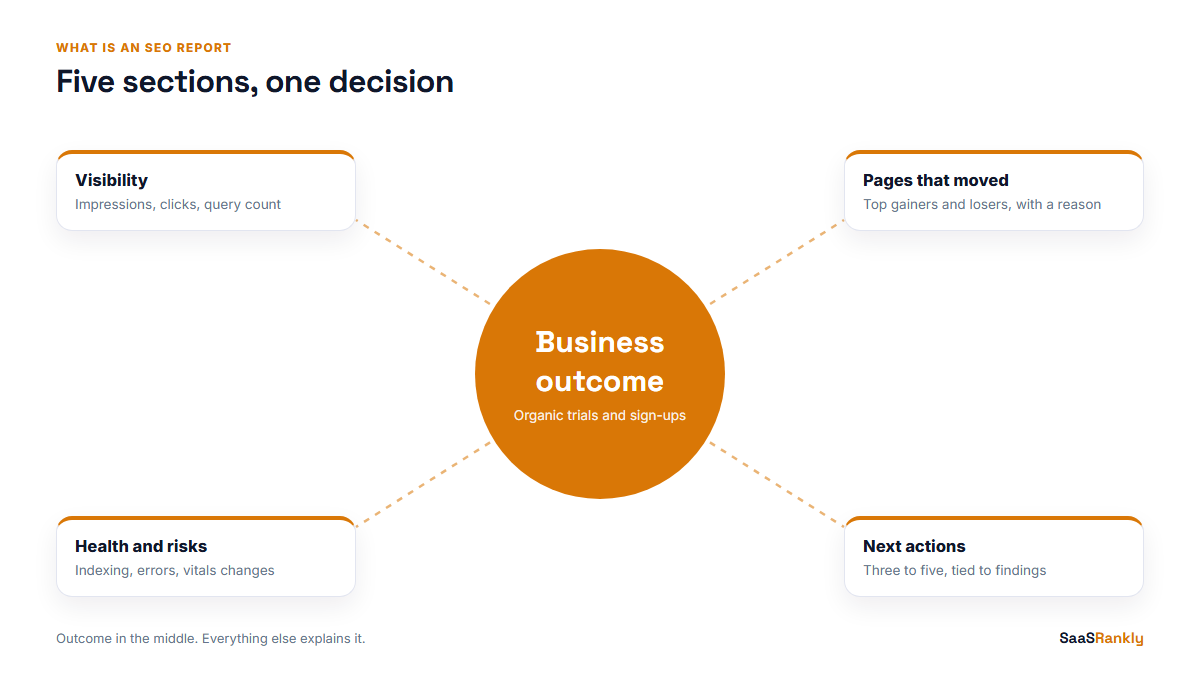
We build every SEO report around the same five blocks. The order is deliberate: outcome first, then cause, then action.
1. Business outcome
Organic sign-ups, trials or demo requests, with the change against last month and the same month last year. For a SaaS company this is the only number the founder really needs. If you cannot attribute conversions to organic yet, fix that before you polish anything else. Our guide to measuring SaaS SEO in GA4 and GSC shows the setup.
2. Search demand and visibility
Impressions and clicks from Search Console, plus the number of queries the site appears for. On a young site, impressions and query count move months before clicks, so they are the honest early signal.
3. Pages that moved
The five to ten pages with the biggest gains and losses in clicks or impressions, each with a one-line reason. This is where the report stops being a data dump and starts being analysis.
4. Health and risks
Indexing status, big crawl errors, Core Web Vitals regressions and any manual actions. Only list what changed. “No new issues” is a perfectly good line.
5. Next actions
Three to five things the team will do before the next report, each tied to something above. If a report has no actions, it is a scoreboard, not a report.
Rows to cut from your SEO report
Ask what is an SEO report meant to change, and most templates fail the question. They include a metric because the tool can measure it, not because anyone makes a decision with it. Here is what we cut and why.
| Metric | Why we cut it | What to show instead |
|---|---|---|
| Bounce rate | Mostly measures page design and GA4 settings, not SEO | Organic conversion rate |
| Domain Rating or Domain Authority | A third-party score that moves for reasons unrelated to your traffic | New referring domains to money pages |
| Total keywords ranked | Grows with every irrelevant long-tail term | Rankings for the 20 to 30 terms that drive sign-ups |
| Site-wide average position | Averages hide everything, one new page at 80 drags it down | Position for named priority terms |
| Pages per session | Rarely tied to revenue on a SaaS site | Visits to pricing and sign-up from organic |
| Full keyword ranking table | Nobody reads 400 rows | Link to the rank tracker for those who want it |
Many popular templates lead with exactly those rows, which is why we suggest starting from a blank page rather than a gallery.
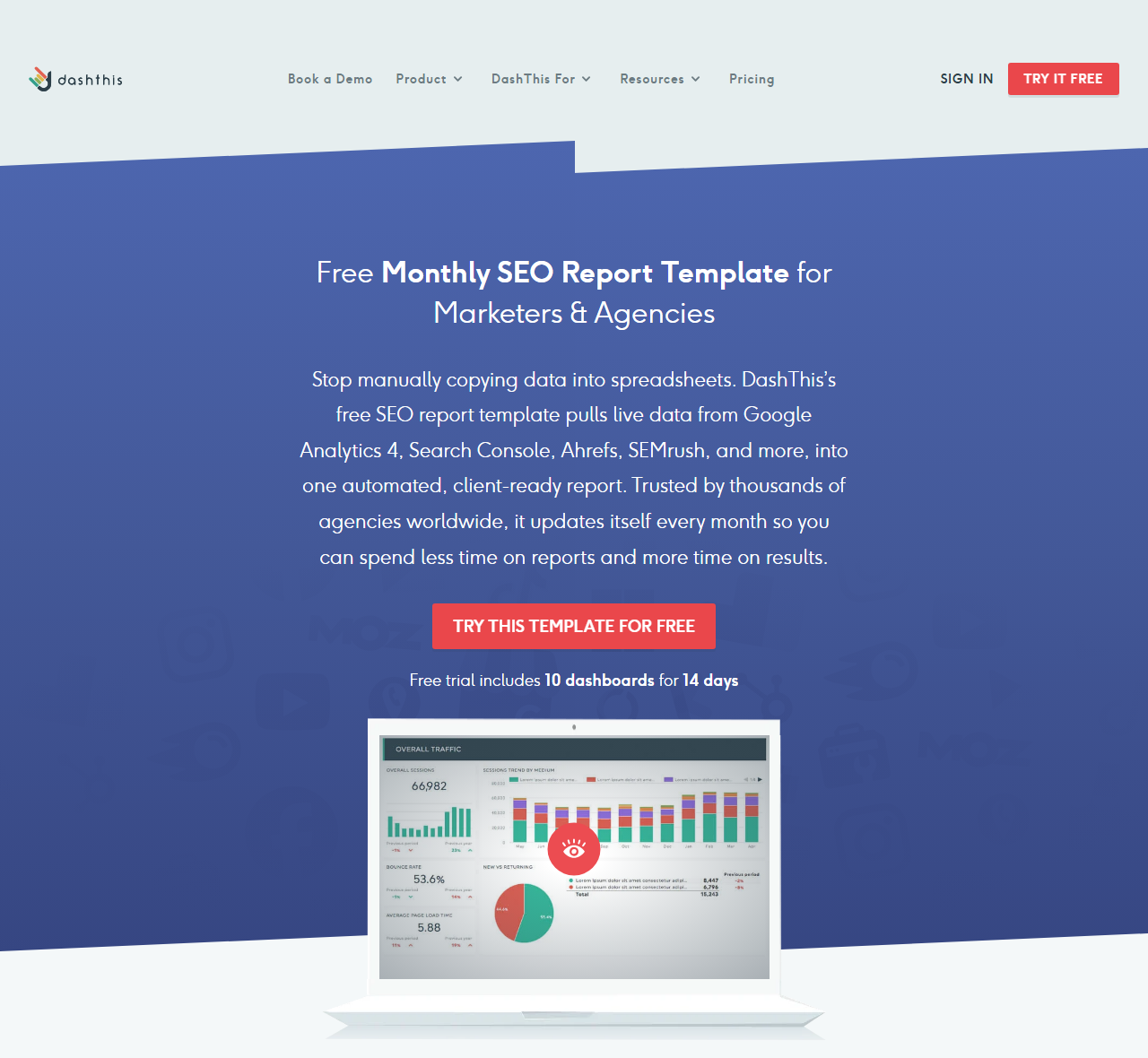
Templates are not bad. They are a good way to see which charts are possible. The mistake is copying all of them into one report.

What is an SEO report in practice? A one-page example
Here is an illustrative monthly SEO report for a fictional SaaS product, “Ledgerly”, an invoicing tool. Every number is invented to show the format.
| Section | This month | vs last month | Note |
|---|---|---|---|
| Organic trials | 142 | +18% | Driven by the new “invoice template” pages |
| Organic clicks | 9,400 | +11% | Seasonal lift at month end, expect a dip next month |
| Impressions | 410,000 | +26% | 12 new posts indexed |
| Queries appearing for | 6,800 | +900 | Mostly long-tail template terms |
| Top gainer | /invoice-template-uk/ | +1,200 clicks | Moved from position 9 to 3 after a rewrite |
| Top loser | /blog/late-payment-fees/ | -400 clicks | AI Overview now answers the query |
| Health | 2 pages dropped from index | new | Accidental noindex on a template, fixed |
Next actions: build three more country-specific invoice template pages, rewrite the late payment post around a calculator the AI answer cannot replace, and add internal links from the template hub to the pricing page.
That is the whole report. It fits on a screen, the founder gets their answer in the first row and the SEO lead has a to-do list. For a longer version with more sections, see our post on SEO analytics reports.
How often should an SEO report go out?
Part of answering what is an SEO report is deciding its rhythm. Monthly is right for most SaaS teams. SEO moves slowly, and weekly reports mostly report noise.
- Weekly: an internal check only, for the SEO lead. Indexing issues, big drops, broken pages.
- Monthly: the main SEO report, in the format above.
- Quarterly: a review against goals, with a look at which content types and page templates are paying back. This is where you talk about SEO ROI.
What is an SEO report worth if nobody acts on it?
Nothing, and that is the test we apply to any report. A few habits make a report more likely to lead to action.
- Write the summary as three sentences of plain English at the top, before any chart.
- Explain every big change. “Clicks fell 20%” is a number, “Clicks fell 20% because the pricing page lost its featured snippet” is a finding.
- Keep the same structure every month so readers know where to look.
- Carry last month’s actions forward and mark them done or not done.
- Put the report where people already work, such as a Slack post or a shared doc, not only an attachment.
For choosing which metrics sit in each section, our list of SEO KPIs goes deeper, and for larger teams the enterprise SEO dashboard post covers splitting reports by product line.
Quick recap: what is an SEO report
- An SEO report summarises organic performance, explains the change and lists next actions.
- Lead with the business outcome, usually organic trials or sign-ups.
- Use five sections: outcome, visibility, pages that moved, health, next actions.
- Cut bounce rate, DR or DA, total keywords ranked and site-wide average position.
- Send it monthly, with weekly checks kept internal.
- If a report has no actions, it is a scoreboard, not a report.
FAQ
What is an SEO report in simple terms?
It is a regular document showing how much traffic and business a website gets from search engines, what changed and what the team plans to do about it.
What should an SEO report include?
At minimum: organic conversions, clicks and impressions, the pages that gained or lost the most, any indexing or technical issues, and a short list of next actions.
What tools do I need to make an SEO report?
Google Search Console and GA4 cover the core data for free. A rank tracker and a reporting tool such as Looker Studio make it faster, but they are optional.
How long should an SEO report be?
One page for the summary is ideal. Detail can live in an appendix or a linked dashboard for the people who want it.
What is the difference between an SEO report and an SEO audit?
Knowing what is an SEO report helps here. A report tracks performance over time and repeats on a schedule. An audit is a one-off deep check of a site’s technical and content health, usually done before a plan is set.
Should an SEO report include keyword rankings?
Include rankings for a short list of priority terms that drive sign-ups. Leave the full ranking table in the rank tracker and link to it.