A rank tracker is the one SEO tool a SaaS team looks at every week, and in 2026 it has to answer two questions instead of one: where do we rank in Google, and are we mentioned when someone asks ChatGPT, Perplexity or Google AI Mode the same thing. This list covers the best rank tracker tools we have used on SaaS accounts, split into classic Google trackers and the newer AI search monitoring tools, with the pricing and limits that actually decide the choice.
The short list
| Tool | Best for | Starting price | Tracks AI search |
|---|---|---|---|
| Ahrefs Rank Tracker | Teams already on Ahrefs | Included from the Lite plan, about 129 USD a month | Brand Radar for AI Overviews and ChatGPT mentions |
| Semrush Position Tracking | Daily updates plus AI Mode, Gemini and ChatGPT in one report | Starter plan, about 139 USD a month | Yes, native toggles |
| SE Ranking | Best value for a startup | About 65 USD a month | Yes, AI prompt visibility |
| AccuRanker | Large keyword sets, on-demand refresh | About 129 USD a month for 1,000 keywords | AccuLLM add-on |
| Nightwatch | Local and multi-country tracking on a budget | About 32 USD a month | Yes, six AI platforms |
| Otterly.ai | Pure AI search monitoring | About 29 USD a month | Only AI search |
| Peec.ai | Brand-level AI visibility for marketing teams | About 89 EUR a month | Only AI search |
| Google Search Console | Free baseline | Free | No |
Prices are list prices at the time of writing and change often. Check the vendor page before you buy, and read the limits section below, because the tracked keyword cap is what a growing SaaS hits first. If you are not ready to pay yet, our breakdown of each free SERP rank tracker shows where every free plan caps out.
What a rank tracker needs to do for a SaaS site
SaaS keyword sets look different from an e-commerce or publisher set. A typical B2B account has 300 to 2,000 keywords: product terms, “X vs Y” comparisons, “alternative to” queries, integration pages and a long tail of how-to content. Most of it is desktop, most of it is one or two countries, and the money terms move slowly. That changes what matters in a tracker.
- Update frequency. Daily is the standard now. Weekly updates make it impossible to connect a ranking change to a release, a migration or a Google update.
- Tagging and grouping. You need to see “comparison pages” or “integrations” as a group, not 400 individual rows. Every tool below supports tags; the difference is how well the reports roll them up.
- Share of voice against named competitors. A SaaS team cares less about position 4 versus 5 and more about whether the direct competitor is above them for the 50 keywords that drive trials.
- SERP feature tracking. AI Overviews, People Also Ask and featured snippets now take most of the space above the fold for informational SaaS queries. A tracker that only reports the blue-link position hides that.
- AI search monitoring. Whether your product is named in ChatGPT, Perplexity, Gemini and Google AI Mode answers for “best tool for” prompts. This is the new column in every report, and it is why the list below is split in two.
Best rank tracker tools for Google (with AI search built in)
1. Ahrefs Rank Tracker
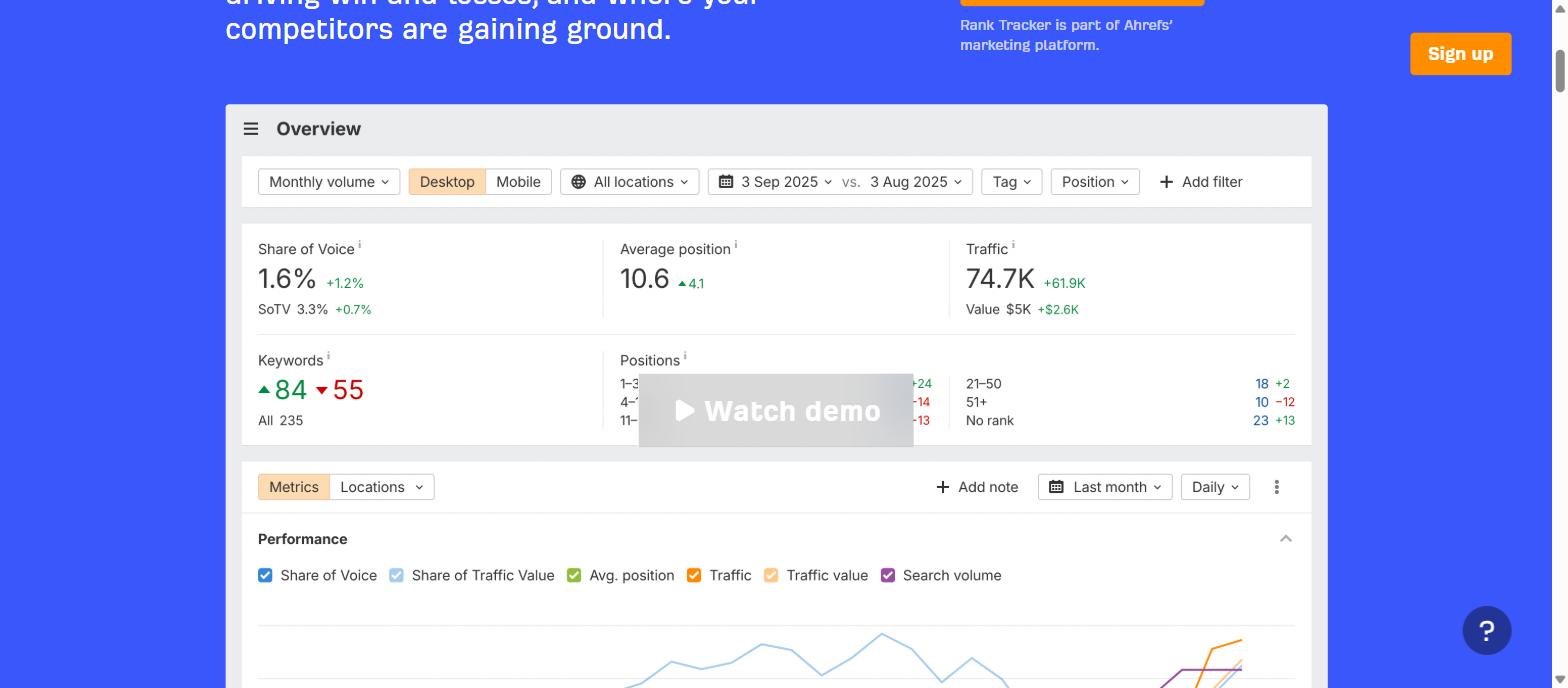
If your team already pays for Ahrefs, the built-in Rank Tracker is the obvious choice and it has improved a lot since 2024. Every plan includes it: Lite tracks 750 keywords, Standard 2,000 and Advanced 5,000, and daily updates are available as an add-on on the lower plans. The reports are clean, tags work well, and the competitors view shows share of voice for up to ten domains.
The AI piece lives in a separate tool, Brand Radar, which reports how often your brand shows in AI Overviews and in ChatGPT, Perplexity, Gemini and Copilot answers. It is a mentions view rather than a prompt-by-prompt tracker, which is fine for a marketing lead and thin for an SEO who wants to know which exact prompt lost a citation.
Best for: teams already on Ahrefs who want one login. Watch out for: the tracked keyword cap on Lite, and the fact that mobile and desktop count as separate keywords.
2. Semrush Position Tracking
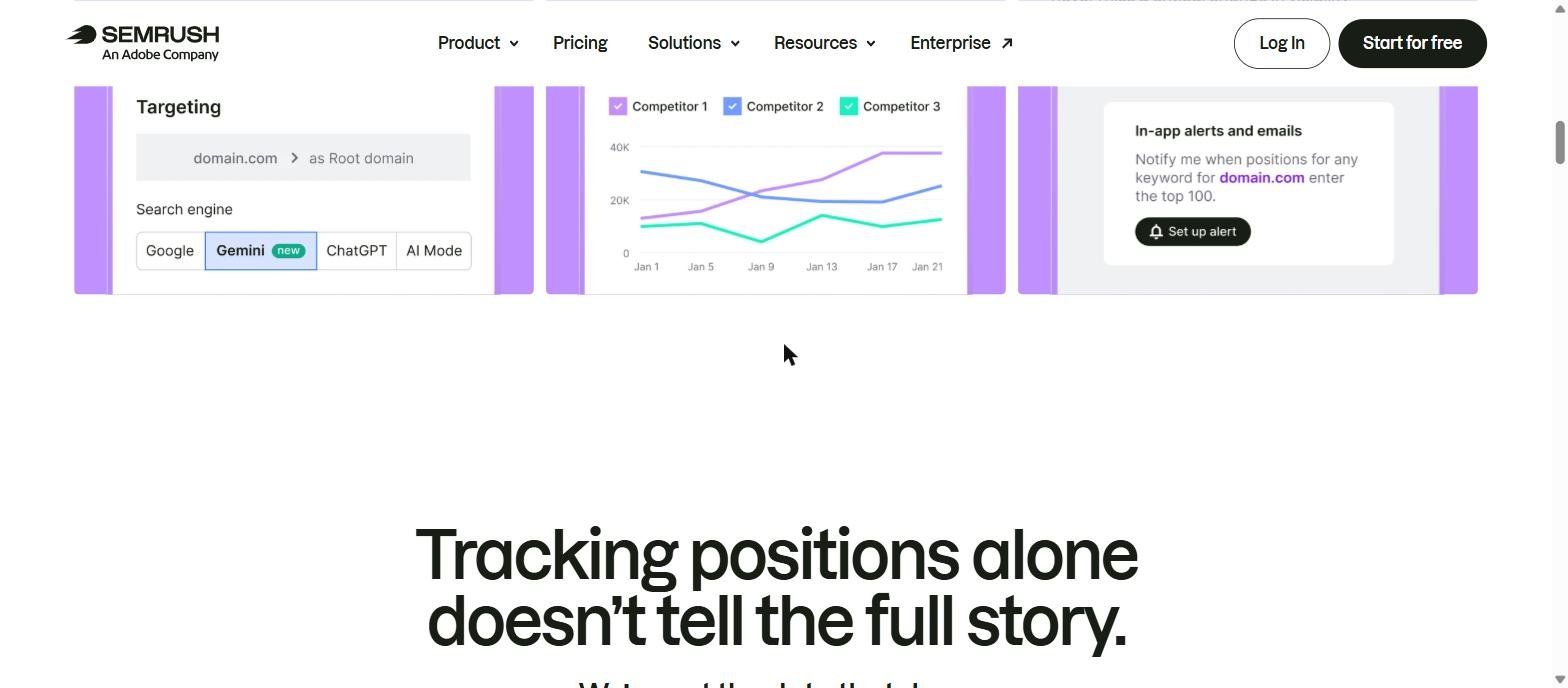
Semrush was first of the big suites to put AI engines into the same rank tracking report as Google, and that is still its strongest argument. You add a keyword list once and toggle between Google organic, Google AI Mode, Gemini and ChatGPT. Updates are daily on every plan, tagging and cannibalisation reports are mature, and the share of voice chart is the one we paste into weekly SaaS reports most often.
Pricing changed in 2025: the SEO toolkit now starts with a Starter plan at roughly 139 USD a month for 500 tracked keywords, Pro+ at about 248 USD on annual billing for 1,500, and Advanced for 5,000. If you also run paid search or need the content toolkit, the bundle is easier to justify. Read our Ahrefs vs Semrush for SaaS comparison before deciding between the two suites.
Best for: teams that want Google and AI search in one weekly report. Watch out for: keyword limits are shared across all projects on the account.
3. SE Ranking
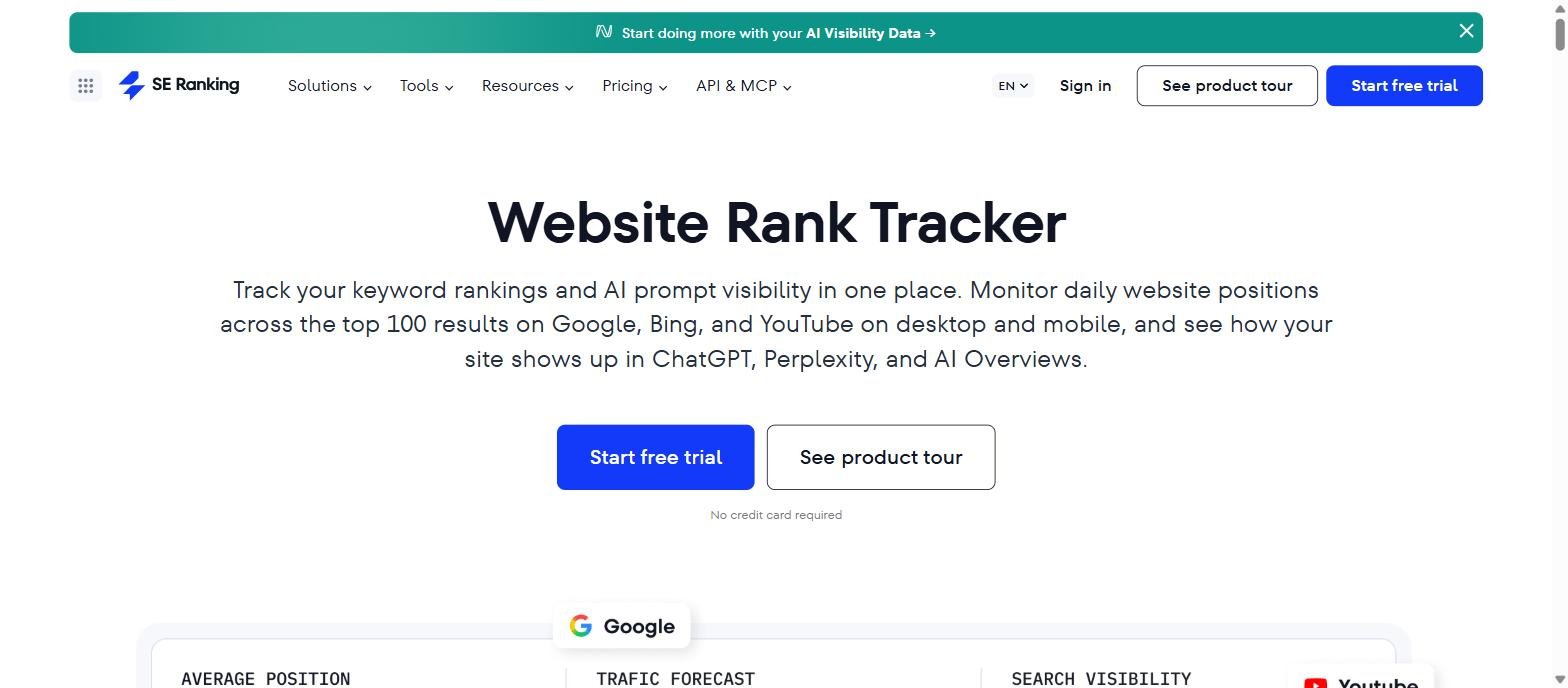
SE Ranking is the tool we recommend to most SaaS startups under 50,000 sessions a month. The Essential plan is about 65 USD a month for 750 keywords with daily updates, Pro is about 119 USD for 2,000, and the rank tracker itself is as accurate as the two suites above. Local tracking, competitor tracking and the reporting builder are all included instead of being add-ons.
In 2025 SE Ranking added AI visibility tracking, so the same keyword list reports whether your domain is cited in ChatGPT, Perplexity and Google AI Overviews. It is less detailed than a dedicated LLM tracker but it is included, which at this price is the point.
Best for: startups and small agencies that want the full feature set without the suite price. Watch out for: the backlink and site audit modules are weaker than Ahrefs and Semrush, so it is a tracker first.
4. AccuRanker
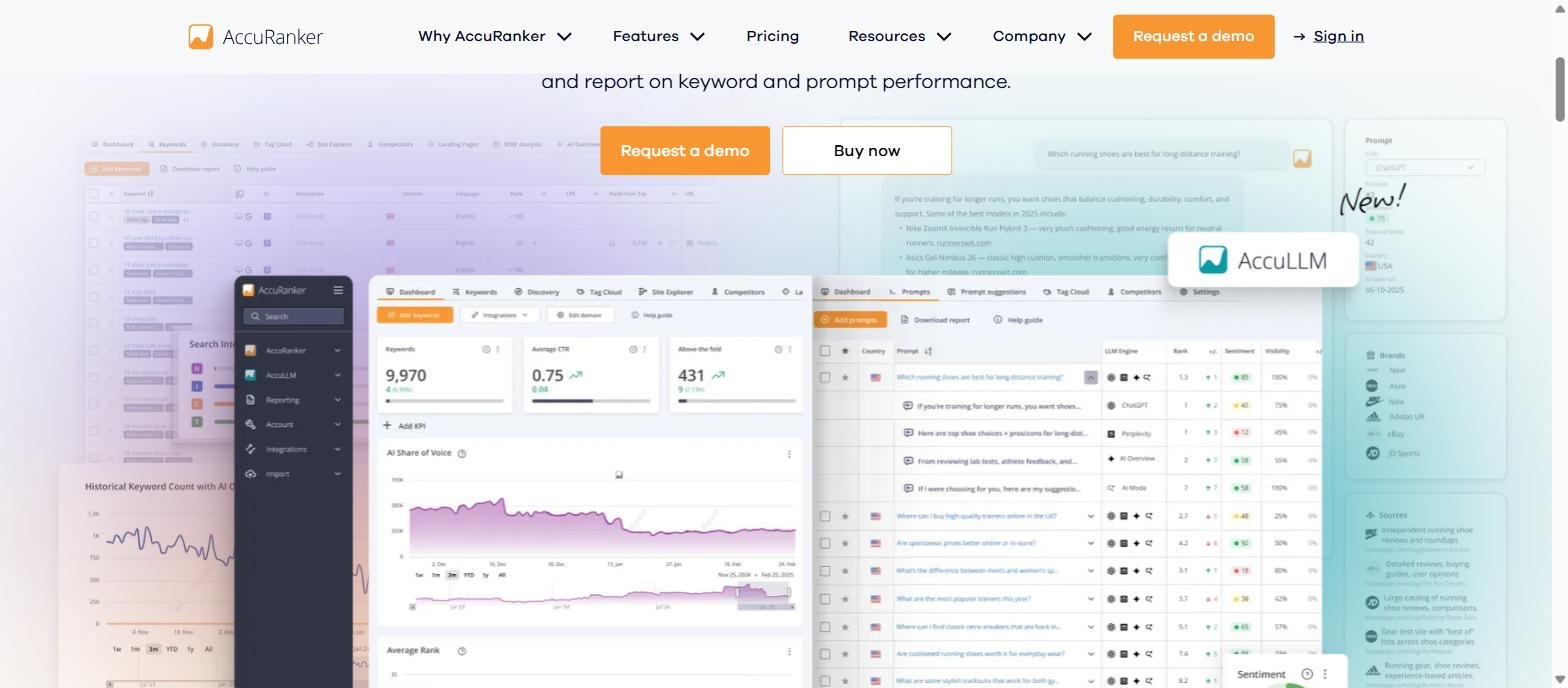
AccuRanker only does rank tracking, and it does it faster than anyone else. Positions update daily with an on-demand refresh button, so you can check a keyword five minutes after a deploy. The interface is built for large keyword sets: filters, tags, landing page grouping and a share of voice model that weights by search volume. Pricing starts at about 129 USD a month for 1,000 keywords and scales linearly, which is cheaper than the suites once you pass 2,000 keywords.
AccuLLM, launched in 2025, adds prompt tracking across ChatGPT, Perplexity, AI Overviews and AI Mode with sentiment and visibility scores per prompt. It is sold as an add-on.
Best for: SaaS companies with thousands of keywords, agencies, anyone who needs an instant refresh. Watch out for: no keyword research or audit tools, so you still need Search Console and one research tool.
5. Nightwatch
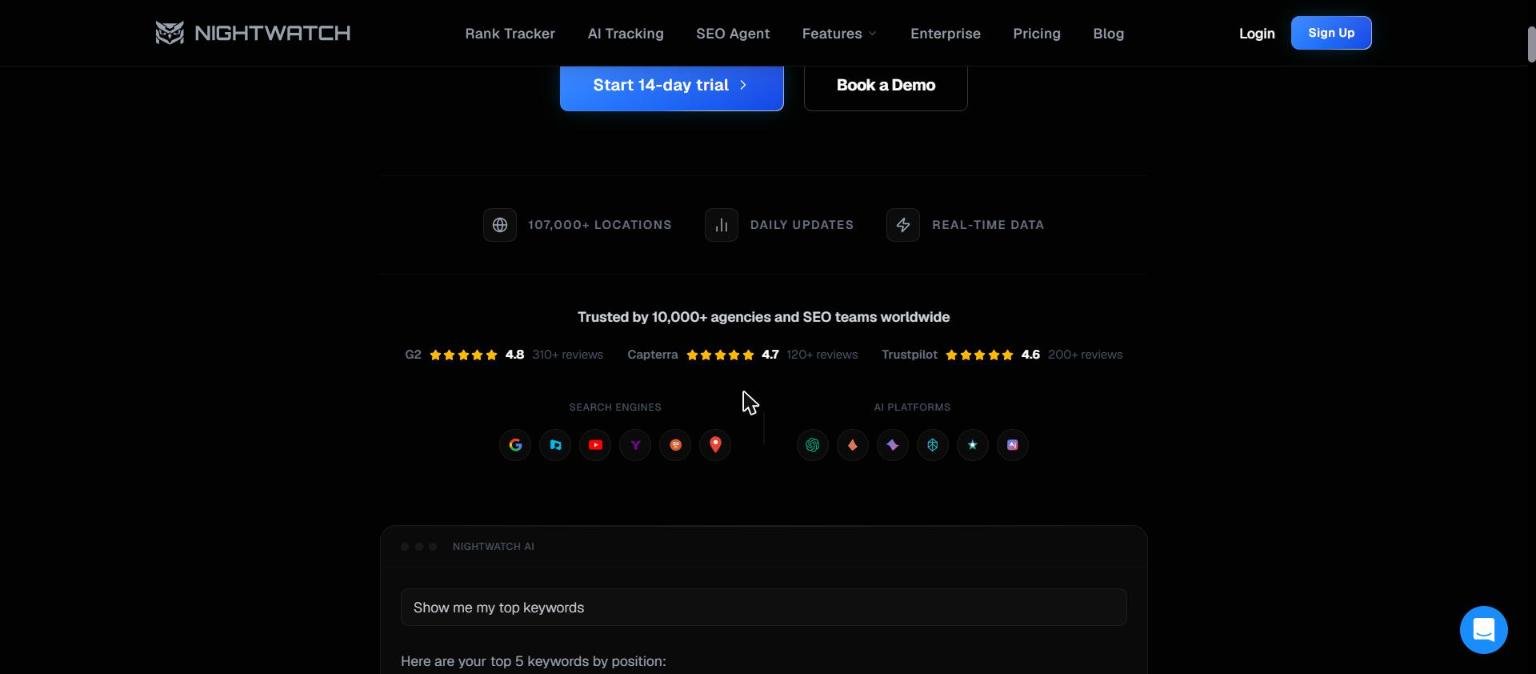
Nightwatch is the budget pick that does not feel like one. Plans start at about 32 USD a month, updates are daily, and it tracks over 107,000 locations, which matters if your SaaS sells into specific cities or countries. The dashboard is customisable, the reporting is white-label friendly, and the AI tracking module covers ChatGPT, Perplexity, Gemini, Claude, Copilot and Grok.
Best for: multi-country SaaS and agencies that need local tracking cheaply. Watch out for: the interface is dense and takes an afternoon to set up properly.
Best AI search monitoring tools
The tools above added AI engines to a Google tracker. The two below started from the AI side. They track prompts rather than keywords, report mentions and citations rather than positions, and are better at telling you which sources the models rely on for your category. Most SaaS teams end up with one from each group.
6. Otterly.ai
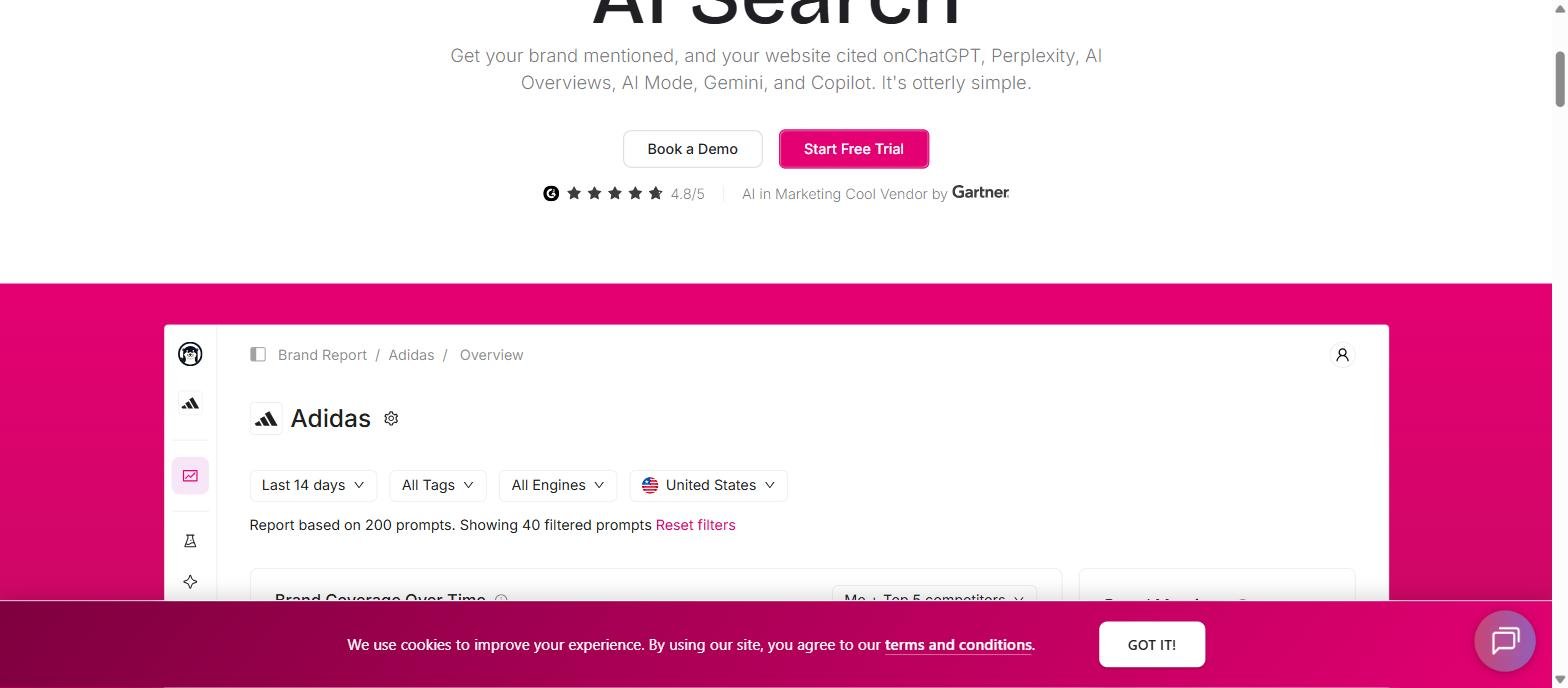
Otterly is the simplest way to start monitoring AI search. You enter prompts such as “best rank tracker for SaaS”, pick the engines and country, and it reports whether your brand and URL are mentioned, which competitors are mentioned instead, and which pages the models cite. Plans start at about 29 USD a month for a small prompt set, with larger plans around 99 and 189 USD.
Best for: a first AI visibility baseline without a big budget. Watch out for: prompt limits are low on the entry plan, so choose the 20 to 50 prompts that map to trial-driving queries.
7. Peec.ai
Peec.ai is aimed at marketing teams rather than SEOs. It reports brand visibility, position within the answer, sentiment and the sources cited across ChatGPT, Perplexity, Gemini and AI Overviews, with competitor benchmarking built in. Pricing starts at about 89 EUR a month. It is the tool to choose when the goal is a monthly AI visibility number for leadership, not prompt-level debugging.
Profound and Semrush’s AI toolkit sit in the same category at enterprise prices; if you are spending more than 500 USD a month on AI monitoring you should compare all three.
8. Google Search Console (free baseline)
Search Console is not a rank tracker, but it is the source of truth every tracker is estimating. The Performance report gives average position, clicks and impressions per query for the last 16 months, free. For a SaaS site under 500 keywords it is often enough for the first year, especially combined with the Search Console and GA4 reporting setup we use. Its limits are that positions are averages across all impressions, there is no competitor data, and the data lags two days.
How to choose: a decision table for SaaS teams
| Situation | Pick |
|---|---|
| Pre-seed, under 200 keywords, no tool budget | Search Console plus the free SEO tools on this site |
| Seed to Series A, one SEO or marketer | SE Ranking Essential or Pro |
| Already paying for Ahrefs or Semrush | Use the built-in tracker; add Otterly for AI prompts |
| 2,000 or more keywords, multiple products | AccuRanker, with AccuLLM if AI search matters |
| Selling into many countries or cities | Nightwatch |
| Leadership wants an AI visibility score | Peec.ai or Semrush AI toolkit |
Setting up rank tracking for a SaaS site properly
- Build the keyword list from bottom of funnel up. Start with product, comparison, alternative and integration keywords from your keyword research, then add the top 100 informational queries from Search Console. Ignore vanity terms you will never convert on.
- Tag everything on import. Funnel stage, page type and product line. Every good report later depends on this.
- Add three to five named competitors. Share of voice against real competitors is the metric your CEO understands.
- Track desktop for B2B unless data says otherwise. Check the device split in Search Console first; most SaaS sites are 70 percent desktop or more.
- Add 20 to 50 AI prompts. Use the “best X for Y” and “X alternative” phrasing buyers actually type into ChatGPT. Track them monthly, not daily; AI answers vary run to run and daily deltas are noise.
- Report weekly on groups, not keywords. The weekly SEO reporting dashboard post shows the layout we use.
Frequently asked questions about rank tracker tools
What is the best rank tracker for a SaaS startup?
SE Ranking for most startups: daily updates, 750 keywords and AI visibility for about 65 USD a month. If you already pay for Ahrefs or Semrush, use their built-in tracker instead of adding a tool.
Do I need a separate AI search monitoring tool?
Not on day one. Semrush, SE Ranking, AccuRanker and Nightwatch all include some AI engine tracking now. Add Otterly or Peec when you need prompt-level detail, source citations or a visibility score to report to leadership.
How accurate are rank trackers?
Within one or two positions of what a logged-out user in that location sees. Personalisation, location and SERP features mean no two people see the same result, so treat positions as a trend, and compare against Search Console average position monthly.
How often should rankings update?
Daily for Google. Weekly or monthly for AI prompts, because model answers change between identical runs and a daily chart mostly shows noise.
Is Google Search Console enough instead of a rank tracker?
For a small site, yes for the first year. You lose competitor data, exact positions and same-day updates, which is what you pay a tracker for once rankings start driving pipeline.
Rank tracking is only one job; if you would rather buy one suite, see how the main SEO platforms compare on price and coverage.
Quick recap: Best rank tracker tools
Best rank tracker tools usually comes down to a short, repeatable checklist. Use this whenever best rank tracker tools comes up again:
- Diagnose best rank tracker tools by checking the relevant report first, not assumptions.
- Confirm the current setup is actually causing best rank tracker tools before you change anything.
- Re-check best rank tracker tools again after the fix ships, not before.
Treat best rank tracker tools as an ongoing signal rather than a one-time fix. For background on the platform rules behind this, see Google Search Central.