Most lists of SEO components are a pile of nouns: keywords, content, links, technical, local. That is accurate and almost useless, because the list never tells you what to build first or what depends on what. We run SEO for SaaS teams, and the order is where money gets wasted. A team that buys links before its pages can be crawled has paid for authority that flows into a wall.
So this guide treats the SEO components as a build sequence. Each one gets what it is, what it depends on, how long it takes to show up in the data, and the mistake we see most often with it.
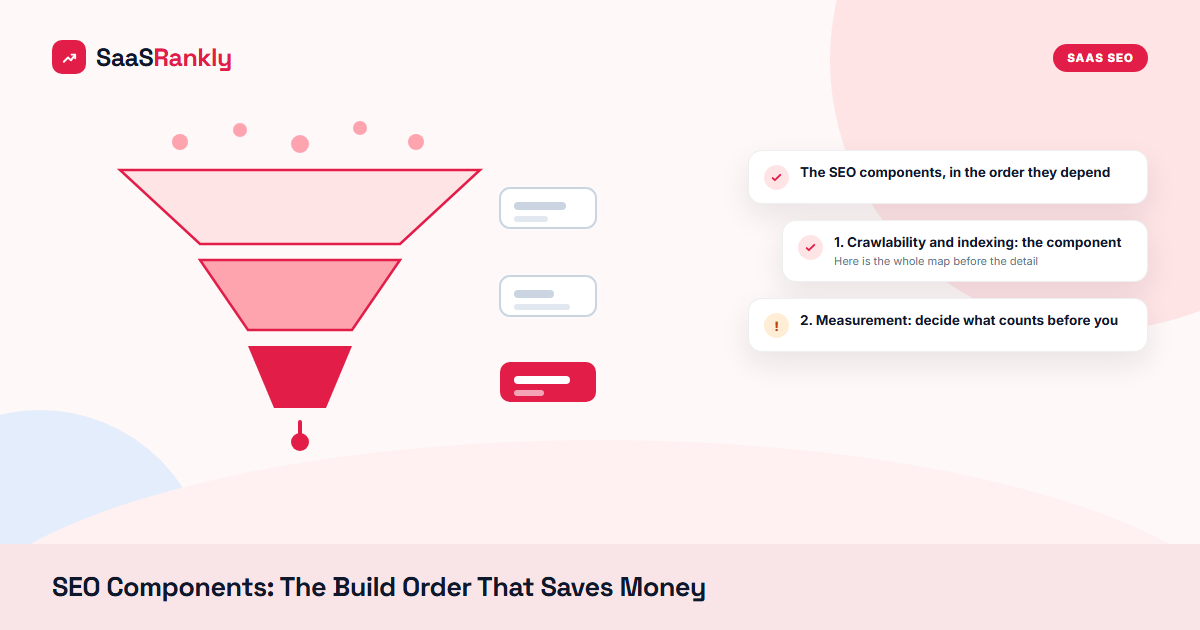
The SEO components, in the order they depend on each other
Here is the whole map before the detail. Read the “needs” column. That column is the reason order matters. We turned the same idea into a working sequence in SEO fundamentals in priority order.
| # | Component | Needs first | First signal in data | Owner on a small team |
|---|---|---|---|---|
| 1 | Crawlability and indexing | Nothing | 1 to 3 weeks | Engineer, half a day |
| 2 | Measurement | 1 | Immediately | Marketer |
| 3 | Keyword and intent map | 2 | Not directly | Marketer |
| 4 | Site architecture and internal links | 1, 3 | 4 to 8 weeks | Marketer plus engineer |
| 5 | On-page optimisation | 3, 4 | 2 to 6 weeks | Marketer |
| 6 | Content | 3, 4, 5 | 2 to 6 months | Writer |
| 7 | Authority and links | 6 | 3 to 9 months | Founder or outreach |
| 8 | SERP presentation | 5, 6 | 2 to 4 weeks after ranking | Marketer |
Two things surprise people when they see it laid out. Measurement sits second, before any keyword work, because you cannot judge the next six components without it. And links sit near the end. Not because they matter less, but because a link to a thin or unindexable page is close to wasted.
1. Crawlability and indexing: the component everything sits on
If Google cannot fetch and index a page, none of the other SEO components apply to it. This is the cheapest one to fix and the most expensive one to ignore.
On SaaS sites the usual failures are specific: the marketing site and the app share a domain and the app’s robots rules leak onto marketing pages, a JavaScript framework renders content that the crawler never sees, or a staging noindex tag ships to production. We covered the full check list in technical SEO for SaaS.
The mistake we see most: teams check that the homepage is indexed and assume the rest is too. Check the Pages report in Search Console for the whole property, not one URL.
2. Measurement: decide what counts before you start
Search Console connected, GA4 recording signups as a conversion, and a single sheet that joins the two. That is the entire component, and it takes an afternoon. Skip it and every later decision is a guess dressed up as strategy.
The one number to set up before anything else is organic signups by landing page. Traffic is easy to grow and hard to pay rent with. If you want the exact setup, it is in measuring SaaS SEO in GA4 and GSC.
3. The keyword and intent map
This is where most people think SEO starts. It is third for a reason: without components 1 and 2 you cannot tell which keywords are worth the effort.
The output is not a keyword list. It is a map of which page targets which query, with the intent written next to it. One page, one primary topic. When two pages chase the same query, they split the ranking and neither wins. Our process is written up in SaaS keyword research.
A quick test for whether your map is done
- Every commercial page has exactly one primary keyword.
- No two URLs share a primary keyword.
- Every keyword has an intent label: learn, compare, or buy.
- You can point to the page that should rank for your product’s main category term.
4. Site architecture and internal links
Architecture is how authority moves around your own site. Internal links are the pipes. A page with no internal links pointing at it is an orphan, and Google treats orphans as unimportant no matter how good they are.
For a SaaS site under 200 pages, the working rule is simple: every page should be reachable within three clicks of the homepage, and your money pages (pricing, comparison, integration pages) should get links from your most visited blog posts. Topic clusters make this systematic, and SaaS content strategy with topic clusters shows how we lay them out.
5. On-page optimisation: the small SEO components that add up
Title tag, H1, meta description, headings, image alt text, structured data, and the opening paragraph answering the query directly. Each one is minor. Together they decide whether a page that could rank actually does.
Structured data is the one most often broken rather than missing. A schema template with an error gets copied onto every page that uses it. Run it through a schema validator once, before you roll it out.
6. Content
Content comes after the first five SEO components because it inherits all of them. A strong article on a page that is hard to crawl, poorly linked, and mistitled will underperform a merely decent article with the plumbing done.
For SaaS, bottom-of-funnel content (comparisons, alternatives pages, integration pages) should come before broad educational posts. It converts faster and the competition is thinner. Educational content is still worth doing, just second.
7. Authority and links
Links are how Google judges whether anyone outside your company vouches for you. They take the longest to build and the longest to show results, which is exactly why people are tempted to buy them early.
Resist that until components 1 to 6 are in place. The links that last for SaaS companies come from assets you already own: original data, integration partners, customers, and a founder with an actual opinion. We break those tactics down in SaaS link building.
8. SERP presentation
Once a page ranks, how it looks in the results decides whether it gets clicked. A clear title, a meta description that matches intent, sitelinks, and FAQ or review markup where it is genuinely valid. This is the last of the SEO components because it only matters for pages that already appear.
If you only have budget for half the SEO components
A seed-stage team with one marketer cannot do all eight properly. Here is how we would split a thin budget, with a fictional example: a 12-person project management startup, 30 marketing pages, one marketer at roughly 10 hours a week on SEO.
| Component | Hours per week | Why that much |
|---|---|---|
| Crawlability and indexing | 0.5 | One-off fix, then a monthly check |
| Measurement | 0.5 | Set up once, read weekly |
| Keyword map | 1 | Front-loaded in month one |
| Architecture and internal links | 1 | Added every time a page ships |
| On-page | 1 | Checklist per page |
| Content | 5 | One bottom-of-funnel page a week |
| Links | 1 | Partner and integration asks only |
| SERP presentation | 0 | Wait until pages rank |
Content takes half the hours, and that is correct at this stage. What gets cut is broad link outreach and SERP polishing, both of which pay off later rather than now.
Quick recap: seo components
- Treat SEO components as a build order, not a checklist. Each one depends on the ones before it.
- Crawlability and indexing come first because nothing else applies to a page Google cannot see.
- Set up measurement second, before keyword work, so every later decision has data behind it.
- A keyword map is one primary topic per page, with intent labelled. Not a spreadsheet of volumes.
- Links come late. A link into an unindexed or thin page is mostly wasted.
- On a small budget, give content half the hours and postpone broad link outreach.
FAQ
What are the main components of SEO?
Crawlability and indexing, measurement, keyword and intent mapping, site architecture and internal links, on-page optimisation, content, authority and links, and SERP presentation. Many guides group them into three buckets (technical, on-page, off-page), which is fine as a summary but hides the dependencies between them.
Which SEO component matters most?
Whichever one is currently broken. In our experience that is most often indexing on young SaaS sites and content on mature ones. A site with perfect content and a crawl problem gets nothing, so fix the foundation first.
Are backlinks still an SEO component in 2026?
Yes. Google has been clear that links remain one of the signals it uses, though it no longer describes them as the top one. The practical change is that a handful of relevant links now outweighs a large number of irrelevant ones.
How long does each SEO component take to show results?
Indexing fixes show up within one to three weeks. On-page changes within two to six weeks. New content usually needs two to six months on a young domain, and link building three to nine months. Measurement shows value on day one because it tells you what the others are doing.
Can a small team handle every SEO component?
Not properly at once. Do crawlability, measurement and the keyword map in the first month, then spend most of the ongoing hours on content. Bring in link outreach and SERP polishing once pages are ranking.
Is technical SEO a separate component from on-page SEO?
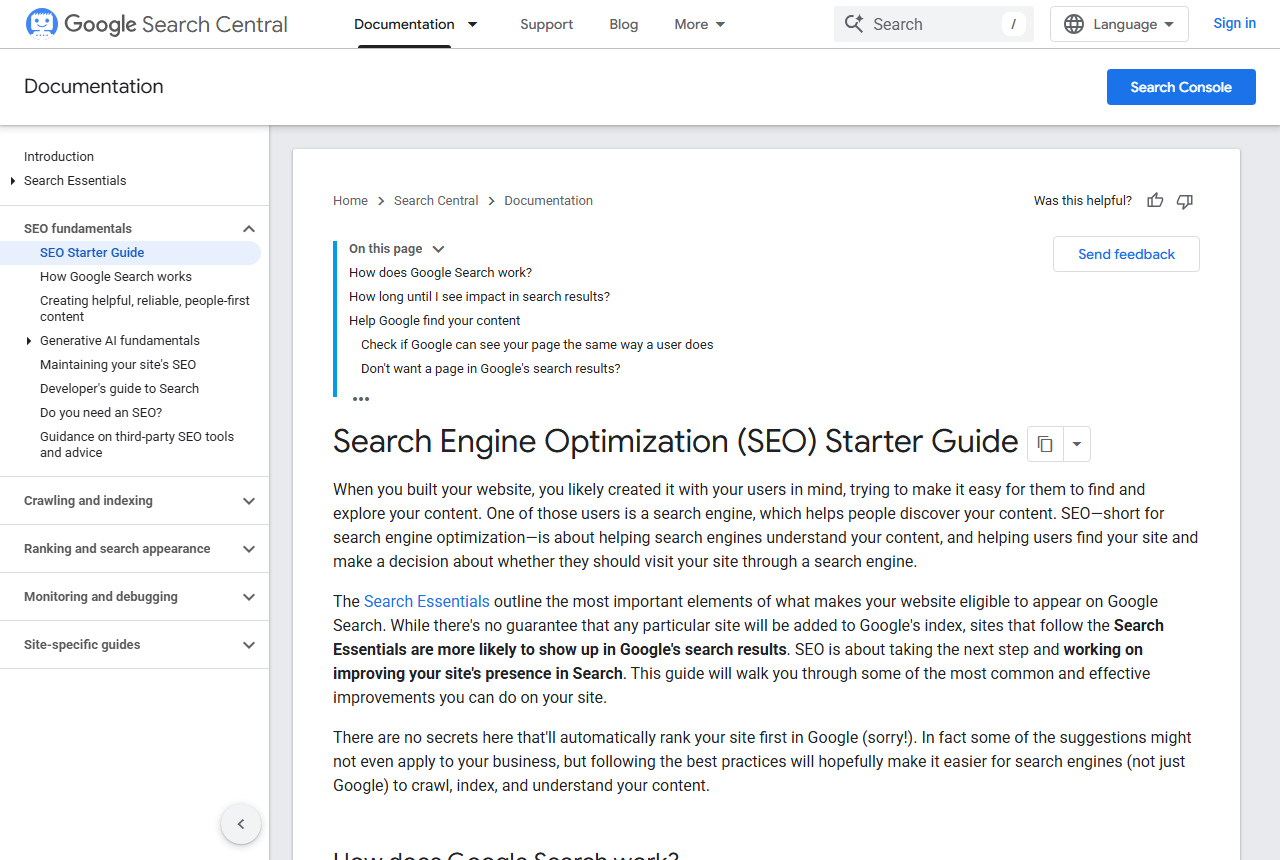
They overlap but are worth separating. Technical SEO is about whether search engines can reach and understand the site at all. On-page SEO is about how well an individual page matches a query once it is reachable. Google’s SEO starter guide covers both and is a good neutral reference.