Niche keyword research for a small SaaS category starts with an awkward truth: most of the terms your buyers use show “0” or “10” in every keyword tool. If you sell scheduling software for dog groomers, or a compliance tracker for small dental practices, the tools were not built with you in mind. They sample big markets well and tiny ones badly. So the method has to change, not just the filters.
We have run this process for a handful of small-category SaaS products, and the pattern holds. The keywords that bring trials are usually invisible in the tools, obvious in sales calls, and cheap to rank for once you find them. Here is how we do it, what we skip, and a worked example you can copy.
Why niche keyword research breaks the usual playbook
The standard advice says filter by volume, sort by difficulty, pick the gaps. In a small category that produces one of two results: a list of broad head terms you cannot win (“scheduling software”, 20,000 searches, every big brand ranking) or an empty list because nothing passes a 100-search minimum.
Three things are different when the market is small.
- Volume data is noise below about 50 searches a month. Tools round, bucket and estimate. A term showing 0 can get 30 real searches, and a term showing 40 can get none.
- The buyer’s vocabulary is specific. Groomers say “booking app for mobile grooming van”, not “appointment management solution”. Tools rarely hold those phrasings.
- One page can win the whole category. With few competitors, a single good page often ranks for 50 or more variants. Volume per keyword matters less than coverage of the topic.
That last point changes how you judge success. In a broad market you count keywords. In a niche you count the questions your page answers.
Myth and fact: what tools tell you about small markets
Myth: zero-volume keywords are not worth a page.
Fact: in our client data, small-category pages built on “zero volume” terms regularly pull a few hundred impressions a month from variants no tool listed. Search Console shows the real demand only after the page exists.
Myth: low keyword difficulty means easy.
Fact: KD scores are based on backlinks to the current top pages. In a niche the top pages are often forum threads or directory listings with no links, which shows a low score, but the intent may not fit a product page at all.
Myth: you need a paid tool for niche keyword research.
Fact: paid tools help with the head of the list. The tail comes from free sources, and our list of free SEO tools for keyword research covers most of what we use.
Our six-step routine for niche keyword research
1. Mine your own conversations first
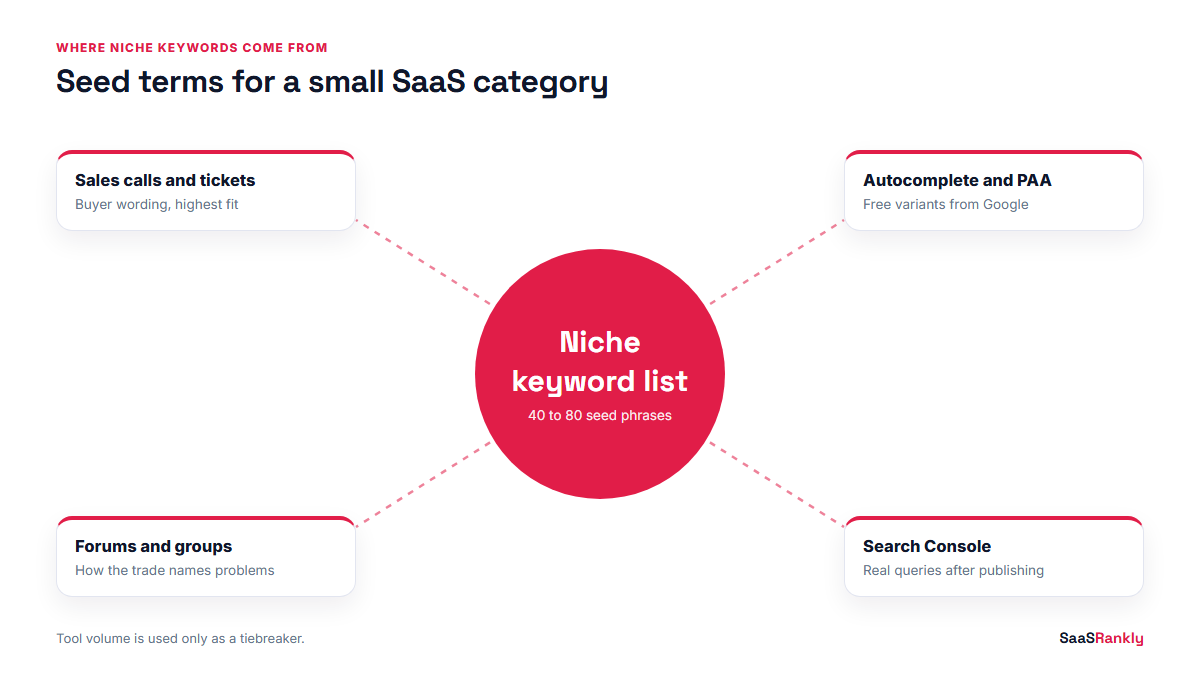
Before opening any tool, export the last 50 sales call notes, support tickets and demo request forms. Highlight every phrase a customer used to describe the problem. These are your seed terms, in your buyer’s words. We usually end up with 40 to 80 phrases in an afternoon.
2. Expand with free sources
Take each seed into Google autocomplete, People also ask, related searches and the Reddit or Facebook groups where your buyers talk. For trade niches, industry forums and association websites are gold: their menu labels and article titles show how the profession names its own problems.
3. Check intent on the results page, not in a tool
Search each candidate and look at what ranks. If the top five are product pages and comparison posts, a product page can win. If they are definitions, write a guide. If they are YouTube videos, a written page will struggle. Our keyword intent classifier gives a quick first sort before you check by hand.
4. Score with a niche-friendly matrix
Volume alone is the wrong filter here, so we score on four columns and treat volume as a tiebreaker. The matrix below is the one we use.
| Factor | Score 3 | Score 2 | Score 1 |
|---|---|---|---|
| Buyer fit | Phrase came from a customer | Close variant of a customer phrase | Found only in a tool |
| Intent | Results show products or comparisons | Mixed results | Definitions, news or video only |
| Competition | Forums and directories ranking | Small blogs ranking | Big brands or marketplaces ranking |
| Product link | Your feature solves it directly | Your product helps with part of it | Loose connection |
Anything scoring 10 to 12 goes into the first batch. Volume decides the order only between equal scores. For the commercial side of this scoring, our piece on high-intent keywords explains why the buyer-fit column matters most.
5. Group into pages before you write
Small niches punish thin pages. Ten near-identical posts for “grooming booking app”, “mobile groomer scheduling” and “dog grooming appointment software” will compete with each other. Cluster them, then write one strong page per cluster. Our guide to keyword clustering shows how we group terms by shared results.
6. Let Search Console finish the research
Publish, wait four to eight weeks, then read the queries tab for each page. This is where niche keyword research actually completes. You will see phrasings nobody on the team guessed, and each one is either a heading to add or a new page to plan.
Worked example: a booking app for mobile groomers (illustrative)
The company and numbers below are invented to show the arithmetic. Picture a small SaaS selling booking and route planning to mobile dog groomers in the US, priced at $39 a month. Here is part of the shortlist after steps one to four.
| Keyword | Tool volume | Buyer fit | Intent | Competition | Product link | Total |
|---|---|---|---|---|---|---|
| mobile grooming booking app | 90 | 3 | 3 | 2 | 3 | 11 |
| route planner for mobile groomers | 0 | 3 | 3 | 3 | 3 | 12 |
| how to price mobile dog grooming | 260 | 2 | 2 | 2 | 1 | 7 |
| grooming client reminder text template | 20 | 3 | 2 | 3 | 2 | 10 |
| dog grooming software | 1,300 | 2 | 3 | 1 | 2 | 8 |
Look at the second row. A tool says nobody searches for it. Three customers used almost exactly those words on calls, the results page is two forum threads and a directory, and the product does exactly that job. It goes first. The pricing guide has the most volume but the weakest link to the product, so it waits. The broad “dog grooming software” term stays on the list for later, once the site has a few pages ranking and some links.
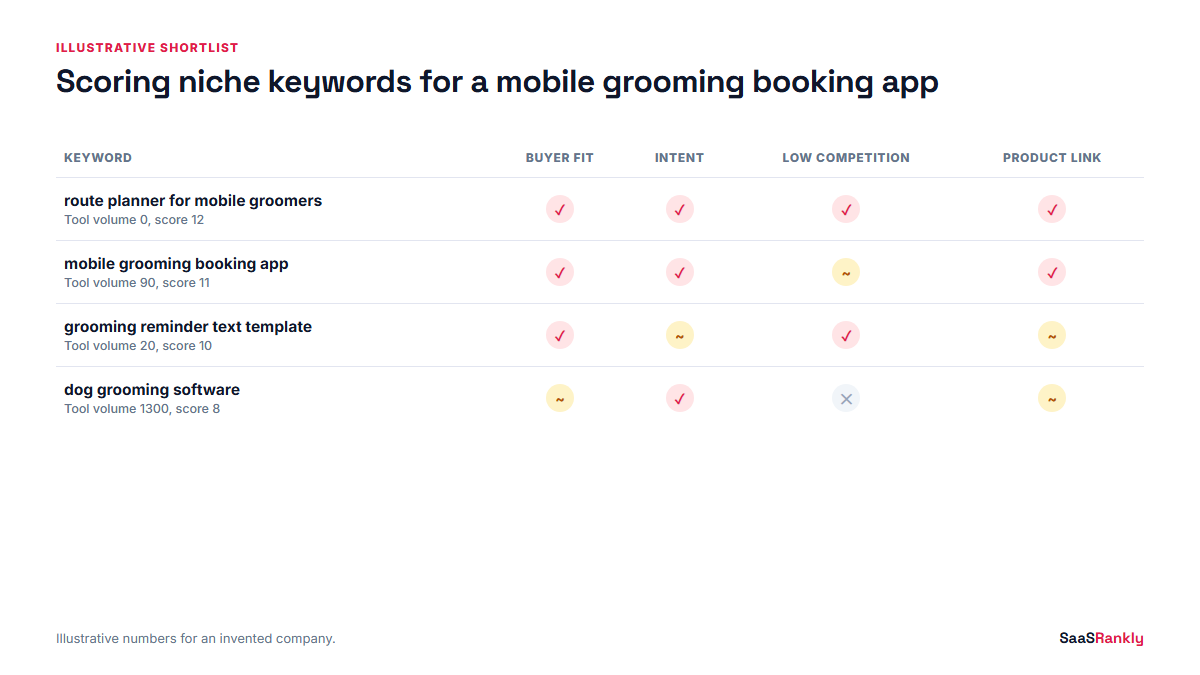
In our experience a first batch like this, five to eight pages, starts showing trial sign-ups within three months. Traffic stays small. A few hundred visits a month from the right buyers is a good result in a market of a few thousand businesses.
The checklist we run before publishing
- The main phrase appears in the title, the first paragraph and at least one heading, in the buyer’s wording.
- The page answers the three questions that came up most in sales calls on that topic.
- There is a screenshot or short walkthrough of the feature that solves the problem.
- Close variants live as headings on the same page, not as separate posts.
- The page links to one related guide and to the pricing or signup page.
- A date is set in the calendar to read the Search Console queries for this URL after six weeks.
When to stop doing niche keyword research
There is a ceiling. Once your pages cover the questions your buyers ask and you rank for most of them, more research produces smaller and smaller pieces. At that point the work shifts to links, conversion and adjacent markets. For a small SaaS, adjacent usually means one step out: groomers lead to pet sitters and dog walkers, who share similar scheduling problems. The same routine applies, starting again at step one with their language.
If your niche is a slice of a bigger SaaS market, our broader guide to SaaS keyword research covers the head terms, and finding low-competition keywords with real traffic helps once you are ready to go after them.
Quick recap: niche keyword research
- Niche keyword research starts with customer language from calls and tickets, not with a tool’s volume filter.
- Below about 50 searches a month, tool volume is noise; zero-volume terms often bring real impressions.
- Check intent on the live results page and score candidates on buyer fit, intent, competition and product link.
- Group variants into one strong page per cluster so pages do not compete with each other.
- Search Console finishes the research: read each page’s queries after four to eight weeks.
- Expand to adjacent buyer groups once the core questions are covered.
FAQ
What is niche keyword research?
It is keyword research for a small, specific market where standard tools have little data. It relies more on customer language, community sources and the live results page than on volume numbers.
Should I target keywords with zero search volume?
Yes, if a customer used the phrase and your product solves it. Tools under-report small markets, and a page on a “zero” term often picks up dozens of related queries.
What free tools work for niche keyword research?
Google autocomplete, People also ask, related searches, Search Console, Reddit and industry forums. Keyword Planner gives rough ranges if you have an Ads account.
How many keywords does a small SaaS need?
Fewer than you think. Five to eight well-built pages covering the main buyer problems is a strong first batch for most small categories.
How do I know if a niche keyword has buying intent?
Search it. If the top results are product pages, comparisons or reviews, the searcher is shopping. If they are definitions or news, they are still learning.
How long until niche keyword pages rank?
In small markets with weak competition we usually see first rankings within four to eight weeks and trial sign-ups within about three months, depending on the site’s authority.