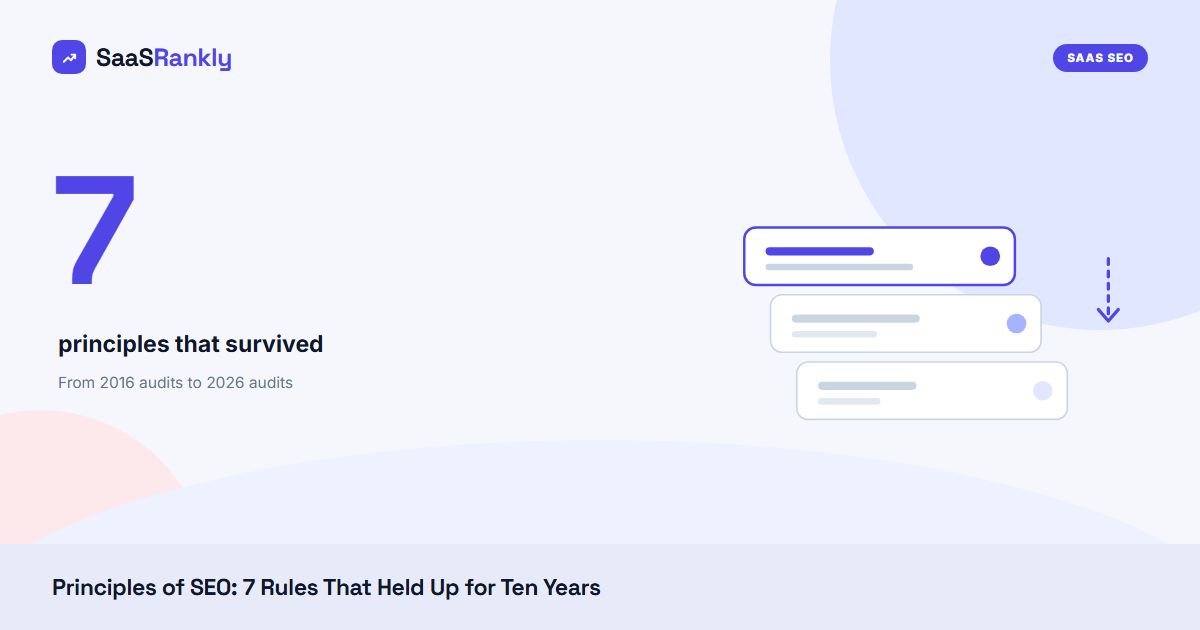
The principles of SEO are the handful of rules that kept working while almost every tactic around them changed. We went back through audit notes from 2016 and compared them with what we check on SaaS sites today. The tools are different, the results page looks nothing like it did, and AI answers now sit above the blue links. Yet seven rules show up in both sets of notes, almost word for word.
This post is about those seven. Not the tactics of the month, not a checklist for this quarter. If you want the build order for a new site, our guide to SEO fundamentals in priority order covers that. Here we are asking a different question: which ideas would you still bet on in 2036?
Why the principles of SEO outlast the tactics
A tactic is a specific move that works because of how Google behaves right now. Exact-match domains, keyword-stuffed footers, guest posts at scale, FAQ rich results on every page. Each one worked for a while, then stopped. A principle is the reason a tactic worked in the first place. When the tactic dies, the principle is usually still standing.
We see teams burn months because they learned tactics without the reasons behind them. When Google changed how FAQ rich results appear in 2023, sites that had added FAQ markup purely for the extra SERP space lost the benefit overnight. Sites that had written FAQs because their buyers actually asked those questions kept the traffic, because the content still answered the query.
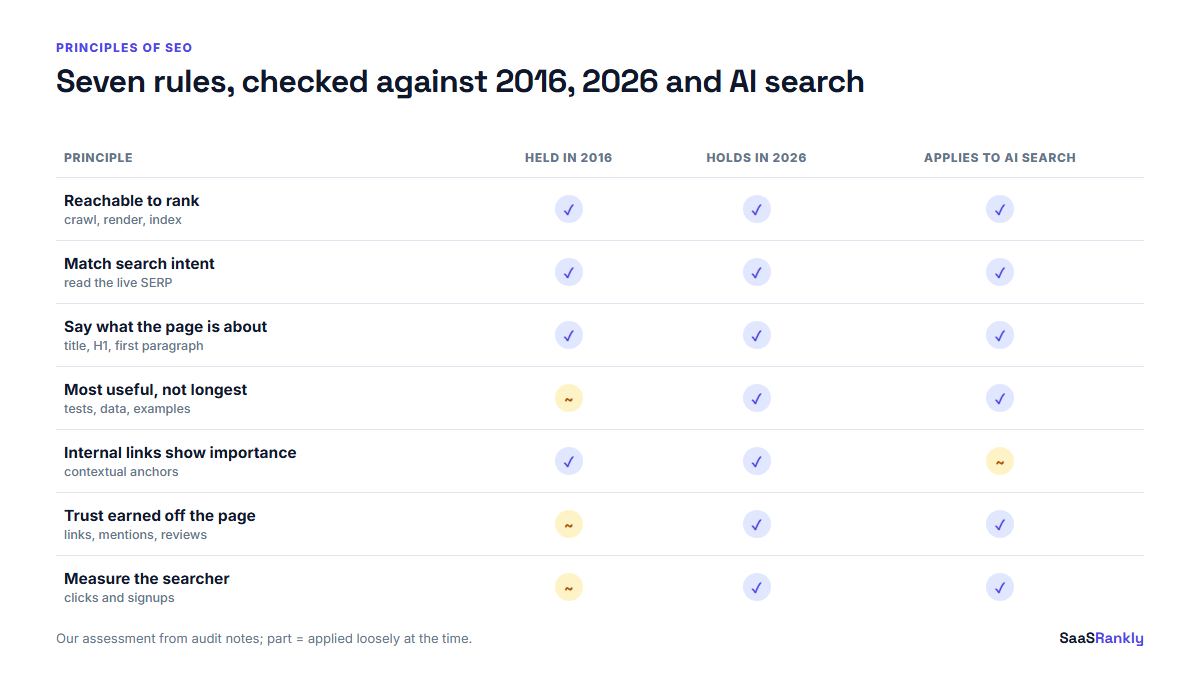
So the test for any principle of SEO is simple. Did it hold in 2016? Does it hold in 2026? Would it hold if Google rebuilt its ranking system from scratch tomorrow? If the answer is yes three times, it belongs on the list.
The seven principles of SEO, then and now
Here is the list, with what each one looked like in practice ten years ago and what it looks like now. The rule stays the same in every row. The way you apply it is what moved.
| Principle | How it showed up in 2016 | How it shows up in 2026 |
|---|---|---|
| 1. A page must be reachable to rank | XML sitemaps, robots.txt, no Flash menus | JavaScript rendering, crawl budget on large SaaS docs, AI crawler access |
| 2. Match what the searcher wants | One keyword per page, early intent research | Intent mapping, SERP-type checks, answer-first sections that AI systems can quote |
| 3. Say clearly what the page is about | Title tag and H1 with the keyword | Same, plus entity clarity and structured data that matches visible content |
| 4. Be the most useful result, not the longest | Long-form content beating thin pages | Original data, first-hand testing, short pages that settle a question |
| 5. Internal links show what matters | Menus and footer links | Contextual links inside body copy, topic clusters, no orphan pages |
| 6. Trust is earned off the page | Backlinks, often bought | Editorial links, brand mentions, reviews, citations in AI answers |
| 7. Measure the searcher, not the ranking | Rank reports and organic sessions | Search Console clicks, signups by landing page, AI referral traffic |
1. A page must be reachable to rank
Nothing else on this list applies to a page Google cannot fetch, render and index. In 2016 the usual failures were Flash, broken sitemaps and an accidental disallow in robots.txt. In 2026 on SaaS sites they are client-side rendered marketing pages, app subdomains leaking into the index, and staging environments that went live with a noindex tag still in place.
The principle has also grown a new branch. AI crawlers such as GPTBot and the bots behind Perplexity now decide whether your content can appear in AI answers, and some CDNs block them by default. Reachability now means reachable by every system you want to be found in.
2. Match what the searcher wants
Google has always tried to rank the result that satisfies the person searching. What changed is how well it can tell. Ten years ago you could rank a product page for an informational query if the page had enough links. Today the results page tells you the intent before you write a word. If the top ten are all guides, your pricing page is not going to break in.
We check intent by looking at the live SERP, not by guessing from the keyword. Our free keyword intent classifier gives a first pass on a list, but the SERP has the final word.
3. Say clearly what the page is about
Title tag, H1, first paragraph. That trio was the backbone of on-page SEO in 2016, and it still is. The difference now is that the reader is not only Google’s ranking system but also language models summarising your page. Vague openings hurt twice: they confuse the ranking system, and they give an AI nothing clean to quote.
4. Be the most useful result, not the longest
Around 2016 the industry decided that long content ranks, and for a few years word counts went up and up. The principle underneath was never length. It was usefulness. In our audits this year, the pages that gained after core updates were usually the ones with something the others lacked: a real test, a price table checked that month, a worked example. Several were under 1,200 words.
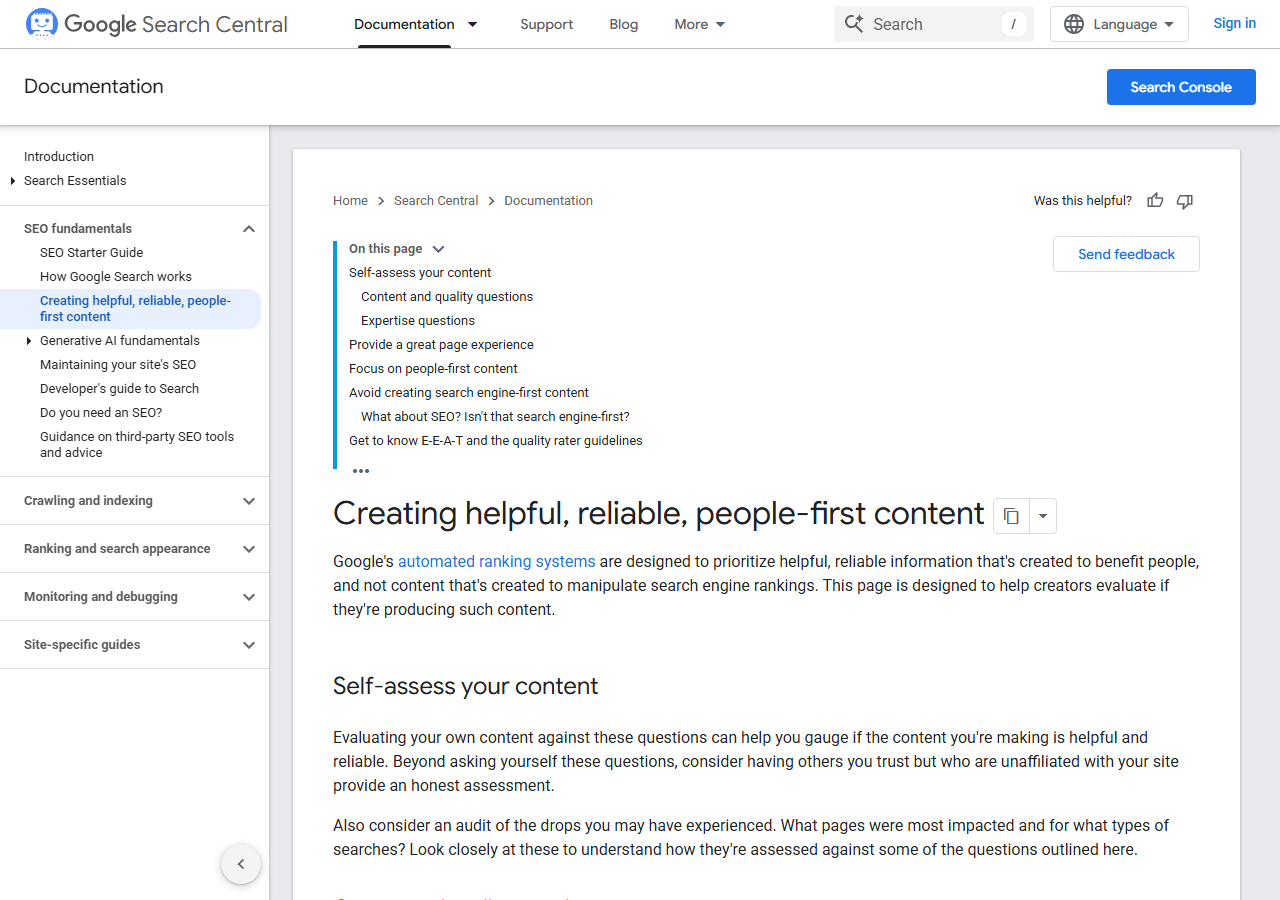
Google’s own guidance on creating helpful, people-first content reads almost like a description of this principle, and it has barely changed since the first version.
5. Internal links show what matters
A site tells Google which pages are important by linking to them. In 2016 that mostly meant menus. Today the stronger signal comes from contextual links in body copy, where the anchor text describes the target. We still find SaaS blogs where a third of posts have no internal link pointing at them at all.
6. Trust is earned off the page
Links from other sites were the strongest off-page signal in 2016 and they are still one of the strongest now. What changed is what counts. Paid link networks that worked then are a liability now, and mentions on review sites, podcasts and industry roundups carry weight in both classic search and AI answers. The white hat SEO approach used to be the slow, safe option. Now it is simply the one that lasts.
7. Measure the searcher, not the ranking
A ranking is a proxy. A click from the right person is the thing you want. The teams that did well in 2016 tracked organic signups, not just positions, and the same is true now. With AI Overviews taking clicks on informational queries, a position-1 ranking can bring half the traffic it did two years ago. If you only track positions, you will miss that.
Myth or principle? Five common SEO rules tested
Plenty of rules get called principles of SEO when they are really tactics with a long shelf life. Here is how we sort the ones we hear most often.
- “Publish every week or Google forgets you.” Tactic, and a weak one. Freshness matters for some queries. Frequency on its own does not.
- “Keyword density should be 2 to 3 percent.” Myth. Using the term naturally in the places that matter is the principle. A number was never part of it.
- “Every page needs 2,000 words.” Myth. Principle 4 says useful, not long.
- “Links from relevant sites matter more than many links.” Principle. It held in 2016 and it holds now.
- “Fast pages rank higher.” Partly. Speed is a tie-breaker and a user experience issue. It rarely lifts a weak page on its own.
An illustrative example: tactic chasing vs principles of SEO
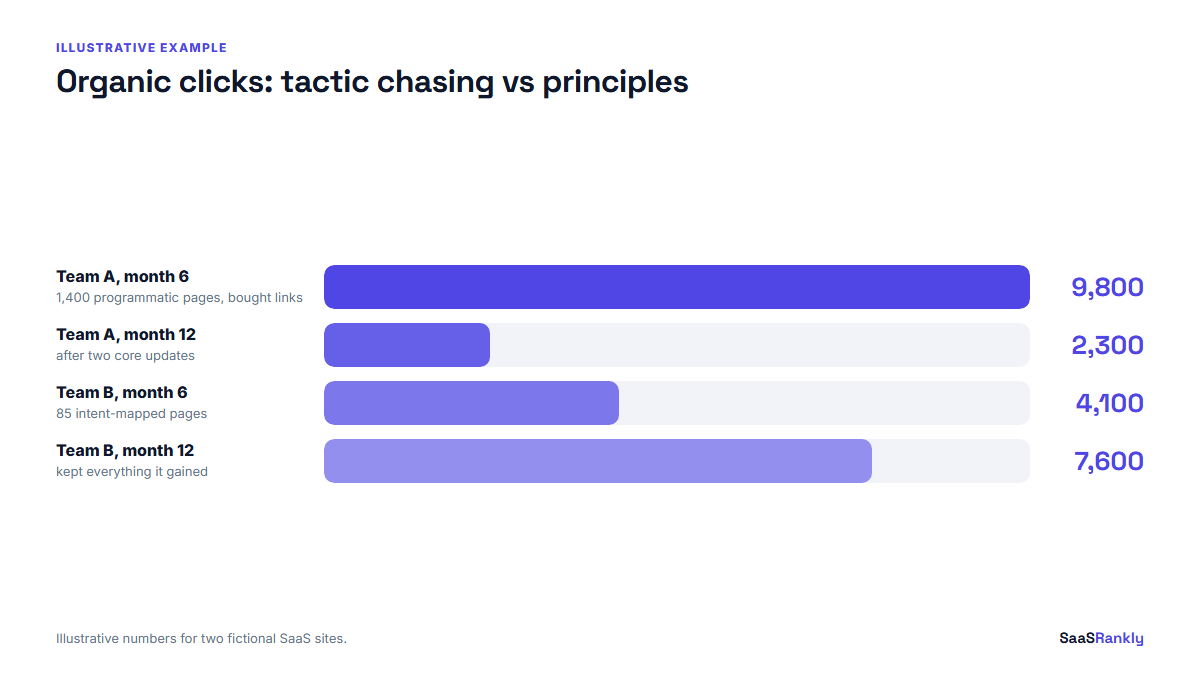
Two fictional SaaS companies, both selling scheduling software, both starting with about 60 indexed pages in early 2025. The numbers below are illustrative, but the pattern is one we have watched play out on real accounts more than once.
| Metric (illustrative) | Team A: chased tactics | Team B: worked from principles |
|---|---|---|
| Main approach | Programmatic pages, bought links, FAQ markup everywhere | Intent mapping, fewer but better pages, internal links, earned mentions |
| Pages published in 12 months | 1,400 | 85 |
| Organic clicks, month 6 | 9,800 | 4,100 |
| Organic clicks, month 12 (after two core updates) | 2,300 | 7,600 |
| Trial signups from organic, month 12 | 31 | 142 |
Team A looked like the winner for half a year. Then two updates took most of the programmatic pages out and the bought links stopped helping. Team B grew slower and kept everything it gained, because every page rested on the same seven rules.
How to apply the principles of SEO to a new tactic
Every month someone pitches a new trick. Here is the four-question filter we run before spending time on one.
- Which principle does it serve? If you cannot name one, it is probably a loophole.
- Would it still help if nobody else used it? Tactics that only work because they are rare stop working when they spread.
- Does it make the page better for the reader? If the answer is no, Google is likely to discount it eventually.
- What happens if it stops working? If the downside is a manual action or a pile of pages to delete, the price is too high.
Run AI search tactics through the same filter. Writing answer-first sections passes all four questions. Stuffing pages with prompts aimed at language models passes none.
Where to start this week
If you only have a few hours, take your ten most important pages and score each one against the seven principles of SEO, one point per principle met. Anything below five gets fixed first. For a faster scoring method, our four SEO pillars scorecard groups the same ideas into four areas, and the eight SEO components post explains the dependencies between them. If you are a founder doing this yourself, the five-day SEO essentials plan turns it into a week of tasks.
Quick recap: principles of SEO
- The principles of SEO are the rules that held from 2016 to 2026 while tactics came and went.
- There are seven worth betting on: reachability, intent match, clarity, usefulness, internal links, earned trust and searcher-based measurement.
- Each principle now applies to AI search as well as classic results.
- Length, density and posting frequency are tactics or myths, not principles.
- Test any new tactic by naming the principle it serves and the cost if it stops working.
- Score your top ten pages against the seven and fix the lowest first.
FAQ
What are the basic principles of SEO?
Make pages reachable and indexable, match search intent, state clearly what each page covers, be genuinely useful, link internally to what matters, earn trust from other sites, and measure clicks and signups rather than rankings alone.
Have the principles of SEO changed because of AI search?
The principles have not changed. How you apply them has. Reachability now includes AI crawlers, and clarity matters more because language models quote clean, direct answers.
What is the difference between SEO principles and SEO tactics?
A tactic is a specific move that works because of how search engines behave right now. A principle is the reason the tactic worked. Tactics expire, principles usually do not.
Which SEO principle matters most for a new SaaS site?
Reachability. If Google cannot crawl and index your pages, the other six do nothing. After that, intent matching usually gives the fastest return.
Are backlinks still an SEO principle in 2026?
Earned trust is the principle, and links remain one of the main ways it is measured. Relevance and editorial quality matter far more than volume, and mentions in reviews and AI answers now count too.
How often should I review my site against these principles?
We do a light check every quarter on the top pages and a full review once a year, or after any core update that moves traffic by more than 20 percent.