Search for b2b seo solutions and the first page is almost entirely agencies selling retainers. That is fine, but it hides the actual question a SaaS marketing lead is asking, which is what a B2B search programme has to do differently when the buyer is a procurement committee and the total addressable search volume is 4,000 a month instead of 4 million. B2B SEO solutions live or die on that difference. This post covers the five that consistently pay back, the four failure patterns we see most, and the order we would run them in.
What B2B SEO Solutions Have to Solve That Consumer SEO Does Not
Consumer SEO is a volume game with a short decision. B2B is a low-volume game with a long one. Every tactic that assumes the first is wrong for the second, which is why generic checklists feel so useless when you apply them to a SaaS site.
| Variable | Consumer search | B2B SaaS search | What it changes |
|---|---|---|---|
| Monthly volume on the money terms | 10,000 plus | 200 to 2,000 | Rankings alone will not show up in a traffic chart |
| People involved in the decision | One | Three to eight | You need pages for the champion and for the sceptic |
| Time from first click to revenue | Minutes to days | 60 to 400 days | Attribution windows break by default |
| Value of one converted visitor | Low | High | A page with 90 visits a month can be the best page on the site |
| Who writes the winning page | A writer | A writer plus someone who has used the product | Pure content teams stall on depth |
Read the bottom row again, because it is the one that quietly kills most programmes. If nobody on the content team has ever sat in a demo, the pages come out generic and the sales team ignores them. Our position is blunt: a B2B search programme without a recurring 30-minute call with an account executive is a content programme, not a revenue one.
The Five B2B SEO Solutions Worth Paying For
These are ordered by how fast they tend to show something you can defend in a board deck, not by how much we enjoy doing them.
1. Bottom-of-funnel page coverage
Comparison pages, alternatives pages, integration pages, pricing-adjacent pages. Low volume, high intent, and usually written by nobody else in the category because the incumbent will not write about competitors. Nothing else you can do on a young B2B site pays back this fast. The mechanics are in our guide to X vs Y comparison pages and the companion piece on competitor alternatives pages.
2. Intent sorting before anything gets written
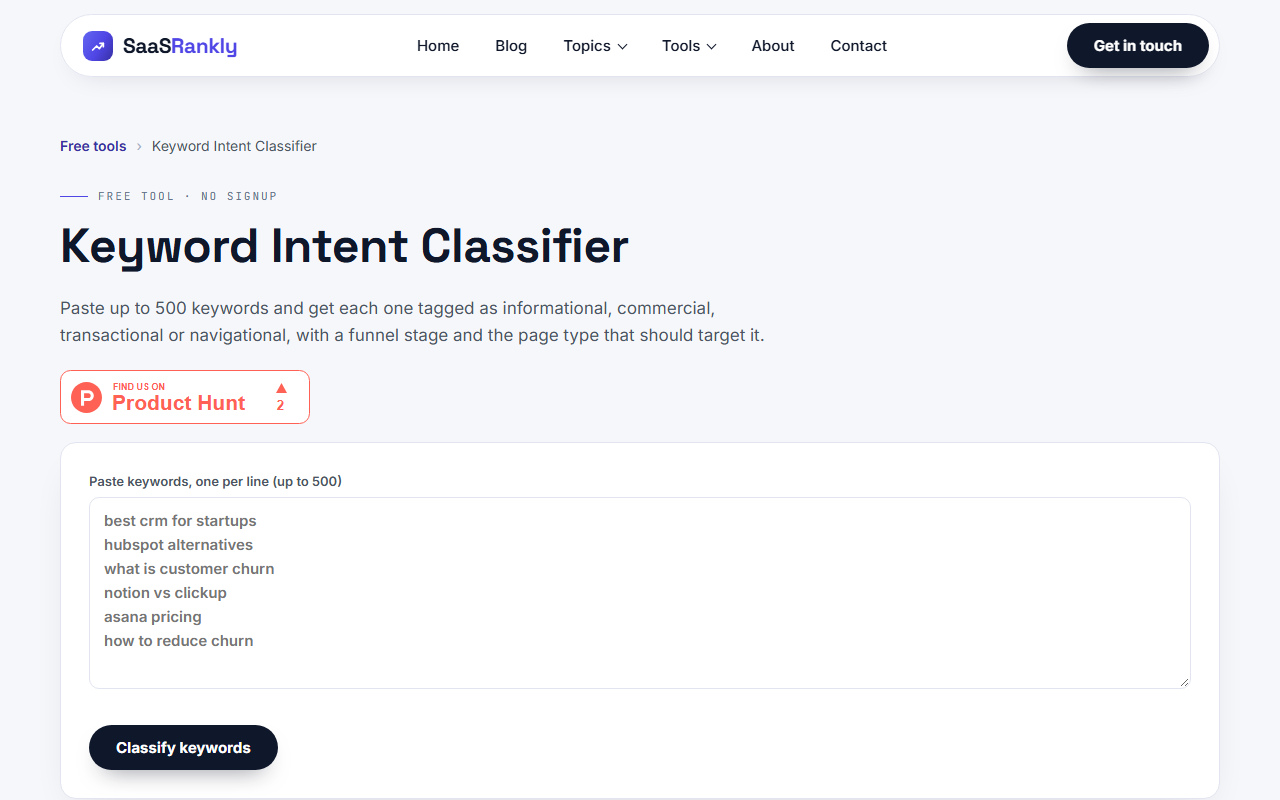
Half the wasted spend in B2B search comes from writing an informational post for a term where Google is showing product pages, or the reverse. Classify first. We built a free intent classifier for exactly this step, and the broader logic sits in how we pick high-intent keywords.
3. Technical hygiene, but only the parts that block indexing
Most b2b seo solutions oversell this stage. Core Web Vitals will not save a B2B site. An unindexed template of 400 integration pages will sink one. Check indexation coverage, canonical behaviour on templated pages, and whether your JavaScript framework is serving real content to the crawler. Stop there until those three are clean. Google crawling and indexing documentation is the reference worth reading before you pay anyone to explain it to you.
4. One reporting view that connects search to pipeline
If you cannot say which closed deals touched an organic page, every budget conversation turns into a debate about traffic. That is a losing debate. Our write-up on SEO ROI for SaaS covers the maths and the honest caveats around it.
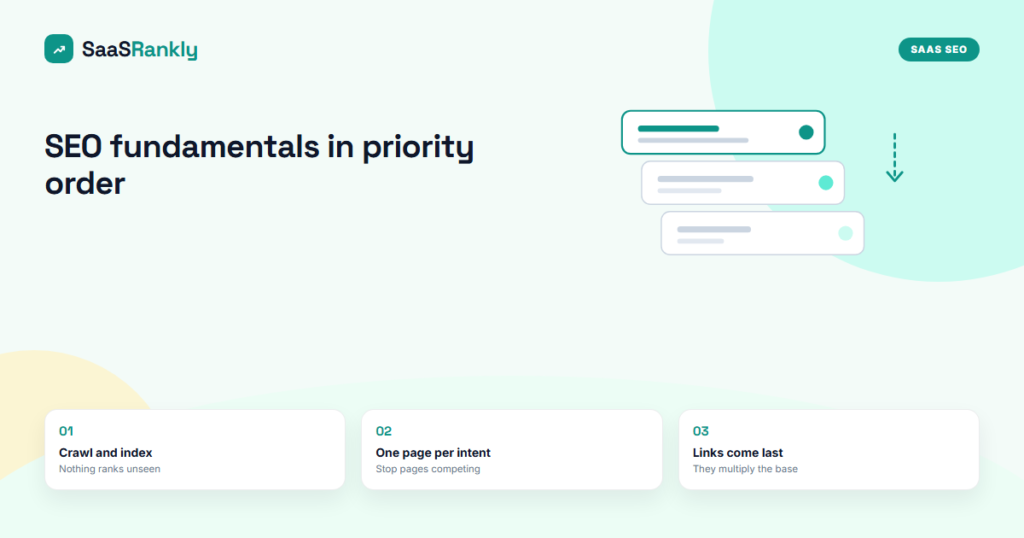
5. Links, last, and only to pages that are already close
Buying links to a page sitting at position 60 is burning money. A link to a page at position 9 can be worth several thousand dollars of pipeline. Rank first, then reinforce. Any sequencing of b2b seo solutions that starts with links has the order backwards.
Where B2B SEO Solutions Go Wrong: Four Failure Patterns
Every one of these is common enough that you can check for it in an afternoon.
Claim: more posts equals more pipeline.
Reality: in B2B the correlation breaks around the point where you have covered the commercial terms. After that, extra informational posts mostly add crawl load. We would rather see 40 pages that map to a real buying question than 400 that map to a content calendar.
Claim: the blog should target head terms because that is where the volume is.
Reality: “project management software” has volume and a SERP owned by G2, Capterra and four incumbents with nine-figure funding. “asana vs monday for agencies” has a couple of hundred searches and a winnable page. Volume is not opportunity.
Claim: b2b seo solutions should be judged on monthly traffic.
Reality: judge on assisted pipeline and on ranking position for the 30 terms that matter. Traffic is a lagging, noisy proxy that one informational post can distort for months.
Claim: you need a full technical audit before writing anything.
Reality: you need an indexation check, which takes an hour. The 90-page audit is often a way to bill for a month without publishing anything.
A Worked Example: B2B SEO Solutions Applied to a 40-Person SaaS
The numbers below are illustrative. We made up a company to show the arithmetic, because the arithmetic is the part people skip. Call it a workflow automation tool, 40 staff, $1.4m ARR, average contract value $9,600, and a 22 percent close rate from demo.
| Page type | Pages | Monthly visits each | Demo rate | Demos per month | Modelled ARR |
|---|---|---|---|---|---|
| Competitor alternatives | 6 | 70 | 4.0 pct | 16.8 | $35,500 |
| X vs Y comparisons | 9 | 45 | 3.2 pct | 13.0 | $27,400 |
| Integration pages | 22 | 30 | 1.1 pct | 7.3 | $15,400 |
| Use-case pages | 5 | 110 | 1.6 pct | 8.8 | $18,600 |
| Informational blog | 48 | 180 | 0.15 pct | 13.0 | $27,400 |
Look at the last row against the first. Forty-eight informational posts produce roughly the same modelled pipeline as six alternatives pages, and they cost maybe eight times as much to produce. That ratio is the whole argument for sequencing b2b seo solutions bottom-up. The informational posts still matter, they feed the topical footprint and the internal link graph, but they are not where you start when the budget is finite.
One honest caveat on that table. Demo rates on comparison pages vary wildly by category. In crowded categories with a clear incumbent they run high, because the searcher has already decided to switch. In categories where nobody is famous, they land closer to the use-case row. Model your own numbers, do not borrow ours.
The Order We Would Run B2B SEO Solutions In
- Week 1. Export every query from Search Console, tag by intent, and find the terms where you already rank 8 to 25. Those are the cheapest wins on the board. Getting real query data out of Search Console has the extraction steps.
- Week 1. Run an indexation check. Count how many of your templated pages are actually in the index, and if the answer is “most are not”, find out why before writing a word.
- Weeks 2 to 6. Ship the bottom-of-funnel set: alternatives, comparisons, and the top five integrations by partner traffic.
- Week 4. Stand up the reporting view. Organic sessions, assisted opportunities, and position for your 30 tracked terms, on one page.
- Weeks 6 to 12. Build the informational layer around the commercial pages, linking inward rather than outward into a void.
- Month 4 onward. Outreach, digital PR, whatever link acquisition you can do legitimately, pointed only at pages already sitting on page two.
If you run a larger programme with multiple product lines and a legal review step, the sequence holds but the timelines roughly double. We covered that situation in enterprise SaaS SEO, and the strategic frame behind all of it sits in our SaaS SEO strategy guide.
How to Judge a Vendor Selling B2B SEO Solutions
Four questions, and the answers tell you most of what you need to know about whether their b2b seo solutions fit a SaaS business.
- “Which of our existing pages would you improve before writing anything new?” A vendor who cannot answer has not looked at the site.
- “What ships in month one?” If it is a 90-page audit and nothing published, be careful.
- “How will you report?” If the answer is traffic and rankings with no mention of pipeline, they will be arguing with your finance team within a quarter.
- “Who writes the pages, and have they used software like ours?” Ask for a sample in your category, not a portfolio from a different vertical.
On pricing, at the time of writing the honest range for a competent B2B SaaS retainer in the US market runs roughly $4,000 to $12,000 a month, with strategy-only engagements lower and full content production higher. Below about $3,000 you are usually buying volume writing with a strategy deck attached. That can still work if you supply the subject matter expertise yourself, but be clear with your team that is the deal you are making.
Quick recap: b2b seo solutions
- B2B search is low volume and high value, so measure pipeline influence rather than sessions.
- Sequence bottom-up: alternatives and comparison pages before informational posts.
- Classify intent before writing, because a mismatched page cannot rank no matter how good it is.
- Technical work should stop at whatever is blocking indexing until that part is clean.
- Links come last, and only to pages already ranking on page two.
- Any vendor selling b2b seo solutions should be able to name the pages they would fix on day one.
FAQ
How long do b2b seo solutions take to show results?
Bottom-of-funnel pages on a domain with any history can rank within 6 to 12 weeks, because competition for those terms is thin. A brand-new domain should expect 4 to 7 months before the commercial pages hold stable positions. Informational content takes longer and shows up as impressions first, clicks later.
Is B2B SEO different from SaaS SEO?
Mostly no. SaaS is a subset of B2B with a self-serve option bolted on, which adds one page type, the free-tool or free-plan landing page, and shortens part of the funnel. Everything about committee buying, long cycles and low volume carries straight across.
Should a B2B company do SEO in-house or hire an agency?
In-house wins on product knowledge, agencies win on pattern recognition across many sites. The setup we see work best is an in-house owner who controls strategy and publishing, with an external partner for technical work and link acquisition. A fully outsourced programme with no internal owner drifts within two quarters.
What budget do b2b seo solutions need to be viable?
If your average contract value is above roughly $5,000, the maths works at almost any budget, because one deal covers a quarter of spend. Below $1,000 ACV with no self-serve motion, paid search usually beats search on speed, and SEO only makes sense as a long-term margin play.
Do backlinks still matter for B2B SEO?
Yes, but less than the industry sells. For low-competition commercial terms, a technically sound page with genuine depth often ranks with a handful of links. Save the link budget for terms where every result on page one has 200 referring domains.
How many keywords should a B2B SaaS site target?
Start with 30 to 50 commercial terms mapped one page each, then expand outward. Trying to cover 500 terms in year one produces thin pages and a crawl budget problem. There is a longer answer in how many keywords per page.