SEO for fintech works like SEO for any SaaS product, with one large difference: Google treats money topics as “Your Money or Your Life” content, and so do your compliance team, your bank partner and, in some markets, a regulator. That raises the bar on who writes, what you can claim and how fast you can publish. We have worked with payments, lending, payroll and expense tools, and the teams that win in search are not the ones that publish most. They are the ones that built a review process that can ship two good pages a week without a legal bottleneck.
This guide covers what changes in SEO for fintech, the content types that rank and convert, a compliance-safe workflow we use, and the mistakes that cost fintech sites rankings they had already earned.
Why SEO for fintech is harder than ordinary SaaS SEO
Three things stack up against a fintech site that a project management tool never deals with.
YMYL scrutiny. Google’s guidance on helpful, reliable content and its quality rater guidelines single out financial topics as areas where a bad answer can cause real harm. In practice, pages about loans, taxes, payments or investing are judged more strictly on who wrote them, what sources they cite and whether the business behind them looks trustworthy. Our guide to E-E-A-T for SaaS sites explains the signals; in fintech they stop being nice extras.
Competition from banks and publishers. Your SERPs are full of NerdWallet, Investopedia, big banks and government sites. They have decades of links. You will not beat them on “what is APR”. You can beat them on “APR on invoice financing for agencies”, because they do not write that page.
Compliance review. Marketing claims about rates, fees, approval speed or security are often regulated. In the US that can mean CFPB and FTC rules on advertising, plus your sponsor bank’s policies. In the UK, the FCA’s financial promotions regime applies to a lot of content that looks like a blog post. A review step that takes three weeks will kill any content calendar.
Myths about SEO for fintech we hear on most kickoff calls
Myth: you need a bank-sized backlink profile to rank.
Fact: you need a bank-sized profile for head terms. For the long tail of product, use case and integration queries, a fintech SaaS with 80 to 150 good referring domains ranks fine, because the big publishers do not cover those topics.
Myth: every page needs a certified financial planner as the author.
Fact: product and how-to pages need someone who actually knows the product and the process, named, with a real bio. Advice pages on taxes or investing do benefit from a credentialed reviewer. Match the reviewer to the risk of the page, not to a blanket rule.
Myth: compliance makes good content impossible.
Fact: compliance makes vague content impossible, which is no loss. “Get paid up to 3x faster” will be blocked. “Most invoices on our platform are paid in 4 to 6 days, based on Q2 2026 data” will usually pass, and it is better copy.
Myth: AI search has made fintech SEO pointless.
Fact: AI answers do take some definitional clicks. But people still click through before they connect a bank account or send money to a new provider, and AI tools cite pages with clear numbers, named authors and current dates. Those are the same pages that rank.
The content types that work, ranked by payback
This is the decision matrix we use when a fintech client asks where to start. Effort assumes a two-person content team with a compliance reviewer available a few hours a week. Risk is how much legal review the page tends to need.
| Page type | Example query | Effort | Compliance risk | Payback | Start here? |
|---|---|---|---|---|---|
| Integration pages | “quickbooks expense card integration” | Low | Low | Fast | Yes |
| Comparison and alternatives | “brex alternatives for startups” | Medium | Medium (claims about rivals) | Fast | Yes |
| Use case pages | “how agencies pay contractors abroad” | Medium | Low | Medium | Yes |
| Fee and pricing explainers | “ach transfer fees for businesses” | Medium | High | Medium | After review flow works |
| Calculators and templates | “invoice late fee calculator” | High | Medium | Slow, then strong links | Quarter two |
| Regulatory explainers | “1099-k threshold 2026” | Medium | High | Spiky, seasonal | Only with an expert reviewer |
| Glossary terms | “what is a sweep account” | Low | Low | Slow, often answered by AI | Last |
Integration and comparison pages are where we see the first trials, for the same reason we lay out in high intent keywords for SaaS: the searcher has already decided to buy something and is choosing which. For comparison pages, keep every claim about a competitor checkable and dated. A comparison that admits where the rival is stronger reads as more credible, and it is much easier to get past legal.
A compliance-safe content workflow for SEO for fintech
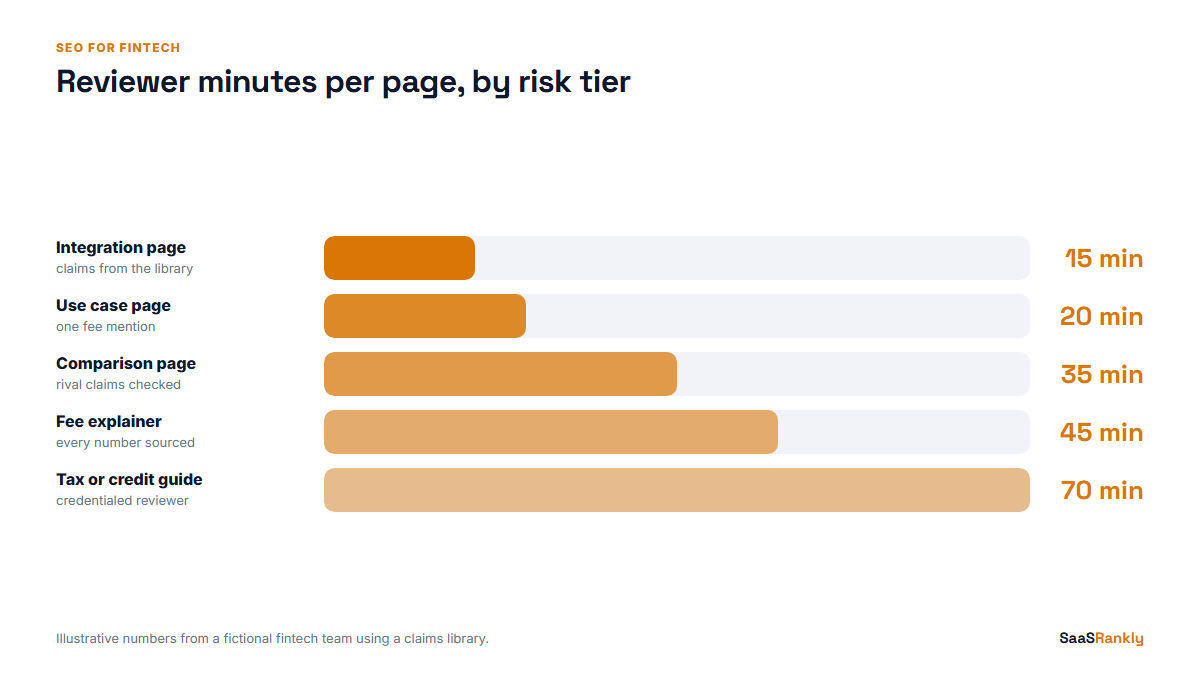
This is the seven-step flow we hand to fintech teams. It keeps legal review to one pass per page and roughly 30 minutes of reviewer time.
- Keep a claims library. One shared document of pre-approved statements: fees, speeds, limits, security certifications, licensing language, each with a source and a review date. Writers pull from it instead of inventing new phrasing.
- Classify the page risk in the brief. Low (integration, use case), medium (comparison, pricing), high (tax, credit, investing). Only high-risk pages need a credentialed reviewer.
- Write with sources inline. Every number links to its source: your own dated data, a regulator page, or a primary document. Reviewers approve faster when they can check claims in place.
- Name the author and reviewer on the page. A real person with a bio page, and a “reviewed by” line on medium and high-risk content. Mark it up with Person schema and check it with our schema validator.
- Add required disclosures once, in a component. Licensing, sponsor bank, “not financial advice” where relevant. Build it into the template so writers cannot forget it and legal approves the wording once.
- Review in the CMS, not in a document. A comment round in a Google Doc followed by a rebuild in the CMS doubles the error rate. Review the staged page.
- Set a re-review date. Fees and thresholds change. Every page with a number gets a review date in the CMS, usually 6 or 12 months out, and the date shows on the page.
Technical checks that matter more on fintech sites
Most technical SEO is the same as for any SaaS site, but a few checks carry more weight here.
- Logged-in app versus marketing site. Keep the app on a subdomain and block it from crawling. We still find fintech sites with thousands of thin dashboard URLs indexed.
- Trust pages that are easy to reach. Security, licensing, about, contact and pricing should be linked from the footer of every page. Raters and buyers both look for them.
- Country versions. Products and rules differ by market, so a UK page and a US page are not duplicates; they need hreflang and different content. Our guide to canonical tags covers the cases where they do overlap.
- Fast product pages. Heavy compliance scripts, chat widgets and tracking tags slow pages down. Check Core Web Vitals on your top 20 commercial URLs after every tag change.
Worked example: an expense card startup’s first six months
The numbers below are illustrative, built from a fictional expense management startup selling to companies with 20 to 200 staff. They reflect the kind of curve we see when a fintech team follows the matrix above instead of starting with a glossary.
| Month | Pages shipped (cumulative) | Mix | Non-branded clicks | Demo requests from organic |
|---|---|---|---|---|
| 1 | 8 | 6 integration, 2 comparison | 140 | 2 |
| 2 | 16 | +4 comparison, +4 use case | 520 | 7 |
| 3 | 24 | +5 use case, +3 fee explainers | 1,300 | 15 |
| 4 | 30 | +1 calculator, +5 use case | 2,100 | 21 |
| 5 | 36 | +6 fee explainers | 3,050 | 26 |
| 6 | 42 | +4 glossary, +2 refreshes | 3,900 | 31 |
Two things to notice. Demo requests climb faster than clicks in the first three months, because integration and comparison pages convert at several times the rate of informational posts. And the calculator in month four did little on its own but earned 14 referring domains by month six, which lifted the fee explainers around it. That is a pattern we see across B2B SEO generally, but it is stronger in fintech because useful finance tools attract links from accountants and bloggers.
Link building without the risky shortcuts
Fintech is a category where paid link networks and private blog networks are common, and where a manual action costs the most. Stick to the white hat side. What works for the teams we see: original data from your own platform (anonymised and aggregated, cleared with legal), calculators that accountants link to, partner pages with integration partners, and expert commentary for finance journalists on rule changes. One good data study a quarter tends to outperform a year of guest posts.
Quick recap: SEO for fintech
- SEO for fintech is held to YMYL standards, so authorship, sources and trust pages matter more than on other SaaS sites.
- Skip the head terms the big publishers own and target integration, comparison and use case queries first.
- A claims library and a risk tier in each brief keep legal review to one short pass per page.
- Name authors and reviewers, add disclosures through a template component, and set re-review dates on every page with a number.
- Keep the logged-in app out of the index and handle country versions with hreflang.
- Earn links with platform data and useful calculators; avoid paid link networks in a category where penalties hurt most.
FAQ
What is SEO for fintech?
It is search engine optimisation for financial technology companies such as payments, lending, banking, expense and payroll products. It follows normal SEO practice but adds stricter standards for expertise, sourcing and compliance because Google treats financial content as high stakes.
How long does SEO for fintech take to show results?
For a new site targeting long-tail commercial queries, we usually see the first demos or signups within two to three months. Competitive informational terms can take a year or more, and some head terms are realistically out of reach for a startup.
Do fintech blog posts need legal review?
Any page with claims about fees, rates, speed, approval or security should be reviewed. A pre-approved claims library and a risk tier per page keep that review short. Low-risk pages such as integration guides often need only a quick check.
Does Google penalise fintech sites for YMYL content?
No, there is no YMYL penalty. Google simply applies higher quality expectations to financial topics. Pages without clear authorship, sources or business information tend to rank below pages that have them.
Which keywords should a fintech startup target first?
Integration, comparison, alternatives and use case keywords. They have lower competition than definitional terms, the big financial publishers rarely cover them, and the searchers are already evaluating products.
Is AI search a threat to SEO for fintech?
It takes some clicks on simple definitions. It is less of a threat on product and comparison queries, where people still visit sites before they trust a provider with money. Clear numbers, named experts and current dates also make your pages more likely to be cited in AI answers.