Enterprise SEO is not startup SEO with a bigger budget. The bottleneck stops being “what should we write” and becomes “how do we get anything shipped across five teams, three CMSs, and a legal review queue” — and most enterprise SaaS SEO advice ignores that entirely.
What actually changes at enterprise scale
| Startup SEO | Enterprise SaaS SEO |
|---|---|
| One person decides and ships same day | SEO, engineering, brand, and legal all sign off |
| One domain, one sitemap | Multiple subdomains, regional sites, product lines |
| Crawl budget is not a concern | Millions of URLs compete for the same crawl budget |
| A redirect ships in minutes | A redirect goes through a change-management ticket |
Fix the technical foundation before adding content
Large sites lose more traffic to crawl and indexing problems than to weak content. Before scaling content production, confirm the basics: a single canonical sitemap index per property (not one sitemap per team, which routinely leaves half the site unlisted), no 3xx redirects listed as URLs inside that sitemap, and no orphaned subdomains crawling separately from the main site’s authority. Run the site through the Sitemap Checker tool to catch dead and redirected URLs before they waste crawl budget, and see technical SEO for SaaS for the full checklist. If pages are published but not showing up in Search Console weeks later, that is almost always a crawl-budget or internal-linking problem at this scale — this indexing guide maps each Search Console status to its cause.
The real constraint is workflow, not strategy
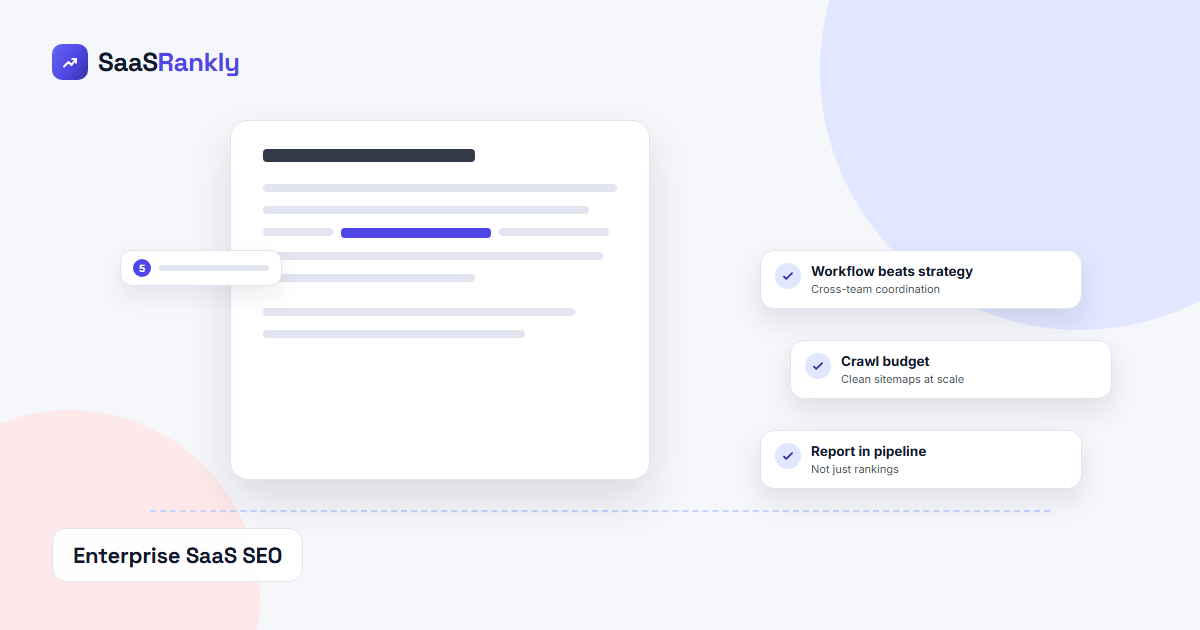
An enterprise SEO team that cannot get a title tag changed without a two-week engineering sprint will lose to a smaller competitor every time, regardless of strategy quality. Two things fix this in practice: a standing SEO-to-engineering Slack channel with an agreed SLA for low-risk changes (title tags, meta descriptions, redirects), and a self-serve CMS layer for anything content-only so SEO does not need an engineering ticket to fix a heading.
Avoid the programmatic SEO trap
Enterprise sites have the templates and data to generate thousands of near-identical pages quickly, and that is exactly the mistake Google has been penalizing. Google can lose confidence in an entire site over a pattern of low-value programmatic pages, not just the individual pages themselves — see this breakdown of Mueller’s comments on the topic. Before scaling a template, ask whether each generated page would stand on its own if a human wrote it individually. If the honest answer is no, the template needs more differentiated data per page, not a bigger rollout.
Governance: one keyword map, not five
The single most common enterprise SEO failure is five teams independently targeting the same keyword with five different pages, splitting the ranking signal instead of concentrating it. A shared keyword ownership map, reviewed monthly, is a bigger unlock than most content investments: it tells every team which page owns which query before they start writing, not after two of them are already competing with each other in the search results.
Reporting that survives an executive review
Session and ranking reports do not hold up in a QBR. Executives want pipeline impact: signups, trials, and revenue attributed to organic, not position tracking. Set up GA4 and Search Console to track signups instead of sessions — this guide walks through the setup — so the SEO team is reporting the same currency as sales and paid marketing, not a separate scoreboard that gets cut in budget season.
Do not skip AI search visibility
Enterprise brands are well represented in classic Google results and poorly represented in ChatGPT, Perplexity, and AI Overviews, because those systems weight recent, structured, and citable content differently than traditional ranking factors. Track it directly rather than assuming Google rankings carry over — these AI search visibility tools show what each engine is actually citing today.
FAQ
What is the biggest difference between startup and enterprise SEO? Workflow and coordination overhead, not strategy. The tactics are similar; getting them shipped across teams is the hard part.
How do large sites avoid wasting crawl budget? A clean, accurate sitemap with no redirected or broken URLs, strong internal linking to important pages, and pruning or consolidating thin/duplicate pages that compete for the same crawl slots.
Should every product line have its own subdomain? Only if the audiences and content are genuinely distinct. Splitting authority across subdomains without a real reason is one of the most common enterprise SEO mistakes.
Quick recap: Enterprise saas seo
Enterprise saas seo usually comes down to a short, repeatable checklist. Use this whenever enterprise saas seo comes up again:
- Diagnose enterprise saas seo by checking the relevant report first, not assumptions.
- Confirm the current setup is actually causing enterprise saas seo before you change anything.
- Re-check enterprise saas seo again after the fix ships, not before.
Treat enterprise saas seo as an ongoing signal rather than a one-time fix. For background on the platform rules behind this, see Google Search Central.