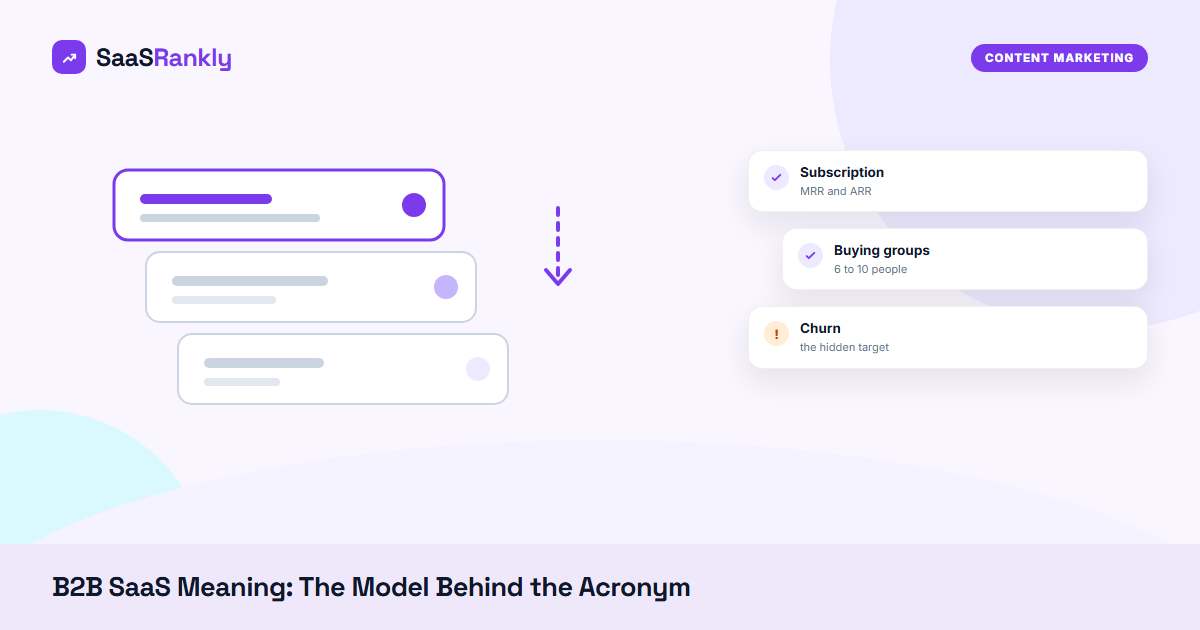
The short B2B SaaS meaning is software that one business rents from another business over the internet, paid by subscription instead of bought once. That sentence is correct and almost useless on its own. What a marketer actually needs is the second layer: who signs the contract, how revenue is counted, why the sales cycle is long, and what all of that does to the way buyers search.
We work on SaaS sites every week, and we still meet marketers who joined from ecommerce or agencies and quietly Google the acronym on day two. No shame in it. This post gives you the plain definition, the vocabulary you will hear in your first meeting, a worked example with real-looking numbers, and the parts of the model that change your content plan.
The B2B SaaS meaning, one word at a time
Break the acronym apart and each piece carries a business consequence.
| Part | What it stands for | What it means in practice |
|---|---|---|
| B2B | Business to business | The customer is a company. Several people inside it use, approve and pay for the product. |
| SaaS | Software as a service | The vendor hosts the software. Customers log in through a browser or app; nobody installs a server. |
| Subscription | Implied by the model | Revenue arrives monthly or yearly, so keeping a customer matters as much as winning one. |
| Seats or usage | The usual pricing unit | Price scales with users, records, API calls or volume, so one account can grow tenfold without a new sale. |
Slack, HubSpot, Zoom, Notion and Salesforce all fit the pattern. Salesforce is the usual origin story: it launched in 1999 with a “no software” campaign aimed squarely at companies that bought CRM licences on CDs and ran them on their own hardware. Twenty-seven years later, that delivery model is the default, and the B2B SaaS meaning has shifted from “new way to ship software” to “a specific set of economics.”
How B2B SaaS differs from B2C SaaS and classic software
People mix these up constantly, and the difference drives everything from pricing pages to keyword choice. Here is the comparison we hand to new hires.
| B2B SaaS | B2C SaaS | On-premise software | |
|---|---|---|---|
| Who pays | A company budget | One person’s card | A company, upfront |
| Typical price | $20 to $2,000+ per month | $5 to $20 per month | Large licence plus yearly maintenance |
| Who decides | A buying group | The user | IT and procurement |
| Sales cycle | Days (self-serve) to 9 months (enterprise) | Minutes | Months |
| Main growth lever | Expansion inside accounts | New sign-ups | New licences |
| Search behaviour | Comparison, alternatives, integrations, pricing | App store, “best app for” | Vendor names, analyst reports |
The row we care about most is the last one. B2C buyers often decide inside an app store. B2B buyers research, shortlist, share links in Slack and come back three weeks later. That is why B2B SEO works differently from consumer search, and why comparison pages earn their keep on almost every SaaS site we audit.
The vocabulary that comes with it
Half of understanding the B2B SaaS meaning is learning the words finance and sales throw around. These are the ones you will hear in week one.
- MRR and ARR. Monthly and annual recurring revenue. ARR is simply MRR times 12 for most teams, though some count only annual contracts.
- Churn. The share of customers or revenue lost in a period. A 3 percent monthly logo churn sounds small and wipes out roughly a third of your customers in a year.
- NRR (net revenue retention). Revenue from last year’s customers this year, including upgrades and losses. Above 100 percent means the existing base grows on its own.
- CAC and LTV. What it costs to win a customer, and what that customer is worth over their lifetime. The old rule of thumb is LTV at least three times CAC.
- Payback period. Months until a customer’s gross margin repays their acquisition cost. Under 12 months is healthy for SMB tools.
- ICP. Ideal customer profile: the company size, industry and tech stack you sell to best.
If any of these appear in your marketing goals, ask how they are calculated before you agree to a target. We have seen two teams in the same company report ARR that differed by 18 percent because one counted signed contracts and the other counted invoiced ones.
A worked example: what the model looks like on paper
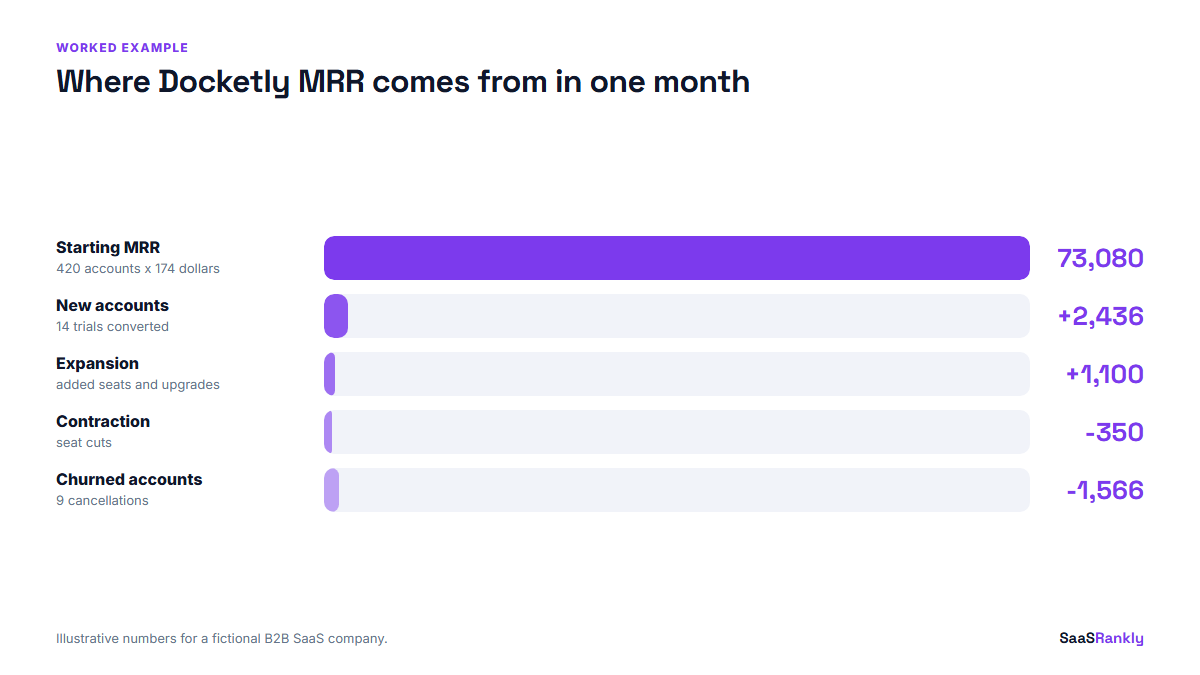
Here is an illustrative company, not a client. “Docketly” sells contract tracking software to law firms and finance teams. Every number below is invented, but the proportions are typical of a self-serve B2B SaaS product with a light sales assist.
| Metric | Docketly (illustrative) | What it tells marketing |
|---|---|---|
| Price | $29 per seat per month | Average account has 6 seats, so about $174 MRR |
| Customers | 420 | About $73,000 MRR, or roughly $877,000 ARR |
| Monthly logo churn | 2.1 percent | About 9 accounts lost each month that must be replaced |
| Net revenue retention | 108 percent | Seat growth inside accounts outpaces cancellations |
| Blended CAC | $1,450 | Payback of about 10 months at 80 percent gross margin |
| Share of trials from organic search | 41 percent | SEO is a core channel, not a side project |
Two things jump out. First, the business only grows if new customers outnumber the nine lost each month, which sets a floor for how many trials marketing must produce. Second, 108 percent NRR means the customers already in the door are worth more every year, so content that helps users adopt more features (integration guides, templates, use cases) is revenue work, not “just support docs.”
Myths about the B2B SaaS meaning we hear from new marketers
Myth: B2B means boring, formal copy. Fact: the people reading your page are still people, often tired ones at 4 p.m. Plain language wins. The formality myth is how you end up with headlines like “Empowering Enterprise Workflow Excellence” that nobody searches for.
Myth: the user is the buyer. Fact: in most B2B deals the user, the budget holder and the security reviewer are three different people. Gartner’s often quoted figure is six to ten people in a typical buying group for a complex purchase. Your content needs a page for each of them, which our piece on the B2B content marketing funnel maps out.
Myth: SaaS means low price. Fact: subscription does not mean cheap. Plenty of B2B tools cost more per year than the perpetual licence they replaced. The difference is that the cost is spread out and can be cancelled.
Myth: once they sign, marketing is done. Fact: in a subscription business, the sale repeats every renewal. Churn is a marketing problem as much as a product one, especially when buyers were sold on a use case the product handles badly.
What the B2B SaaS meaning changes in your SEO and content plan
This is the part that matters if you were hired to grow traffic. The model creates four search patterns we plan around on every site.
- Problem searches come first. Before anyone knows your category exists, they search the pain: “track contract renewal dates,” “too many spreadsheets for invoices.” These are the top of the funnel and the hardest to convert.
- Category searches follow. “Contract management software for small law firms.” These signal a shortlist is forming. A strong category page here is often the single best page on a young site.
- Comparison and alternatives searches decide deals. “Docketly vs Ironclad,” “Ironclad alternatives.” Volumes are small, intent is very high. We cover what to build here in our post on lower funnel marketing.
- Integration and pricing searches close them. “Docketly Salesforce integration,” “Docketly pricing.” If you do not own these pages, a review site will rank for your own name.
The subscription side adds a fifth pattern that consumer marketers rarely plan for: existing customers searching how to do things in your product. Those queries keep accounts alive and expanding. On the Docketly numbers above, every account saved is worth about $2,000 a year.
For the bigger picture of channels and where search fits next to paid and outbound, our SaaS marketing channels ranked by payback is the companion read, and SaaS product marketing covers positioning, which you need before writing a single category page.
Is your product B2B SaaS? A quick checklist
Founders sometimes argue about labels. A product fits the B2B SaaS meaning if most of these are true:
- The paying customer is a registered business, not an individual.
- The software is hosted by you and accessed online.
- Billing is recurring, monthly or annual.
- Pricing scales with seats, usage or tiers.
- Customers can cancel or downgrade without buying new software.
- You ship updates to everyone at once rather than shipping versions.
Hybrids exist. A marketplace that charges businesses a subscription plus a transaction fee is mostly B2B SaaS. A desktop app with a yearly licence is not, even if it phones home for updates.
Quick recap: B2B SaaS meaning
- B2B SaaS is software a business rents from another business online, paid by recurring subscription.
- Revenue is counted as MRR or ARR, and keeping customers (churn, NRR) matters as much as winning them.
- Buyers are groups of people, so one product needs pages for users, budget holders and reviewers.
- Sales cycles run from days for self-serve tools to months for enterprise deals.
- Search intent moves from problem to category to comparison to pricing and integrations.
- Content that helps customers adopt more features is retention work and protects revenue.
FAQ
What is the simple B2B SaaS meaning?
It is software sold by one company to other companies as an online subscription. The vendor hosts and updates it, and customers pay monthly or yearly to keep using it.
What are examples of B2B SaaS companies?
Salesforce, HubSpot, Slack, Zoom, Atlassian, Notion and Shopify are well known examples. Smaller ones include niche tools for payroll, scheduling, contract tracking and SEO.
Is Netflix B2B SaaS?
No. Netflix is a subscription service sold to individuals, so it is B2C. It also delivers content rather than software for doing work, so most people would not call it SaaS at all.
What is the difference between B2B SaaS and B2C SaaS?
B2B SaaS is bought by companies, usually involves several decision makers and costs more per account. B2C SaaS is bought by individuals, often in minutes, at a lower price.
How do B2B SaaS companies make money?
Mostly through recurring subscriptions priced per seat, per usage unit or by tier. Growth comes from new customers plus expansion inside existing accounts, such as added seats or plan upgrades.
Why does the B2B SaaS meaning matter for SEO?
Because the model shapes what buyers search. Long research cycles and buying groups create demand for comparison, alternatives, integration and pricing pages, which convert far better than generic blog traffic.