High intent keywords are the searches people type when they are close to choosing a product: “notion vs clickup”, “hubspot alternatives”, “asana pricing”, “best crm for startups”. For a SaaS site they convert to trials at five to twenty times the rate of “what is” queries, they are usually less competitive than the big head terms, and in 2026 they are the queries where Google still returns clickable links instead of an AI Overview. This guide explains how to find high intent keywords for your product, how to spot the low hanging fruit already sitting in your Search Console, and how to build pages that convert them.
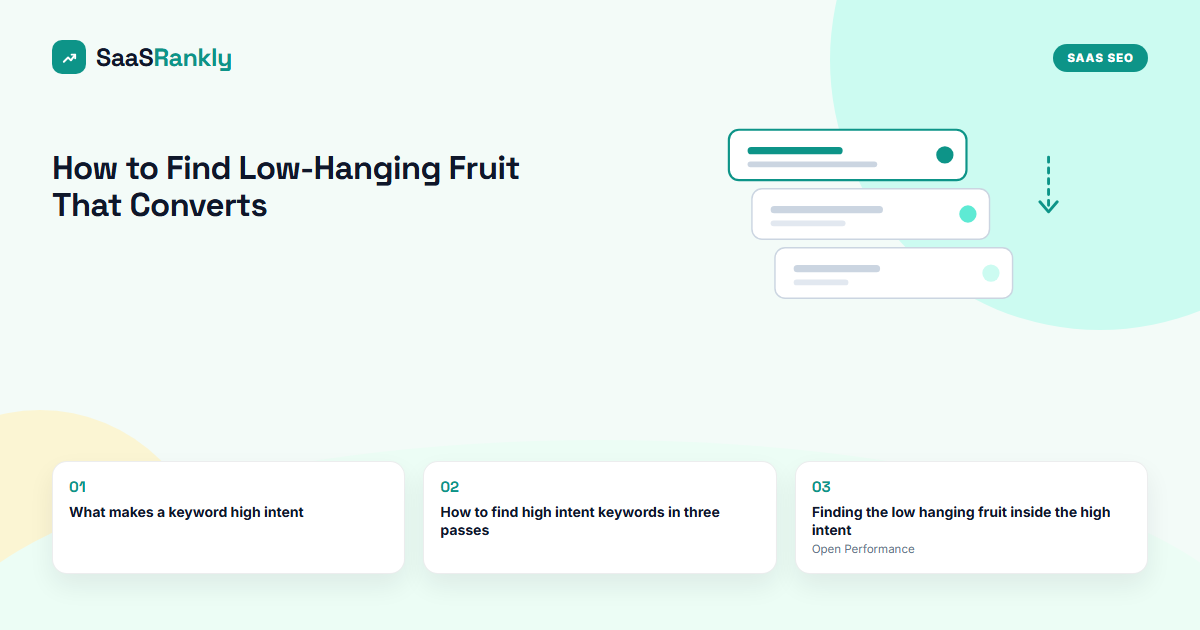
What makes a keyword high intent
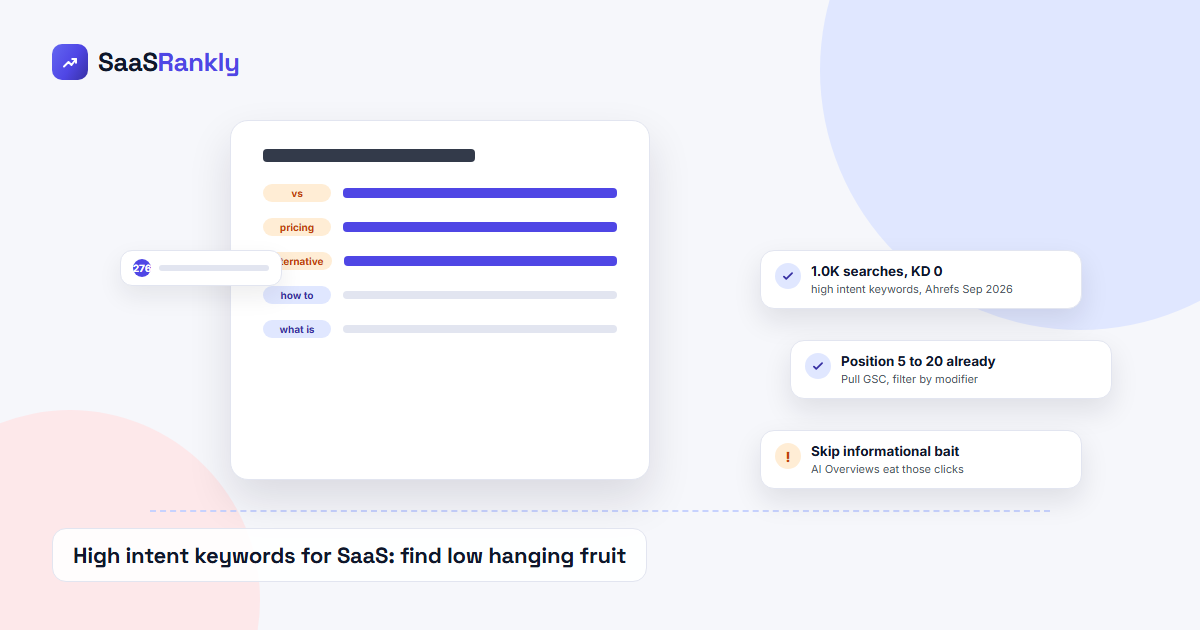
Intent is about what the searcher wants to happen next. A high intent keyword signals that the next step is evaluating or buying a specific type of product. In practice you can spot it from the modifiers:
| Modifier pattern | Example | What the searcher is doing | Page type that wins |
|---|---|---|---|
| [brand] vs [brand] | monday vs asana | Choosing between two shortlisted tools | Comparison page |
| [brand] alternatives / competitors | intercom alternatives | Leaving a tool, shortlisting | Alternatives page |
| [brand] pricing / cost | zendesk pricing | Checking budget fit | Pricing explainer |
| best [category] for [segment] | best crm for real estate | Building a shortlist | Listicle you appear on |
| [category] software / tool / platform | churn analytics software | Category search | Product or category landing page |
| [brand] review / is [brand] worth it | is clickup worth it | Final validation | Review, case study, community answer |
| [brand] integration with [tool] | slack integration with hubspot | Checking fit with existing stack | Integration page |
| [category] free trial / demo | crm free trial | Ready to try | Signup landing page |
Low intent keywords look like “what is customer churn” or “how to run a retrospective”. They bring traffic, they are useful for topic authority, and in 2026 most of them are answered inside an AI Overview before the user reaches your link. That is why the balance of a SaaS content plan should shift toward the high intent keywords in the table above.
How to find high intent keywords in three passes
Pass 1: Your own Search Console
Open Performance, filter to the last 6 months, and add a query filter for each modifier: “vs”, “alternative”, “pricing”, “best”, “review”, “integration”. Sort by impressions. Any query where you sit between position 5 and 20 with real impressions is low hanging fruit: Google already thinks you are relevant, you just have not given it a good enough page. Export these rows. This pass usually produces 50 to 200 candidate keywords for a site with a year of content.
Pass 2: Competitor keyword gaps
In Ahrefs or Semrush, run a content gap between your domain and three competitors, then filter the result with the same modifiers. What you want is keywords where two or more competitors rank and you do not. For SaaS, “[competitor] alternatives” and “[competitor] vs [competitor]” are the richest seams because every competitor is, by definition, a keyword. Our SaaS keyword research process walks through the export and scoring. Whatever the gap report scores them at, remember that every keyword difficulty tool uses its own maths, so check the result page yourself before you commit.
Pass 3: Classify by intent, not by volume
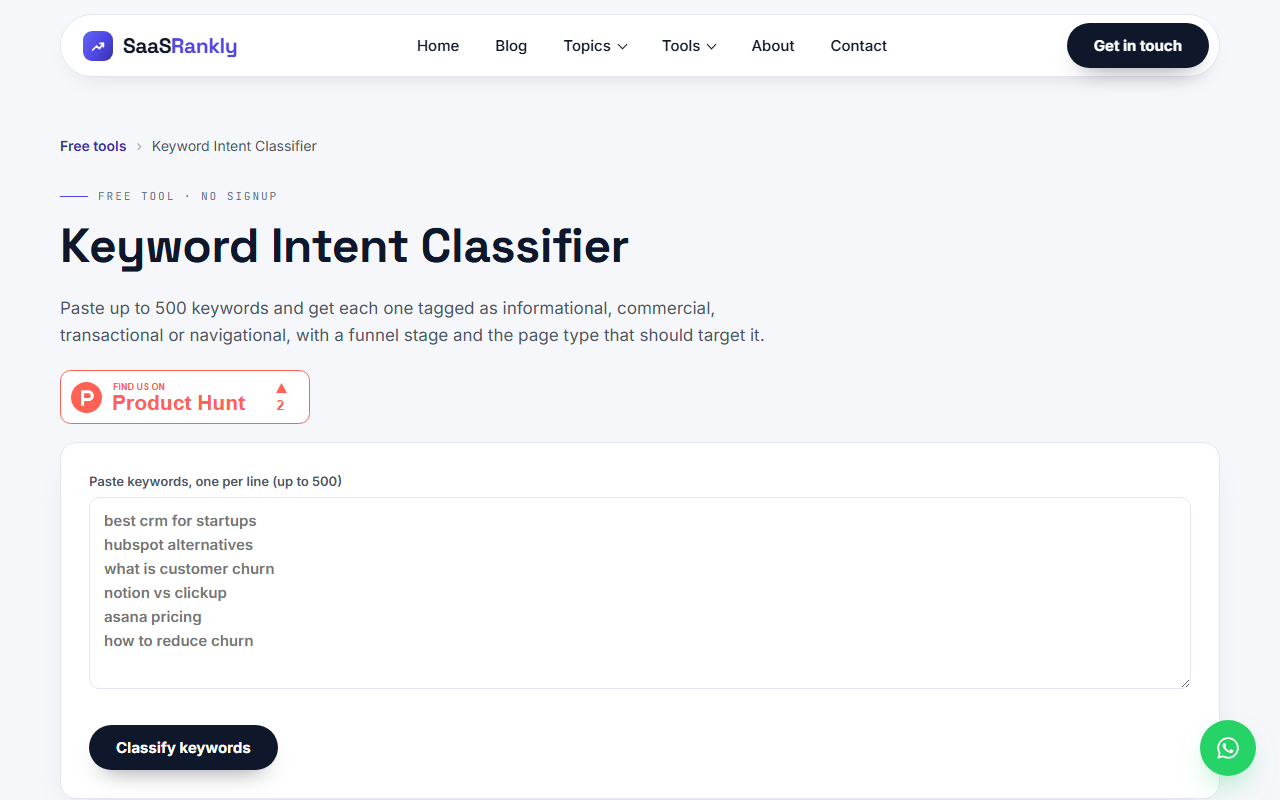
Paste the combined list into our free keyword intent classifier. It tags each keyword as informational, commercial, transactional or navigational, assigns a funnel stage, and suggests the page type. Sort by “commercial” and “transactional” first, then by your current position, then by volume. Volume is the last sort key on purpose. A 90 search a month “alternatives” keyword will out-convert a 9,000 search a month “what is” keyword every time.
Finding the low hanging fruit inside the high intent list
Low hanging fruit means high intent keywords where the effort to rank is smallest. Score each candidate on four things:
- Current position 5 to 20. You are on page one or two already. Improving the page is cheaper than creating one.
- Keyword difficulty under 20. In Ahrefs terms, fewer than 25 referring domains needed. Most “[mid-size competitor] alternatives” terms sit here. “High intent keywords” itself is a KD 0 term at the time of writing, which tells you how thin competition is on this topic.
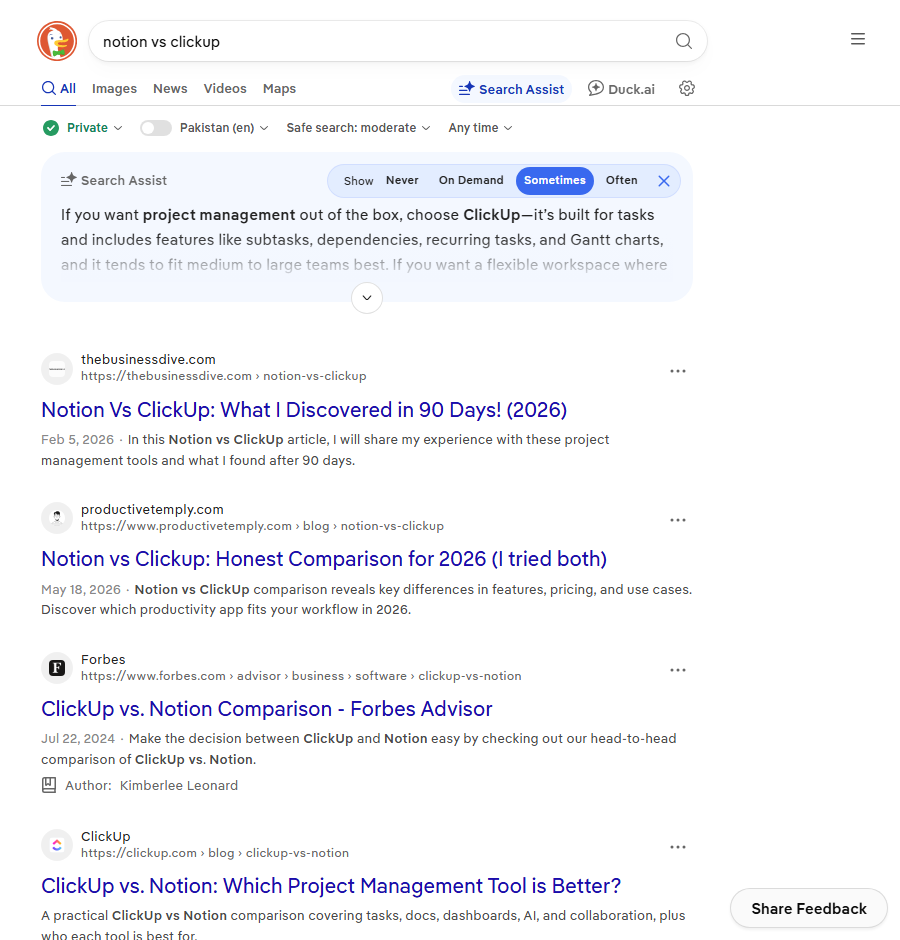
- SERP returns links. Check the SERP for an AI Overview. If one is present and covers the whole first screen, discount the keyword by half. Our guide to SERP features for SaaS covers how to check this quickly.
- You have a page type that fits. If the winning page type is a comparison page and you have none, that is a build, not a fix. Still worth doing, but it goes in a different queue.
Keywords that score well on all four go into a “fix this month” list. In our experience a small SaaS site can move 10 to 15 of these per month with one writer and no new links.
Building pages that convert high intent keywords
Ranking is half the job. The pages that convert high intent keywords share a structure:
- Answer the comparison in the first screen. A “vs” page that opens with 400 words of company history loses the reader. Put the verdict, a short comparison table and a “best for” line above the fold.
- Use real pricing and real screenshots. Searchers on high intent keywords are checking facts. Pages that quote actual plan prices, with a “last verified” date, outrank and outconvert the vague ones.
- Be honest about where the competitor wins. It builds trust and it gets your page cited in AI Overviews and ChatGPT, which increasingly show these comparisons. See how to get cited by ChatGPT.
- One call to action, matched to intent. “Start free trial” on a pricing page, “See the comparison” on a vs page, “Migrate from X” on an alternatives page.
Templates for each of the three main page types are in comparison pages, alternatives pages and integration pages.
A worked example
A fictional customer support SaaS pulled six months of Search Console data and filtered for the modifiers above. Results: 143 candidate keywords. After classification, 61 were commercial or transactional. Of those, 19 sat between positions 5 and 20 with KD under 20 and a SERP without an AI Overview. The team rewrote four existing pages and built three new alternatives pages over six weeks.
| Keyword | Before | After 8 weeks | Monthly trials |
|---|---|---|---|
| [competitor A] alternatives | 14 | 4 | 11 |
| [competitor B] vs [competitor A] | 9 | 3 | 7 |
| help desk software for shopify | 17 | 6 | 9 |
| [competitor C] pricing | 11 | 5 | 4 |
Thirty-one monthly trials from four pages, with no new backlinks, is a typical outcome for high intent keywords that were already on page two.
Mistakes that waste the effort
- Chasing head terms first. “CRM software” at KD 80 is not low hanging fruit, no matter how much volume it has.
- Treating every “best” keyword as yours to rank for. Most “best [category]” SERPs are owned by G2, Capterra and big publishers. Your job is to be on their lists, not to outrank them.
- Ignoring navigational intent. “[Your brand] login” is high intent too, and if a competitor’s ad sits above your login page you are losing existing customers to confusion.
- Publishing and forgetting. Pricing and competitor features change. Re-verify high intent pages every quarter.
High intent keywords by SaaS growth stage
Which high intent keywords you can realistically win depends on how established your domain is.
- Pre-launch to 500K ARR. Target “[mid-size competitor] alternatives” and “[competitor] vs [competitor]” where neither competitor is a household name. These SERPs are thin, often KD under 10, and you can rank with a strong page and a handful of links. Skip “best [category]” entirely.
- 500K to 5M ARR. Add “[category] for [segment]” pages and integration pages. Start pitching the review-site listicles that own “best [category]” so your brand appears there. Comparison pages against the category leader become viable.
- 5M ARR and up. Now the category terms are in reach, and your own brand generates “[your brand] vs” and “[your brand] alternatives” searches. Own those pages yourself before a competitor or affiliate does.
The full growth playbook by stage is in our SaaS SEO strategy guide.
Tracking high intent keywords after you rank
Ranking for high intent keywords is only useful if you can see the signups they produce. Set up three things:
- A dedicated rank tracking tag. Tag every commercial and transactional keyword in your tracker so you can report on them as a group, separate from informational terms. Weekly is enough. Options are compared in best rank tracker tools.
- Landing page signup rate in GA4. Build an exploration with landing page, sessions from organic, and trial signup conversions. Comparison and alternatives pages should convert at two to five times the site average. If one does not, the page is the problem, not the keyword.
- A quarterly re-verification task. Competitor pricing, plan names and features change. A “vs” page with last year’s prices loses the click and the trust. Put a “last verified” date on the page and a recurring ticket to update it.
Once the pipeline is in place, high intent keywords become the one part of SaaS SEO where you can draw a straight line from a keyword to revenue, which is exactly the line finance wants to see when SEO budget comes up.
Quick recap: high intent keywords
- High intent keywords carry modifiers like vs, alternatives, pricing, best for, review, integration and free trial.
- Find high intent keywords in Search Console first, then in competitor gaps, then classify by intent before looking at volume.
- Low hanging fruit is the subset at position 5 to 20, KD under 20, with a SERP that still returns links.
- Build comparison, alternatives, pricing and integration pages with the verdict above the fold and verified numbers.
- Expect page-two to page-one moves within eight weeks without new links.
- Re-verify high intent keywords and their pages quarterly.
FAQ
What are high intent keywords?
Search terms that signal the user is evaluating or ready to buy, such as “[brand] vs [brand]”, “[brand] alternatives”, “[brand] pricing” and “best [category] for [segment]”.
How do I find high intent keywords for free?
Filter Google Search Console queries by modifiers like vs, alternative, pricing and best, then classify them with a free intent tool such as the SaaS Rankly keyword intent classifier.
What are low hanging fruit keywords?
Keywords you already rank for on page one or two, with low difficulty, where improving an existing page is enough to move up. They overlap heavily with high intent keywords for most SaaS sites.
Are high intent keywords more competitive?
Usually less. Head terms like “crm software” are far harder than “[mid-size competitor] alternatives”, and the latter converts better.
Do AI Overviews affect high intent keywords?
Less than informational queries. Comparison and alternatives SERPs still return links in most SaaS categories, which is a big part of why they deserve priority in 2026.
How many high intent keywords should a SaaS site target?
Start with 20 to 30 where you already have a position, then add competitor-based terms as you build comparison and alternatives pages. Quality of the page matters more than the size of the list.