Short answer: what is white hat seo? It is search optimisation that stays inside Google’s published spam policies and would still make sense if search engines did not exist. You improve the page, the site and the reasons other people link to it. You do not manipulate the signals Google uses to judge those things.
That definition sounds tidy. In practice the line is blurry, most of the arguments happen in the grey middle, and a lot of “white hat” advice online is written by people who sell the grey stuff. So this post skips the moralising and gets specific: which tactics sit where, how we decide on borderline cases, and what it costs to stay clean.
What is white hat SEO, in one test
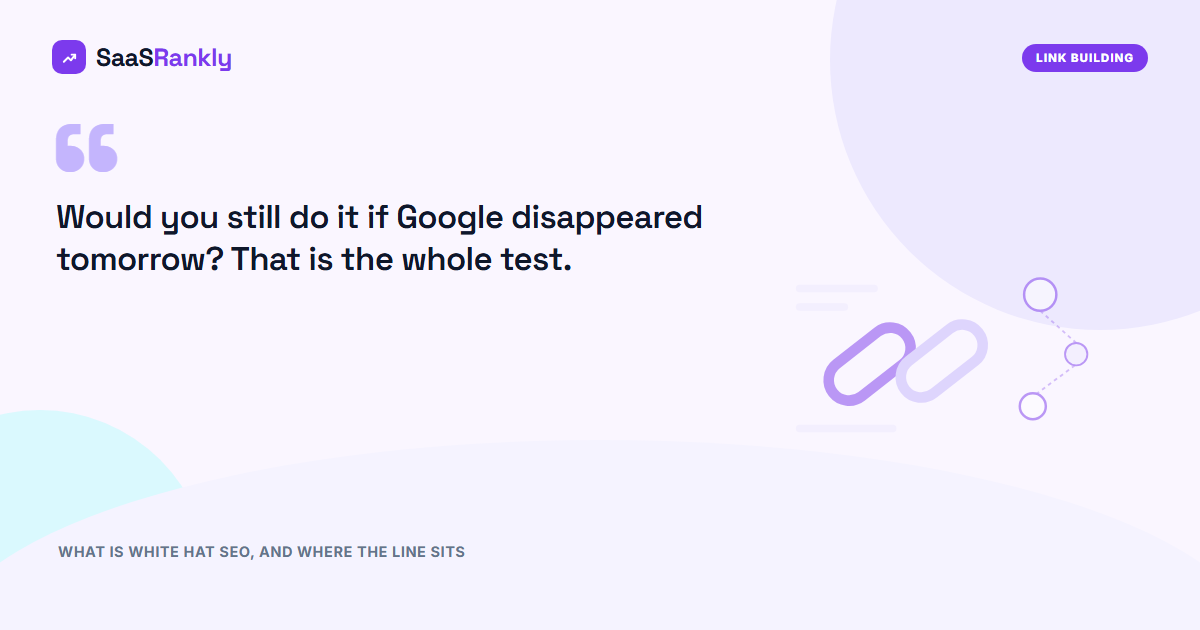
We use one question before any tactic goes into a plan: would we still do this if Google disappeared tomorrow?
- Fixing a slow checkout page: yes, customers hate it too. White hat.
- Writing a guide that answers the question your sales team gets every week: yes. White hat.
- Pitching a journalist with original data: yes, it is PR. White hat.
- Paying $150 for a “guest post” on a site that publishes anyone who pays: no. Nobody reads that site. The only reason to buy it is the link.
- Hiding a block of keyword text in the footer: no.
The test is not perfect, but it sorts about nine out of ten cases in a few seconds. The tenth case is where you need the detail below.
The white, grey and black hat SEO spectrum
If you are asking what is white hat seo for one specific tactic, this table is the short version. Here is how we classify the tactics clients ask about most. “Grey” means the tactic is not automatically a violation, but the way most people do it is.
| Tactic | Where it sits | Why |
|---|---|---|
| Original research, surveys, data studies | White | Earns links because it is cited, not because it is traded |
| Technical fixes (crawl, speed, canonicals) | White | Helps Google read what is already there |
| Guest posts on real publications, written by you | White | Editorial choice by the host; audience is real |
| Broken link building with a genuine replacement | White | You are offering something useful, the editor decides |
| Link exchanges (“I’ll link you if you link me”) | Grey | Fine in small, natural numbers; excessive exchanges are named in the spam policy |
| Expired domains redirected into your site | Grey to black | Buying a domain for its old links and pointing them at unrelated content is “expired domain abuse” |
| AI content at scale | Grey | The tool is not the issue; mass pages with little value is “scaled content abuse” |
| Paid links without rel=”sponsored” | Black | Directly listed as link spam |
| Private blog networks | Black | Fake editorial signals by design |
| Cloaking, hidden text, sneaky redirects | Black | Shows Google something users never see |
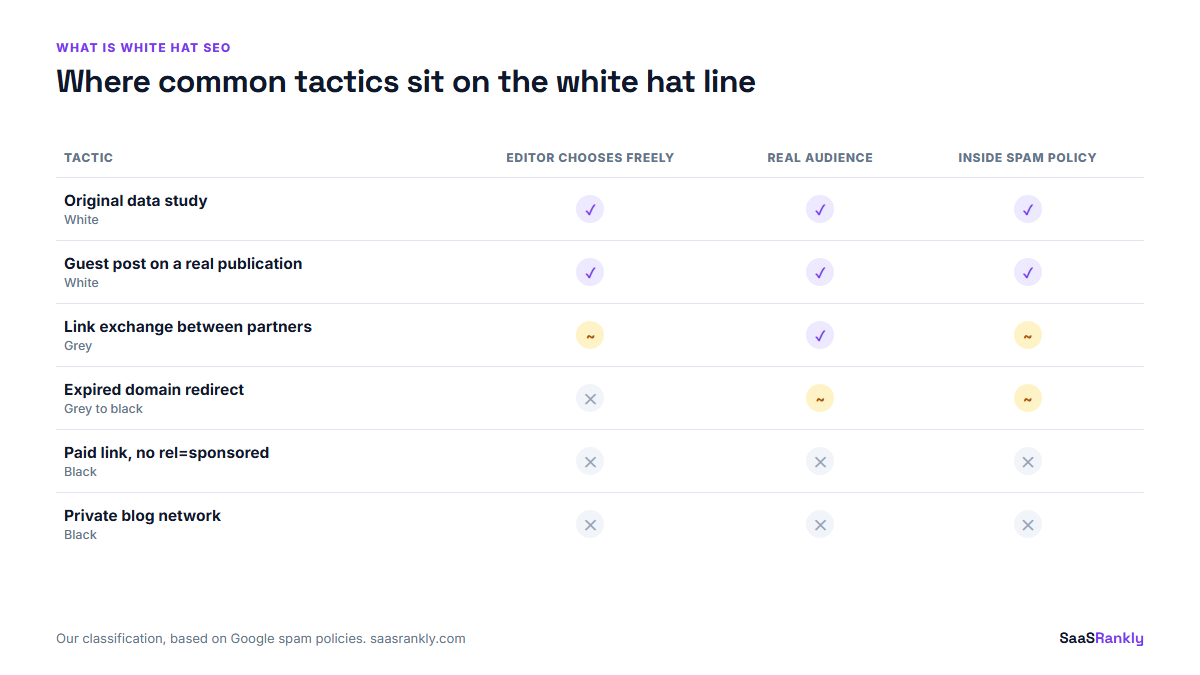
The interesting rows are the grey ones. A link exchange between two SaaS tools that genuinely integrate is normal business. Fifty exchanges a month through a Facebook group is a pattern, and patterns are what Google’s systems look for.
Myths about white hat SEO we hear every month
Ask ten marketers what is white hat seo and most answers will include at least one of these.
Myth: white hat means you never ask for links. Asking is fine. Outreach is fine. What matters is whether the other site’s editor makes a free choice and whether money or a quid pro quo decides it. Our guide to off-page SEO covers outreach that stays on the right side.
Myth: using AI to write is black hat. Google’s guidance is about the output, not the tool. A human-edited article that answers the question well is fine. Ten thousand thin pages pushed out to catch long-tail queries are not, whoever or whatever typed them.
Myth: white hat is slow and black hat is fast. Black hat is fast to show a result and fast to lose it. White hat is slower to start and compounds. We show the numbers for that below.
Myth: if a competitor does it and ranks, it must be safe. Plenty of sites rank on bought links for a year and then drop overnight in a spam update. You are seeing them before the update, not after.
What Google actually penalises
You do not have to guess. Google publishes its spam policies, and they are more specific than most people expect. The ones that matter most for SaaS and content sites:
- Link spam: buying or selling links that pass ranking credit, excessive link exchanges, automated link building, and requiring a link as part of a terms-of-service or contract.
- Scaled content abuse: generating many pages mainly to manipulate rankings, however they are made.
- Site reputation abuse: third-party pages hosted on a strong domain to borrow its ranking power.
- Expired domain abuse: buying an old domain and repurposing it for unrelated, low-value content.
- Cloaking, hidden text and sneaky redirects: the classics.
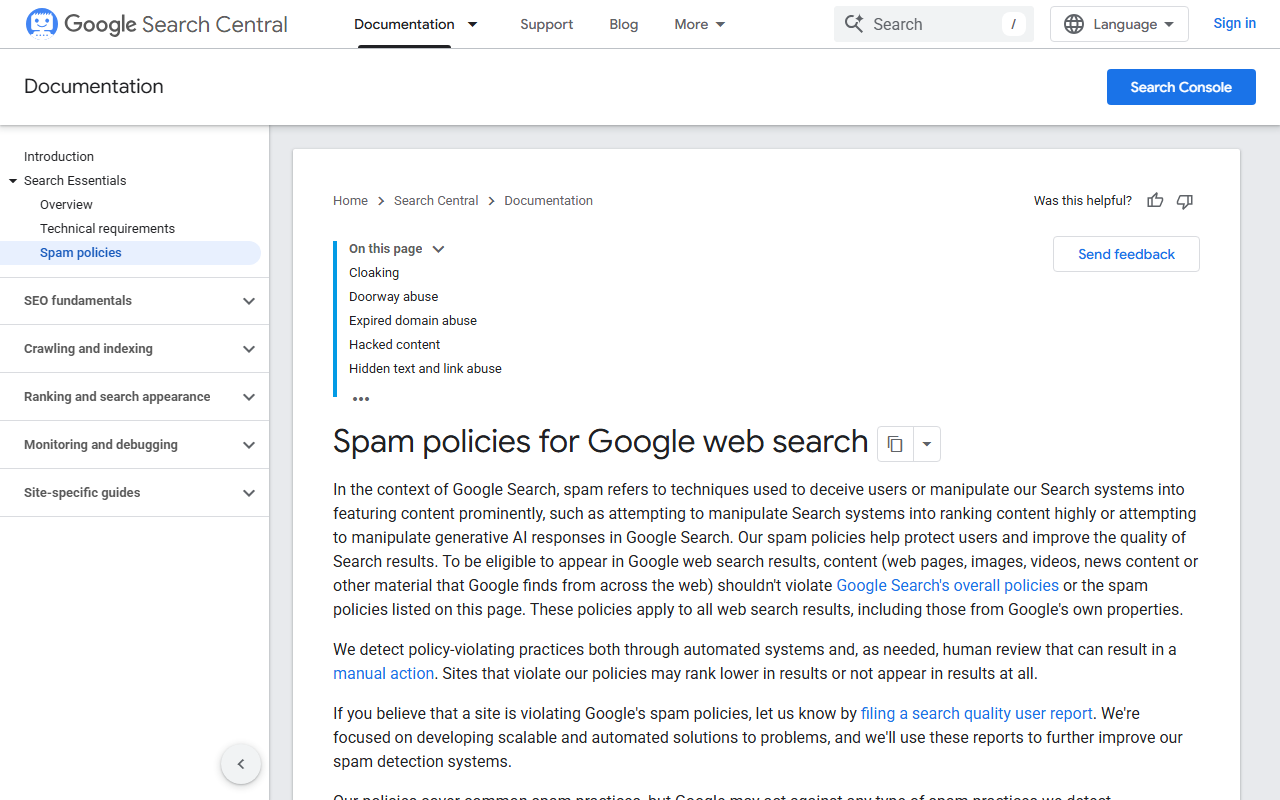
Penalties come in two forms. Algorithmic demotions happen quietly during spam updates and show up as a traffic drop with no message. Manual actions come with a notice in Search Console and need a reconsideration request. If you have inherited a messy link profile, our post on when to disavow covers the cleanup side.
White hat SEO techniques we actually use for SaaS
This is the working list, ordered by how often each one pays back on the SaaS sites we look after.
- Pages built from real sales and support questions. Every repeated question is a keyword someone types. We cover how to find them in our SaaS keyword research guide.
- Comparison and alternatives pages written honestly. Including the cases where the competitor is the better fit. Buyers trust it, and those pages earn links from review sites.
- Original data. Anonymised product usage stats, a small survey, a benchmark. One good dataset can earn links for two years.
- Integration pages with the partner’s help. The partner links to you because the page is useful to their users, not because you traded.
- Technical hygiene. Clean canonicals, no orphan pages, a sitemap that matches what you want indexed.
- Digital PR. Founders commenting on news in their space, with a real opinion.
Notice what is missing: link packages, “DA 50+ guest posts”, and anything sold by the hundred. For the link side in more depth, see our SaaS link building playbook.
A worked example: two ways to spend $3,000 on links
Illustrative numbers, but the shape matches what we see. Two SaaS sites in the same niche, each with $3,000 for one quarter.
| Site A: bought guest posts | Site B: one data study plus outreach | |
|---|---|---|
| What the money bought | 20 posts at $150 on “write for us” blogs | Survey tool, 400 responses, design, 3 weeks of outreach time |
| Links after 90 days | 20 | 11 |
| Links still live after 12 months | 13 (sites expired or deindexed) | 27 (study kept getting cited) |
| Referring sites with real traffic | 2 | 19 |
| Risk in a spam update | High | Near zero |
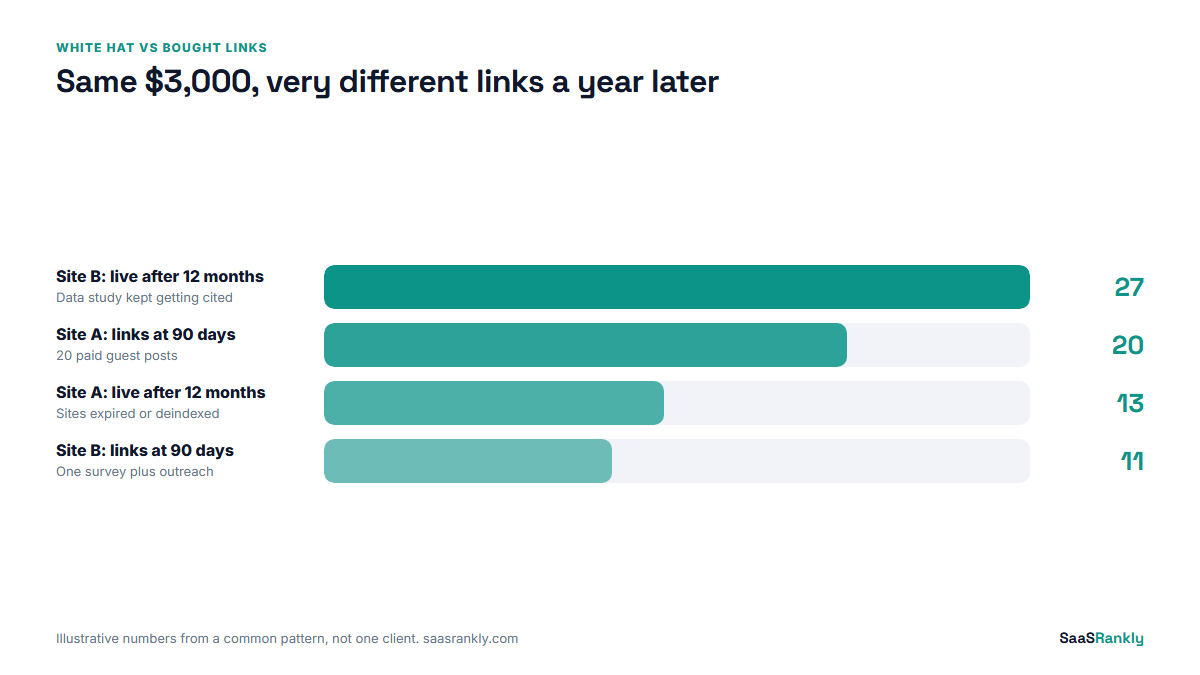
Site A wins the first quarter on link count. Site B wins every quarter after that, and it owns an asset its sales team can use in decks. This is the mistake we see most: judging link building on a 90-day count instead of a 12-month one.
When grey hat is tempting, and our answer
Clients ask for grey tactics in three situations. A competitor is visibly buying links and outranking them. A funding round needs a traffic chart that goes up this quarter. Or they bought an old domain and want to redirect it.
Our answer is the same each time: you can do it, but price the downside honestly. A manual action on a SaaS domain does not only hit the blog. It can hit the pricing page, the login page and the brand query. For most SaaS companies, organic sign-ups are a large share of pipeline, so the risk sits on the whole business, not one channel. That is really what is white hat seo in practice: choosing the slower route on purpose. We would rather tell a client “this will take six months” than explain a 70 percent traffic drop to their board.
If you want to see how risky link schemes get layered, our breakdown of tiered link building walks through one.
Quick recap: what is white hat seo
- White hat SEO follows Google’s spam policies and would still make sense without search engines.
- Use the “would we do this if Google disappeared” test on every tactic.
- Grey tactics (exchanges, expired domains, AI at scale) depend on scale and intent.
- Paid links without rel=”sponsored”, PBNs and cloaking are black hat, full stop.
- Judge link building on what survives 12 months, not what appears in 90 days.
- For SaaS, the downside of a penalty lands on the whole funnel, not just the blog.
FAQ
What is white hat seo in simple words?
It is doing SEO the way search engines ask you to: make useful pages, fix technical problems, and earn links because people want to reference your work. No tricks aimed only at rankings.
Is guest posting white hat?
It can be. Writing for a real publication with a real audience, where the editor decides what runs, is white hat. Paying for a slot on a site that publishes anyone who pays is a paid link, and it should carry rel=”sponsored”.
Can white hat SEO get you penalised?
Very rarely. Sites doing clean work can still drop in a core update, but that is a quality reassessment, not a penalty. Manual actions for spam almost always trace back to a tactic that broke a published policy.
How long does white hat SEO take to work?
On a new SaaS domain, expect three to six months before steady traffic, and longer for competitive terms. Technical fixes can show results in weeks; links and authority take quarters.
Is buying links always black hat?
Buying a link is allowed if it is marked rel=”sponsored” or nofollow, because then it does not pass ranking credit. Buying links that pass credit is link spam under Google’s policies.
What is the difference between white hat and black hat SEO?
White hat improves the site and earns signals. Black hat fakes the signals: bought links, hidden text, cloaking, doorway pages. White hat builds slowly and lasts; black hat can work briefly and then collapses in an update.