Getting primary and secondary keywords wrong is the quietest way to waste a good page. The writing is fine, the topic is right, and the page still ranks 14th for four different terms instead of 3rd for one. We see it constantly on SaaS blogs, and the fix is usually a 20-minute edit rather than a rewrite.
This is how we assign primary and secondary keywords to a page, with a full worked map for a fictional product so you can copy the shape of it.
What primary and secondary keywords actually are
A primary keyword is the single term you want the page to win. One page, one primary. Secondary keywords are the related terms the same page can realistically also rank for without changing what the page is about.
| Primary keyword | Secondary keywords | |
|---|---|---|
| How many per page | Exactly 1 | 3 to 8, usually |
| Appears in | Title, H1, URL, first 100 words, meta description | H2s, H3s, body copy, image alt |
| Search intent | Defines the page | Must match the primary’s intent |
| Typical volume | Highest of the set | Lower, more specific |
| If it does not rank | The page failed | Fine, that is normal |
| Chosen | Before writing | Before writing, refined after 90 days |
The row that matters most is intent. A secondary keyword is not just any related term with volume. If the primary is “project management software” (someone shopping) and you add “what is project management” (someone learning) as a secondary, you have not added reach, you have made the page vague enough to lose both. Our post on high-intent keywords goes deeper on separating those two audiences.
How to pick primary and secondary keywords for a page
Four filters, in order. Stop as soon as a candidate fails one.
- Same SERP shape. Search the primary and the candidate secondary. If the top ten overlap by three results or fewer, they need separate pages. This single check settles most arguments.
- Same intent. Both queries want the same kind of answer: both a definition, both a comparison, both a how-to. Mixed intent on one page ranks for neither.
- Lower or equal volume. If your candidate secondary has more volume than your primary, you picked the wrong primary. Swap them.
- Natural to write. If you cannot work the term into an H2 or a sentence without it reading badly, drop it. A forced keyword is worth less than the trust you lose.
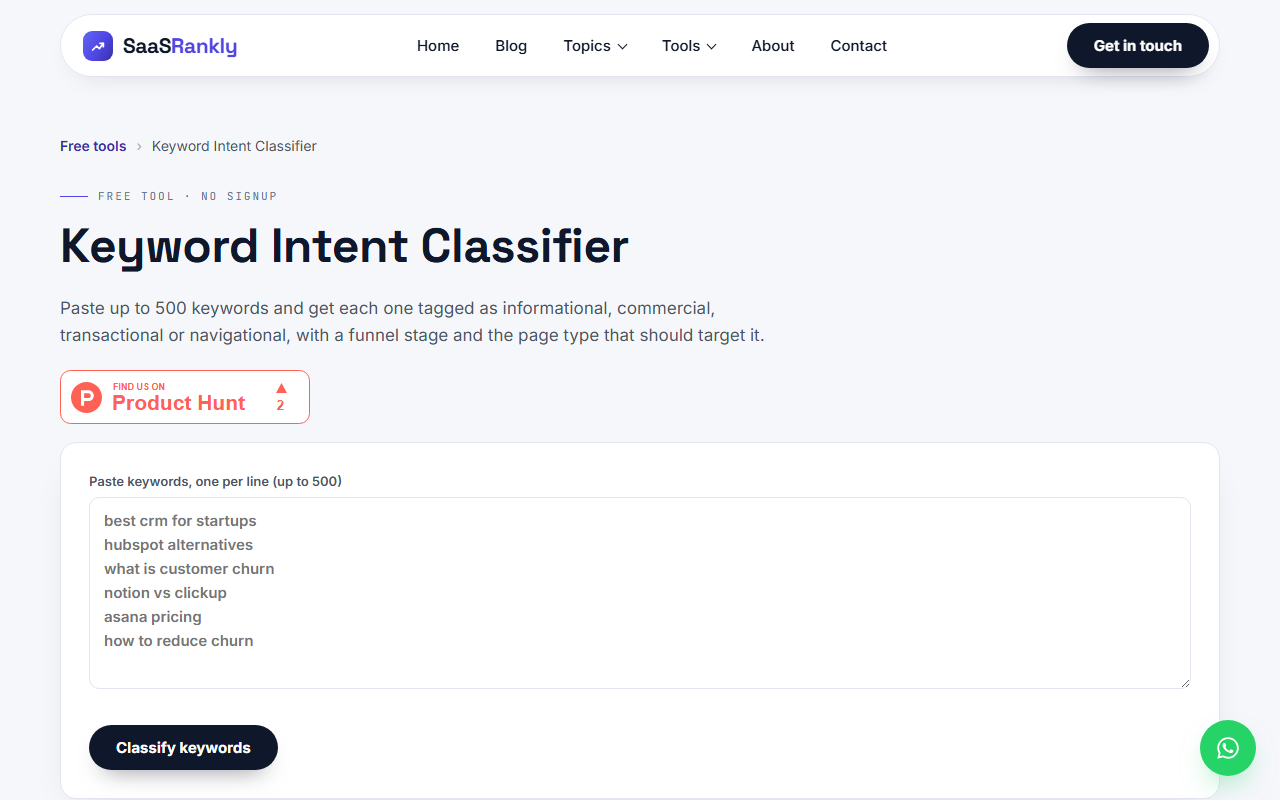
Filter 1 does about 80 percent of the work. We keep a spreadsheet with the top ten for each candidate pasted in, and the overlap count in a column. It is tedious for an hour and then you never argue about page structure again. If you want a shortcut on classifying the intent half, our keyword intent classifier handles a list in bulk.
How many secondary keywords is too many
Past eight, the page starts to sprawl. We have tested this on our own properties and the pattern holds: pages targeting three to six secondaries outrank pages targeting twelve, on the same primary, with similar link profiles. The twelve-term pages read like they were built for a checklist, because they were. There is a longer treatment in how many keywords per page.
Worked example: a page map for a fictional invoicing SaaS
Say you run Billfold, an invoicing tool for freelancers. Here is how we would split a cluster of 11 related queries across four pages instead of cramming them into one.
| Page | Primary keyword | Vol | Secondary keywords |
|---|---|---|---|
| /invoicing-software-for-freelancers/ | invoicing software for freelancers | 1,900 | freelance invoicing app, best invoicing tool for freelancers, self-employed invoice software |
| /blog/how-to-invoice-a-client/ | how to invoice a client | 2,400 | what to include on an invoice, invoice payment terms, when to send an invoice |
| /free-invoice-template/ | free invoice template | 8,100 | invoice template word, simple invoice template, blank invoice form |
| /blog/late-payment-fees/ | late payment fee | 1,300 | how much to charge for late payment, late fee wording invoice |
Now the part people skip. Write the on-page placement out before you draft:
| Element | Contains | Example for page 1 |
|---|---|---|
| URL | Primary, trimmed | /invoicing-software-for-freelancers/ |
| Title tag | Primary first, under 60 chars | Invoicing Software for Freelancers: 9 Picks (2026) |
| H1 | Primary, can differ from title | The best invoicing software for freelancers |
| First 100 words | Primary verbatim, once | opening sentence |
| H2 #2 | Secondary 1 | What makes a good freelance invoicing app |
| H2 #4 | Secondary 2 | Picking the best invoicing tool for freelancers |
| Body, twice | Secondary 3 | self-employed invoice software |
| Image alt | Primary | invoicing software for freelancers dashboard |
Ten minutes of this before drafting saves an hour of retrofitting afterwards. It also stops the writer from inventing a fifth H2 about tax deductions that pulls the page off target.
Five mistakes we see with primary and secondary keywords
Two pages sharing a primary. Cannibalisation. Google picks one, usually the weaker one, and both underperform. Merge them or repoint one at a different primary. Check for this by filtering Search Console’s Performance report by a query and looking at how many of your URLs appear.
Picking the primary by volume alone. The 8,100-volume template keyword above brings people who want a free file, not a subscription. It is still worth a page, but the primary you assign to your money page should be the one whose searchers can buy. See SaaS keyword research for how we weight that.
Treating plurals and word order as separate keywords. “Invoice software freelancer” and “invoicing software for freelancers” are the same query to Google. Do not build a second page, and do not write both awkwardly into one.
Never revisiting. After 90 days, open the Performance report, filter to the page, and look at what it actually ranks for. Two or three of those queries will be terms you never targeted. Promote the good ones to official secondaries and add a section for them. This is the highest-return SEO task nobody does.
Stuffing the primary to hit a density number. Eight to twelve natural mentions in a 1,500-word page is plenty. If you are counting to hit a percentage, you have already lost the plot. Density targets are a tool heuristic, not a ranking factor, and Google’s own guidance has said as much for years.
A repeatable process for assigning primary and secondary keywords
- Export every keyword in the topic with volume above your floor. We use 50 for niche B2B, 200 for broad markets.
- Group by intent first, volume second. Informational, commercial, transactional.
- Within each group, the highest-volume term becomes a candidate primary.
- Run the SERP overlap check on every remaining term against that primary.
- Overlap of four or more, it becomes a secondary. Three or fewer, it becomes its own page.
- Write the placement table before drafting.
- Revisit at 90 days and promote whatever Google decided you were about.
On a 40-keyword cluster this takes about two hours and produces a content plan you can hand to a writer without a briefing call. If the cluster turns out to need 60 near-identical pages, you are into programmatic SEO territory and the rules change.
Quick recap: primary and secondary keywords
- One primary keyword per page, three to eight secondaries, never more.
- Secondaries must share the primary’s intent, not just its topic.
- The SERP overlap test decides same page versus separate page. Four or more shared results means same page.
- Primary goes in the URL, title, H1, first 100 words and image alt. Secondaries go in H2s and body.
- If a secondary has more volume than your primary, you chose the wrong primary.
- Revisit after 90 days and promote the terms Google actually gave you.
The fastest source of secondary keywords is your own data; here is how to export Google Search Console keywords for any page.
FAQ
What is the difference between primary and secondary keywords?
The primary keyword is the one term a page is built to rank for, and it drives the URL, title, and H1. Secondary keywords are supporting terms with the same intent and usually lower volume, worked into subheadings and body copy. One primary, several secondaries.
How many secondary keywords should I use per page?
Three to eight. Below three you are probably leaving easy reach on the table; above eight the page loses focus and tends to rank worse for the primary. Longer pages support more, but the ceiling is about intent coherence, not word count.
Can a page have two primary keywords?
Technically nothing stops you, and in practice it goes badly. If both terms genuinely deserve to lead, you have two pages. The exception is close variants that Google already treats as the same query, like a singular and plural, which are one keyword regardless of how your spreadsheet lists them.
Should secondary keywords go in the title tag?
Usually not. You have under 60 characters and the primary needs to come first. If a secondary happens to fit naturally after the primary and still leaves room for a number or a year, take it. Do not sacrifice a readable title for it.
How do I find secondary keywords?
Three cheap sources: the “related searches” and People Also Ask boxes on the primary’s SERP, the query list for your own page in Search Console after it has been live 90 days, and the terms your top three competitors’ page already ranks for. That last one is the fastest if you have a keyword tool.
Do secondary keywords help rankings for the primary?
Indirectly. They do not boost the primary by themselves, but covering the related questions makes the page a better match for the topic, which tends to improve engagement and coverage. The measurable win is that the page earns impressions across a wider set of queries, which usually adds more traffic than a small move on the primary would.