What is LSI keyword in SEO? The short answer: it is a name for “related words you should mention on a page”, borrowed from an indexing method called latent semantic indexing that Google has never said it uses. The idea behind the label is half wrong and half genuinely useful. This post separates the two, so you can stop buying LSI keyword lists and keep doing the part that actually helps a SaaS page rank.
We get asked what is LSI keyword in SEO every few weeks, usually by someone who has just seen an “LSI keyword generator” or an audit tool flagging “missing LSI terms”. Fair question. Here is how we answer it.
What is LSI keyword in SEO, in one paragraph
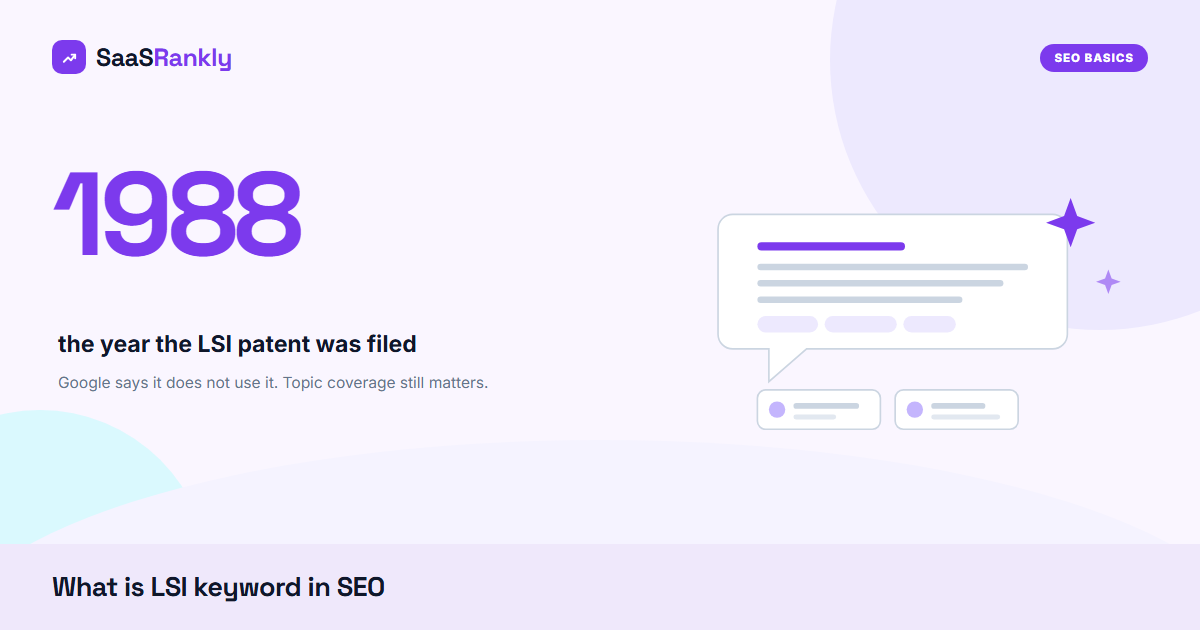
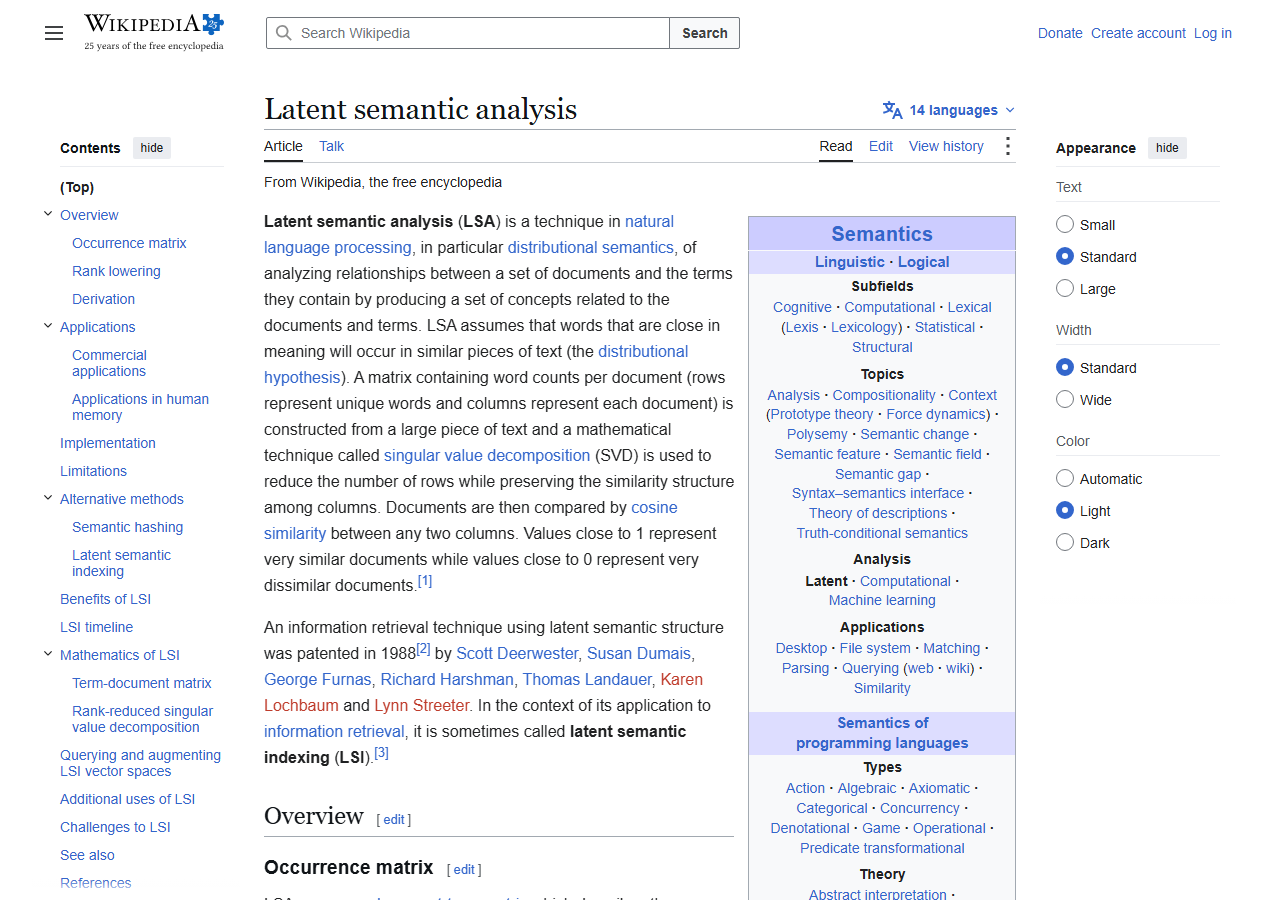
Latent semantic indexing is a retrieval technique from the late 1980s. It looks at which words tend to appear together across a set of documents and uses that pattern to match a query with documents that do not contain the exact query words. The patent was filed in 1988, and the method was designed for small, fixed collections, the kind a library or a company archive would have. SEO writers later picked up the term and used “LSI keywords” to mean synonyms and related phrases. So when someone asks what is LSI keyword in SEO, they are almost always asking about related terms, not the 1988 maths.
Myth and fact: what is LSI keyword in SEO really doing
Most of the confusion comes from five claims that keep getting repeated. Here they are, one at a time.
Myth: Google uses LSI to rank pages.
Fact: Google has said publicly, through John Mueller among others, that there is no such thing as LSI keywords in its systems. LSI does not scale to a web of hundreds of billions of documents that change every minute. Google’s language understanding comes from much newer systems, from synonym handling in the 2000s to the neural matching and BERT-style models it has described since 2019.
Myth: you need a set number of LSI keywords per page.
Fact: there is no count. A page about payroll software will naturally mention tax, employees, pay runs and compliance because the topic demands it. Forcing in 15 terms from a generator produces a page that reads like a checklist.
Myth: LSI keywords are just synonyms.
Fact: synonyms are the least useful part. The valuable related terms are the entities and sub-topics a searcher expects to see covered: the features, the problems, the alternatives, the numbers.
Myth: LSI tools show what Google wants.
Fact: most “LSI generators” scrape Google autocomplete and related searches, then relabel them. That data is useful. The label is marketing.
Myth: since LSI is fake, related terms do not matter.
Fact: this is the overcorrection, and it is just as wrong. Pages that cover the expected sub-topics of a query do better, because they answer more of what the searcher came for and match more of the long-tail queries around the head term.
The useful part of what is LSI keyword in SEO: topic coverage
Throw away the LSI label and you are left with a sound idea: a page should cover the concepts a searcher expects for that query. We call this topic coverage, and it is something you can measure without any special tool.
The question to ask is not “which LSI keywords am I missing?” It is “what would an expert expect to find on this page, and is it here?” For a SaaS feature page about time tracking, an expert would expect billable hours, timesheets, approvals, integrations with payroll, mobile clock-in and pricing per user. If three of those are missing, the page is thin regardless of keyword density.
How we find related terms without an LSI tool
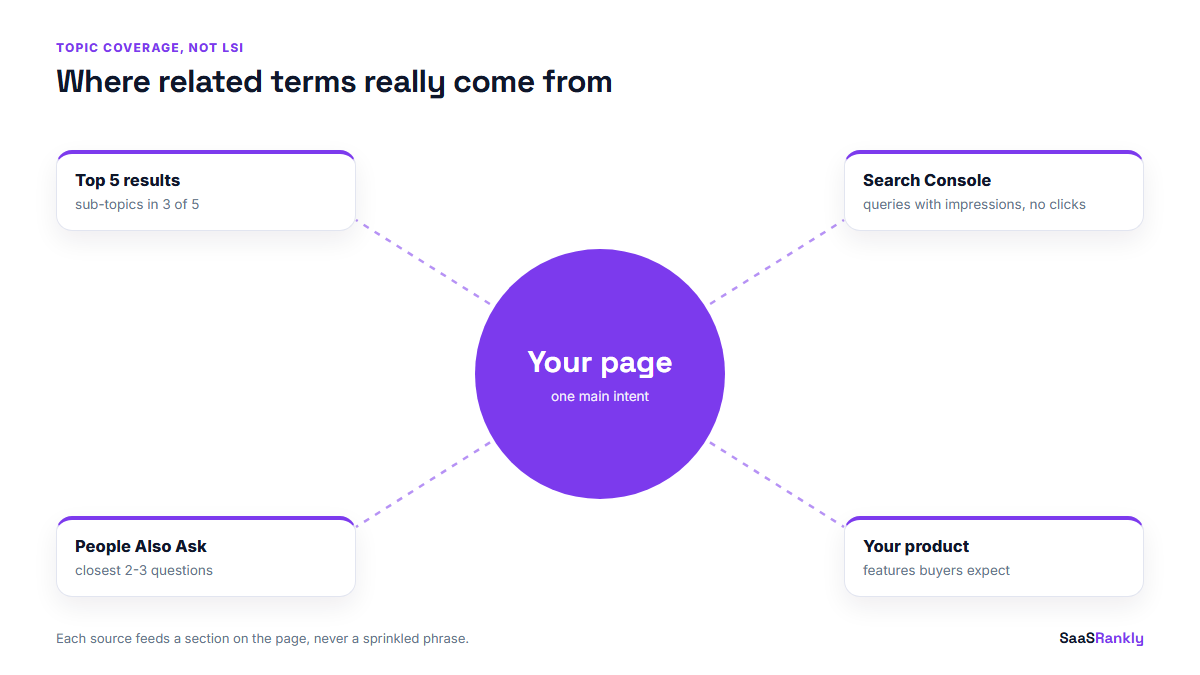
If you came here asking what is LSI keyword in SEO because a page is stuck, this is the five-step check we run on any page that is stuck between positions 8 and 20. It takes about 40 minutes per page.
- Read the top five results. Not skim. Note every sub-topic that appears in at least three of them. Those are the expected concepts.
- Pull your own queries from Search Console. Filter by the page and sort by impressions. Queries with impressions but almost no clicks often name a sub-topic the page mentions once and never explains. Our guide to Search Console keyword data shows the filter.
- Check People Also Ask and related searches. These are the same inputs LSI generators use, without the subscription.
- Compare against your page. Mark each sub-topic as covered, mentioned only, or missing.
- Write sections, not sprinkles. A missing sub-topic gets a paragraph or an H3, not a word dropped into an existing sentence.
Step five is where most teams go wrong. Adding the phrase “employee scheduling” once to a paragraph about something else does nothing for a reader. A short section that explains how scheduling connects to time tracking does.
Worked example: a stuck feature page
Clockwell is a fictional time-tracking SaaS. Its “Timesheet approvals” page sat at position 14 for its main term for four months. Here is the coverage check we ran. Every number is illustrative but realistic for a page of this type.
| Sub-topic | Found in top 5 | On Clockwell page | Action |
|---|---|---|---|
| Approval workflow steps | 5 of 5 | Covered | None |
| Manager vs admin roles | 4 of 5 | Mentioned once | New H3 with a role table |
| Rejecting and editing entries | 4 of 5 | Missing | New section with screenshots |
| Payroll export after approval | 3 of 5 | Missing | Paragraph plus link to integrations |
| Audit trail | 3 of 5 | Mentioned once | Expanded to a short section |
| Mobile approvals | 2 of 5 | Missing | Skipped, not expected enough |
The page grew from about 700 words to about 1,150. Six weeks after the update it moved to position 6, and Search Console showed it appearing for 38 new queries, most of them phrased around rejection and payroll export. No generator was used, and nobody on the team asked what is LSI keyword in SEO even once. The related terms came from reading the SERP and the page’s own query data.
A coverage checklist you can reuse
- Every sub-topic found in three or more of the top five results is covered with at least a paragraph.
- The page answers the two or three People Also Ask questions closest to its intent.
- Queries with impressions but under 1 percent CTR have been checked against the copy.
- Related terms appear because a section needs them, not as a list at the bottom.
- The page links to deeper posts for sub-topics it cannot cover fully, so it does not swell into a guide.
- The title and H1 still match the main intent after the additions.
That last point matters. Coverage work can drift a page off its intent. If a feature page starts reading like a how-to guide, split the guide into its own post and link to it. Our post on how many keywords one page can target covers where that line sits, and topic clusters shows how the split pages fit together.
Where LSI-style tools still earn a place
We are not against the tools, only the label. Ask a vendor what is LSI keyword in SEO and the honest ones will say it is shorthand. A content optimisation tool that lists terms common to the top results is a decent shortcut for step one above, as long as you treat the list as questions (“should this page explain X?”) rather than instructions (“insert X four times”). At the time of writing those tools run from about $19 to $99 a month for a small team. If you are already paying for one, use it for the comparison and skip the term counts.
For the bigger picture of how one page relates to a group of searches, our guide to primary and secondary keywords is the practical next read, and the SERP snippet preview helps you check that the title still reads right after a rewrite.
Quick recap: what is LSI keyword in SEO
- LSI is a 1988 indexing method for small document sets; Google says it does not use it.
- “LSI keywords” in SEO usually means related terms and sub-topics.
- The label is a myth, but covering expected sub-topics is useful and measurable.
- Find related terms from the top five results, Search Console queries and People Also Ask.
- Add missing sub-topics as real sections, never as sprinkled phrases.
- Split the page when coverage pushes it away from its intent.
FAQ
Does Google use LSI keywords?
No. Google representatives have said there is no such thing as LSI keywords in its ranking. Google understands related terms through its own language models, which are far newer than latent semantic indexing.
What is an example of an LSI keyword?
For “project management software”, SEO writers would list terms like Gantt chart, task dependencies, kanban board and team workload. Those are really related sub-topics, and they help because searchers expect them, not because of LSI.
Are LSI keywords the same as semantic keywords?
People use the two terms loosely for the same idea: words and concepts related to the main topic. “Semantic keywords” is the more accurate name, since it does not refer to a specific old algorithm.
How many related keywords should a page have?
There is no target number. Cover each sub-topic that most top-ranking pages cover, at the depth a reader needs, and let the related terms follow from that.
Are LSI keyword generators worth paying for?
Usually not on their own. Most reuse autocomplete and related-search data you can see for free. A content optimisation tool that compares you with the top results is more useful, if you treat its list as prompts.
Can adding LSI keywords hurt a page?
Yes, if they are forced in. Stuffing generator terms into unrelated sentences makes the copy worse for readers and does not help rankings. Add sections that explain sub-topics instead.