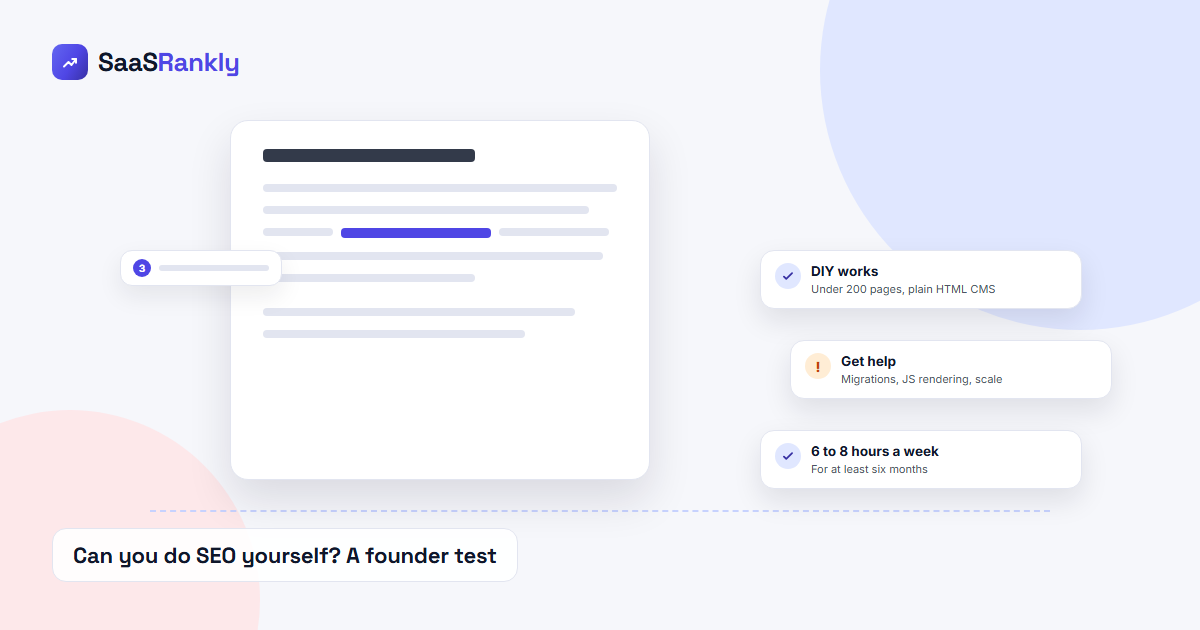
Can you do SEO yourself? For most SaaS companies under about $1M ARR, yes, and you will probably do it better than a cheap agency would. You know the product, you talk to customers, and SEO for an early product is mostly writing useful pages about problems you understand. Founders rarely get stuck on skill. They get stuck on time, consistency, and a few technical traps that are easy to miss if you have never seen them.
We have coached founders through DIY SEO and cleaned up after a few who tried it alone. Here is how to tell which group you are in before you spend six months finding out. If you do go it alone, work through the SEO fundamentals in order rather than picking tactics at random.
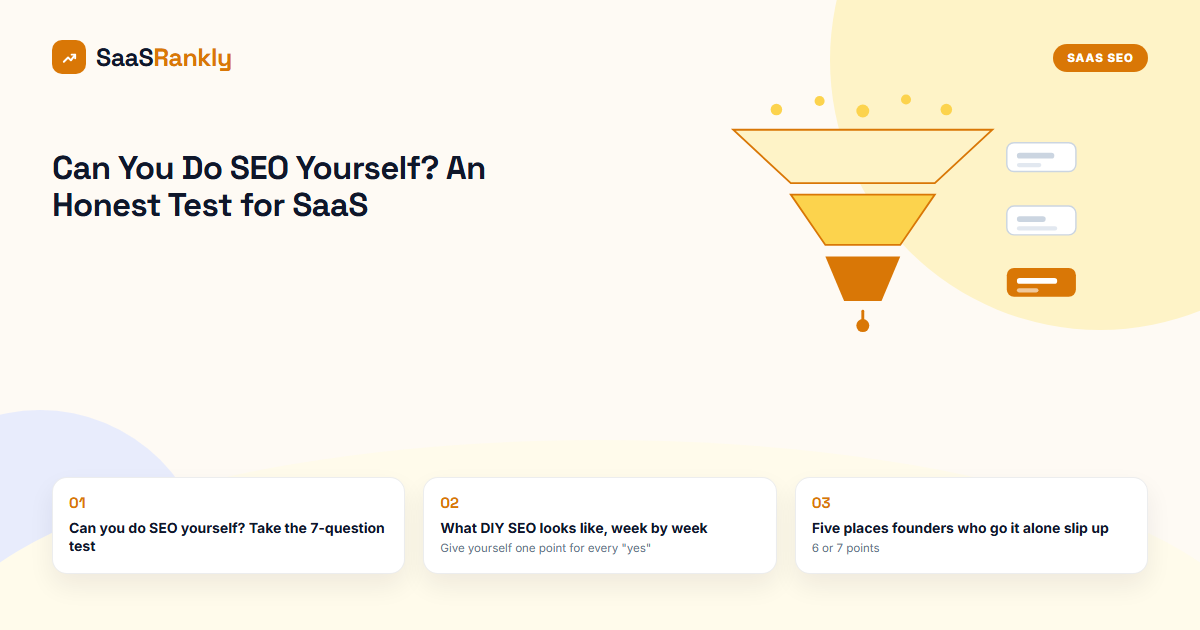
Can you do SEO yourself? Take the 7-question test
Give yourself one point for every “yes”. Nobody is checking, so be honest.
| # | Question | Why it matters |
|---|---|---|
| 1 | Can you protect 6 to 8 hours a week for at least six months? | SEO rewards consistency far more than talent. |
| 2 | Does your site have fewer than about 200 indexable pages? | Small sites rarely have crawl or duplication problems. |
| 3 | Is the marketing site on WordPress, Webflow or another CMS that serves plain HTML? | JavaScript-rendered sites need someone technical. |
| 4 | Can you describe your main use cases in the words customers use? | That is most of keyword research. |
| 5 | Are you comfortable reading Search Console once a week? | It is the only report you truly need at the start. |
| 6 | Is organic a secondary channel for the next six months? | If SEO must carry growth now, a slow learning curve costs too much. |
| 7 | Is there no migration, rebrand or domain change planned this year? | Migrations are where DIY SEO goes badly wrong. |
6 or 7 points: do it yourself. Pay for help only for one-off technical checks.
4 or 5 points: write the content yourself, and pay a specialist for a technical audit and a quarterly review.
3 or fewer: you can still own parts of it, but budget for outside help before you start, not after traffic stalls.
What DIY SEO looks like, week by week
| Weeks | Focus | Output |
|---|---|---|
| 1 to 2 | Setup: Search Console, GA4 key events, sitemap, basic technical check | A clean baseline and a list of indexing issues |
| 3 to 4 | Keyword research from customer language | 30 to 50 target queries tagged by intent |
| 5 to 8 | Bottom-of-funnel pages: comparisons, alternatives, use cases | 6 to 8 pages |
| 9 to 12 | Supporting articles and internal links | 6 to 8 articles, each linking to a money page |
| Ongoing | Weekly Search Console check, monthly refresh of pages ranking 5 to 15 | 1 or 2 updates a month |
Weeks 3 and 4 decide most of the outcome. Our SaaS keyword research guide shows how to turn support tickets and sales calls into target queries, and the SaaS SEO strategy post is the bigger plan this 12-week block sits inside.
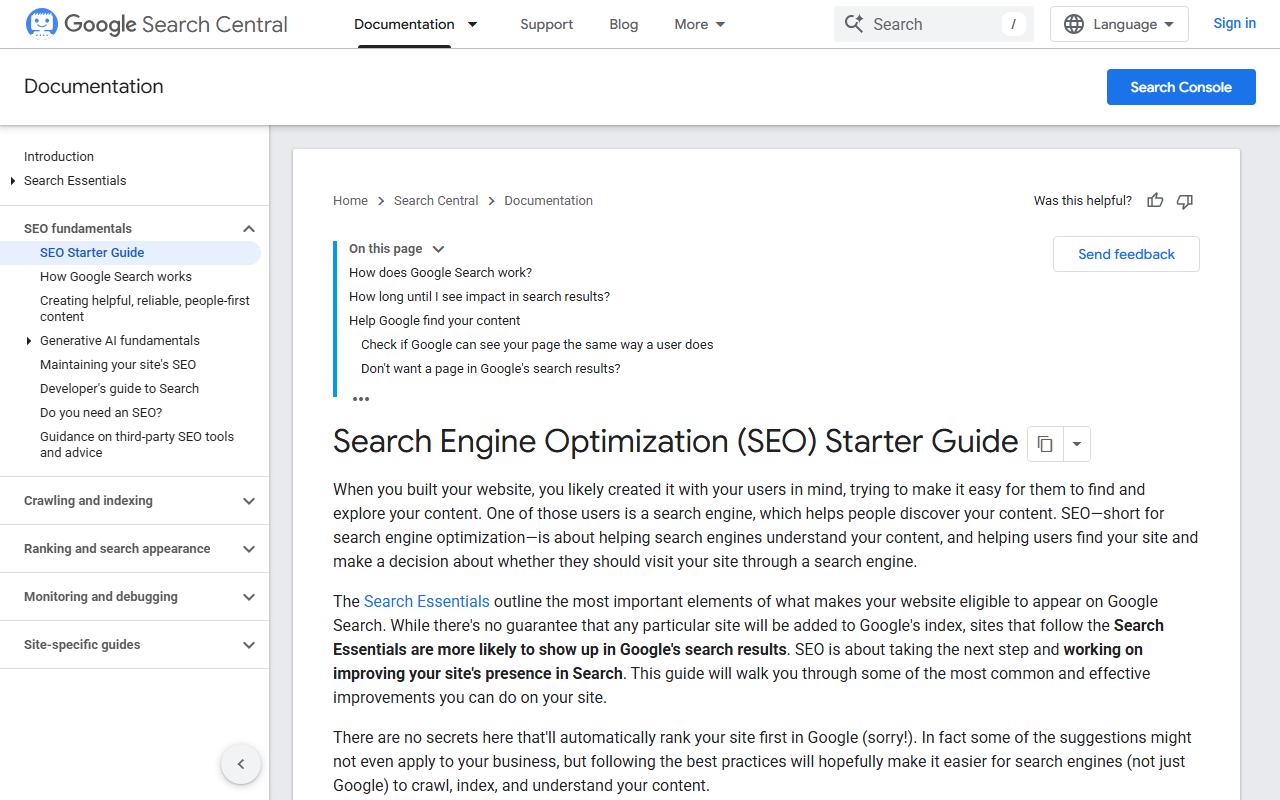
Before week one, read Google’s own SEO Starter Guide, shown above. It is written for exactly this reader, a site owner doing the work themselves. It is free, it takes an evening, and it is more accurate than most paid courses we have seen.
Five places founders who go it alone slip up
1. Writing for volume instead of intent
A founder writes “what is project management” because it has tens of thousands of searches. A new domain will not rank for it, and the people searching are mostly students. A page on “Asana alternatives for agencies” with 150 searches a month will bring more trials.
2. Publishing and never updating
Most gains between month 4 and month 12 come from improving pages already sitting in positions 5 to 15. Put a monthly refresh slot in the calendar.
3. Missing the JavaScript problem
If the marketing site is a client-side React app, Google may see an almost empty page. Check a few URLs with the URL Inspection tool before you write anything. Our technical SEO for SaaS checklist covers the fixes.
4. Buying cheap link packages
A $50 bundle of 500 links is the fastest way to turn a slow start into a penalty. Skip it entirely.
5. Checking rankings every day
Daily movement is mostly noise, and founders who watch it end up changing titles that were about to work. Once a week is plenty.
Worked example: a founder’s first six months of DIY SEO
“Quotebird” is a fictional quoting tool for trade contractors, run by a solo founder with no SEO background. She spent about 6.5 hours a week on it and $49 a month on a rank tracker. Everything else was free.
| Month | Pages published | Organic clicks | Organic trials | What she worked on |
|---|---|---|---|---|
| 1 | 4 | 30 | 0 | Setup, fixed 11 pages blocked by a leftover noindex |
| 2 | 4 | 110 | 1 | Three competitor alternatives pages |
| 3 | 3 | 290 | 4 | Use-case pages for plumbers and electricians |
| 4 | 2 | 540 | 7 | Rewrote titles using a SERP snippet preview |
| 5 | 2 | 820 | 11 | Refreshed 5 pages ranking 6 to 12 |
| 6 | 2 | 1,150 | 15 | First guest post on a trade association blog |
Seventeen pages in six months is not a lot. What made it work was the order: the leftover noindex fixed in month 1, bottom-of-funnel pages in months 2 and 3, and refreshes instead of new posts in month 5. About two thirds of her trials came from five pages. That is typical, and it is the strongest argument that a founder can do SEO themselves: the pages that matter most are the ones a founder is best placed to write.
Can you do SEO yourself cheaper than hiring? The real costs
| Option | Monthly cost at the time of writing | Your time per week | Best for |
|---|---|---|---|
| DIY with free tools | $0 to $100 | 6 to 8 hours | Pre-revenue to about $50K MRR |
| DIY plus a one-off technical audit | $0 to $100, plus $1,000 to $2,500 once | 5 to 7 hours | Founders with a JavaScript-heavy site |
| Freelance writer, you edit | $1,500 to $4,000 | 2 to 3 hours | When content volume is the bottleneck |
| Agency | $3,000 to $10,000 | 1 to 2 hours | Funded teams that need speed |
| In-house SEO hire (US) | $7,000 to $11,000 in salary cost | 1 hour, managing | Once organic is a top-two channel |
We keep a list of the free options in best free SEO tools for SaaS startups. Now the uncomfortable part. Seven hours a week of founder time at a notional $150 an hour is about $4,500 a month. If you can hire a good writer for less and put those hours into sales, that is often the better trade. Our SEO ROI guide shows how to judge the return either way.
When the answer to “can you do SEO yourself” becomes no
- You skipped SEO work in three of the last six weeks.
- Organic now brings in more than 30 percent of trials, so a mistake would hurt.
- A migration, replatform or domain change is on the roadmap.
- Pages are not getting indexed and an afternoon of digging did not explain why.
- You have more than 20 pages ranking 5 to 15 and no time to refresh them.
None of these mean you did it wrong. They mean SEO is now worth enough to deserve someone’s full attention.
Quick recap: can you do seo yourself
- Can you do SEO yourself? For most SaaS founders under about $1M ARR, yes.
- Score yourself on the 7-question test before you start.
- Protect 6 to 8 hours a week for at least six months.
- Build bottom-of-funnel pages first, then supporting articles.
- Get a one-off technical audit if your site relies on JavaScript rendering.
- Hand it off when organic becomes a main channel or a migration is coming.
FAQ
Can you do SEO yourself with no experience?
Yes. Read Google’s SEO Starter Guide, set up Search Console, and start with pages about your product’s use cases and competitors. Our SEO essentials plan splits that first week into five days. Most of the early wins come from understanding customers, which you already do.
Can you do SEO yourself for a SaaS startup?
For most early SaaS, yes. The exceptions are sites built as JavaScript apps, sites going through a migration, and teams that need organic to be the main growth channel within a few months.
How long does DIY SEO take to work?
On a new domain, expect the first meaningful clicks after 2 to 4 months and trials after 4 to 6, if you publish consistently. Established domains move faster.
How many hours a week does SEO take?
About 6 to 8 hours for the first six months: roughly two for research and checks, the rest for writing and updating pages. After that, 3 to 5 hours can hold your position.
What SEO tasks should I never do myself?
Site migrations and domain changes, unless you have done one before. A bad migration can wipe out months of work in a week. Pay for a specialist to plan the redirects.
Is in-house SEO better than an agency?
For SaaS, usually yes once organic is a top channel, because product knowledge matters so much. Before that point, a founder plus a part-time specialist is often better value than either.