Picking between the best AI search engines is not really a question of which one writes the nicest paragraph. They all write fine paragraphs. What separates them is where the answer came from, whether the citation survives a click, and how often they send a real visitor to the site they quoted. We ran the same 40 queries through each one, half commercial and half informational, and the spread on that last point was enormous.
Below is what we found across the best AI search engines, at the time of writing, with prices and the sourcing model for each.
The best AI search engines at a glance
| Engine | Underlying index | Free tier | Paid from | Cites sources | Best at |
|---|---|---|---|---|---|
| Google AI Mode / AI Overviews | Yes | $19.99 (AI Pro) | Yes, links in a panel | Reach. It is in front of everyone. | |
| Perplexity | Own crawler plus partners | Yes, limited Pro searches | $20 | Yes, numbered inline | Research with a trail you can follow |
| ChatGPT Search | Bing plus own crawler | Yes | $20 | Yes, inline chips | Follow-up questions in one thread |
| Claude with web search | Brave plus partners | Yes | $20 | Yes, inline | Long documents and careful reasoning |
| Microsoft Copilot | Bing | Yes | $20 | Yes, footnotes | Anyone already inside Microsoft 365 |
| Bing Copilot Search | Bing | Yes | Free | Yes | Blue links and an answer side by side |
| You.com | Own plus partners | Yes | $15 | Yes | Switching models per query |
| Brave Leo / Brave Search AI | Brave’s own index | Yes | $14.99 | Yes | Privacy, no account required |
| Andi | Own index | Yes | Free | Yes | Clean answers, small index |
Rankings across the best AI search engines shift every few months, so treat this table as a snapshot. If you want one recommendation and no nuance: Perplexity for research, ChatGPT for anything that turns into a task, and whatever your browser does by default for the other 90 percent of queries. That is honestly how most of our team uses them.
How the best AI search engines actually source answers
This is the part that matters if you publish anything, and it is the part almost no comparison covers. There are three sourcing models running underneath these products.
Live retrieval. The engine runs a query against a live index, pulls the top handful of documents, and generates from those. Perplexity and Google AI Mode work this way. Your page can appear in an answer within days of publishing, and it can vanish just as fast.
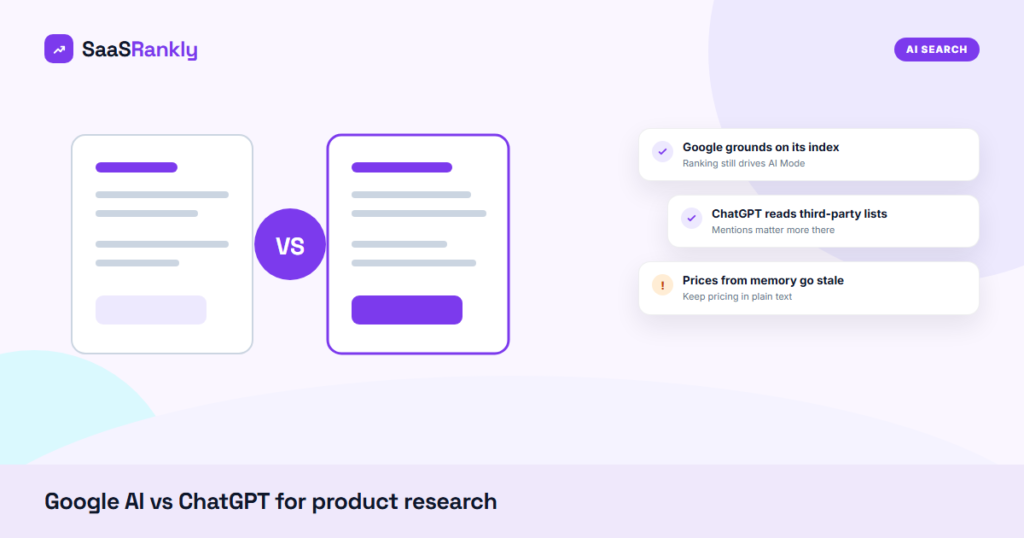
Model memory. The answer comes from training data with no retrieval at all. Fast, confident, and stale. This is where you get a 2023 pricing figure quoted as current. Most engines now retrieve for anything that looks time-sensitive, but the boundary is fuzzy and undisclosed. We compare how that plays out against Google’s own index in our Google AI vs ChatGPT breakdown.
Licensed partner feeds. Some engines pay publishers and weight that content heavily. It is why the same handful of large sites turn up across answers on unrelated topics.
For a marketer the practical read is this: live retrieval is the only one you can influence quickly. Being clearly written, well structured, and factually checkable is what gets you pulled into a live-retrieval answer. We broke down the tactics in how to get cited by ChatGPT.
What we found running 40 identical queries
Illustrative numbers from our own test set, not a peer-reviewed study. Forty queries, twenty commercial (“best X for Y”, “X pricing”), twenty informational.
| Engine | Avg sources cited | Cited a source in Google’s top 10 | Broken or wrong citation |
|---|---|---|---|
| Perplexity | 6.4 | 61 pct | 2 of 40 |
| Google AI Mode | 4.1 | 88 pct | 0 of 40 |
| ChatGPT Search | 4.8 | 44 pct | 5 of 40 |
| Copilot | 3.6 | 52 pct | 3 of 40 |
| Brave | 4.0 | 39 pct | 4 of 40 |
Two things stood out about the best AI search engines in this set. Google AI Mode barely strays from its own top ten, which means classic ranking still drives your visibility there. And ChatGPT Search cites plenty of pages that do not rank in Google at all, which is genuinely good news for smaller sites with clear, specific content.
“Broken or wrong citation” means the link 404ed or the cited page did not contain the claim. Five out of forty is not a small error rate, and it is a reason to click through rather than trust the summary on anything that matters.
Which of the best AI search engines send traffic
Very little, is the honest answer, and anyone telling you otherwise is selling something. Across the SaaS properties we have visibility into, referral traffic from AI assistants runs somewhere between 0.4 and 3 percent of organic sessions at the time of writing. It converts well, often two to four times better than generic organic, because the visitor arrives already briefed. But the volume is small.
The bigger effect is indirect. Buyers now arrive at your pricing page having already been told, by a machine, what you cost and who you compare to. If that summary is wrong, you are fighting it in the sales call. Checking what the engines say about your product is now part of the job, and we listed the tooling for it in AI search visibility tools.
A short checklist if you publish content
- Search your brand name in three engines monthly. Screenshot the answers. Track the drift.
- Make key facts extractable: pricing in a table, not a paragraph; a one-sentence definition near the top of each page.
- Keep a public, current pricing page. Engines quote whatever they can find, and if they cannot find yours they quote a review site.
- Do not block AI crawlers reflexively. Decide per bot. Blocking the retrieval crawler removes you from the answer.
- Watch which of your pages get cited, not just how often. That tells you what format works.
On point 4: the crawler that fetches pages for a live answer is often a different user agent from the one collecting training data. You can allow one and refuse the other. Most teams we talk to do not realise this and block both.
Should you optimise separately for the best AI search engines?
Mostly no, and we say that as people who could easily sell the opposite. The pages that get cited are the pages that already rank, are already clear, and already answer a specific question early. There is no separate discipline here yet, whatever the acronym of the month suggests. Our full argument is in AEO vs GEO.
The one genuine difference is format. Answer engines pull from structured, self-contained chunks. A 3,000-word essay where the answer is buried in paragraph nine gets skipped in favour of a competitor’s clean 200-word section with a table. That is a writing change, not a channel. If you want a measurement setup that covers both, see measuring SaaS SEO in GA4 and GSC.
If you are picking tooling rather than an engine to use yourself, our list of best AI SEO tools covers the monitoring side.
Quick recap: best ai search engines
- Perplexity for research trails, ChatGPT for task-shaped questions, Google AI Mode for sheer reach.
- Live retrieval is the sourcing model you can influence; model memory is the one that quotes stale prices.
- Google AI Mode mostly cites its own top ten, so classic rankings still matter there.
- ChatGPT Search cites plenty of non-ranking pages, which favours smaller specific sites.
- Referral volume is low, between 0.4 and 3 percent of organic, but it converts unusually well.
- Check what these engines say about your product monthly. Wrong summaries cost you deals.
FAQ
Which is the best AI search engine right now?
For research with sources you can verify, Perplexity. For reach, Google AI Mode, simply because it appears above ordinary results for a huge share of queries. For everyday use inside a conversation, ChatGPT Search. There is no single winner, and the gap between the top four narrows every few months.
Are AI search engines replacing Google?
Not at the moment. Google still handles the overwhelming majority of searches, and its own AI features keep most of that usage inside Google. What has changed is the click. Zero-click behaviour is up, and informational content that used to earn traffic now often gets summarised instead.
Is Perplexity better than ChatGPT for search?
For factual lookups where you need to check the source, yes. Perplexity cites more sources per answer and puts them inline where you will actually use them. ChatGPT is better once the query turns into a task, like drafting something based on what it found.
Do AI search engines use Google’s index?
None of them use Google’s index directly. Google’s own products do, ChatGPT and Copilot lean on Bing, Perplexity and Brave run their own crawlers alongside partner data. This is why the same query returns visibly different sources across engines.
Are there free AI search engines?
All of the main best AI search engines have a usable free tier. Bing Copilot Search, Brave’s AI answers, and Andi are free outright. Perplexity, ChatGPT, and Claude cap the number of advanced searches per day on free accounts, which is enough for casual use.
How do I stop AI search engines from using my content?
Add the relevant user agents to robots.txt, for example GPTBot, ClaudeBot, PerplexityBot, and Google-Extended. Be deliberate about it: some of those agents fetch pages to build a live answer that cites you, and blocking them removes your site from those answers. The robots.txt spec is the reference if you are writing the rules by hand.