Google AI vs ChatGPT is no longer a question about which chatbot writes a better email. For a SaaS team it is a question about where buyers now do their first round of product research, and which of the two will put your product in the answer. We compared Google’s AI Mode and AI Overviews with ChatGPT search on the jobs a software buyer actually runs: shortlisting tools, checking prices, reading comparisons and asking follow-ups. The short version is that they pull from different places, cite differently and reward different work on your side.
Prices and features below are correct at the time of writing. Both products change every few weeks, so treat the specifics as a snapshot and the reasoning as the part that lasts.
Google AI vs ChatGPT: the short verdict
If you only read one table, read this one. It sums up how the two behave when someone types a buying question like “best help desk software for a 10 person team”.
| Question | Google AI Mode and AI Overviews | ChatGPT search |
|---|---|---|
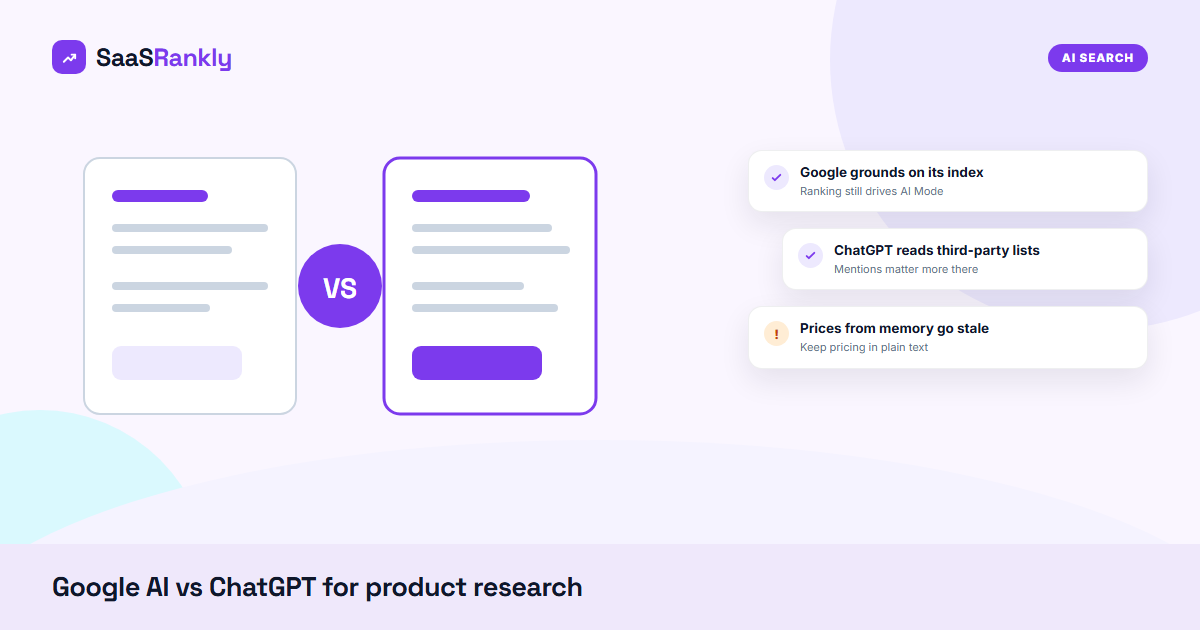
| Where do the sources come from? | Google’s own index, the same one that ranks blue links | OpenAI’s crawler plus third-party search partners |
| How fresh is it? | Very fresh for anything Google has recrawled | Fresh when it runs a search, stale when it answers from memory |
| How visible are citations? | Link cards beside the answer, easy to miss | Inline source chips plus a sources panel |
| Follow-up questions | Good in AI Mode, limited in AI Overviews | The core strength, context carries across many turns |
| Cost to the user | Free inside Google Search | Free tier with search, paid plans from about $20 a month |
| What earns you a mention | Ranking well and being quotable | Being crawlable by OAI-SearchBot and being named on pages it trusts |
Our opinion on Google AI vs ChatGPT: for a SaaS brand, Google still decides most of the outcome because AI Mode leans on pages that already rank. ChatGPT is the bigger swing factor because it rewards being mentioned on third-party lists, reviews and forums, which is work most SaaS teams have not started.
What each one actually is
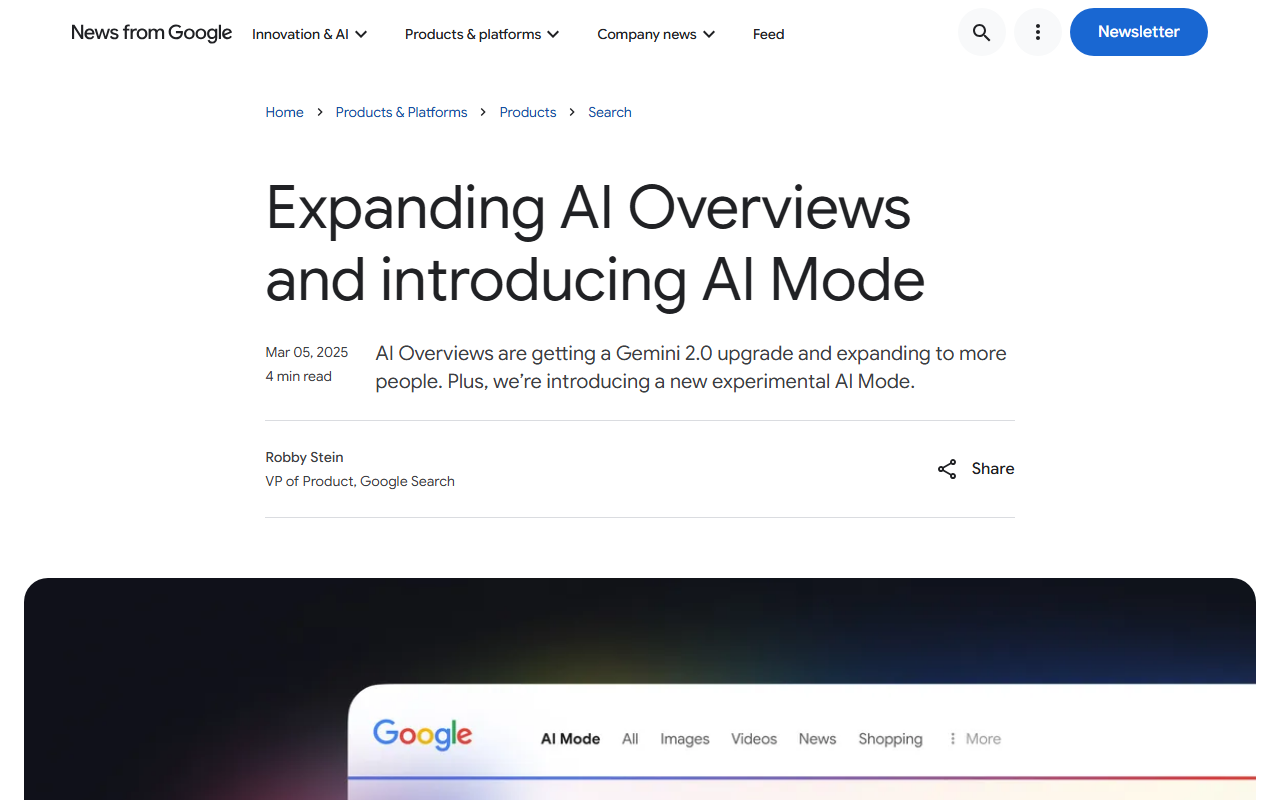
The names are messy, and half of the Google AI vs ChatGPT debate online is people comparing different products. Here is what we mean. “Google AI” in a search context covers two things. AI Overviews are the summary boxes at the top of a normal results page. AI Mode is a separate tab where the whole page becomes a conversation. Google announced AI Mode in March 2025 as an experiment and has since rolled it out widely. The Gemini app is a third product, closer to ChatGPT as a general assistant, but it is not where most search behaviour happens.
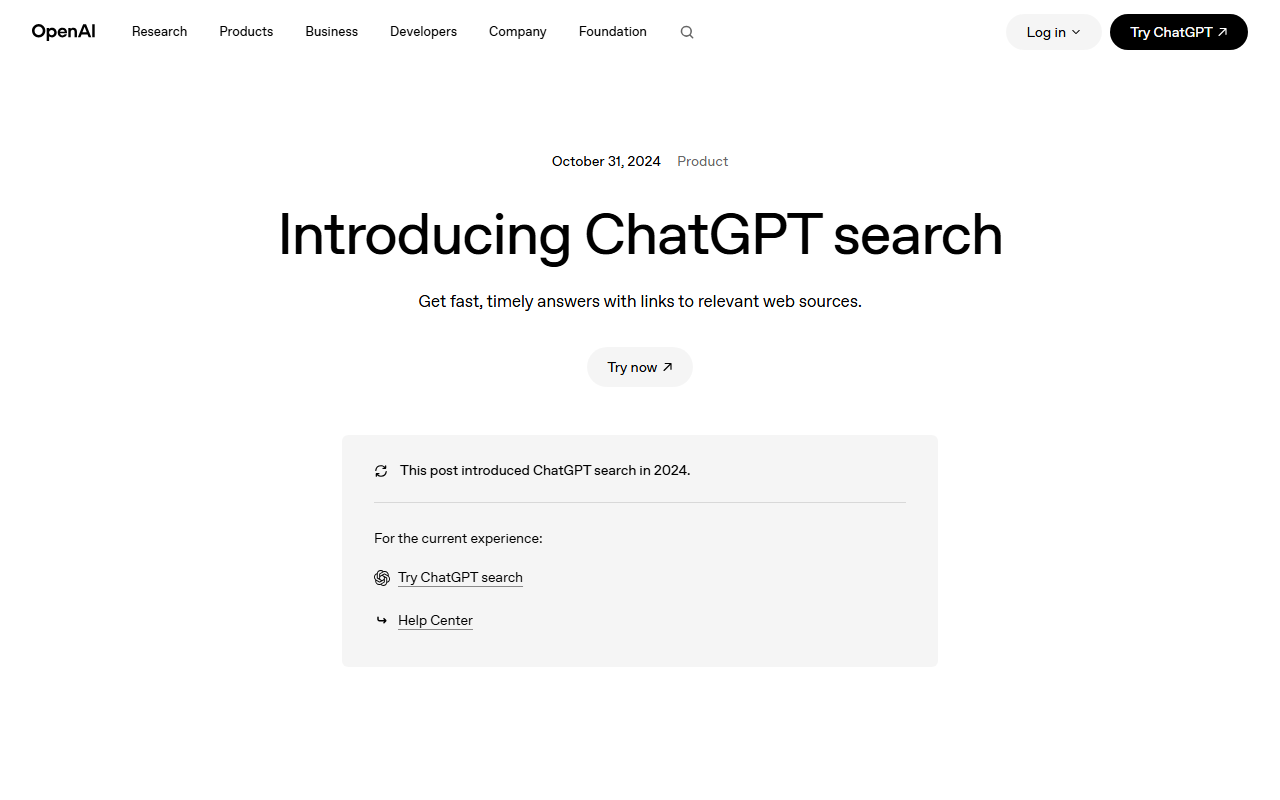
ChatGPT search is the web-browsing layer inside ChatGPT. OpenAI launched it in October 2024 and later made it available to logged-out and free users. When a question needs current information, ChatGPT runs a search, reads a handful of pages and writes an answer with source links. When it decides it does not need to search, it answers from its training data, and that is where stale prices and discontinued plans come from.
Google AI vs ChatGPT on a buyer’s research tasks
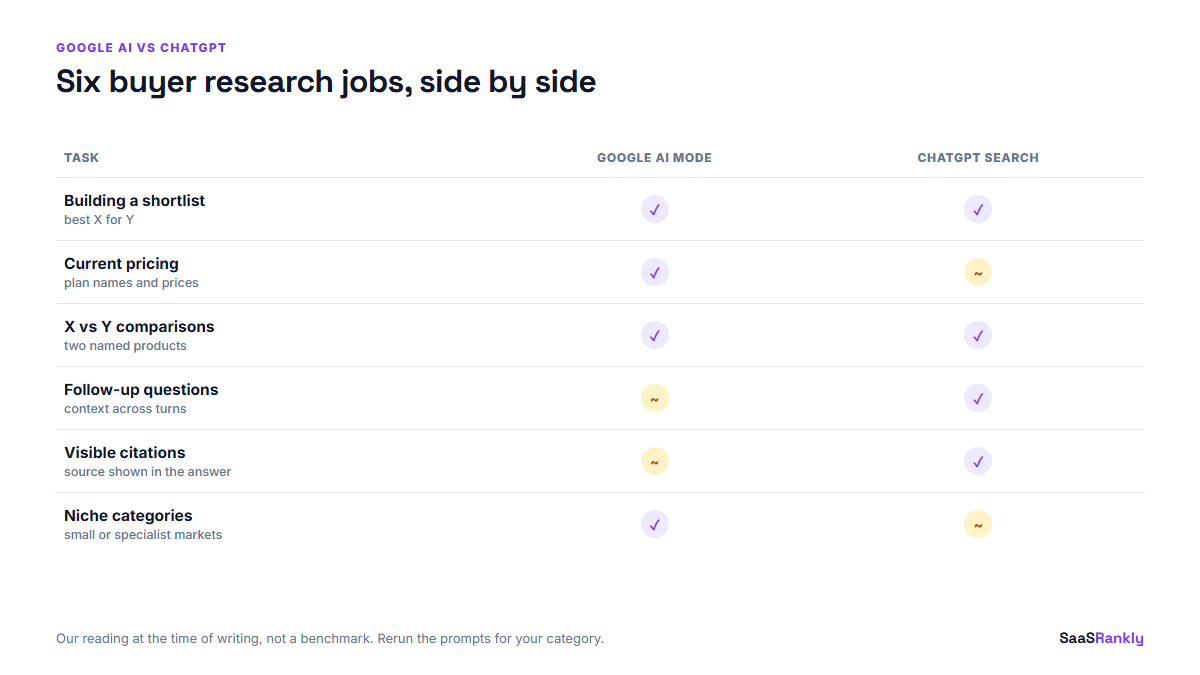
We think the fairest way to judge Google AI vs ChatGPT is by task, not by feature list. The grid below is our summary of how each handles six jobs in a typical B2B software search. It reflects our reading of how the products work at the time of writing, not a lab benchmark, and you should rerun the prompts for your own category.
1. Building a shortlist
Both do this well. Google AI Mode tends to name the tools that already hold page one for the category term, because it grounds on the same index. ChatGPT often adds one or two smaller names it found on a listicle or a Reddit thread. If you are a challenger brand without page one rankings, ChatGPT is the easier place to get into the shortlist.
2. Checking current pricing
This is where the gap is widest. Google pulls prices from pages it recrawled recently, so a pricing change shows up fast. ChatGPT gets it right when it searches and gets it wrong when it answers from memory. The fix on your side is boring: keep one clear pricing page, put plan names and numbers in plain HTML text rather than inside images or toggles, and update the “last updated” line when prices change.
3. Comparing two named products
For “X vs Y” questions, both lean heavily on comparison pages. Google favours whichever comparison page ranks, which is often a vendor’s own. ChatGPT tends to mix vendor pages with review sites. Owning a fair, specific comparison page is the single most useful asset for both, which is why we keep pushing SaaS comparison pages up the priority list.
4. Follow-up questions
ChatGPT wins. A buyer can ask “which of these has an API”, then “which integrates with HubSpot”, then “rank them for a team on a $500 budget”, and the context holds. AI Mode handles follow-ups too, but most people still meet Google’s AI through AI Overviews, which reset with every new search.
5. Showing the source
Google shows link cards and lists, and a real share of users never click them. ChatGPT shows source chips inside the text, which reads more like a citation and invites a click when the question is specific. Neither sends the kind of click volume that a first place blue link used to.
6. Local and niche categories
Google is stronger when the category is small or specialist, because its index is deeper. ChatGPT sometimes fills a thin category with generic advice or with tools that only half fit. If you sell into a narrow vertical, Google AI is likely where your buyers get the better answer.
A worked example with a fictional help desk tool
To make this concrete, here is an illustrative example. “Tessaly” is a made-up help desk product with decent rankings for its brand and two comparison pages, but almost no mentions on third-party lists. The numbers are invented to show the pattern we would look for, not results from a real account.
| Prompt (illustrative) | Named in Google AI Mode? | Named in ChatGPT? | Likely reason |
|---|---|---|---|
| best help desk for small teams | No | No | No page one ranking, no listicle mentions |
| Tessaly vs Zendesk | Yes, cites Tessaly page | Yes, cites a review site | Owns the comparison page |
| help desk with shared inbox under $20 | Yes | No | Pricing page ranks, not on lists ChatGPT reads |
| Tessaly pricing | Yes, current price | Yes, old price | ChatGPT answered from memory |
| alternatives to Freshdesk | No | No | No alternatives page at all |
Read across the rows and the Google AI vs ChatGPT gap becomes a to-do list: an alternatives page, a push to get onto three or four “best help desk” lists, and a pricing page that ChatGPT can read and date. That pattern, strong on owned pages and weak on third-party mentions, is the one we see most on young SaaS sites.
What Google AI vs ChatGPT means for your SaaS visibility
In Google AI vs ChatGPT terms, the two systems reward overlapping but different work. Here is how we would split the effort.
Work that helps both
- Pages that answer one question clearly in the first two sentences, so either system can lift the answer.
- Comparison and alternatives pages that are fair enough to be quoted.
- Pricing, integrations and limits written as plain text, not hidden in tabs or images.
- Consistent product naming across your site, G2, Capterra and LinkedIn.
Work that mostly helps Google AI
- Classic rankings. AI Mode leans on pages that already rank, so the old SEO work still matters most.
- Clean indexing. A page that is “Discovered, currently not indexed” cannot be cited. Our guide on AI Overviews visibility for SaaS covers this side in more depth.
Work that mostly helps ChatGPT
- Let OAI-SearchBot crawl you. Plenty of sites block it by accident with a blanket AI-bot rule.
- Get named on the lists, reviews and threads ChatGPT tends to read. Our notes on how to get cited by ChatGPT go through the sources that come up most.
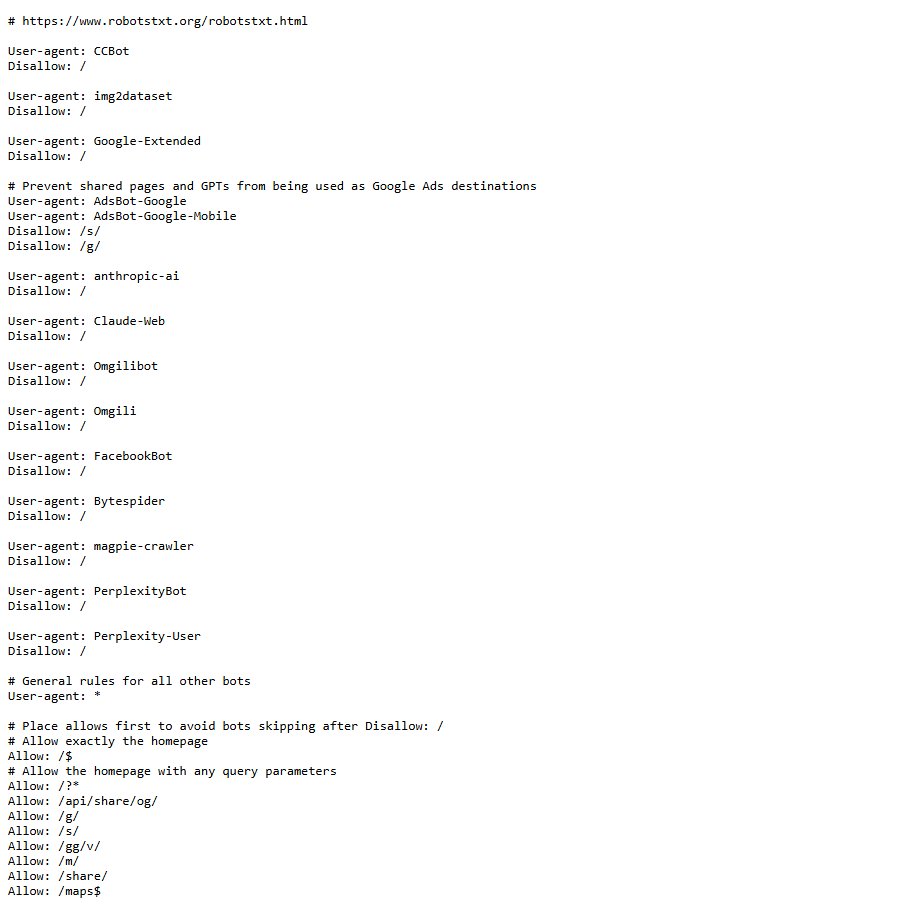
That robots.txt is a good reminder that crawler rules are a business decision, not a default. Check yours line by line. If you are unsure what a rule blocks, our post on blocked by robots.txt explains how to read it.
Google AI vs ChatGPT: myths worth dropping
Myth: ChatGPT uses Google results. Fact: OpenAI runs its own crawler and works with third-party search partners. Ranking on Google does not guarantee a ChatGPT mention, and the reverse is also true.
Myth: blocking Google-Extended keeps you out of AI Overviews. Fact: Google says Google-Extended controls use for Gemini models, not inclusion in Search. AI Overviews and AI Mode are part of Search, so the normal Googlebot rules apply.
Myth: AI answers killed the click. Fact: they cut clicks on simple questions hard. On buying questions people still click through to pricing and comparison pages before they sign up, which is why those pages deserve the effort.
Myth: you can track this with a normal rank tracker. Fact: you need a prompt tracker. Our roundup of AI search visibility tools compares the ones that check both Google AI and ChatGPT.
Which one should you optimise for first?
Use this Google AI vs ChatGPT decision matrix as a starting point rather than a rule.
| Your situation | Start with | Why |
|---|---|---|
| You already rank on page one for category terms | ChatGPT | Google AI is probably citing you already, ChatGPT is the gap |
| New domain, few rankings | Indexing and rankings feed AI Mode, and they compound | |
| Crowded category with big listicles | ChatGPT | Getting onto three good lists moves ChatGPT answers fastest |
| Narrow vertical, few competitors | Deeper index, fewer third-party lists to chase |
Quick recap: Google AI vs ChatGPT
- Google AI vs ChatGPT is really AI Mode and AI Overviews against ChatGPT search for buyer research.
- Google grounds on its own index, so ranking still drives most AI Mode mentions.
- ChatGPT mixes its own crawl with partner search and rewards third-party mentions.
- ChatGPT is stronger for long follow-up chains, Google is stronger on freshness and niche depth.
- Comparison, alternatives and plain-text pricing pages help on both.
- Check that OAI-SearchBot and Googlebot can both reach the pages you want cited.
FAQ
Is Google AI better than ChatGPT for research?
For fresh facts and niche categories, Google AI is usually more reliable because it grounds on a large, recently crawled index. For multi-step research with lots of follow-up questions, ChatGPT is easier to work with.
Does ChatGPT search use Bing?
OpenAI says it uses third-party search providers alongside its own crawler, and Bing has been one of them. It is not a copy of Bing results, so rankings there do not map one to one.
How do I get my SaaS mentioned in Google AI Mode?
Rank for the underlying query, answer it clearly near the top of the page and make sure the page is indexed. AI Mode draws on the same index as normal results.
How do I get my SaaS mentioned in ChatGPT?
Allow OAI-SearchBot, keep pricing and features readable as text, and earn mentions on the third-party pages ChatGPT reads for your category, such as review sites and “best tools” lists.
Is Google AI vs ChatGPT a fair comparison if one is free?
For a buyer, yes, because both have free access to search features at the time of writing. Paid ChatGPT plans add higher limits and newer models, but the search behaviour is broadly the same.
Which sends more traffic to SaaS websites?
Google still sends far more, because Search volume is much larger. ChatGPT referrals are smaller but often arrive further along in the buying process, so they are worth tracking as their own channel in GA4.