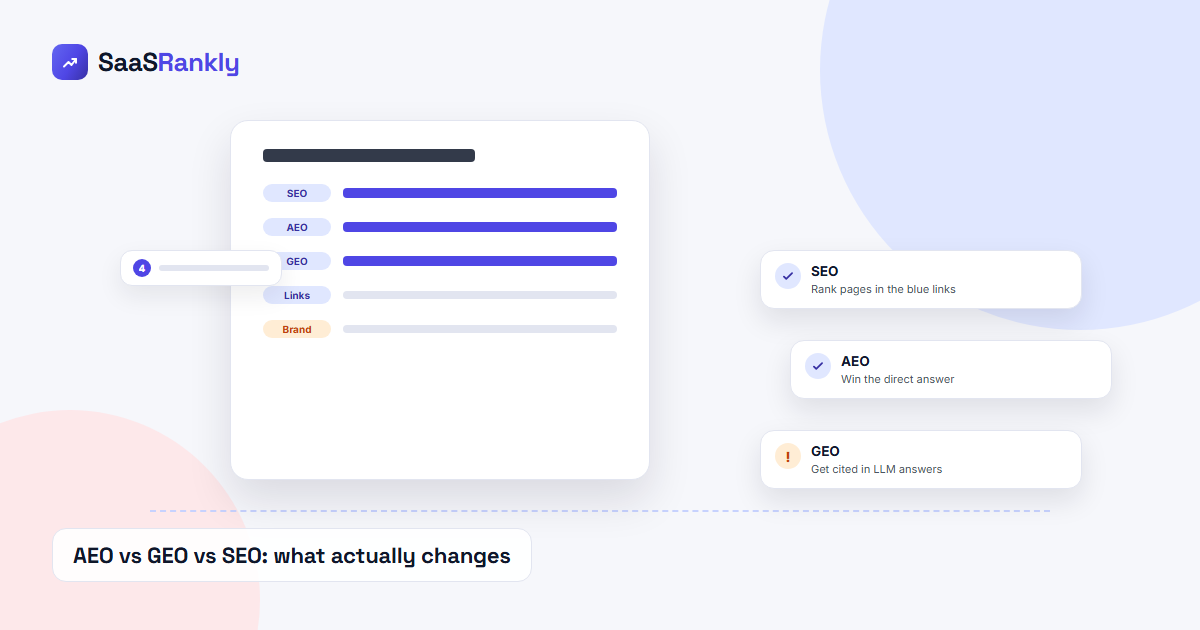
AEO vs GEO is the argument every SaaS marketing team seems to be having this year, usually right after someone sees a competitor cited in ChatGPT. Short version: SEO gets your page ranked in Google’s results, AEO (answer engine optimization) gets your content picked as the direct answer, and GEO (generative engine optimization) gets your brand cited inside AI-generated answers from tools like ChatGPT, Perplexity and Google AI Mode. They overlap far more than the new acronyms suggest.
The three terms in one line each
- SEO: rank a page in the organic results so people click it.
- AEO: format content so a search engine or assistant lifts it as the answer, such as featured snippets, People Also Ask and voice results.
- GEO: make your brand and pages the sources large language models cite or mention when they write an answer.
SEO vs AEO vs GEO side by side
| SEO | AEO | GEO | |
|---|---|---|---|
| Where you show up | Blue links in Google and Bing | Featured snippets, PAA, voice answers | ChatGPT, Perplexity, Gemini, AI Overviews, AI Mode |
| What “winning” looks like | Position 1 to 3, a click | Your text quoted as the answer | Your brand named or linked in the generated answer |
| Main unit | A page | A passage (40 to 60 words) | An entity and its reputation across the web |
| Main levers | Relevance, links, technical health | Question headings, tight answers, lists and tables | Mentions on third-party sites, clear facts, crawlable pages |
| How you measure it | Search Console clicks and rankings | Snippet and PAA ownership in a rank tracker | Prompt tracking, citations, referral visits from AI tools |
| How mature the tooling is | Very mature | Mature | Early, and the numbers vary a lot between tools |
Our honest take: most AEO vs GEO work is just SEO
Google says it plainly. Its documentation on AI features states there are “no additional requirements to appear in AI Overviews or AI Mode”. You can read it on the page below.
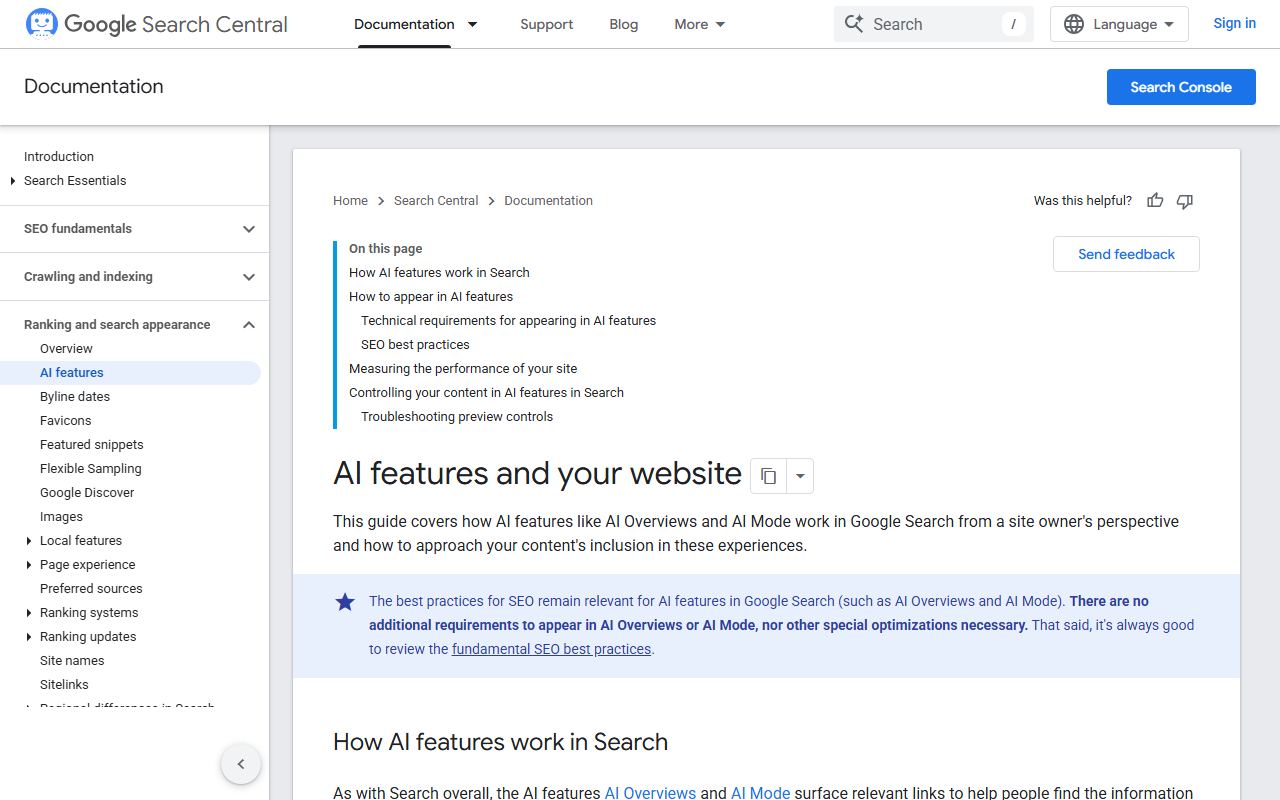
That is from Google’s AI features and your website guide. For Google’s own AI surfaces, the page has to be indexed and eligible for a snippet. That is SEO. ChatGPT and Perplexity use their own retrieval, often through Bing or their own crawlers, but they reward the same basics: a crawlable page that answers the question clearly and a brand other sites talk about.
So when an agency sells a separate “GEO retainer” that does not touch your SEO, be skeptical. In our experience about 80 percent of the work is shared. The other 20 percent is where AEO vs GEO genuinely differ, and that is worth knowing.
Where AEO vs GEO actually differ
AEO is about the passage
Answer engines lift a block of text. The page can be long, but the answer has to be short and self-contained. What works for us:
- A question as the H2 or H3, phrased the way people search it.
- A 40 to 60 word answer directly below, with no warm-up sentence.
- Steps as a numbered list, comparisons as a table.
- FAQ schema where it is honest. You can test it with our schema validator.
We covered which answer formats Google shows for SaaS queries in SERP features for SaaS.
GEO is about the entity
Language models answer “what is the best X for Y” by pulling from many sources at once. Your own page is one input. Review sites, Reddit threads, comparison articles and documentation are the rest. What moves GEO:
- Being listed on the third-party “best tools” pages the model reads. This is the single biggest lever we see.
- Consistent facts everywhere: same pricing, same category, same one-line description on your site, G2, LinkedIn and Crunchbase.
- Pages that state specific, quotable facts: numbers, limits, integrations, prices.
- Not blocking AI crawlers in robots.txt by accident. Check for GPTBot, OAI-SearchBot and PerplexityBot rules.
Our guide on how to get cited by ChatGPT goes deeper on the entity side.
Worked example: one comparison page, three kinds of optimization
Take a fictional SaaS, “Formzy”, with a page targeting “Formzy vs Typeform”. Here is what we would change for each discipline, and what each change is meant to do.
| Change | SEO | AEO | GEO |
|---|---|---|---|
| Title and H1 include “Formzy vs Typeform” | Yes | Helps | Neutral |
| A 50-word verdict right under the H1 | Helps | Yes | Yes |
| Feature table with prices at the time of writing | Helps | Yes | Yes |
| FAQ section with 6 real sales questions | Helps | Yes | Helps |
| Internal links from 5 related pages | Yes | Neutral | Neutral |
| Getting Formzy added to 3 “Typeform alternatives” listicles on other sites | Helps | Neutral | Yes |
| Matching pricing and positioning on G2 and Capterra | Neutral | Neutral | Yes |
Five of the seven changes help SEO. Only the last two are pure GEO work, and both happen off your site. That is the pattern: AEO lives inside the page, GEO lives mostly outside it.
AEO vs GEO: where to spend your first 10 hours
| Your situation | Spend first on | Why |
|---|---|---|
| Under 50 indexed pages, little traffic | SEO basics | Nothing gets cited if nothing gets crawled and ranked. |
| Ranking on page 1 but losing clicks to AI Overviews | AEO formatting on your top 10 pages | You already have the rankings. Win the answer block. |
| Competitors named in ChatGPT, you are not | GEO: listicle outreach and review profiles | The model is reading other sites, not yours. |
| Enterprise product with long sales cycles | GEO plus tracking | Buyers shortlist in AI tools long before they visit. |
Whichever row you are in, track it. Our LLM rank tracking setup shows a simple prompt list you can check monthly, and the AI search visibility tools roundup compares the paid options.
Quick recap: aeo vs geo
- SEO ranks pages, AEO wins the direct answer, GEO earns citations inside AI-generated answers.
- In the AEO vs GEO debate, roughly 80 percent of the work is shared with ordinary SEO.
- Google says no special work is needed to appear in AI Overviews or AI Mode beyond being indexed and snippet-eligible.
- AEO is passage-level: question headings, 40 to 60 word answers, lists, tables.
- GEO is entity-level: third-party listicles, reviews and consistent facts across the web.
- Fix SEO basics first, then add AEO formatting, then GEO outreach.
FAQ
What is the difference between AEO vs GEO?
AEO optimizes a passage so a search engine or assistant uses it as the direct answer. GEO optimizes your brand’s presence across the web so AI models cite or mention you when they generate an answer.
Is GEO replacing SEO?
No. AI answers still depend on search indexes and crawlable pages, and Google’s AI features use the same eligibility rules as normal results. GEO is an extra layer on top of SEO, not a replacement.
Do I need separate tools for AEO vs GEO?
For AEO, a normal rank tracker that shows featured snippets and PAA is enough. For GEO you need a prompt tracker that checks AI answers for brand mentions, because Search Console does not report them separately.
Is AEO the same as optimizing for AI Overviews?
Mostly. AI Overviews pull passages much like featured snippets did, so clear question headings and short answers help both. The difference is that AI Overviews blend several sources into one answer.
Which matters more for SaaS, AEO or GEO?
For most SaaS products, GEO, because buyers ask AI tools for tool recommendations and comparisons. But GEO only works if your SEO basics are already in place.
How do you measure GEO results?
Track a fixed list of buyer prompts monthly and count how often your brand is cited, then watch referral visits from chatgpt.com and perplexity.ai in GA4. Expect noisy numbers and look at trends over several months.