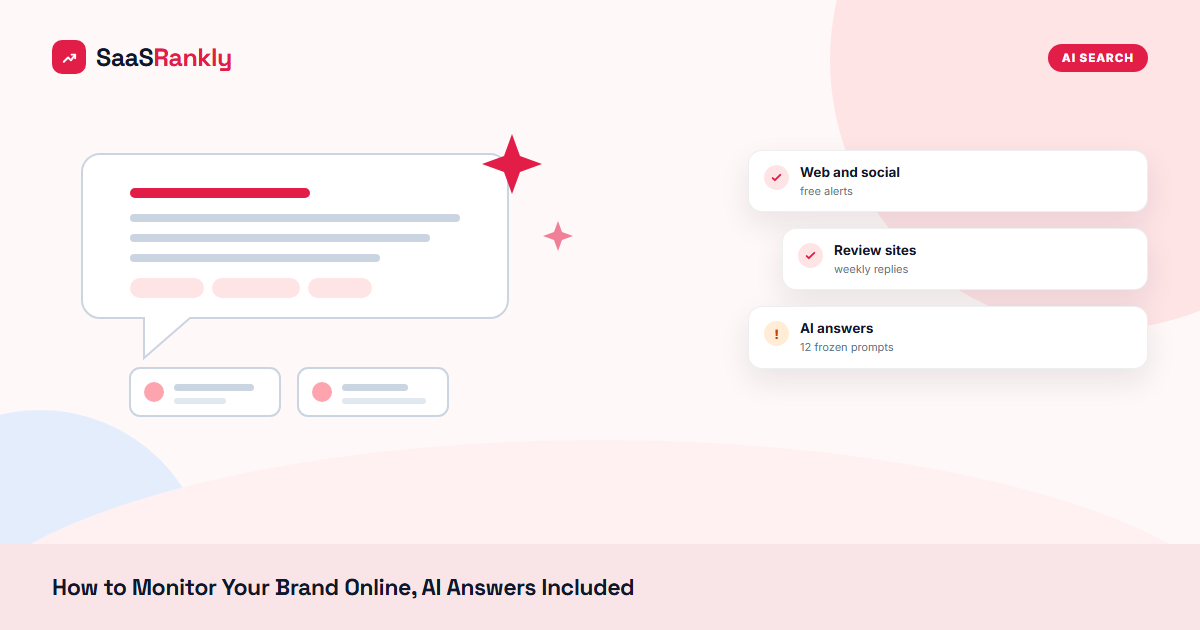
Two years ago, if you wanted to monitor your brand online, you set up a few alerts, watched social mentions, and checked review sites once a month. That still matters. But a growing share of buyers now meet your brand inside an answer: a ChatGPT reply, a Perplexity summary, an AI Overview on a branded query. Nobody sends you a notification when an AI model describes your pricing wrong. This guide covers both halves, the classic mention tracking and the newer AI answer checks, with what each costs at the time of writing and the weekly routine we actually run for SaaS clients.
What it means to monitor your brand online in 2026
We split it into four surfaces. Each one needs a different method, and most teams only cover the first.
- Mentions on the open web: news, blogs, forums, Reddit, Hacker News, podcasts with transcripts.
- Social platforms: X, LinkedIn, YouTube comments, TikTok if your buyers are there.
- Review and directory sites: G2, Capterra, Trustpilot, Product Hunt, app marketplaces.
- AI answers: what ChatGPT, Gemini, Perplexity, Claude, and Google AI Overviews say when someone asks about you or your category.
The fourth surface is the one that changed the job. A Reddit thread from 2023 complaining about a bug you fixed long ago can end up as the main source for how an assistant describes your product today. We wrote about how that sourcing works in our LLM visibility guide. The short version: if you do not look, you will not know.
Myths and facts about brand monitoring
| Myth | Fact |
|---|---|
| Google Alerts catches most mentions | In our tests it catches a minority. It misses most forum and social posts and is slow on smaller blogs. |
| You need a paid tool from day one | Under roughly 50 mentions a month, free alerts plus a weekly manual check is enough. |
| AI answers are random, so tracking them is pointless | Wording varies, but the facts and sources repeat. Tracking the same prompts weekly shows clear patterns. |
| Unlinked mentions are worthless | They are some of the easiest link requests you will ever send, and models read them either way. |
| Sentiment scores tell you how people feel | Automated sentiment misreads sarcasm and technical complaints often. Read the negatives yourself. |
Tools to monitor your brand online, by budget
Here is where we land on tools at the time of writing. Prices change often, so check the vendor page before you buy.
- Google Alerts: free. Fine as a backstop. Use quotes around the brand name and add a minus term for any common-word clash.
- Talkwalker Alerts: free. Emails similar to Google Alerts, and in our experience it picks up some sources Google misses.
- Native platform search: free. Reddit search, X advanced search, and LinkedIn content search sorted by recent. Saved searches take ten minutes to set up.
- Brand24: paid. The pricing page currently lists Individual at $199 a month (billed annually) for 3 keywords and 2,000 mentions, up to Enterprise from $1,499 a month, which is also the only plan listing an AI Visibility module.
- Dedicated AI visibility trackers: paid. These run fixed prompts across assistants and log whether you are mentioned and cited. We compared several in our AI visibility software review.
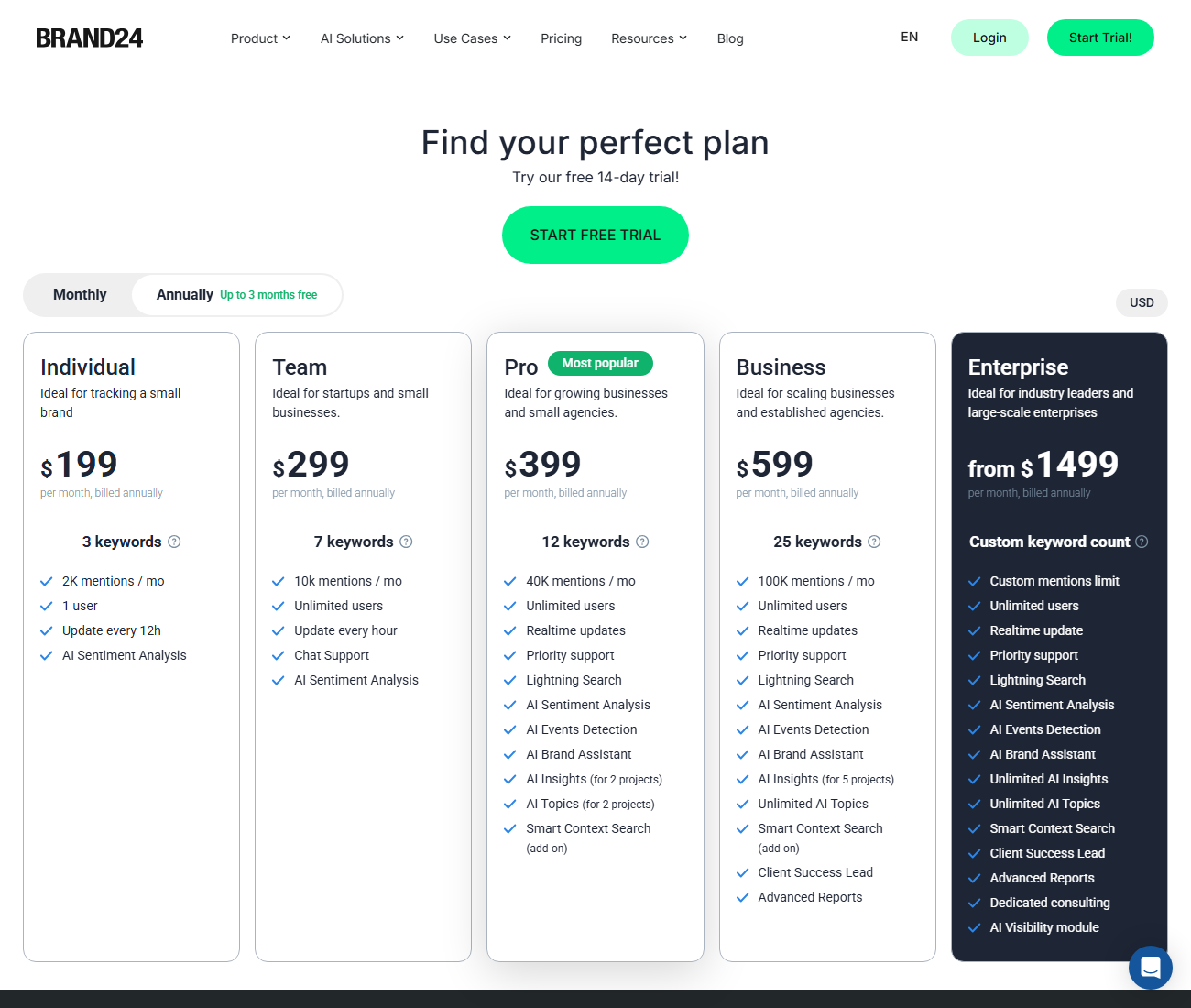
Look at what the entry plan actually buys: 3 keywords. Your brand name, your product name, and your founder’s name use all three. That is fine for a single-product SaaS, but if you also want to track two competitors, you are on the $299 or $399 tier straight away. We see a lot of teams buy the bottom plan and then quietly stop using it because it cannot answer the questions they bought it for.
Decision matrix: which setup fits your stage
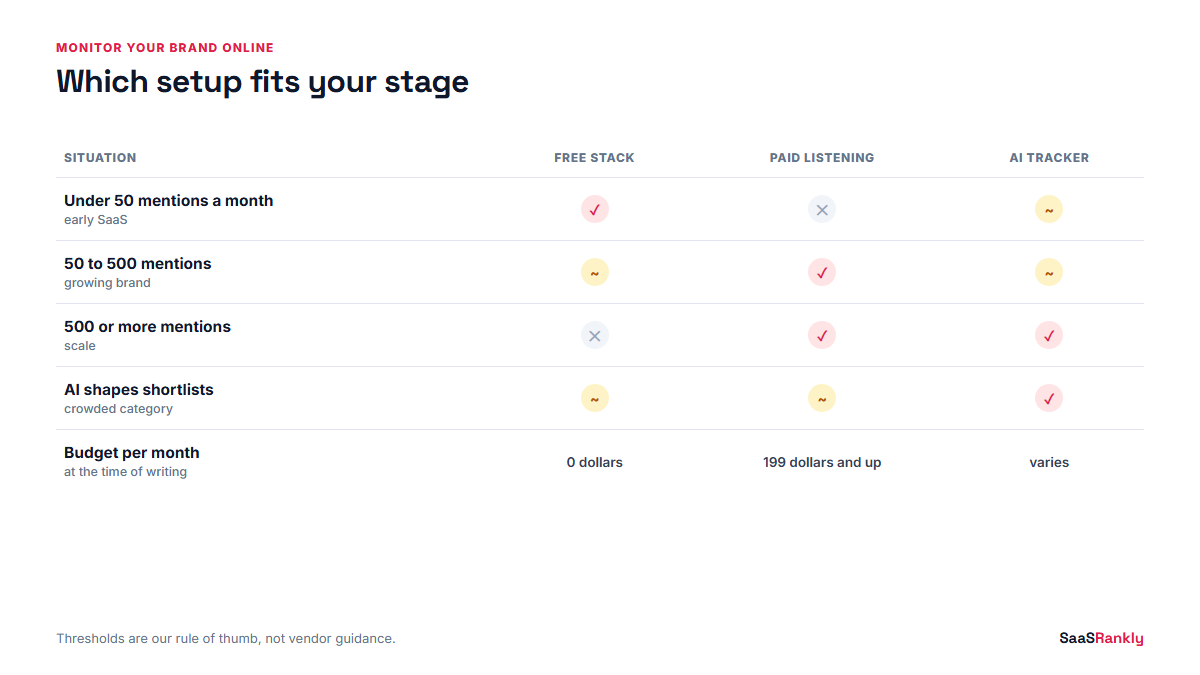
Our rule of thumb is simple. Under 50 mentions a month, a free stack plus 30 minutes of manual checks each week beats any paid tool, because you will read every mention anyway. Between 50 and 500, a paid listening tool pays for itself in saved time. Above that, or if you sell into a category where AI assistants already shape shortlists, add a dedicated AI answer tracker.
How to monitor your brand online in AI answers
This is the part most guides skip, so we will be specific. You do not need a tool to start. You need a fixed list of prompts and a spreadsheet.
Step 1: write 12 prompts and freeze them
Split them into three groups of four. Brand prompts (“what is [brand]”, “is [brand] worth it”, “[brand] pricing”). Comparison prompts (“[brand] vs [competitor]”, “alternatives to [competitor]”). Category prompts (“best [category] tool for small teams”). Freeze the wording. If you change prompts every week, you cannot compare weeks.
Step 2: run them in the same assistants each week
We use ChatGPT, Gemini, Perplexity, and Google itself for the branded queries, since AI Overviews now show on more of those (we tracked that shift in our AI Overviews on branded queries post). Use a logged-out or clean session where you can, so personal history does not skew the answer.
Step 3: log four things per answer
Were you mentioned? Were you cited with a link? Is any fact wrong (price, features, founding year)? Which sources were cited? The sources column is the gold. It tells you which pages the model trusts for your category, and those are the pages where a mention or correction moves the needle. Our guide on getting cited by ChatGPT covers what to do with that list.
Step 4: fix the source, not the answer
You cannot edit a model’s reply. You can update your own pricing page so it states prices in plain text, answer the old Reddit thread with a current fix, ask a review site to update a stale listing, or publish a clear comparison page. Then re-run the prompts in two to four weeks.
A worked example (illustrative)
A fictional 15-person project management SaaS ran the 12-prompt check for six weeks. The numbers below are invented for illustration, but the pattern matches what we see with real clients.
| Week | Prompts mentioning brand (of 48 runs) | Cited with link | Wrong facts found | Action taken |
|---|---|---|---|---|
| 1 | 14 | 3 | 4 (old price $9, missing Gantt view) | Pricing page rewritten in plain text |
| 2 | 15 | 3 | 4 | Replied to 2023 Reddit thread with current pricing |
| 3 | 15 | 4 | 3 | Asked a comparison blog to update its table |
| 4 | 18 | 6 | 2 | Published a vs-competitor page |
| 5 | 21 | 7 | 1 | None |
| 6 | 22 | 8 | 1 | Logged remaining error for next month |
The lesson is not the size of the jump. It is that the wrong price disappeared within three weeks of fixing the two sources the assistants kept citing. Nobody would have caught it without a weekly look.
The 30-minute weekly routine
This is the checklist we hand to a junior marketer. It is the cheapest way to monitor your brand online properly without buying anything.
- Read the Google Alerts and Talkwalker digests (5 minutes).
- Run saved searches on Reddit, X, and LinkedIn, sorted by new (5 minutes).
- Check G2, Capterra, and Trustpilot for new reviews and reply to each one (5 minutes).
- Run the 12 frozen AI prompts and fill the spreadsheet (10 minutes).
- Copy any unlinked mention on a decent site into a link request list (2 minutes).
- Write one line in a shared channel: best mention, worst mention, one action (3 minutes).
Unlinked mentions deserve a quick note. A polite email saying “thanks for the mention, would you link to the page you described?” converts far better than cold outreach, in our experience often around one in four. It also overlaps with backlink monitoring, so run both from the same sheet.
Quick recap: monitor your brand online
- To monitor your brand online today, cover four surfaces: open web, social, review sites, and AI answers.
- Free alerts plus native platform search are enough under about 50 mentions a month.
- Paid listening tools start around $199 a month at the time of writing, and entry plans cap keywords tightly.
- Track AI answers with 12 frozen prompts across the same assistants every week.
- Log the cited sources, then fix those sources rather than chasing the answer.
- Turn unlinked mentions into link requests during the same weekly routine.
FAQ
What is the cheapest way to monitor your brand online?
Google Alerts and Talkwalker Alerts for web mentions, saved searches on Reddit, X, and LinkedIn, and a weekly manual check of review sites. All free, about 30 minutes a week.
Is Google Alerts enough for brand monitoring?
Not on its own. It misses most social and forum conversation and is slow on smaller sites. Use it as one input, not the whole system.
How do I see what ChatGPT says about my brand?
Write a fixed set of brand, comparison, and category prompts, run them weekly in a clean session, and log whether you are mentioned, whether you are cited, and any wrong facts. Paid AI visibility trackers automate the same process.
How often should I check brand mentions?
Weekly for most SaaS companies. Daily only during a launch, an outage, or a PR moment, when a fast reply matters.
Can I correct wrong information in AI answers?
Not directly. You correct the sources the model relies on: your own pages, outdated reviews, old forum threads, and third-party comparison articles. Answers usually update within a few weeks after those sources change.
Should I track competitors too?
Yes, at least in the AI prompts. Comparison and category prompts show you which competitor gets recommended instead of you, and which sources make that happen.