AI SaaS is software sold as a subscription where a model does part of the work the customer used to do by hand: drafting, answering, sorting, summarising, deciding. That definition sounds obvious. The positioning problem it creates is not. Almost every SaaS product now says it has AI, so the phrase “AI SaaS” on its own tells a buyer nothing, and buyers have changed how they search because of it.
We work on search for a handful of AI SaaS companies and a larger number of older SaaS products that bolted AI on in the last two years. The pattern we see is the same on both sides. Positioning written for investors (“AI-native platform for the future of work”) ranks for nothing and gets recommended by nobody. Positioning written around the job and the buyer’s words does both. This post covers how buyers search for AI software now, a decision matrix for how to position, a worked example with keyword data, and the pricing page mistakes that quietly cost AI SaaS teams citations in ChatGPT and Google’s AI Mode.
How buyers actually search for AI SaaS
Very few buyers type “AI SaaS”. The people who do are founders, investors and students. Buyers type the job. Here are the query patterns we see most in Search Console for AI products across support, sales and content tools, grouped by what the person is trying to do.
| Query pattern | Example | Intent | Page that should rank |
|---|---|---|---|
| ai + job + tool | ai meeting notes tool | Shortlisting | Category or feature page |
| ai agent for + job | ai agent for customer support | Shortlisting, higher budget | Product page for the agent |
| category + with ai | crm with ai | Upgrading an existing tool | Feature page on your core product |
| brand + alternative | otter ai alternative | Switching | Alternatives or comparison page |
| brand + pricing | fin ai pricing | Late evaluation | Pricing page in plain HTML |
| can ai + task | can ai write my support replies | Early, sceptical | Blog post or explainer |
Two things jump out when we look at real data. First, the “ai agent for” pattern has grown fastest over 2025 and 2026, and it carries buyers with bigger budgets, because an agent replaces a person rather than helping one. Second, the sceptical queries (“can ai”, “is ai good at”, “ai vs human”) are larger than most teams expect. They do not convert directly, but they are exactly the questions people also ask ChatGPT, and the pages that answer them honestly get cited.
Running a raw export through our keyword intent classifier is a quick way to split these groups before you plan pages. It takes a pasted list and labels each term by funnel stage.
AI-native or AI feature: the AI SaaS positioning decision
Every AI SaaS team has to pick which story it tells. There are really only three options, and the right one depends on what your product replaces.
| If your product… | Position as | Lead keyword shape | Watch out for |
|---|---|---|---|
| Replaces a person or a whole workflow | AI agent / AI teammate | ai agent for [job] | Overclaiming. Buyers test agents hard and churn fast. |
| Does one job far faster than before | AI tool for [job] | ai [job] tool, ai [job] software | Crowded SERPs full of listicles; you need to be on them. |
| Is an existing product with AI added | [Category] with AI | [category] with ai, ai [category] | Relabelling everything “AI” and losing the category terms you already rank for. |
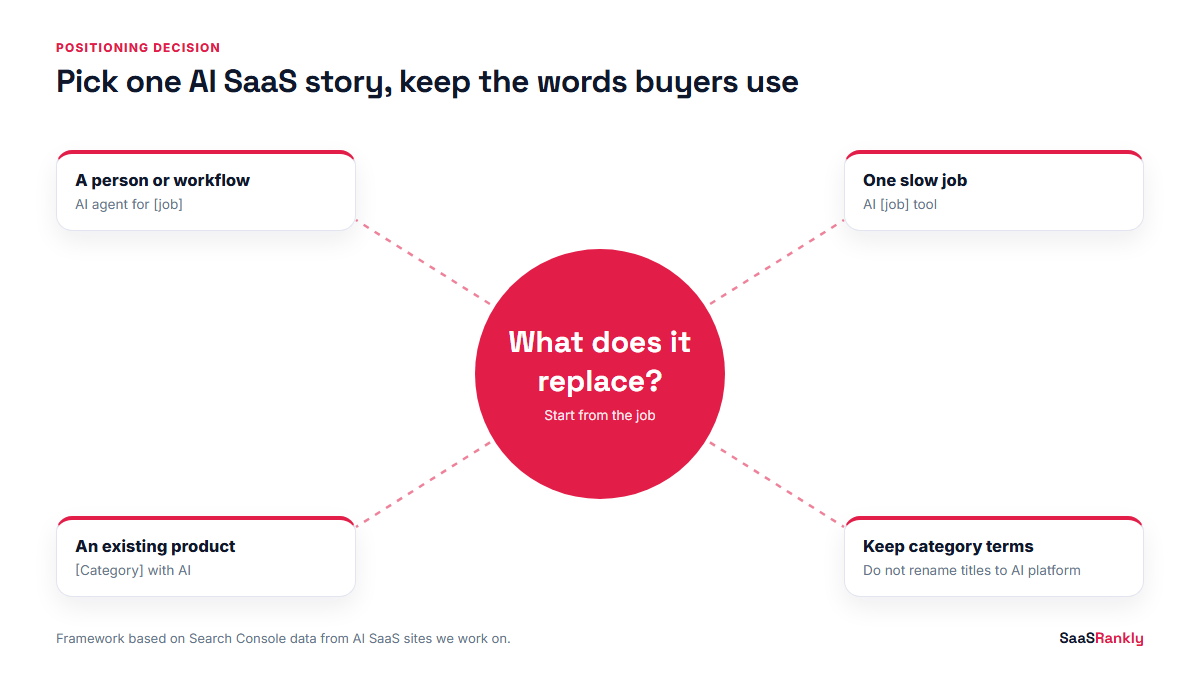
The third row is where we see the most self-inflicted damage. A project management tool renames its product pages to “AI Work Platform”, swaps “project management software” out of its title tags, and loses 30 to 40 percent of non-brand traffic within two months. The AI features were real. The rename threw away the words buyers still use. Keep the category term in the title and add AI as the modifier, not the other way round. You can check how the new title looks before shipping it with our SERP snippet preview.
Worked example: Notewell, a fictional AI meeting notes product
Notewell (fictional) records calls, writes summaries and pushes action items into a CRM. It costs 18 USD per seat a month. Its first homepage headline was “The AI-native layer for team intelligence”. Here is the keyword set we built for it instead. The volumes and difficulty scores are illustrative, but they are in the range we see for this category in US data.
| Keyword | Monthly volume (illustrative) | KD | Intent | Target page |
|---|---|---|---|---|
| ai meeting notes | 6,500 | 38 | Shortlisting | Homepage |
| ai note taker for zoom | 1,900 | 22 | Shortlisting | Zoom integration page |
| ai meeting summary for sales calls | 480 | 9 | Shortlisting, niche | Sales use case page |
| otter ai alternative | 1,300 | 17 | Switching | Alternatives page |
| is ai note taking accurate | 320 | 4 | Sceptical | Blog: accuracy test |
| ai notes hipaa compliant | 260 | 6 | Late evaluation | Security page |
Notice where the easy wins are. The head term is hard. The long ones, especially the use case, the compliance question and the accuracy test, are winnable in weeks and convert better. After four months on this plan, Notewell’s sales use case page ranked in the top five for its main term and drove about 40 percent of trials from organic, despite a fraction of the head term’s volume. That is a normal outcome in AI SaaS: the specific pages do the selling.
The accuracy post is the one teams resist. Publishing “our tool gets names wrong about 6 percent of the time, here is how we measured it” feels risky. In our experience it is the page that earns links and AI citations, because it is the only page in the SERP with a real number on it.
Pricing pages decide more AI SaaS citations than you think
When someone asks ChatGPT or Gemini “how much does [tool] cost” or “cheapest AI support agent”, the answer comes from whatever the engine can read. If your pricing sits behind a “Contact sales” button, inside a JavaScript calculator, or in an image, the engine either skips you or quotes an old number from a review site.
Pricing models in AI SaaS have also moved away from simple seats. At the time of writing, Intercom’s pricing page lists its Fin AI Agent at 0.99 USD per outcome, on top of helpdesk seats that start at 19 USD a month. That is an outcome-based model. Other tools charge per credit, per minute of audio or per task. Whatever your model, spell it out in text on the page.
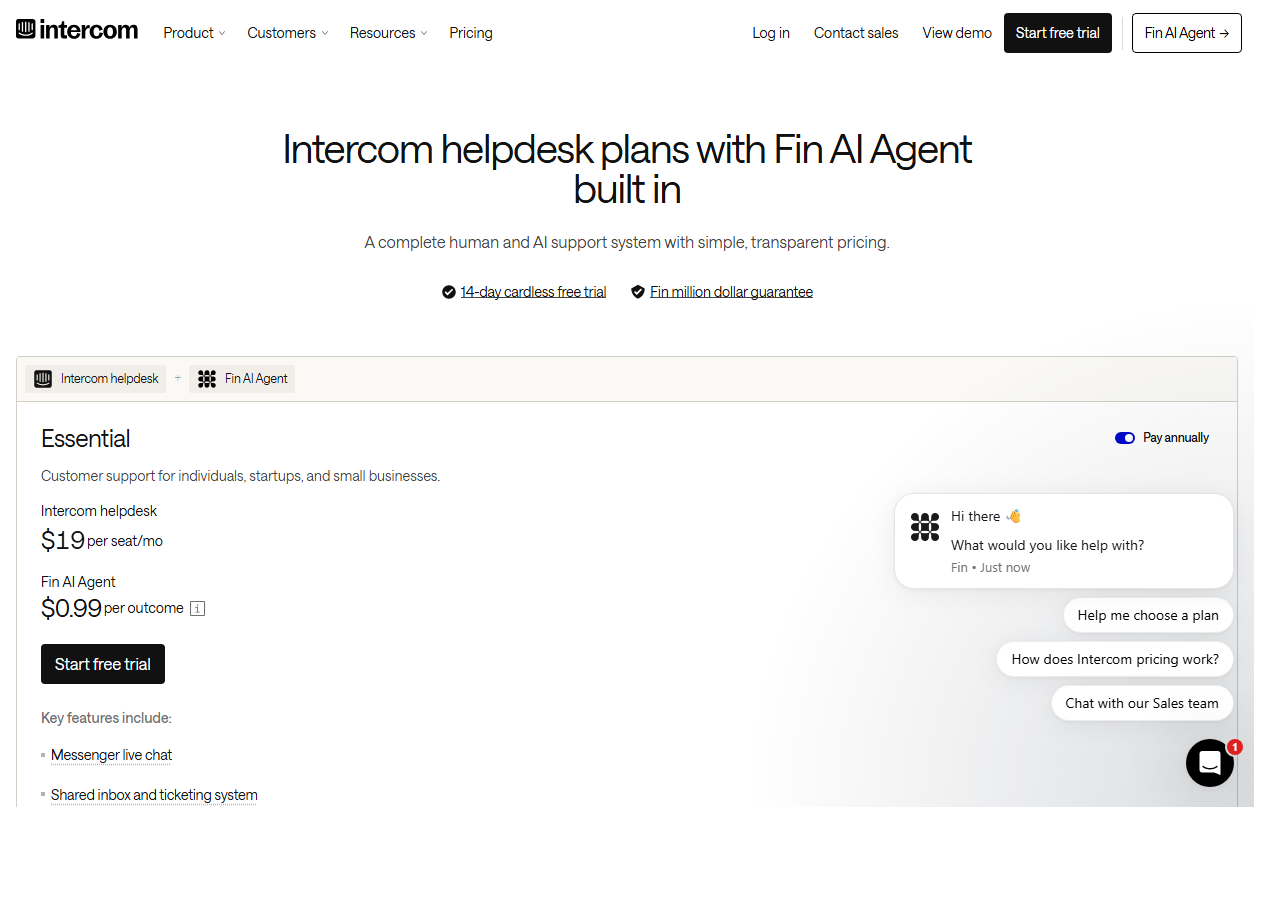
Our checklist for an AI SaaS pricing page that engines can use:
- Every plan name, price and billing period written as text, not only inside a toggle.
- Usage limits stated plainly: “500 AI credits a month”, “20 hours of transcription”.
- What counts as a unit. “A resolution is a conversation closed without a human” is exactly the sentence an assistant quotes.
- A short FAQ answering “is there a free plan” and “what happens when I go over”.
- Product and offer structured data that matches the visible prices. Run it through our schema validator after every price change.
- A “last updated” date, because stale prices on review sites are the most common wrong answer we see assistants give about AI tools.
Getting an AI SaaS product recommended by AI assistants
The irony of the category: buyers of AI software are the heaviest users of AI assistants for research. For AI SaaS, being named in ChatGPT, Perplexity, Gemini and AI Mode answers is not a side project. It is often the first shortlist a buyer builds.
What we see move those mentions, in order of effect:
- Listicle presence. Assistants lean on “best AI [job] tools” articles. If you are not in the top three or four ranking listicles for your category, you are rarely in the answer.
- Review profiles. A G2 or Capterra page with recent reviews that mention the specific use case.
- Clear comparison pages. Honest “us vs them” pages with tables get quoted, especially for “alternative” prompts.
- Crawler access. OAI-SearchBot, PerplexityBot and Googlebot must reach your pages. We still find AI companies whose own CDN blocks AI crawlers, which we cover in our post on GPTBot rules.
- Consistent naming. One product name, one category phrase, used the same way on your site, your review profiles and your LinkedIn page.
To see where you stand, run a fixed set of buyer prompts every month and count mentions, as we describe in LLM visibility. If you want to understand why different engines give different shortlists, our Grok vs Gemini comparison shows how much the answers vary for the same SaaS question.
Common AI SaaS SEO mistakes we keep fixing
A short list, because they come up on almost every audit:
- Thin programmatic “AI for X” pages. 300 pages like “AI for dentists”, “AI for lawyers”, each with the same three paragraphs. Google treats these as scaled content. Build ten real use case pages instead.
- Demo videos with no text. The product explanation lives in a two-minute video with no transcript. Neither Google nor an assistant can read it.
- Changelogs as the only fresh content. Release notes are useful, but they do not answer buyer questions.
- Chasing the “AI SaaS” head term. It is mostly founders, investors and people looking for startup ideas. Useful for a directory or an investor blog. Not for trials.
Quick recap: AI SaaS
- AI SaaS is subscription software where a model does work the customer used to do by hand; buyers search for the job, not the label.
- The fastest-growing buyer pattern is “ai agent for [job]”, and it carries bigger budgets.
- Pick one story: AI agent, AI tool for a job, or existing category with AI, and keep the category terms you already rank for.
- Long, specific pages (use cases, compliance, accuracy tests) usually beat the head term for trials.
- Write pricing, limits and units as plain text so assistants quote you correctly.
- Listicles, review profiles, comparison pages and crawler access drive AI assistant mentions.
FAQ
What is AI SaaS?
AI SaaS is software sold on a subscription where artificial intelligence does part of the work, such as writing, answering customer questions, summarising calls or classifying data. It can be a new AI-first product or an older SaaS tool with AI features added.
How is AI SaaS different from traditional SaaS?
Traditional SaaS gives people a tool to do the work. AI SaaS does some of the work itself. That changes pricing (often usage or outcome based), support (accuracy questions) and marketing (buyers want proof it works on their data).
What keywords should an AI SaaS company target?
Start with the job your product does: “ai [job] tool”, “ai agent for [job]”, “[category] with ai”, plus “alternative” and “pricing” terms for competitors. The generic phrase “AI SaaS” rarely brings buyers.
Should we rename our product pages to include AI?
Add AI as a modifier, but keep the category terms buyers already search for. Replacing “project management software” with “AI work platform” in titles often drops non-brand traffic sharply.
How do AI SaaS tools get recommended by ChatGPT?
Mostly through sources the assistant reads: ranking listicles, review sites, comparison pages and your own crawlable pages. Plain-text pricing, clear use case pages and access for OAI-SearchBot all help.
What pricing model is most common for AI SaaS?
Seat pricing with usage limits is still common, but credit, usage and outcome pricing are spreading, such as a fee per resolved support conversation. Whatever the model, define the unit clearly on the pricing page.