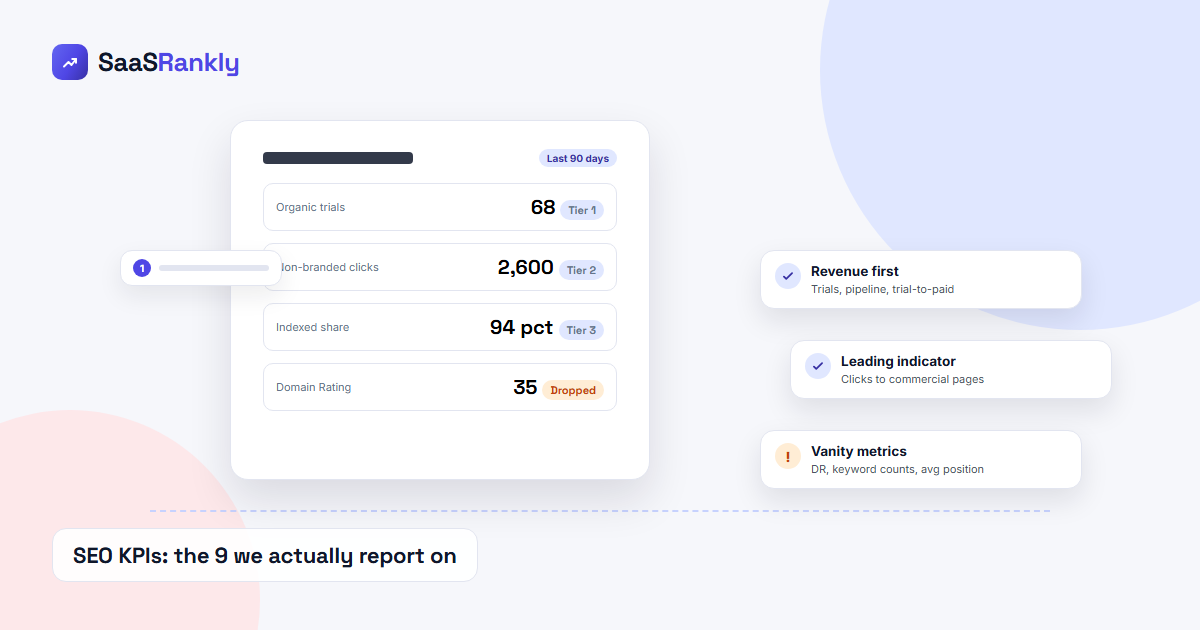
Most SEO KPIs we see in SaaS reports are not KPIs at all. They are metrics that happen to be easy to pull: impressions, total ranking keywords, Domain Rating. A founder reads them, nods, and still cannot say whether SEO paid for itself last quarter. This is the short list we actually use with SaaS clients, the numbers we stopped reporting, and a worked example of setting targets you can defend in a board meeting.
SEO KPIs vs SEO metrics: the split that fixes most reports
A metric is anything you can count. A KPI is a metric you have agreed to be judged on, with a target and an owner. Every KPI is a metric. Very few metrics deserve to be KPIs.
The test we use is simple. If the number went up 30 percent next month, would anyone outside the marketing team care? If the answer is no, it belongs in a diagnostic tab, not at the top of the report. If you are still deciding what the report itself should look like, start with what an SEO report is and the rows worth cutting.
| Number | Metric or KPI? | Why |
|---|---|---|
| Impressions in Search Console | Metric | Rises when you rank on page 3 for queries nobody clicks |
| Non-branded clicks to pricing, feature and comparison pages | KPI | Sits directly upstream of trials |
| Total keywords ranking | Metric | Most of them usually drive zero clicks |
| Organic-sourced trials or demo requests | KPI | The number finance already tracks |
| Domain Rating | Metric | A third-party score, not a Google signal |
| Organic pipeline in dollars | KPI | Lets you compare SEO and paid on the same line |
The 9 SEO KPIs we put in front of a SaaS founder
We group them in three tiers. The top tier is what the CEO sees. The other two explain why the top tier moved. If you only have time for three SEO KPIs, take the first three and skip the rest for now.
Tier 1: revenue (report monthly)
- Organic-sourced trials or demo requests. First-touch attribution or the self-reported “how did you hear about us” field, whichever your CRM trusts more. Pick one model and do not change it mid-year.
- Organic pipeline value. Trials or demos multiplied by average opportunity size. For self-serve products, use new MRR from organic signups once the trial closes.
- Organic trial-to-paid rate. If SEO signups convert at half the rate of paid signups, you are ranking for the wrong queries, not too few of them.
Tier 2: demand (report monthly, glance weekly)
- Non-branded clicks to commercial pages. Filter Search Console to exclude your brand name, then to pages under /pricing, /features, /vs/, /alternatives/ and /integrations/. This is the best single leading indicator of Tier 1.
- Top-3 share for money keywords. Take the 30 to 50 keywords with clear buying intent and count how many sit in positions 1 to 3. We track this in a rank tracker instead of average position, because averages hide the pages that matter.
- AI answer citations. How many of your tracked prompts cite your domain in ChatGPT, Perplexity or Google AI Overviews. It is new in most reports this year, and it already moves demo requests for some of our clients.
Tier 3: health (check monthly, report only when broken)
- Indexed share of important URLs. Of the sitemap URLs you care about, how many are indexed. Anything under 90 percent is a technical problem first, and our SaaS indexing fixes cover the usual causes.
- Pages with zero clicks in 90 days. A rising count means you publish faster than you rank. Prune, merge or improve.
- Days from publish to first 10 clicks. A rough but honest read on how much Google trusts the site. On new domains we see 40 to 70 days. On established ones, under 14.
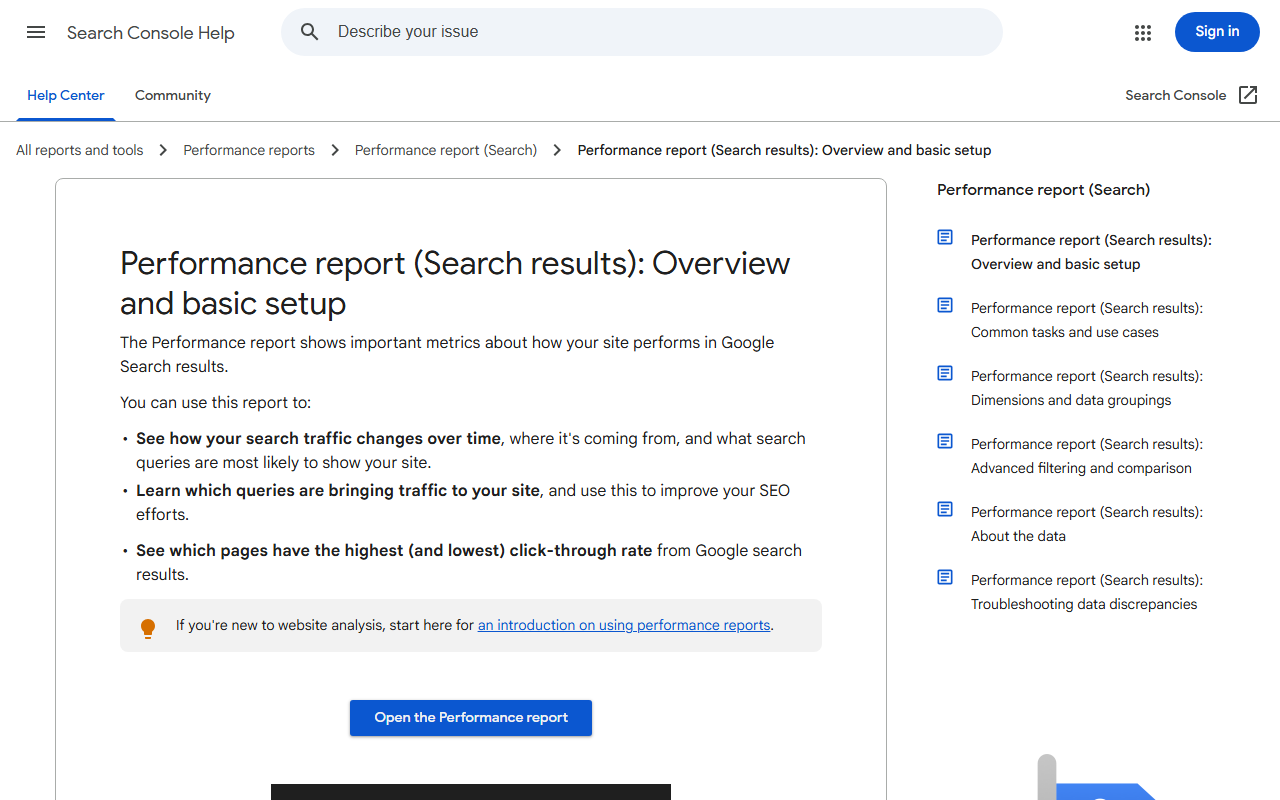
Most Tier 2 numbers come straight out of the Search Console Performance report, documented in the page above. Google’s Performance report overview explains how clicks, impressions, CTR and position are counted, which matters the first time a stakeholder asks why your numbers do not match GA4. Our GA4 and GSC measurement guide walks through the brand and page filters step by step. The query-level version of this report, with regex filters and the 1,000-row limit explained, is in our post on Google Search Console keywords.
Six numbers we stopped reporting
Myth: Domain Rating going up means SEO is working.
DR is Ahrefs’ own score for a link profile. We have watched a client’s DR climb from 22 to 35 while signups stayed flat, because the links came from pages nobody searches for. Keep it in the link report, not on the KPI slide.
Myth: More ranking keywords means more traffic.
One new post can add 400 ranking keywords overnight, most of them in positions 60 to 100. If you must count keywords, count the ones in the top 10. Clicks tell the same story more honestly.
Myth: Sitewide average position should improve every month.
It usually gets worse as you grow, because new pages enter around position 40 and drag the average down. A healthy site can show a worse average position and double its clicks in the same quarter.
Myth: Bounce rate shows content quality.
GA4 replaced it with engagement rate for a reason. A visitor who reads your answer and leaves satisfied still looked like a bounce.
Myth: Total organic sessions is the headline number.
One glossary post that takes off can double sessions and add zero trials. Split sessions by page type before anyone celebrates.
Myth: Backlink count is a KPI.
Ten links from relevant SaaS publications beat 300 directory links every time. Report referring domains that send traffic or rank themselves, and treat it as a diagnostic.
Worked example: setting targets for SEO KPIs at a scheduling SaaS
Here is a fictional but realistic case. “Rotaly” sells shift-scheduling software at $49 per month per location. Its organic trial-to-paid rate is 16 percent. The founder wants to know what SEO should deliver over the next six months.
We work backwards from revenue, not forwards from traffic.
| KPI | Baseline (March) | Target (September) | Where the target comes from |
|---|---|---|---|
| Non-branded clicks to commercial pages per month | 1,400 | 2,600 | 12 new comparison and integration pages at about 100 clicks each |
| Commercial page to trial rate | 2.4% | 2.6% | Pricing page test already running |
| Organic-sourced trials per month | 34 | 68 | 2,600 x 2.6% |
| Organic trial-to-paid | 16% | 16% | Held flat, not an SEO lever |
| New paying locations from organic per month | 5 | 11 | 68 x 16% |
| New organic MRR per month | $245 | $539 | 11 x $49 |
Two things stand out. First, the click target is built from a page plan, not a hope. If the team ships only six of the twelve pages, everyone knows why the number missed. Second, $539 of new MRR a month sounds small until you stack it. If Rotaly holds the target rate for six months, organic adds roughly $3,200 a month in recurring revenue, or about $38,000 in ARR. That is the figure to compare against the writer and the tools. Our SEO ROI guide for SaaS has the full payback math.
This is the mistake we see most often: teams set SEO KPIs as percentages (“grow organic traffic 50 percent”) with no link to trials. A percentage target on the wrong metric is how you end up with a great traffic chart and a flat revenue line.
How often to review each of the SEO KPIs
| Cadence | KPIs | Who looks |
|---|---|---|
| Weekly | Non-branded commercial clicks, indexed share | SEO lead |
| Monthly | Organic trials, pipeline, top-3 share, AI citations | Head of marketing and founder |
| Quarterly | Trial-to-paid, zero-click pages, publish-to-10-clicks | Leadership review |
Weekly checks are for catching breakage, not judging progress. SEO moves in 4 to 8 week steps, and a founder who stares at a weekly traffic chart will panic twice a month for no reason.
Where to pull SEO KPIs from without buying another tool
- Search Console: clicks, CTR and position by page and query. Free.
- GA4: key events (trial started, demo booked) by landing page and session source. Free.
- Your CRM: pipeline and closed revenue by first-touch source.
- A rank tracker for the 30 to 50 money keywords. We compared the options in best rank tracker tools.
- A prompt tracker for AI citations. See our list of AI search visibility tools.
Put all of it on one Looker Studio page. Our SaaS SEO reporting dashboard is the layout we hand to clients, with Tier 1 at the top and the diagnostics folded underneath.
Before you set a click target, agree on the definition. We explain what is a click in Search Console, GA4 and Google Ads.
Quick recap: seo kpis
- SEO KPIs are the few metrics you agree to be judged on, each with a target and an owner.
- Lead with revenue: organic trials, organic pipeline and trial-to-paid rate.
- Use non-branded clicks to commercial pages as the main leading indicator.
- Keep DR, keyword counts and sitewide average position in diagnostic tabs.
- Build every target backwards from a page plan and real conversion rates.
- Review SEO KPIs monthly, check health weekly, and change the attribution model once a year at most.
FAQ
What are the most important SEO KPIs for a SaaS company?
Organic-sourced trials or demos, organic pipeline value and non-branded clicks to commercial pages. Those three connect rankings to revenue. Everything else explains why they moved.
What is the difference between SEO KPIs and SEO metrics?
A metric is any number you can measure. SEO KPIs are the handful of metrics tied to a business goal, each with a target and an owner. Impressions are a metric. Organic trials are a KPI.
How many SEO KPIs should we track?
Three to five in the headline report. We use nine across three tiers, but only the top three reach the CEO. More than that and nobody reads the report.
Is Domain Rating a good SEO KPI?
No. It is a third-party estimate of link strength that Google does not use. Track it as a diagnostic for link building, never as a target.
How long before SEO KPIs show results?
Leading indicators like clicks to new pages move within 4 to 8 weeks on an established site. Revenue numbers lag by one sales cycle on top of that, so plan on 3 to 6 months.
Should AI search citations be an SEO KPI in 2026?
For most B2B SaaS, yes, as a Tier 2 demand number. Buyers now shortlist tools inside ChatGPT and AI Overviews, and a citation there often shows up later as a branded search or a direct visit.