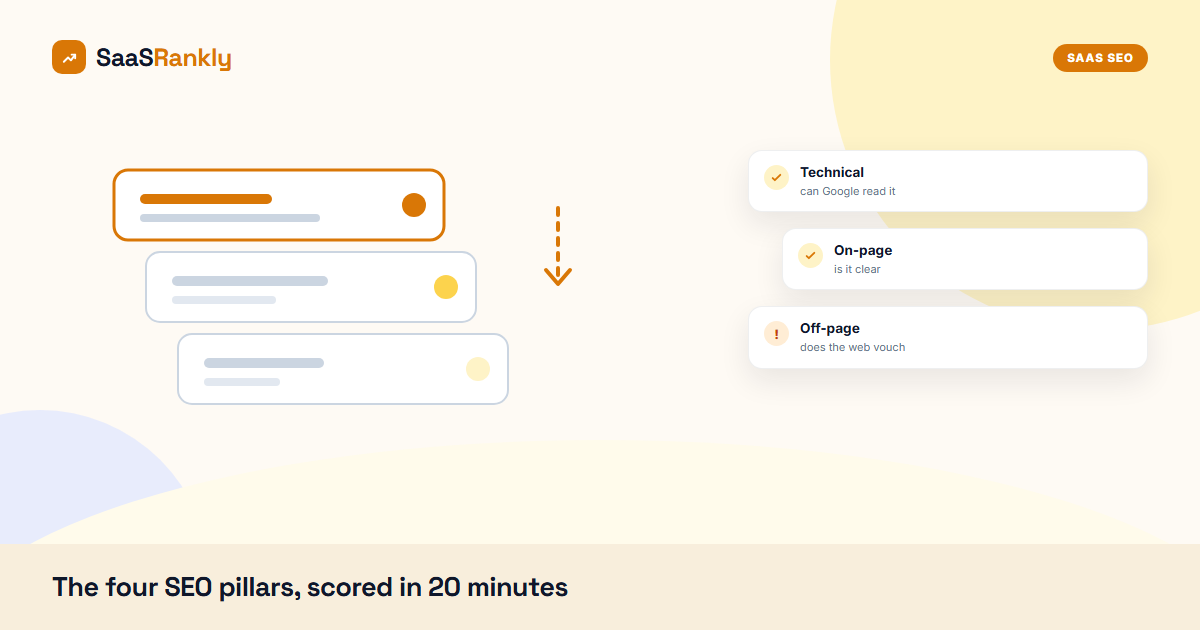
The SEO pillars are usually listed as four: technical SEO, on-page SEO, content and off-page authority. You will find that list in a hundred places. What you will not find often is how to use it. We treat the SEO pillars as a diagnostic, not a definition. Score each pillar, find the weakest one, and spend the next month there. A site is only as strong as its weakest pillar, and most SaaS teams keep investing in the one they already do well.
This post covers what each pillar includes, a 20-minute scoring sheet you can run on your own site, how we split budget across the four pillars at different stages, and an illustrative example. If you want the full build order of every SEO component, read our SEO components guide. This one is about balance.
The four SEO pillars in plain terms
1. Technical SEO: can Google reach and read the page?
Crawling, indexing, site speed, mobile rendering, canonical tags, sitemaps and structured data. If this pillar fails, nothing else counts, because pages that are not indexed cannot rank. Our technical SEO for SaaS checklist has the 12 checks we run first.
2. On-page SEO: does the page say clearly what it is about?
Title tags, headings, the first paragraph, internal links, image alt text and how well the page matches the search intent. This is the cheapest pillar to fix and the one most often half done. See our list of on-page SEO checks.
3. Content: is the page the best answer?
Depth, accuracy, original examples, freshness and whether a buyer would finish reading it. Content is where most SaaS budgets go, which is often the problem. More posts do not help if pillars one and two are broken.
4. Off-page authority: does the web vouch for you?
Backlinks, brand mentions, reviews, citations in AI answers and the general sense that real people know the company exists. It is the slowest pillar to build. Our post on off-page SEO for SaaS covers what counts beyond buying links.
Some frameworks add a fifth pillar for user experience or for local SEO. We fold UX into technical and on-page, and local only matters for a small share of SaaS companies. Four SEO pillars is enough to make decisions with.
Score your SEO pillars in 20 minutes
Give each question one point if the answer is yes. Each pillar has five questions, so each pillar scores 0 to 5. Be strict. “Mostly” is a no.
| Pillar | Question (1 point each) |
|---|---|
| Technical | Search Console shows more than 90 percent of your important URLs as indexed |
| No important page has a canonical pointing somewhere else by mistake | |
| Core Web Vitals pass on mobile for your main templates | |
| Your sitemap lists only live, indexable URLs | |
| Product and blog pages render their main text without needing JavaScript clicks | |
| On-page | Every money page has a unique title with its main keyword |
| Each page targets one search intent, not three | |
| Blog posts link to at least one product or pricing page where it makes sense | |
| No two pages target the same main keyword | |
| Headings describe the content rather than being clever | |
| Content | Your top 10 posts were updated in the last 12 months |
| Posts include something competitors cannot copy: data, screenshots, real examples | |
| You have pages for the comparison and alternative terms buyers search | |
| Writers work from a brief with the search intent written down | |
| Thin or outdated pages get merged or removed on a schedule | |
| Off-page | At least 20 different relevant sites link to you |
| Your brand name gets searched every month in Search Console | |
| You appear on review sites buyers in your category use | |
| Someone owns link earning as a task, not a side project | |
| AI assistants mention your brand for at least one category prompt |
How to read the result: any pillar at 2 or below is your bottleneck. If two pillars are low, fix technical or on-page first, because they are faster and they make the other two work better. A site with strong content and a technical score of 1 is wasting most of what it writes.
Which SEO pillar to fund at each stage
We do not split effort evenly across the SEO pillars. The right mix depends on how old the site is and what already works. This is the rough split we use for SaaS clients, as a share of SEO hours per month. It is our working model, not a rule.
| Stage | Technical | On-page | Content | Off-page | Why |
|---|---|---|---|---|---|
| New site, under 30 pages | 30 percent | 25 percent | 40 percent | 5 percent | Get the base right, then publish the first money pages |
| Growing, 30 to 200 pages | 15 percent | 20 percent | 45 percent | 20 percent | Content plus the first real links |
| Established, 200+ pages | 15 percent | 20 percent | 30 percent | 35 percent | Refreshes and authority beat new volume |
| After a traffic drop | 35 percent | 25 percent | 30 percent | 10 percent | Rule out technical causes before rewriting anything |
The pattern most teams get wrong is the last row. After a drop they rush to publish more content. In our experience a large share of SaaS traffic drops have a technical or on-page cause: a template change, a broken canonical, a redirect chain after a migration. Check those first.
An illustrative example: one pillar holding the others back
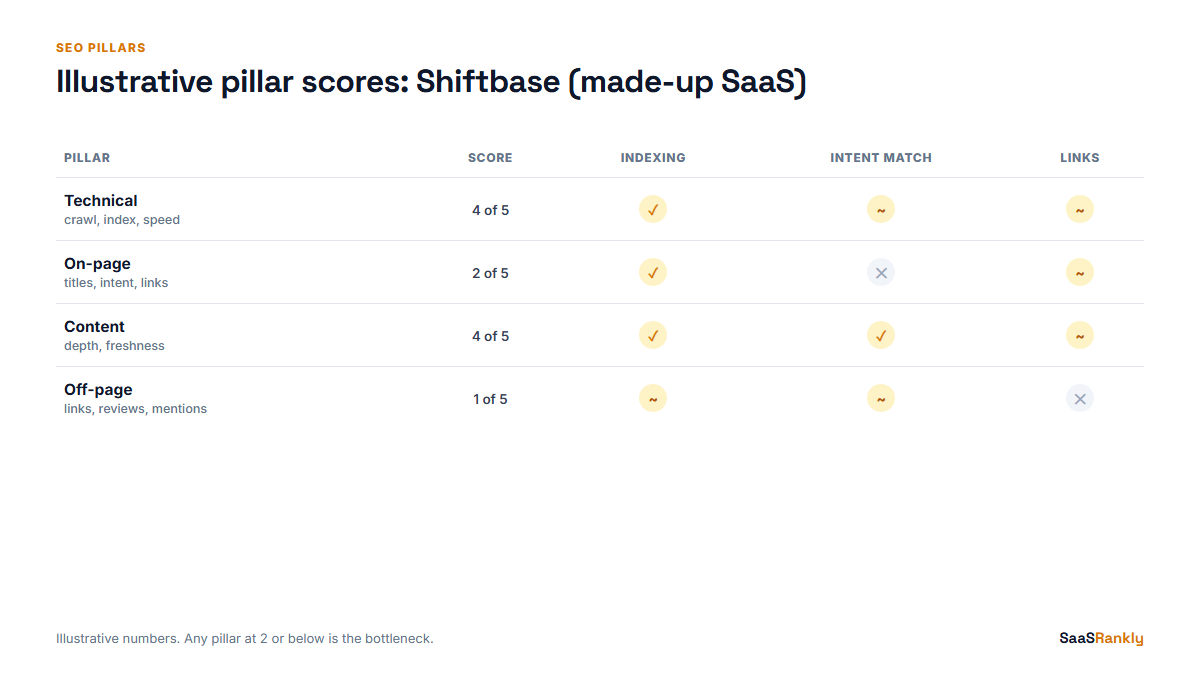
“Shiftbase”, a made-up scheduling SaaS, came to us with 140 blog posts and flat traffic for eight months. Their team was writing four posts a month. Here is the illustrative score.
| Pillar | Score (of 5) | Main finding |
|---|---|---|
| Technical | 4 | Healthy, one slow template |
| On-page | 2 | 31 posts competing for the same 9 keywords |
| Content | 4 | Well written, original screenshots |
| Off-page | 1 | 11 referring domains, no review site profiles |
The content pillar was fine. Writing more would not have helped. The plan we would suggest: one month merging the overlapping posts and fixing internal links (on-page), then shifting two of the four monthly writing slots to link earning and review site profiles (off-page). In a case like this we would expect the first movement within six to ten weeks, mostly on the merged pages, though every site is different.
How the SEO pillars connect
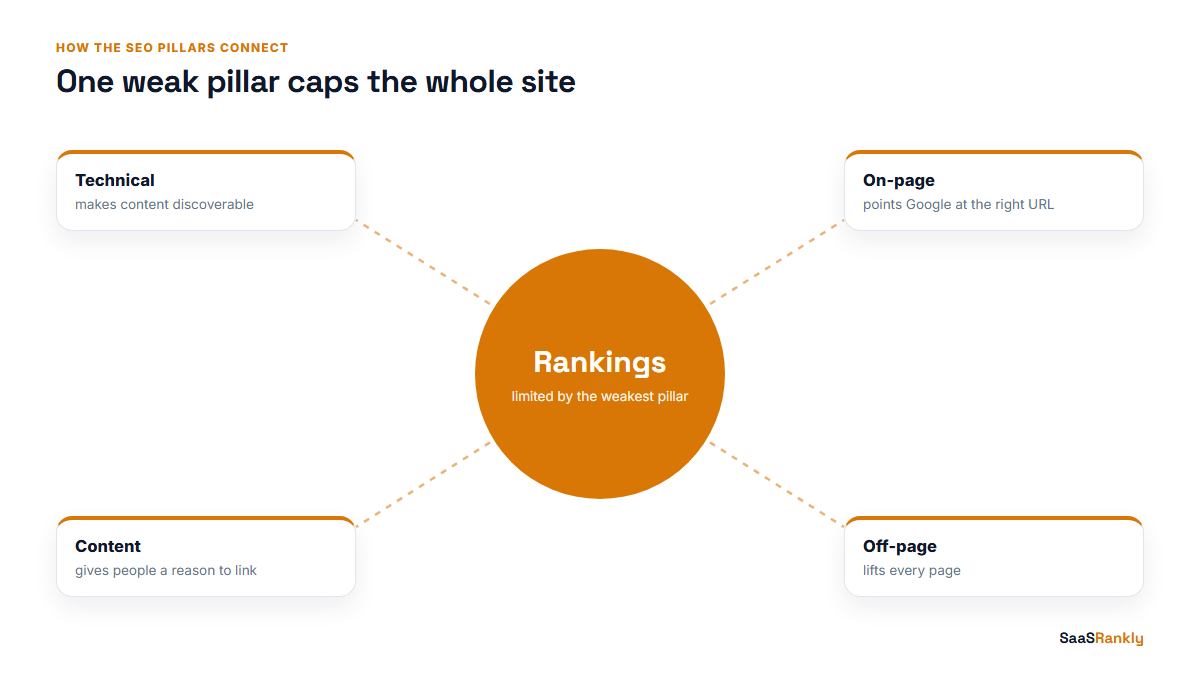
The four SEO pillars are not separate projects. They lean on each other:
- Technical work makes content discoverable. A great post that is not indexed has zero value.
- On-page work tells Google which page is the answer, so content and links point at the right URL.
- Content gives people a reason to link, which feeds the off-page pillar.
- Off-page authority lifts every page, which makes each new piece of content rank faster.
This is why we score them together. Improving one pillar raises the ceiling for the others, and a single weak pillar caps the whole site. Our SEO fundamentals guide shows the same idea as a priority list for a small team.
What the SEO pillars leave out
The model is useful but it has gaps worth knowing:
- Measurement. None of the four pillars covers tracking. Without Search Console and conversion tracking you cannot tell which pillar is improving. We treat measurement as the floor under all four.
- Intent research. Keyword and intent mapping sits between on-page and content. If you skip it, both pillars suffer.
- AI search. Being cited in AI answers depends on all four pillars, but mostly on content clarity and off-page mentions. Many frameworks have not caught up with that yet.
A monthly SEO pillars review
Once a month, rerun the scoring sheet. It takes 20 minutes if nothing changed. Write the four scores in one row of a spreadsheet with the date. After three months you will see which pillar moves and which one stays stuck. The stuck one gets the next month’s hours. That single habit has done more for our clients than any tool purchase.
Quick recap: SEO pillars
- The four SEO pillars are technical, on-page, content and off-page authority.
- Use them as a scoring sheet: five yes or no questions per pillar, 0 to 5 each.
- Any pillar at 2 or below is the bottleneck and gets the next month’s effort.
- Fix technical and on-page before content and links, because they are faster.
- Shift budget toward off-page as the site grows past 200 pages.
- After a traffic drop, rule out technical causes before rewriting content.
FAQ
What are the 4 pillars of SEO?
Technical SEO, on-page SEO, content and off-page authority. Together they cover whether Google can reach a page, understand it, trust it as the best answer and see that other sites vouch for it.
Which SEO pillar is most important?
The weakest one on your site. Technical comes first in order, because nothing ranks without being indexed, but after that the pillar with the lowest score limits the rest.
Is user experience a pillar of SEO?
Some frameworks list it separately. We include page speed and mobile usability under technical, and readability and layout under on-page, which keeps the model at four pillars.
How long does it take to improve an SEO pillar?
Technical and on-page fixes can show results in a few weeks once Google recrawls. Content usually takes two to four months. Off-page authority builds over six months or more.
Do SEO pillars apply to SaaS sites?
Yes, though the balance differs. SaaS sites often have strong content and weak off-page signals, or JavaScript-heavy templates that hurt the technical pillar.
How are the SEO pillars different from SEO components?
The pillars are four broad areas used to score balance. Components are the smaller building blocks inside them, such as sitemaps, titles or briefs, usually listed in the order you build them.