Most lists of saas platforms are written for buyers. This one is written for the people who have to sell them through search. We sort SaaS platforms into the categories buyers actually type into Google, show the query shapes each category produces, and then walk through how a small team picks which category label to fight for. If you market a SaaS product and you are not sure what to call it on your own homepage, start here.
A quick note on scope. We are not going to rank Salesforce against HubSpot. Our SEO platforms comparison does that kind of thing for our own corner of the market. This post is about the map, not the winners.
What counts as one of the saas platforms buyers search for
A SaaS platform is software you rent through a browser, billed per seat, per usage unit or per account, and hosted by the vendor. That definition covers a payroll tool used by a 12-person bakery and a data warehouse used by a bank. The word “platform” usually signals one more thing: other tools plug into it. Slack is a platform because hundreds of apps post into it. A simple invoice generator is SaaS, but nobody calls it a platform.
That difference matters for search. When people type “saas platforms” they are mostly in one of three moods. Some want a definition and a few examples. Some are founders checking which categories are crowded. And a smaller group are buyers who have not yet learned the category word for the thing they need. We see that third group in Search Console all the time, typing things like “platform to manage client approvals” because they have never heard the phrase “proof management software”.
If you want the plain textbook background, the Wikipedia entry on software as a service is decent and stays fairly neutral.
The nine categories of saas platforms and how buyers phrase them
We group SaaS platforms by the job they do for the buyer, because that is how search demand clusters. The prices below are entry paid tiers we checked at the time of writing, rounded, and they move often, so treat them as a sense of scale.
| Category | Typical examples | Entry price (per user per month) | How buyers usually search |
|---|---|---|---|
| CRM and sales | HubSpot, Pipedrive, Salesforce | about $15 to $25 | “crm for small business”, “pipedrive alternatives” |
| Marketing automation | Mailchimp, ActiveCampaign, Klaviyo | contact-based, from about $15 | “email automation for shopify”, “mailchimp vs klaviyo” |
| Collaboration and work management | Slack, Asana, Notion, Monday | about $8 to $12 | “project management tool for agencies” |
| Finance and billing | Stripe Billing, Chargebee, Xero | usage or revenue based | “subscription billing software”, “xero pricing” |
| HR and payroll | Gusto, Deel, BambooHR | base fee plus about $6 per person | “payroll for contractors in 5 countries” |
| Customer support | Zendesk, Intercom, Help Scout | about $20 to $55 per agent | “help desk for saas”, “intercom alternatives” |
| Analytics and data | Mixpanel, Amplitude, Snowflake | free tier, then usage based | “product analytics tool”, “mixpanel pricing” |
| Developer and infrastructure | GitHub, Vercel, Datadog | about $4 to $20, plus usage | “hosting for next.js”, “datadog alternatives” |
| Vertical SaaS | Toast (restaurants), Procore (construction), Clio (law) | often quote based | “software for law firms”, “restaurant pos” |
Two patterns jump out once you lay it out like this. First, the horizontal categories (CRM, support, work management) are where the head terms live, and the head terms are owned by G2, Capterra and the giants. Second, vertical SaaS has small search volume per query but very little competition, because the buyer adds their industry to the search. “Crm for roofing contractors” is a real query with real budget behind it.
Three query shapes every category produces
Across the saas platforms we work with, search demand falls into the same three shapes. Knowing which shape you are targeting tells you what page to build.
1. The category query
“Help desk software”, “payroll software for startups”. These are high volume and listicle-dominated. A vendor page rarely ranks in the top five for the bare category term, so we usually aim for the modified version instead: the category plus an audience, a size or an integration.
2. The brand-adjacent query
“Zendesk alternatives”, “asana vs clickup”, “hubspot pricing”. These are smaller and much closer to a decision. We covered the page format for them in our guides to alternatives pages and X vs Y comparison pages. For most SaaS platforms this is where the first 50 trials from search come from.
3. The problem query
“How to stop clients missing invoice reminders”. No category word at all. The buyer describes the pain. These convert lower but they are how you reach people before they have a shortlist, and they are the easiest to rank for because competitors ignore them.
If you are unsure which shape a keyword belongs to, paste the list into our keyword intent classifier. It will not be perfect, but it sorts a 300-row export in seconds and the mistakes are easy to spot.
Picking the category label: a decision matrix
Here is the part most teams get wrong. They pick a category name in a branding workshop and only check search demand afterwards. We do it the other way round. For each candidate label we score four things and only then argue about taste.
| Question | Score 3 | Score 2 | Score 1 |
|---|---|---|---|
| Do buyers already use this phrase? | 500+ monthly searches for the label or close variants | 50 to 500 | Under 50, or only your brand uses it |
| Who ranks today? | Mix of small vendors and forums | Listicles plus a few vendors | Only G2, Capterra and the top three brands |
| Does the label match your product? | A buyer would shortlist you on the label alone | Needs one sentence of explanation | Needs a demo to make sense |
| Is the category growing? | Clear upward trend over 24 months | Flat | Falling |
A label that scores 10 or more is usually safe. Anything under 7 means you are trying to create a category, which is expensive and mostly something funded companies do with paid budgets, not with SEO.
Worked example: one product, three possible labels
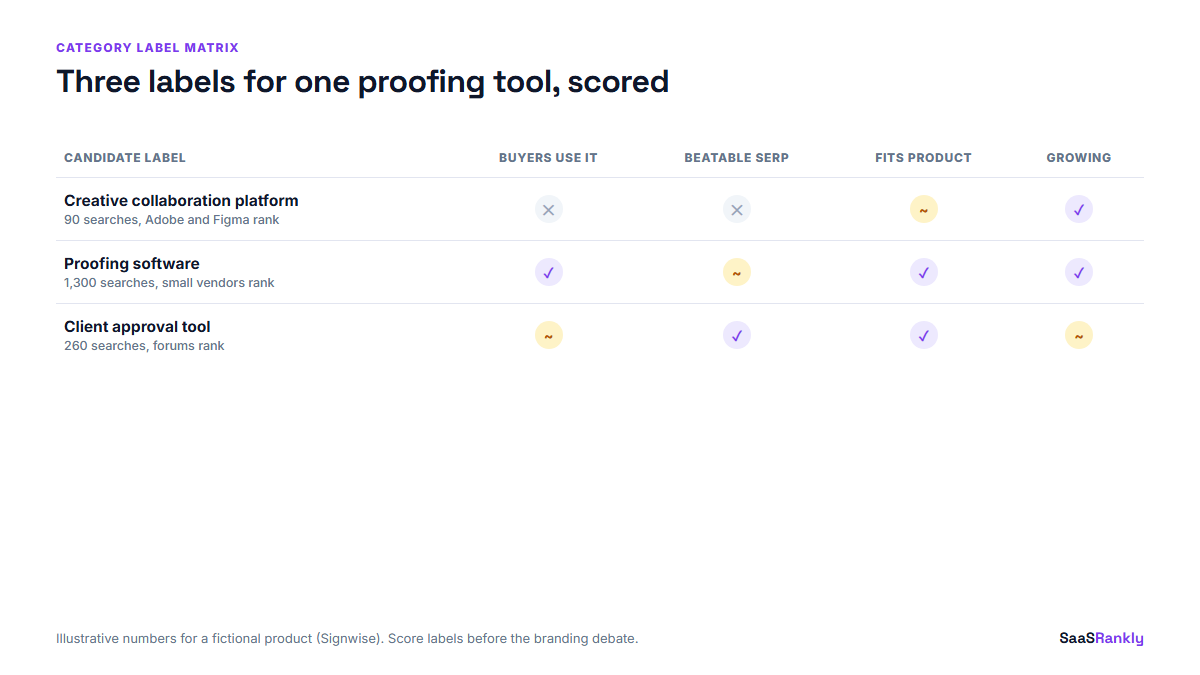
This example is illustrative. The product and numbers are made up, but the pattern is one we have seen several times with clients. Picture a tool called Signwise that lets agencies send design proofs to clients, collect comments and get a final approval with a timestamp. The founders had three candidate labels.
| Candidate label | Monthly searches (illustrative) | Who ranks | Matrix score | Decision |
|---|---|---|---|---|
| Creative collaboration platform | 90 | Adobe, Figma, big listicles | 6 | Rejected: vague and owned |
| Proofing software | 1,300 | Listicles plus 4 small vendors | 11 | Chosen as primary label |
| Client approval tool | 260 | Forums, two small vendors | 10 | Used as secondary label on the agency page |
The team had loved “creative collaboration platform”. It sounded bigger. But it put them on a results page next to Adobe with almost no searches to share. “Proofing software” was less exciting and far more winnable. Within about four months (still illustrative) the homepage ranked on page one for “proofing software for agencies” and the comparison pages were sending most of the trials.
The lesson is not that big labels are bad. It is that small SaaS platforms win by being the obvious answer to a narrower search first and widening later.
Where SEO effort pays off by category
Not every category rewards search equally. This is our opinion from working across them, not a law.
- Vertical SaaS: the best SEO return per hour. Industry terms are specific and competitors are often slow to publish. Ten good pages can carry a young product.
- Developer tools: strong, but docs and GitHub matter more than blog posts. Developers search error messages, not categories.
- CRM and marketing automation: brutal at the head, rewarding in the long tail. Integration pages (“crm for shopify”) and migration guides do well.
- HR and payroll: compliance content ranks and converts, but it must be accurate by country and reviewed. Bad payroll advice gets noticed fast.
- Analytics: template and how-to content works, because buyers search for the outcome (“track feature adoption”).
Whatever the category, the order of work is similar: product and pricing pages first, then alternatives and comparison pages, then problem content. Our post on SaaS marketing channels ranked by payback explains why that order tends to pay back fastest.
Common mistakes when SaaS platforms describe themselves
- Calling yourself a platform before you are one. If nothing integrates with you yet, “platform” just makes the homepage vaguer.
- Using a different category word on every page. Homepage says “workspace”, pricing says “hub”, the blog says “tool”. Google and buyers both lose the thread.
- Ignoring the B2B buying committee. The person searching is often not the one paying. Our explainer on what B2B SaaS means covers who else reads your pages.
- Chasing the category head term in month one. It wastes a year. Go narrow first.
- Never revisiting the label. Categories drift. “Help desk” slowly became “customer service platform” in many SERPs. Check every 12 months.
Quick recap: saas platforms
- Saas platforms are rented, browser-based software that other tools plug into; the “platform” part is about integrations.
- We sort them into nine buyer-facing categories, from CRM to vertical SaaS.
- Every category produces three query shapes: category, brand-adjacent and problem queries.
- Pick your category label with a scoring matrix before the branding debate, not after.
- Small SaaS platforms win by owning a narrow label first, then widening.
- Vertical SaaS usually gives the best SEO return per hour of work.
FAQ
What are examples of saas platforms?
Common examples include HubSpot and Salesforce for CRM, Slack and Notion for collaboration, Zendesk for support, Gusto for payroll, Shopify for ecommerce and Snowflake for data. Vertical examples include Toast for restaurants and Clio for law firms.
What is the difference between a SaaS product and a SaaS platform?
Every SaaS platform is a SaaS product, but not the reverse. “Platform” usually means other apps and partners build on top of it through an API or marketplace. A single-purpose tool without integrations is SaaS, but calling it a platform mostly confuses buyers.
Which SaaS category is easiest to rank in?
In our experience vertical SaaS, because buyers add their industry to the query and few competitors publish for it. Horizontal categories like CRM and project management are the hardest at the head term.
How do I find what buyers call my category?
Look at the words people use in Search Console queries, sales call notes and review site categories. Then check volume and who ranks for each candidate. The phrase buyers use beats the phrase your team prefers.
Should a new SaaS company try to create a new category?
Usually not through SEO. A new category has no search demand by definition, so you would be paying to educate the market. Rank for an existing label first and introduce your own framing on the page.
Do SaaS platforms need comparison pages?
Yes, for most of them. Alternatives and X vs Y pages target buyers who already have a shortlist, and they often produce the first steady trials from organic search.