Most people looking at n8n competitors are in one of two spots: n8n feels too technical for the team that has to maintain it, or the self-hosted instance has become a server someone has to babysit. The right alternative depends on which of those is your problem. This comparison sorts the options by that, with pricing notes at the time of writing and a cost example that shows why “cheapest” depends on how each tool counts usage.
The short answer: n8n competitors by situation
| If your problem is… | Look at | Why |
|---|---|---|
| Non-technical team, needs the biggest app catalogue | Zapier | Easiest builder, most ready-made integrations |
| Want visual logic and branching without code | Make | Canvas-style scenarios, strong routers and iterators |
| Want open source and self-hosting, but simpler than n8n | Activepieces | Open-source core, cleaner builder, cheap cloud plan |
| Developers who would rather write code steps | Pipedream or Windmill | Code-first, good for APIs and scripts |
| Company runs on Microsoft 365 | Power Automate | Often already licensed, deep Microsoft connectors |
| Enterprise IT with governance needs | Workato | Built for central IT control, priced accordingly |
| Hardware, IoT or local network flows | Node-RED | Free, lightweight, runs on a Raspberry Pi |
What n8n does well (so you know what you are giving up)
Before switching, be clear about what you would lose. n8n’s strengths are real:
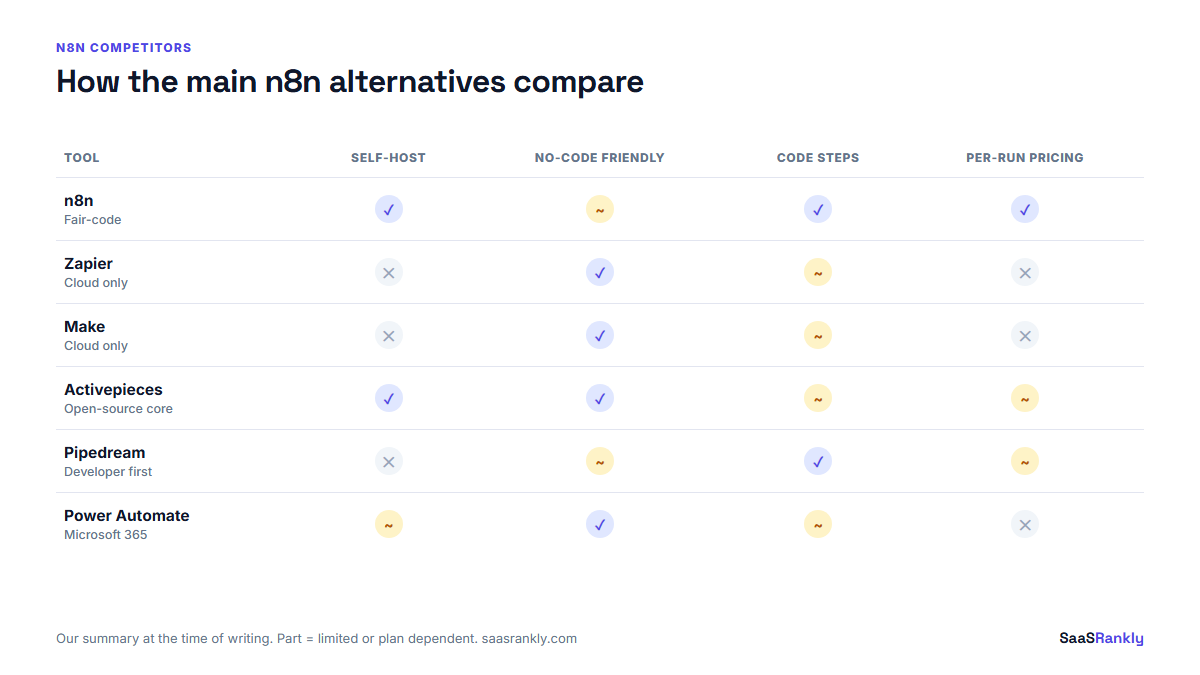
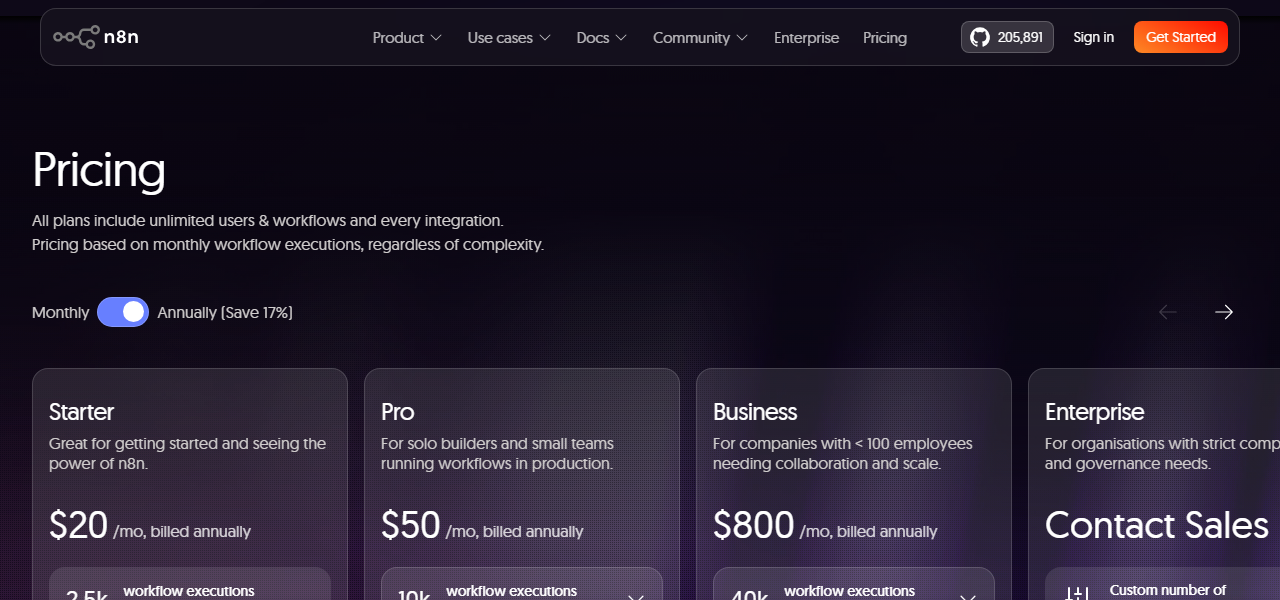
- Execution-based pricing. n8n charges per workflow run, not per step, which is unusually cheap for long workflows. At the time of writing its cloud plans start at $20 a month billed annually (Starter, 2,500 executions), then $50 (Pro, 10,000) and $800 (Business, 40,000).
- Self-hosting. The community edition runs on your own server under n8n’s fair-code licence, so high volumes cost you server time rather than per-run fees.
- Code when you need it. JavaScript or Python in any node, plus strong AI agent nodes.
- A big community. The GitHub repo is past 200,000 stars, and most problems have a forum thread.
If none of your pain points are on the list above, the fix may be better n8n hygiene (naming, error workflows, a managed cloud plan) rather than a new tool.
The main n8n competitors, one by one
Zapier
The default choice for non-technical teams. It has the largest catalogue of prebuilt app integrations and the gentlest learning curve. The trade-off is cost at volume: Zapier bills by task, and every action step in a Zap counts, so a five-step workflow uses several tasks per run. Great for marketing and ops teams running many small automations; expensive for a few heavy ones.
Make
Make (formerly Integromat) sits between Zapier and n8n. The visual canvas shows branching logic better than either, and routers, iterators and error handlers are first-class. Pricing is credit-based with a free tier that has no time limit; each module run uses credits, so long scenarios add up. This is where we send teams who find Zapier too limiting and n8n too technical.
Activepieces
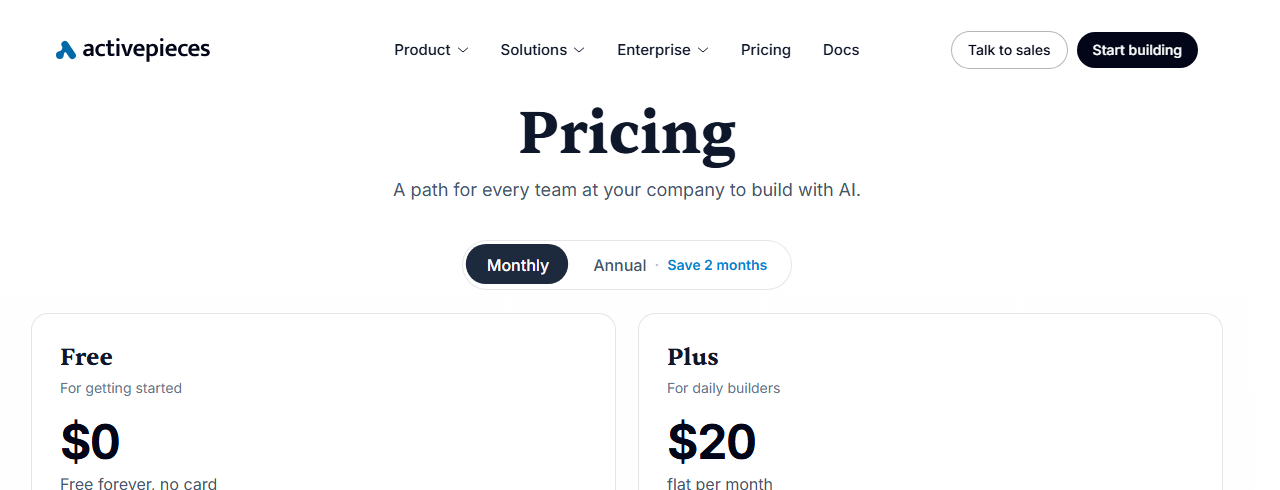
The closest like-for-like n8n alternative. Open-source core you can self-host, a builder non-developers find easier, and a cloud plan that at the time of writing starts free with a $20 flat monthly Plus tier. The integration catalogue is smaller than n8n’s, so check your specific apps first.
Pipedream and Windmill
For developers. Pipedream treats every step as code (Node.js or Python) with prebuilt API auth, which is faster than n8n for anyone comfortable writing functions. Windmill is open source and leans further toward scripts, internal tools and scheduled jobs. Neither is a good fit if the people maintaining workflows do not code.
Microsoft Power Automate
If your company already pays for Microsoft 365, check what Power Automate you already have before buying anything. Connectors for SharePoint, Teams, Outlook and Dynamics are the deepest anywhere. Outside the Microsoft world it is clunkier than the others, and premium connectors cost extra.
Workato
Enterprise integration platform with strong governance, audit and IT controls. Priced for enterprise budgets through sales. Overkill for a startup; the right answer when IT needs to approve and monitor every automation across departments.
Node-RED
Free, open source, and older than all of these. It came out of IoT and still shines there: sensors, home automation, local network devices. It can do web automations too, but you will build more yourself.
Worked example: what one workflow costs across n8n competitors
This is where the “which is cheapest” question about n8n competitors gets answered properly. Illustrative example: a lead-routing workflow with 1 trigger and 5 action steps, running 2,000 times a month.
| Tool | How it counts usage | Units used per month | What that means |
|---|---|---|---|
| n8n cloud | Per workflow execution | 2,000 executions | Fits the Starter tier’s 2,500 |
| n8n self-hosted | No per-run fee | n/a | You pay for the server and your time |
| Zapier | Per task (each action step) | About 10,000 tasks | Needs a mid-tier plan |
| Make | Per module run (credits) | About 12,000 credits | Needs a paid plan above the free tier |
| Activepieces cloud | Per plan limits | Check current plan limits | Often cheapest hosted option at this scale |
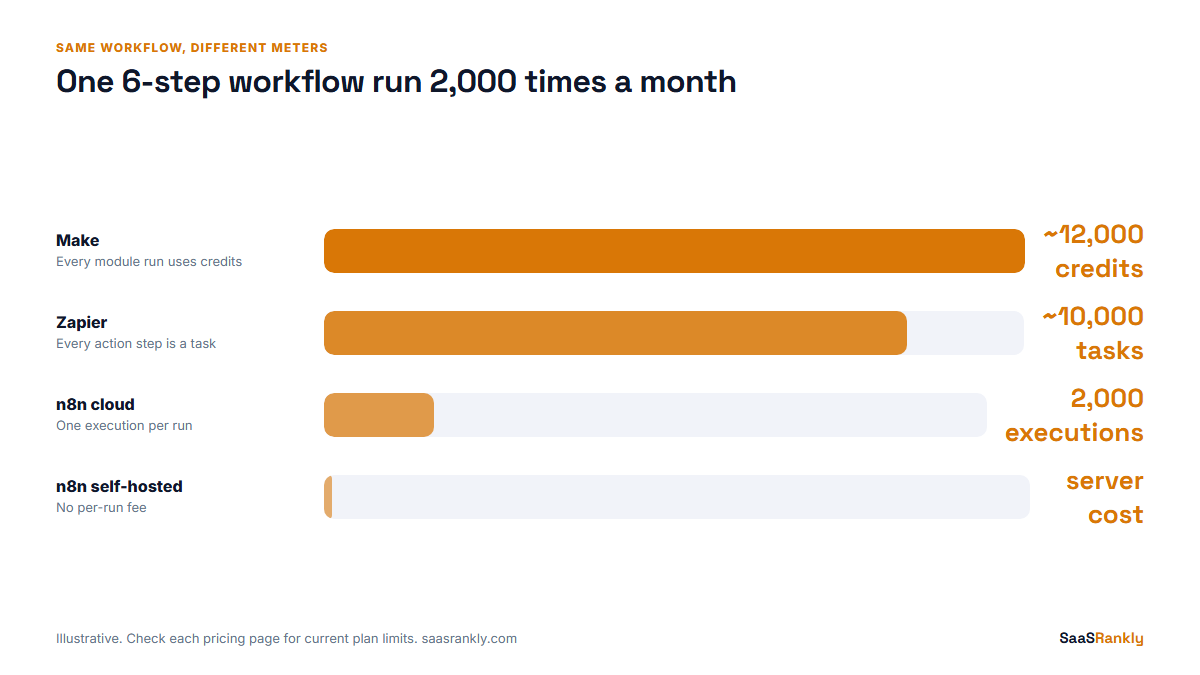
The pattern: for long workflows run often, execution-based pricing (n8n) or self-hosting wins. For many short workflows maintained by non-developers, Zapier’s higher cost often pays for itself in time nobody spends debugging. Price your own top three workflows on each tool’s current pricing page before deciding; plan limits change every few months.
How to choose between n8n competitors: four questions
- Who maintains the workflows in six months? If it is a marketer, lean Zapier or Make. If it is an engineer, Pipedream, Windmill or staying on n8n.
- Do you need self-hosting? Data residency or strict security rules narrow it to n8n, Activepieces, Windmill or Node-RED.
- Are your apps supported natively? Check your five most important apps on each shortlist. A missing integration means HTTP requests and more maintenance. (If you sell SaaS yourself, this is why integration pages rank: buyers search app by app.)
- What does your heaviest workflow cost? Run the counting exercise above with your real step counts.
Migrating off n8n without breaking things
- Export every workflow as JSON first, even the ones you plan to drop. It is your documentation.
- Move the simplest, highest-volume workflows first; they prove the new tool’s reliability quickly.
- Run old and new in parallel for a week on anything touching customers or billing, with the new one in test mode.
- Rebuild credentials fresh in the new tool; do not copy API keys around in chat or docs.
- Keep the n8n instance read-only for a month before shutting it down.
If automation is part of a wider SEO or content workflow, our roundup of SEO automation tools covers the marketing-specific side, and our Semrush alternatives comparison uses the same by-situation format for SEO suites. Writing one of these for your own product? Our guide to competitor alternatives pages covers the format.
Quick recap: n8n competitors
- Zapier for non-technical teams and the biggest app catalogue.
- Make for visual branching logic without code.
- Activepieces for open source that is simpler than n8n.
- Pipedream or Windmill for developer-led, code-first automation.
- Power Automate if you already pay for Microsoft 365; Workato for enterprise IT.
- Compare cost on your own heaviest workflow: n8n counts executions, Zapier counts tasks, Make counts credits.
FAQ
What are the best n8n competitors?
Zapier, Make and Activepieces cover most teams. Pipedream and Windmill suit developers, Power Automate suits Microsoft 365 companies, Workato suits enterprise IT, and Node-RED suits IoT and local automations.
Is there a free alternative to n8n?
Yes. Activepieces, Windmill and Node-RED are open source and can be self-hosted for free, apart from server costs. Zapier and Make have limited free plans.
Is Zapier better than n8n?
For non-technical teams and wide app coverage, usually yes. For long or high-volume workflows, n8n is usually cheaper because it charges per execution rather than per step, and it can be self-hosted.
Is Make cheaper than n8n?
It depends on workflow length. Make charges per module run, so short workflows are cheap and long ones add up. n8n charges per full execution, which favours long workflows.
Which n8n alternative is open source?
Activepieces is the closest open-source alternative. Windmill and Node-RED are also open source, with a more developer-oriented feel.
Can I move my n8n workflows to another tool automatically?
Not reliably. Each tool uses its own format, so workflows have to be rebuilt. Export your n8n JSON first and use it as the spec.