The short verdict on skyscraper technique seo in 2026: the idea still holds, the classic execution mostly does not. Find content that earned links, make something clearly better, tell the people who linked to the old one. Two of those three steps are as sound as they were when Brian Dean named the method in 2013. The third, the cold email to strangers, is where campaigns now go to die. The technique did not stop working. The inbox it depends on did. This post covers what changed, what the numbers look like, and the three versions we would still run for a SaaS company.
Skyscraper Technique SEO in One Paragraph
You find a page in your niche with a lot of backlinks. You build a better version: more current, more complete, better designed, or based on better data. Then you pull the list of sites linking to the original and email each one to say a stronger resource exists. Some of them swap the link or add yours. The logic is that these people have already shown they link to this kind of content, so you are not persuading anyone to care about the topic. The original write-up is still online and still the clearest explanation.
What Changed for Skyscraper Technique SEO Since 2013
Everyone received the email. Anyone who runs a site with decent links has had hundreds of messages that open with “I noticed you linked to” and they delete them on sight. A pattern that was novel in 2013 is now a spam signature.
“Better” collapsed into “longer”. The cheap way to beat a 2,000-word guide was a 4,000-word guide. Then someone wrote 7,000. Readers do not want any of them, and editors can tell a padded page from a useful one in ten seconds.
Links got a price tag. Many site owners learned their links were worth money and now reply with a rate card. That turns an editorial request into a paid placement, with the risk profile we covered in tiered link building.
Old content gets refreshed. In 2013 the page you were trying to beat was often abandoned. Today the serious publishers update their linked assets every year, so “more current” is a weaker pitch than it was.
The Maths of a Skyscraper Technique SEO Campaign
Here is the shape of a campaign as a funnel. These numbers are illustrative, chosen to show where the losses happen, and yours will differ. The proportions are the point.
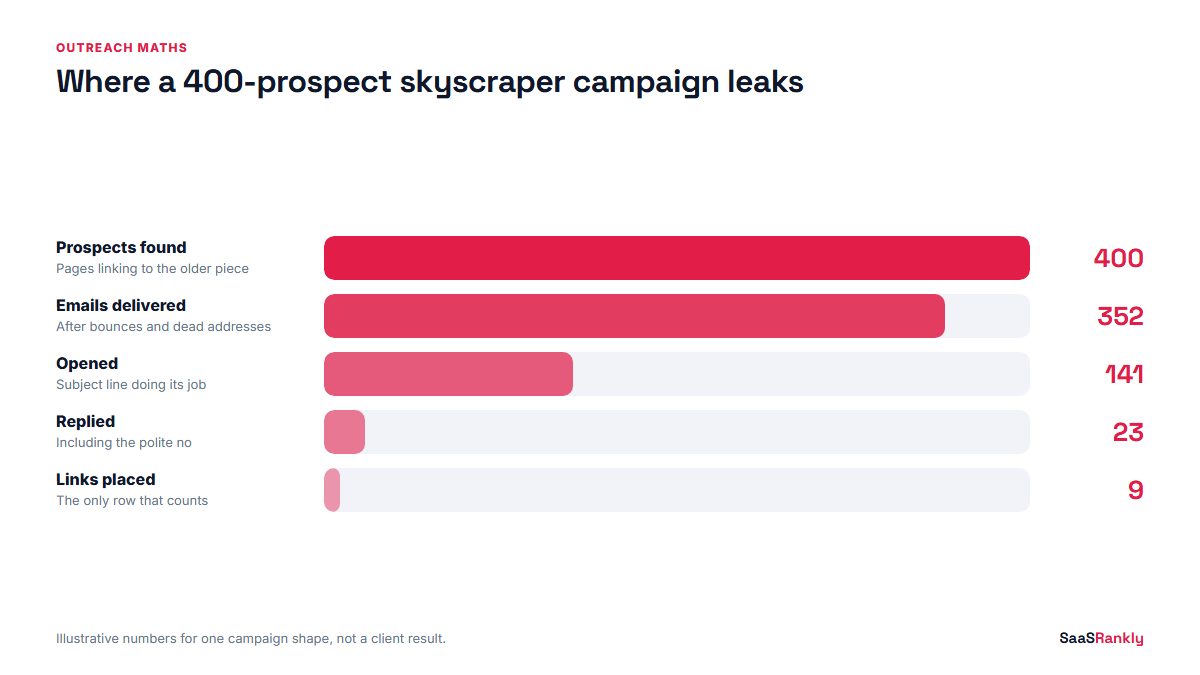
Now price a skyscraper technique seo campaign honestly. The content piece might take 25 hours if it is properly better. Building and cleaning a 400-row prospect list is another 8 to 10. Writing, sending and following up is 10 more, plus an email-finding tool. Call it 45 hours and a small software bill for something like nine links in this illustration. Whether that is good depends entirely on which nine. Nine links from real sites in your category to a page sitting at position 8 can be worth the month. Nine links from whoever happened to reply, to a blog post nobody searches for, is a month lost.
Three Versions of Skyscraper Technique SEO That Still Work
1. The data skyscraper
Do not build a longer guide. Build the number everyone in the category wants to cite and nobody has. A SaaS company has product data, customer surveys and pricing histories no publisher can match. A page that says “we looked at 1,200 accounts and here is the median” earns links from people writing their own articles, without an email, for years. This overlaps with digital PR, and the pitching side is in our digital PR post.
2. The tool skyscraper
Find the most-linked article that explains a calculation, then build the calculator. People link to tools more readily than to articles because a tool saves their reader time. It also cannot be out-written by the next person with a bigger word count.
3. The small-list skyscraper
Keep the classic method and shrink it by ten. Twenty-five prospects instead of 400. Read each linking page. Write each email by hand, mention the specific paragraph where your resource fits, and only send it if the fit is real. Reply rates on this kind of outreach are several times higher than on bulk sends, the total hours are lower, and you do not burn your domain’s sending reputation.
When to Use It and When to Skip It
| Your situation | Verdict | Why |
|---|---|---|
| You have proprietary data or can run a survey | Use it, data version | Your advantage is one nobody can copy quickly |
| A commercial page sits at positions 6 to 15 | Use it, small-list version | A handful of relevant links can move it |
| Brand-new domain, under 20 pages | Skip for now | Nothing to point links at yet. Build the pages first |
| The top-linked piece is from a major publisher, updated yearly | Skip | You will not out-resource them on the same format |
| You plan to send 1,000 templated emails | Skip | Low yield, and it puts your sending domain at risk |
The second row is the one that matters for most SaaS teams. Links should go to pages that are already close, which is the argument we make throughout our SaaS link building guide and in why backlinks still matter.
The Email, If You Send One
- Do name the exact page and the exact sentence where your link would help their reader.
- Do say what is different about your piece in one line. “Includes 2026 pricing for all nine tools” is a reason. “More in-depth” is not.
- Do send from a real person’s address and sign with a real name and title.
- Do not open with “I was browsing your site and noticed”. They have read it four hundred times.
- Do not follow up more than once.
- Do not offer money, a link swap or a “collaboration”. Those are different transactions and they belong in a different conversation, if anywhere. The wider picture is in off-page SEO for SaaS.
After a skyscraper technique seo campaign, check which links actually went live and whether they stay live. A simple monthly check is enough, and the routine is in backlink monitoring.
Quick recap: skyscraper technique seo
- The idea is sound: improve on proven content and tell people who already link to that topic.
- The bulk cold-email execution has collapsed because every site owner has seen the template.
- “Better” has to mean data, a tool or a sharper answer, not a higher word count.
- The biggest loss in the funnel is between opened and replied.
- Small hand-written lists beat large templated ones on links per hour.
- Skyscraper technique seo pays when the links point at a page already near page one.
FAQ
Does skyscraper technique seo still work in 2026?
The principle does. The mass-outreach version returns very little. Teams that get results now build something hard to copy, such as original data or a free tool, and contact a short list of genuinely relevant sites by hand.
Who invented the skyscraper technique?
Brian Dean of Backlinko named and popularised it in 2013. The underlying idea, improving on content that has already earned links, is older than the name.
What reply rate should I expect from skyscraper outreach?
Templated sends to large lists commonly see low single-digit reply rates, and a fraction of those become links. Personal emails to a small, well-matched list do several times better. Your niche and the quality of the asset matter more than any benchmark.
How long should skyscraper content be?
As long as it needs to be to beat the original on usefulness. If the winning page answers the question in 1,200 words, a 5,000-word version is worse, not better. Compete on data, currency, clarity or tooling.
Is skyscraper outreach against Google’s guidelines?
Asking someone to consider linking to a relevant resource is normal and allowed. Paying for the link, swapping links at scale or using automated programs to create links is what the spam policies prohibit.
What tools do I need for a skyscraper campaign?
A backlink index to find who links to the original, an email finder, a spreadsheet and a normal mailbox. For a 25-prospect list you can do the whole thing without outreach software, and the emails will be better for it.