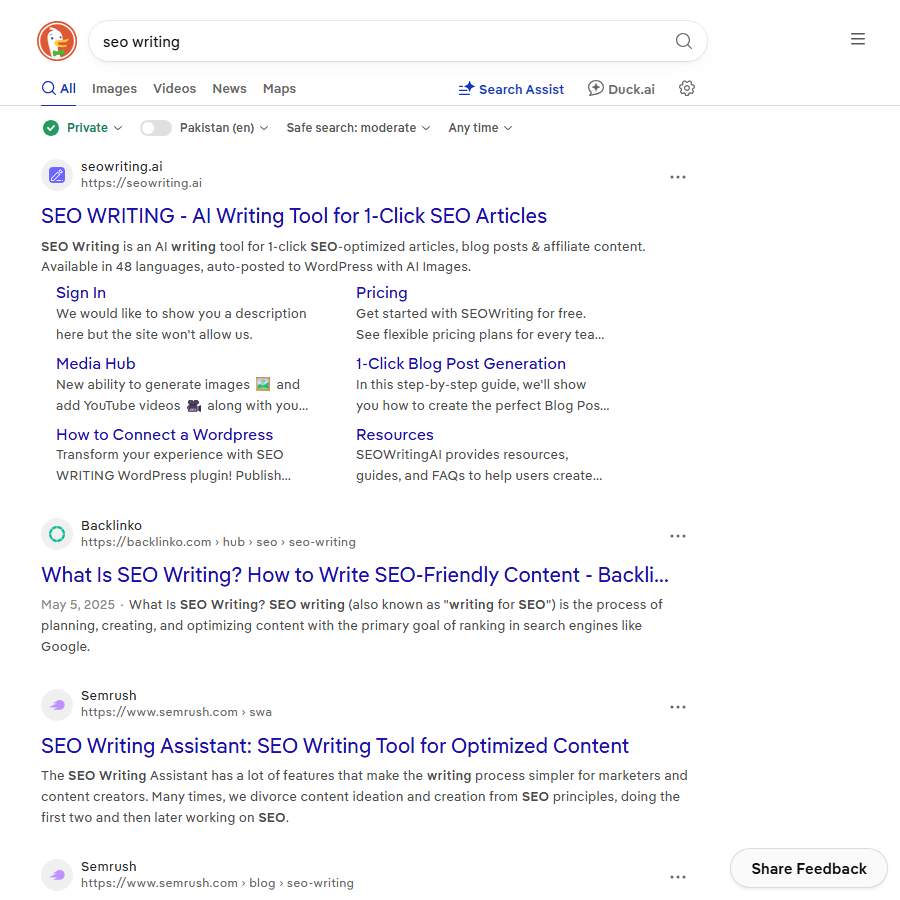
Most advice about SEO writing teaches you to write a page that looks like every other page on the SERP. Same intro, same “in this guide we will cover”, same nine H2s in the same order. It ranks for a while on a site with authority, and it does nothing at all on a site without. This is the version we use on SaaS pages, where the reader is often a buyer with a budget and very little patience.
Start with one rewrite, because it shows the whole argument faster than a list of rules can.
| Draft sentence | What is wrong | Rewrite |
|---|---|---|
| In this comprehensive guide, we will explore the various factors that influence pricing. | Announces the article instead of answering anything. Zero information in 14 words. | Most teams land between $40 and $120 per seat per month. Here is what moves you up or down that range. |
| There are many benefits to using automation software for your business. | True of everything. The reader already believes it or they would not be searching. | Automation pays back fastest on the tasks you do more than twice a week. Below that, the setup time eats the saving. |
| It is important to choose the right tool for your needs. | Filler. It advises nothing. | If you have fewer than five people touching the workflow, skip the enterprise tier. You are paying for permissions you will never set. |
Every rule below is a longer way of saying what that table already shows. Good SEO writing puts information where the filler used to be.
Rule one: answer the query in the first 60 words
The reader arrived with a question. Answer it before the fold, in plain language, then spend the rest of the page earning the scroll with detail they cannot get from a snippet. This single habit fixes more SEO writing than any keyword technique we know.
It also protects you when an AI summary sits above the results. Summaries pull from passages that answer directly. A page whose first answer arrives in paragraph six gets skipped in favour of one that answers in paragraph one. Where that passage sits in the wider brief and refresh cycle is covered in our post on content SEO.
Rule two: one page, one job
The most common structural mistake we see is a page trying to serve a definition query, a comparison query and a pricing query at the same time. Search engines are choosing a page for a query, and a page with three jobs is the second-best answer to all three.
Split it. A “what is X” page, an “X vs Y” page, a “X pricing” page. They interlink, and each one can be short. We covered the keyword side of that decision in how many keywords per page, which is the other half of this problem.
Rule three: the brief decides the SEO writing, not the writer
A brief that says “2,000 words on marketing automation, keyword: marketing automation software” produces the exact template article you were trying to avoid. A brief we would accept looks like this:
- Primary query and the two variants that should appear verbatim, with the reason each one matters.
- The reader’s job title and their objection. Not a persona document. One sentence: “Ops lead at a 40-person company who thinks this will take a quarter to implement.”
- The answer, in one sentence, written by whoever wrote the brief. If they cannot write it, the page is not ready to be assigned.
- Three things only we can say. A number from our data, a support ticket pattern, an opinion the competitors will not print.
- What this page must not cover, with links to the pages that do cover it.
- The one action a reader should be able to take by the end.
Point four is the one that separates a page that ranks from a page that gets ignored. If every source on the SERP says the same nine things, the tenth page saying the same nine things has no reason to exist. Our notes on SaaS content marketing go deeper on where those proprietary points come from.
Rule four: keywords go where they read naturally
Put the primary term in the title, the first paragraph, and two or three H2s where it genuinely fits. After that, stop counting. Density targets past roughly 1 percent start bending sentences, and a bent sentence is obvious to a reader long before it is a problem for a crawler.
What does still help is covering the terms a real answer would contain. Write about pricing and you will naturally use “per seat”, “annual contract”, “overage”. That is not a trick, it is what completeness looks like. The distinction between the main term and its supporting ones is laid out in primary and secondary keywords.
The titles people write versus the titles people click
Write the title for the SERP, not for the document. Check it at the pixel width it will actually display, because a truncated title loses the part you cared about. Our SERP snippet preview shows the cut-off point, and title capitalisation covers the case question that comes up next.

Rule five: specifics, or say nothing
Compare these two sentences. “Implementation usually takes some time.” Versus “Most rollouts land between three and six weeks, and the delay is almost always waiting on someone in IT to approve an integration, not the software.” The second one is a position. Somebody could disagree with it. That is what makes it worth reading.
SEO writing that avoids every specific number in case it ages badly ends up saying nothing. Write the number, add “at the time of writing”, and put a review date in your calendar.
Rule six: cut the words that signal template SEO writing
These are the phrases we delete on sight, and the reason each one earns the cut:
| Phrase | Why it goes |
|---|---|
| “In today’s fast-paced digital world” | Says nothing and dates the page to whichever year it was written. |
| “It is worth noting that” | If it is worth noting, note it. |
| “Let’s dive in” | The reader already dived in. They clicked. |
| “In conclusion” | The reader can see where the page ends. |
| “Robust, scalable, seamless” | Three adjectives in a row is a sign nobody checked what the product does. |
| “Various factors” | Name the factors or delete the sentence. |
None of this is about pleasing an algorithm. It is that these phrases correlate with pages written to hit a word count, and readers have learned to bounce off them.
Rule seven: structure for scanning, write for reading
Headings, tables and short lists let a reader find their section. Inside that section, write actual prose. A page that is nothing but bullets reads like slide notes and gives an AI summary nothing to quote. Mix a two-line paragraph against a six-line one so the rhythm is not flat.
Rule eight: link like a person who has read the other pages
Internal links belong inside sentences, where they promise something specific. “For the intent side of this, see high-intent keywords” is a useful link. A “Related posts” block at the bottom is furniture. Four to six contextual links per page is where we land on most SaaS posts.
Rule nine: edit SEO writing by reading it out loud
It takes ten minutes for a 1,500-word page and it catches everything the checklist misses. Sentences that need a second breath get split. Paragraphs you skim while reading your own work get cut, because a reader will skip them too. In our experience this single pass does more for SEO writing quality than any scoring tool.
Quick recap: seo writing
- Answer the query inside the first 60 words, then earn the scroll with detail.
- Give each page one job, and split definitions, comparisons and pricing into separate pages.
- Write the brief so it names the reader’s objection, the one-sentence answer, and three things only you can say.
- Place the keyword in the title, opening and a few H2s, then stop counting and cover the topic properly.
- Replace vague claims with numbers, dates and opinions somebody could argue with.
- Delete template phrases, link inside sentences, and edit by reading the draft out loud.
FAQ
What is SEO writing?
SEO writing is writing a page that answers a specific search query well enough to be chosen over the others already ranking for it. The search part is choosing the query and covering the topic completely. The writing part is ordinary craft, and it does not get a discount because the page is meant to rank.
How long should an SEO article be?
As long as the answer takes. We publish 900-word pages and 2,600-word pages in the same month. Length correlates with rankings mostly because thorough answers tend to be longer, not because word count is a ranking factor. Padding a short answer to 2,000 words usually loses you the position.
Does AI-written content rank?
Some of it does. Google’s stated position is that it judges quality, not the production method, while treating mass-produced low-value pages as spam. The practical risk is sameness: a model trained on the current SERP produces a page that resembles the current SERP, which gives nobody a reason to rank it tenth.
How many keywords should one page target?
One primary query plus the close variants people type for the same intent. If two terms need different page types, such as a definition and a comparison, they need different pages. We worked through the counting question in detail in how many keywords per page.
Where should the keyword appear in SEO writing?
Title tag, H1, the first paragraph, and two or three H2s where it fits without bending the sentence. Also in the image alt text when the image genuinely shows the thing. Beyond that, write normally and let the supporting terms arrive on their own.
How do I keep SEO writing from sounding like a template?
Include something the other pages cannot include: your own numbers, a pattern from support tickets, a recommendation you would defend in a meeting. Then cut every sentence that would survive unchanged on a competitor’s page. What is left is the article.
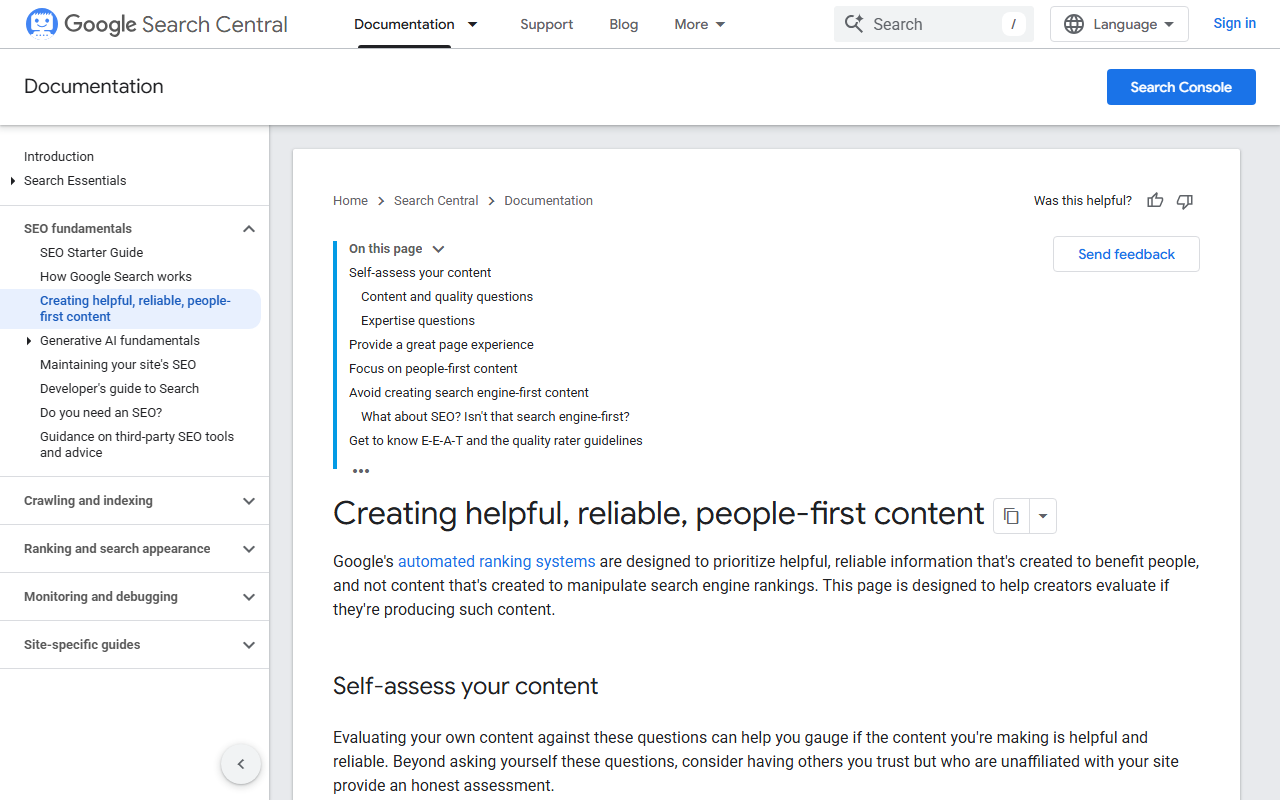
If you want the standard Google publishes on this, read creating helpful, reliable, people-first content and the spam policies on scaled content abuse. Both are short, and both say roughly what the nine rules above say, in flatter language.