Most teams that try to create SEO content at volume do not fail at the writing. They fail at the handoff. The strategist knows why the page exists, the writer gets a keyword and a word count, the editor gets a draft with no context, and the person who publishes it never sees the brief at all. By the time the page goes live, half the intent has leaked out. This post is the brief template we use to stop that leak, field by field, with the reasons each field exists and a filled-in example you can copy.
If you want the bigger loop (brief, draft, refresh), we covered that in our content SEO guide. This one is narrower on purpose. It is about the single document that travels with a piece from idea to publish, and how to create SEO content that still matches the plan after four people have touched it.
Why most attempts to create SEO content break at the handoff
We audited 30 briefs from three SaaS clients earlier this year. Every one of them had a target keyword. Only 9 said who the reader was. Only 4 said what the reader should do after reading. None of them said which existing page on the site should link to the new one, so the new page went live as an orphan and sat there for weeks.
That pattern repeats everywhere we look. The brief is written for the person who wrote it. It is a memory aid, not an instruction. When a freelancer in another timezone opens it at 11pm, they fill the gaps with guesses, and the guesses are usually generic. Generic is the one thing that does not rank in 2026.
The fix is boring. Write the brief for the least informed person in the chain. If a writer who has never seen your product can read it and produce something close to what you wanted, the brief works. If they need a call, it does not.
The brief template, field by field
Here is the full template. We keep it to one page. Anything longer gets skimmed, and a skimmed brief is worse than a short one because people think they followed it.
| Field | What goes in it | Why it survives handoff |
|---|---|---|
| Primary keyword | One phrase, exact, plus monthly volume and source | Stops the writer from optimising for a synonym nobody searches |
| Search intent | Informational, commercial, or transactional, with one sentence of proof from the SERP | The writer sees what Google already rewards |
| Reader | Job title, company size, what they already know | Sets the vocabulary level without a style guide |
| Job of the page | The one action we want after reading | Gives the CTA a reason instead of a template slot |
| Angle | The thing we say that the top 5 results do not | The only field that makes the page worth publishing |
| Must-cover points | 5 to 8 bullets, not headings | Leaves structure to the writer, keeps coverage complete |
| Proof we have | Data, screenshots, client numbers, quotes | Writers cannot invent experience, so hand it to them |
| Internal links | 3 pages this links to, 2 pages that will link back | Kills orphan pages before they exist |
| Do not | Competitor names to avoid, claims legal will not allow | Saves a full rewrite at the review stage |
| Done means | Word range, images needed, owner, publish date | Everyone knows when to stop |
Two fields do most of the work: Angle and Proof we have. If you only have time to fill two boxes, fill those. A writer can find the keyword themselves. They cannot find your customer data.
The intent field needs evidence, not a label
Writing “informational” in the intent box tells the writer almost nothing. Writing “top 5 results are all step-by-step guides with screenshots, two have a template download, nobody shows pricing” tells them exactly what shape to build. We run the keyword through our keyword intent classifier first, then look at the live results ourselves for two minutes and write that one sentence. That two minutes saves more time than anything else in the process.
The angle field is where briefs usually go blank
Ask yourself one question: if someone read the current number one result, why would they still read ours? If you cannot answer it, you are not ready to create SEO content for that keyword yet. Sometimes the honest answer is “we have a client example with real numbers.” That is a perfectly good angle. Sometimes it is “every result is from 2023 and the tool changed its pricing.” Also fine. “Ours will be better written” is not an angle.
A filled-in example (illustrative)
Below is a brief we would write for a mid-funnel post on a fictional invoicing SaaS. The numbers are invented for the example, but the shape is exactly what we hand to writers.
| Field | Filled in |
|---|---|
| Primary keyword | “recurring invoice template” (1,900/mo, Ahrefs US) |
| Search intent | Commercial with a download expectation. 4 of the top 5 offer a free template file; 2 push their own app after the download. |
| Reader | Freelancer or agency owner, 1 to 10 people, invoices 5 to 40 clients a month, currently uses spreadsheets |
| Job of the page | Download the template, then see the auto-send feature |
| Angle | We show the 3 fields that cause late payments (data from 12,000 invoices) and build the template around fixing them |
| Proof we have | Internal stat: invoices with a due date in the subject line get paid 6 days faster on average |
| Internal links | Out: pricing, late-fee guide, invoice numbering post. In: invoicing hub page, freelancer tax post |
| Do not | Name competitors in the H1; claim legal compliance for any specific country |
| Done means | 1,400 to 1,800 words, template file + 2 screenshots, owner Sara, ships 14 Oct |
Notice what is missing: a heading outline. We stopped prescribing headings two years ago. Writers who get an outline fill it in mechanically, and every post on the blog starts to read the same. Writers who get must-cover points and an angle build their own structure, which usually reads better. Our SEO writing rules explain the rest of how we keep drafts from sounding templated.
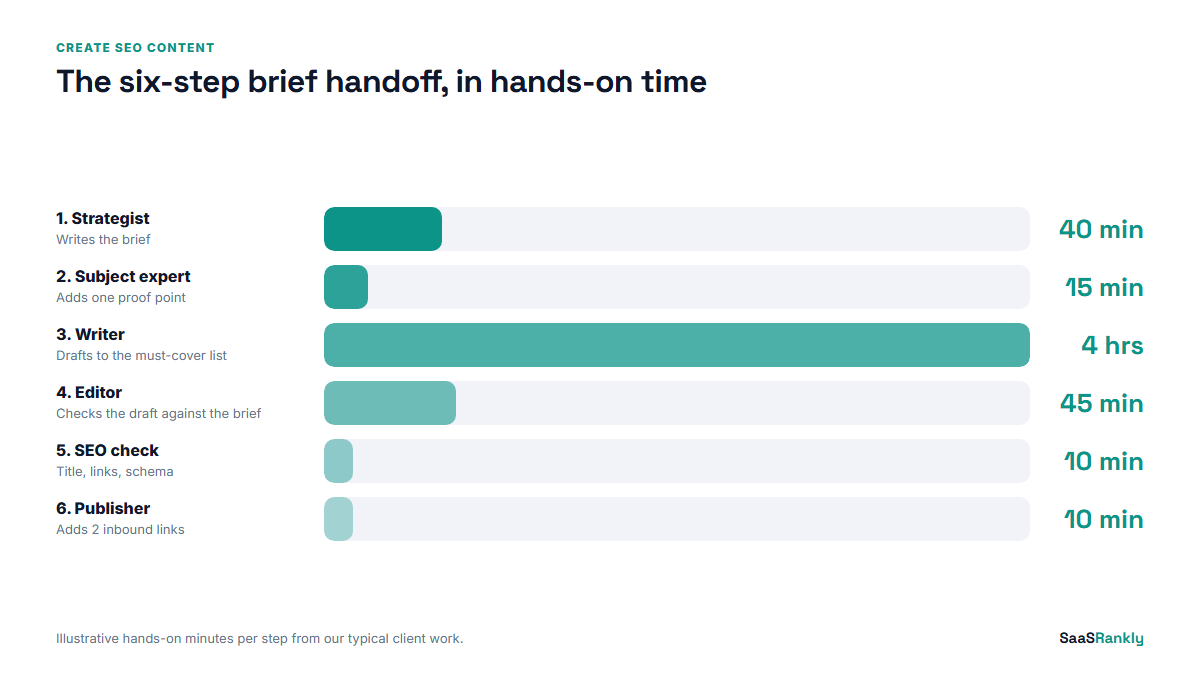
How to create SEO content from the brief: the six-step handoff
The brief is only useful if each person in the chain knows what to do with it. This is the order we run, and who owns each step.
- Strategist writes the brief (30 to 45 minutes). Keyword, intent proof, angle, proof, links. If the angle box is empty after 45 minutes, the keyword goes back in the queue.
- Subject expert adds proof (15 minutes). A product manager, support lead, or founder drops in one number or story the writer could not find anywhere else.
- Writer drafts against the must-cover list. They flag any point they could not cover instead of padding it.
- Editor checks the draft against the brief, not against taste. Does it hit the angle? Does it use the proof? Does it link where the brief said? Taste comments come second.
- SEO check (10 minutes). Title and meta preview in our SERP snippet preview, keyword in the first paragraph, internal links live, schema if it is a how-to.
- Publisher adds the inbound links from the two pages named in the brief, on the same day the post goes live.
Step 6 is the one everybody skips. We see it in almost every audit. If you want to create SEO content that gets indexed and ranked in weeks rather than months, the inbound links from existing pages matter more than most on-page tweaks. A new URL with zero internal links is a page Google has to stumble on.
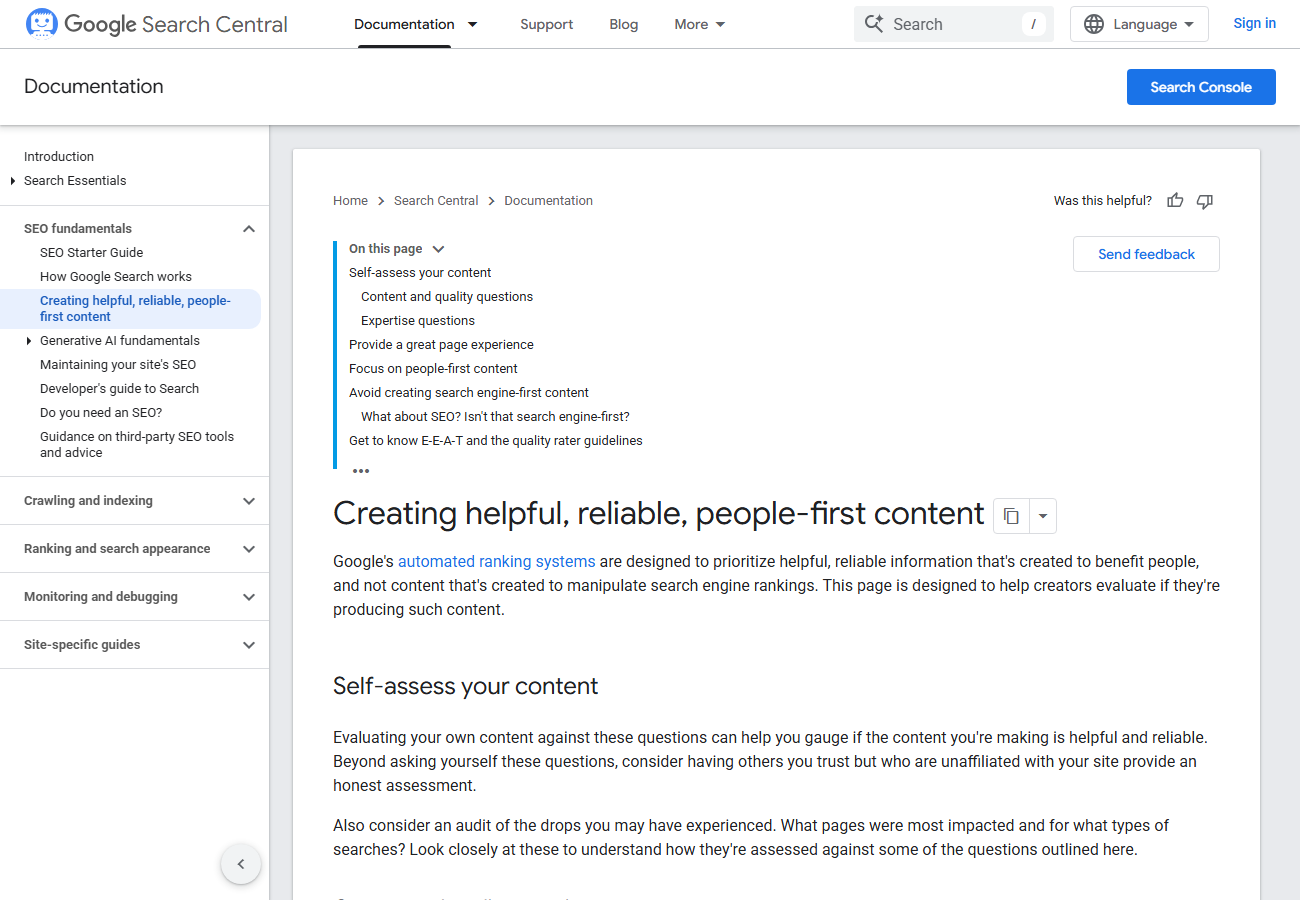
What Google actually asks for, and how the brief maps to it
Google’s own guidance on helpful content asks a set of self-assessment questions: does the content provide original information, does it show first-hand expertise, would a reader leave feeling they learned enough. Those questions read like abstract advice until you map them to brief fields. Then they become a checklist.
- “Original information, reporting, research” maps to Proof we have.
- “Substantial value compared to other pages in search results” maps to Angle.
- “Demonstrates first-hand expertise” maps to the subject expert step.
- “Leave feeling they have learned enough” maps to Must-cover points and Job of the page.
We find that teams who fill those four fields well rarely need to think about helpful content as a separate project. It is already in the document.
Five handoff failures we still see, and the field that fixes each
| Failure | What it looks like live | Fix |
|---|---|---|
| Wrong intent | A 2,000-word guide where the SERP wants a comparison table | Intent field with SERP evidence |
| Keyword drift | Writer targets “recurring billing” instead of “recurring invoice template” | Exact primary keyword with volume |
| Thin proof | Every claim is “studies show” with no source | Proof field filled before drafting starts |
| Orphan page | Zero internal links pointing in after 30 days | Inbound links named in the brief |
| Endless edits | Four review rounds on tone | “Done means” field with an owner |
One more opinion, since people ask. Should AI draft from this brief? It can, and the brief makes it much better at it, because the angle and proof fields are exactly what a model cannot invent. But we would not skip the subject expert step. A draft with no first-hand detail reads like every other draft, whoever or whatever wrote it. If you plan your briefs around topic clusters, the internal links field almost fills itself, and keyword overlap between briefs gets easier to spot too (our primary and secondary keywords post covers how we split terms between pages).
Quick recap: create seo content
- To create SEO content that matches the plan, write the brief for the least informed person in the chain.
- Keep the brief to one page with ten fields; Angle and Proof we have matter most.
- Back the intent label with one sentence of evidence from the live results.
- Give writers must-cover points, not a heading outline.
- Edit against the brief first and taste second.
- Add inbound internal links from two named pages on publish day.
FAQ
How long should an SEO content brief be?
One page. Ours run 250 to 400 words. Longer briefs get skimmed, and a skimmed brief causes more errors than a short one because the writer believes they followed it.
What is the most important part of a brief when you create SEO content?
The angle, meaning the specific thing your page says that the current top results do not. Without it you are writing a sixth version of the same article.
Should a content brief include headings?
We stopped including them. Must-cover points give the same coverage while letting the writer build a structure that reads naturally. Outlines tend to produce posts that all look alike.
Who should write the brief, the SEO or the writer?
The strategist or SEO lead writes it, because they own the keyword choice and the internal linking plan. A subject expert then adds one piece of proof before the writer starts.
Can AI write SEO content from a brief?
It can draft from one, and a good brief improves the output a lot. The proof and first-hand detail still have to come from people who have done the work, so keep that step human.
How many internal links should a new post get?
We aim for three outbound internal links in the body and two inbound links from existing related pages added on publish day. That is usually enough for the page to be found and crawled quickly.