A SaaS brand is the reason someone types your product name into Google instead of a generic category term. That one behaviour, branded search, is the clearest signal we know that brand work is paying off, and it is also the part most SaaS teams never measure. They talk about logos, tone of voice and colour palettes, then wonder why the brand never shows up in the numbers.
We work on organic growth for B2B software companies, and we have watched the same pattern many times. The companies with a strong SaaS brand get cheaper clicks, higher click-through rates on non-branded terms, and more mentions in AI answers. The companies without one fight every keyword from scratch. This guide is about building the first kind, with search as the scoreboard.
What a SaaS brand actually is (and what it is not)
Strip away the agency language and a SaaS brand is three things a buyer carries around in their head: what you do, who it is for, and why you are different from the other five tools in the category. If a buyer can say those three things after one visit, you have a brand. If they remember only the colour of your button, you have a visual identity, which is a smaller thing.
Search engines and AI assistants now behave a lot like buyers here. They build an association between your name and a category, a problem and a set of attributes. When those associations are clear and repeated across the web, you get shown more. When they are fuzzy, you get shown less, no matter how good the logo is.
Myths we hear every quarter
| Myth | What we actually see |
|---|---|
| Brand is a design project you finish once | Brand is a set of associations that drift unless you repeat them in content, product copy and PR every month |
| Brand does not affect SEO | Branded search volume, mentions and co-citations change how often Google and AI tools surface you for category terms |
| Small SaaS companies cannot afford brand work | The cheapest brand work is positioning and consistency, which costs time, not budget |
| Brand is only for consumer apps | B2B buyers shortlist from memory; in our audits most demo requests come from people who already searched the brand name |
| A clever name is enough | A clever name with no category association is invisible; a plain name tied to one clear job gets remembered |
Why search rewards a strong SaaS brand
Google has never published a “brand score”, and we would not trust anyone who claims to know the exact weight. What we can see is the behaviour around brands, and it is consistent across the accounts we manage.
- Higher click-through rate on category terms. When a searcher recognises your name in the results, they click it over an unknown name in a higher position. We regularly see a known brand at position 4 out-click an unknown site at position 2.
- Branded queries are almost free traffic. Someone searching “yourproduct pricing” or “yourproduct vs competitor” is late in the buying process. These queries convert at several times the rate of generic terms.
- Links and mentions come easier. Journalists, reviewers and listicle writers include the names they already know. Our notes on digital PR for SaaS cover how that compounding works.
- AI assistants repeat what the web repeats. If many independent pages describe you as “the invoicing tool for freelancers”, ChatGPT and AI Overviews will too. That is why we treat brand consistency as an AI visibility task as well, which we explain in how to get cited by ChatGPT.
The short version: a SaaS brand turns every other marketing activity into something slightly cheaper. That is why we push founders to start it early, even with a team of three.
The SaaS brand scorecard we use in audits
Before recommending any brand work we score the company on six signals. Each one can be checked in under an hour with free tools, and together they tell us whether the brand is helping search or getting in the way.
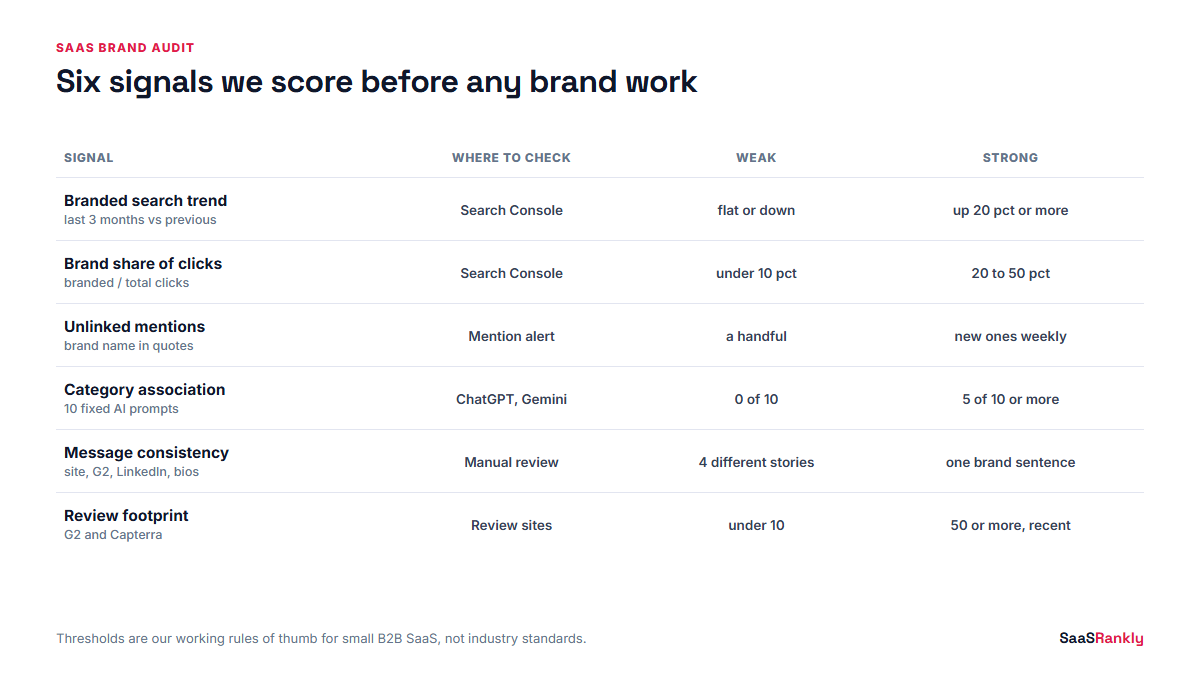
The scorecard is deliberately boring. Every row is something you can measure today and measure again in 90 days. If a brand project cannot move at least two of these rows, we question why it is being done.
How to check each signal
- Branded search trend. In Search Console, filter queries containing your brand name and compare the last 3 months with the previous 3. Growth here is the single best brand KPI we know.
- Brand share of clicks. Divide branded clicks by total clicks. Under 10 percent usually means nobody knows you yet; over 60 percent can mean you are not winning any new demand.
- Unlinked mentions. Search your brand in quotes and count pages that mention you. Our guide to monitoring your brand online has a free setup for this.
- Category association. Ask ChatGPT, Perplexity and Gemini “what are the best [category] tools for [audience]” and note whether you appear and how you are described.
- Message consistency. Compare your homepage H1, your G2 profile, your LinkedIn tagline and your founder’s bio. If they describe four different products, buyers will remember none of them.
- Review footprint. Count reviews on G2 and Capterra and read the last 20. Reviews are where buyers learn your brand in other people’s words.
Building a SaaS brand that search can understand
Here is the order we follow. It starts with words, not visuals, because search engines read words.
1. Pick one category and one audience
Most young SaaS products try to be “the all-in-one platform for teams”. That phrase cannot be remembered and cannot rank. Choose a category people already search for, and narrow it with an audience: “scheduling software for physiotherapy clinics” beats “the future of work”. You can broaden later. Our breakdown of SaaS product marketing shows how one positioning document keeps this choice consistent across teams.
2. Write the brand sentence and repeat it everywhere
Write one sentence: “[Brand] is the [category] for [audience] that [main difference].” Then put that sentence, or a close variant, in your homepage title, meta description, About page, G2 profile, Crunchbase entry, LinkedIn page and every guest post bio. Repetition across independent sites is what builds the association in search engines and language models.
3. Own the branded SERP
Search your brand name. You want the first page to show your site with sitelinks, your review profiles, your social profiles, maybe a YouTube channel, and no confusing results about a different company with a similar name. Add Organization schema with sameAs links to your profiles, and check it with our schema validator.
4. Publish a point of view, not just tutorials
Tutorials attract traffic. Opinions attract memory. A SaaS brand gets remembered when it says something specific: “we think daily rank tracking is a waste for most blogs” is memorable; “rank tracking is important” is not. One strong opinion piece per month, backed by data from your own product, does more for the brand than ten generic how-to posts.
5. Turn customers into the loudest channel
Reviews, case studies, community answers and customer-written posts all spread your brand sentence in someone else’s voice. Ask for reviews right after a success moment in the product, not on a random email schedule. We see review volume roughly double when the ask is triggered by an in-app milestone.
A worked example: one SaaS brand over 12 months
This is an illustrative case built from patterns we have seen, not a real client. “Rotaly” is a shift-scheduling SaaS for small restaurants. At the start it described itself as “smart workforce software”, ranked for almost nothing, and got most signups from paid ads.
The team rewrote its brand sentence to “Rotaly is the shift scheduling app for independent restaurants that builds a week’s rota in five minutes”, repeated it across 14 profiles and directories, ran a monthly data post on restaurant staffing costs, and asked for reviews after each customer’s fourth published rota.
| Metric (illustrative) | Month 0 | Month 6 | Month 12 |
|---|---|---|---|
| Branded searches per month | 90 | 310 | 720 |
| Brand share of organic clicks | 8% | 21% | 34% |
| G2 + Capterra reviews | 6 | 41 | 88 |
| Mentioned in AI answers (10 test prompts) | 0 of 10 | 3 of 10 | 7 of 10 |
| CTR on top 20 non-branded terms | 2.1% | 2.9% | 3.8% |
| Paid share of signups | 70% | 52% | 38% |
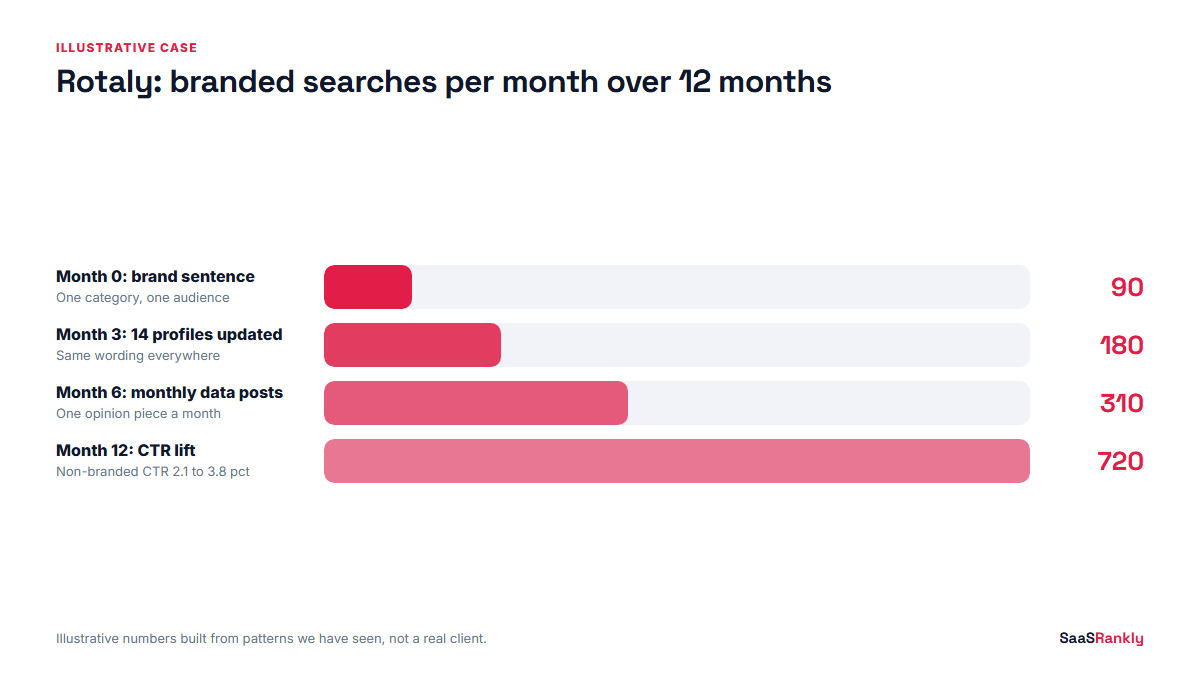
Look at the last two rows. The brand work never targeted non-branded keywords directly, yet click-through rate on those terms almost doubled, because more searchers recognised the name. That is the effect we want founders to understand: a SaaS brand lifts the whole search account, not just the branded queries.
What to measure, and what to ignore
Brand measurement goes wrong in two ways. Either the team measures nothing because “brand is hard to measure”, or it buys an expensive brand-tracking survey that nobody reads. We keep it to a short monthly table.
- Track: branded impressions and clicks in Search Console, branded search share, review count and average rating, AI answer mentions on a fixed prompt set, direct traffic to the pricing page.
- Ignore: follower counts, “brand awareness” survey scores with tiny samples, social impressions, and logo recall tests.
If you already send a monthly SEO report, add two rows for branded search and AI mentions rather than starting a separate brand report. Our SaaS marketing channels guide explains how we rank brand next to the other channels by payback period.
A note on rebrands
Rebranding a SaaS product with existing rankings is risky. A name change resets branded search to zero and can break years of mentions. If you must rebrand, keep the old name visible on the site for at least a year (“Rotaly, formerly ShiftSmart”), redirect every old URL, and update every profile in the same week. We have seen rebrands lose 30 to 50 percent of organic signups for two quarters when this was skipped.
A 30-day SaaS brand checklist
- Week 1: write the brand sentence, pick one category and one audience, and get the founders to agree on it.
- Week 2: update the homepage title, meta description, About page and Organization schema with the brand sentence.
- Week 3: update G2, Capterra, LinkedIn, Crunchbase, Product Hunt and every author bio with the same wording.
- Week 4: set up the branded search filter in Search Console, a mention alert, and a fixed set of 10 AI prompts to test monthly.
After that, the job is repetition. A SaaS brand is built by saying the same clear thing for longer than feels comfortable.
Quick recap: saas brand
- A SaaS brand is what buyers remember: what you do, who it is for, and why you are different.
- Branded search volume is the clearest single sign that brand work is working.
- Strong brands get higher CTR on category terms, easier links and more AI mentions.
- Start with one category, one audience and one brand sentence repeated everywhere.
- Own your branded SERP with clean profiles and Organization schema.
- Measure monthly with Search Console, reviews and a fixed AI prompt set; ignore vanity metrics.
FAQ
What is a SaaS brand?
A SaaS brand is the set of associations buyers hold about a software product: the category it belongs to, the audience it serves and the main reason to choose it. Visual identity is part of it, but the associations are what drive search and sales.
How long does it take to build a SaaS brand?
In our experience, branded search starts to move within three to six months of consistent positioning and content. A brand that buyers recognise in its category usually takes one to two years of steady work.
Does branding help SEO for SaaS companies?
Yes, indirectly. Brand recognition raises click-through rate, makes earning links and mentions easier, and helps AI assistants describe you correctly. None of these is a direct ranking factor on its own, but together they lift organic performance.
How do you measure SaaS brand awareness cheaply?
Use Search Console to track branded queries, count reviews on G2 and Capterra, set a free mention alert, and test the same set of AI prompts every month. That covers most of what a paid brand tracker would tell a small SaaS team.
Should a small SaaS company invest in brand or performance marketing first?
Do the cheap brand work first: positioning, a brand sentence and consistent profiles. It costs time rather than money and makes every paid and organic channel perform better afterwards.
What makes a good SaaS brand name?
A good name is easy to spell after hearing it, has an available domain, does not clash with a bigger company in search results, and can be tied quickly to one category. A plain name with a clear category beats a clever name nobody can place.