Most SaaS go to market strategy documents we are handed have a channel section that reads “SEO, paid, social, partnerships, events.” Five channels, equal weight, no order. That is not a strategy, it is a menu. This guide shows how we build a SaaS go to market strategy where organic search is a first channel rather than an afterthought, what that changes in the first 90 days, and when SEO honestly should not lead.
We work mostly with self-serve and hybrid B2B SaaS teams, so the examples lean that way. The decision points still apply if you sell six-figure contracts.
What a SaaS go to market strategy has to answer
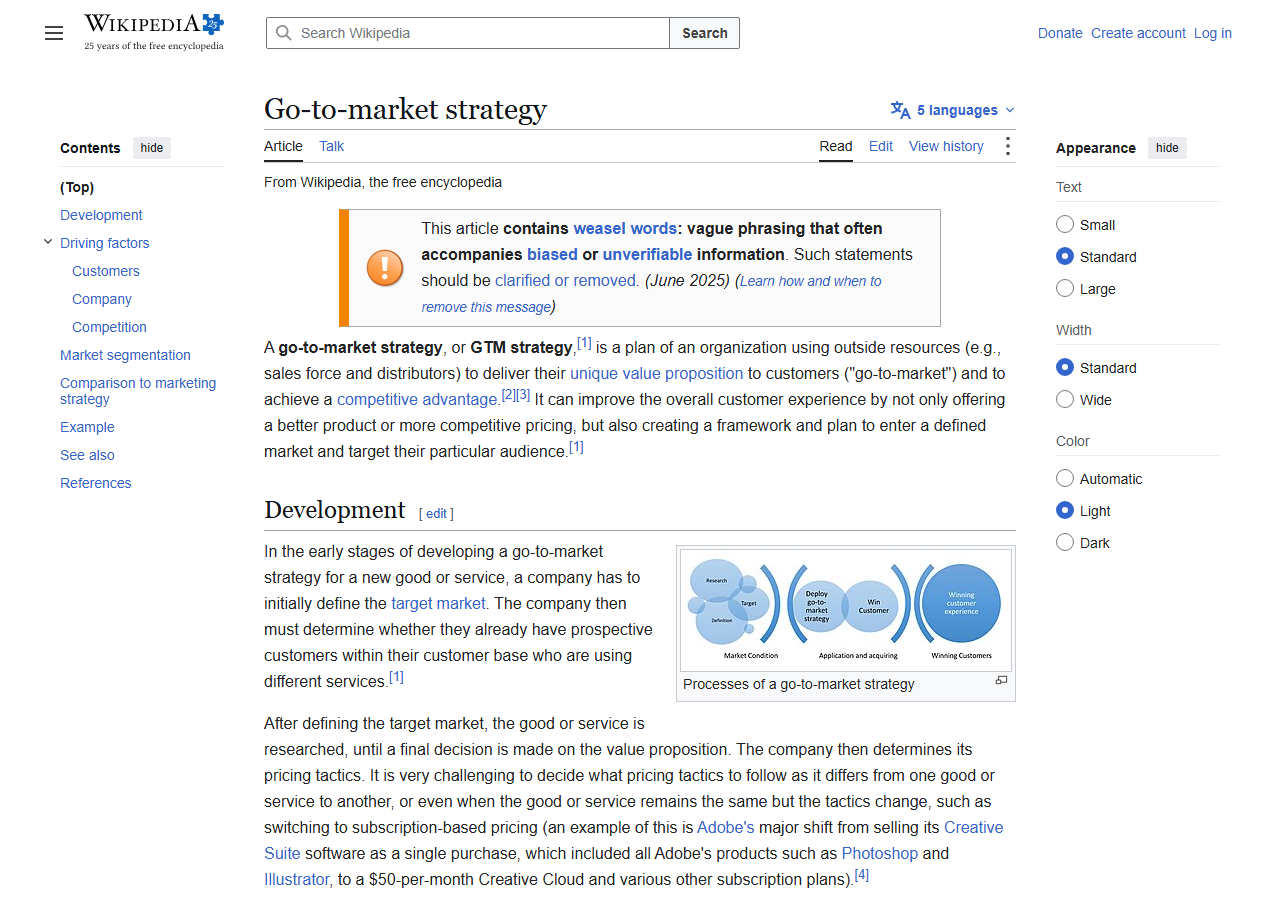
Strip away the slides and a go-to-market plan answers four questions. Who exactly buys this. What problem do they say they have, in their own words. Where do they look when that problem shows up. And how do they move from looking to paying. The standard definition covers the same ground with more formal language.
Search touches all four, which is why we think it belongs near the top. Keyword data tells you how buyers describe the problem. SERPs tell you which competitors and content types already own the conversation. Search Console, once you have pages live, tells you which phrasing actually pulls impressions. Very few channels give you that much free research before you spend a dollar.
Pick your motion first: a decision matrix
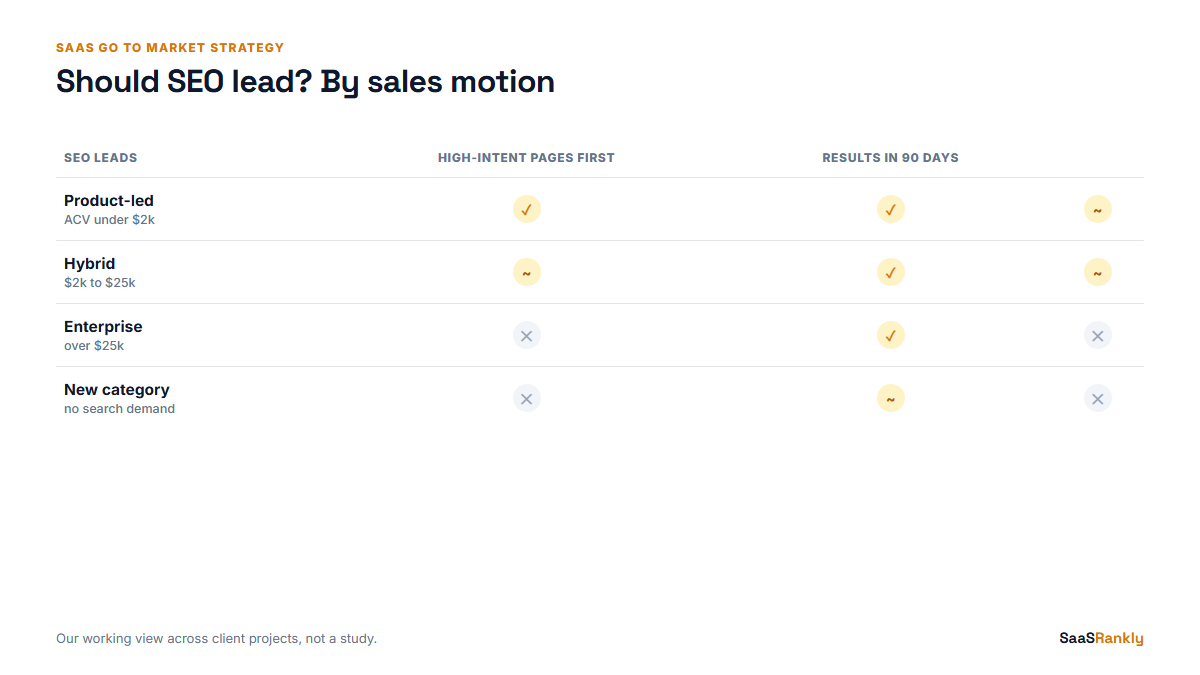
SEO plays a different role depending on how you sell. We use this matrix in the first workshop with a new client. It is opinionated on purpose.
| Motion | Typical ACV | Role of SEO | First pages to build | Main KPI for search |
|---|---|---|---|---|
| Product-led, self-serve | Under $2,000 | Primary acquisition channel | Use-case pages, templates, free tools, how-to guides | Signups from organic |
| Hybrid (PLG plus sales assist) | $2,000 to $25,000 | Co-lead with outbound | Comparison pages, alternatives pages, integration pages | Product qualified leads from organic |
| Sales-led, enterprise | Over $25,000 | Supporting channel, demand capture | Category page, solution pages, security and compliance content | Demo requests and sales-sourced pipeline influenced by organic |
| Brand new category | Any | Weak at first, nobody searches yet | Problem-aware content, adjacent keywords | Impressions on problem terms |
The last row matters. If you are inventing a category, people are not typing your category name into Google yet. SEO can still capture the adjacent problem searches, but it should not be the channel you bet the launch on. In that situation we push founders toward community, partnerships and direct outreach first, and treat search as a 6 to 12 month build. Our breakdown of product-led growth goes deeper on the self-serve row.
Five myths about SEO in a go-to-market plan
Myth: SEO is too slow for a launch.
Fact: Ranking for head terms is slow. Ranking for long-tail problem queries with low difficulty can happen in weeks on a site with modest authority. Launch with ten of those, not one pillar page about your category.
Myth: You need a big blog before SEO works.
Fact: For B2B SaaS, a handful of high-intent pages often outperforms fifty blog posts. Alternatives pages, comparison pages and integration pages convert at multiples of informational posts. We covered how to build competitor alternatives pages that do not read like attack ads.
Myth: Paid search data and SEO data are separate.
Fact: If you run any paid search at launch, the search terms report is the best keyword research you will get. We feed it straight into the content plan.
Myth: Positioning is a brand job, SEO is a technical job.
Fact: Your positioning should be written in words buyers search for. When a positioning doc uses internal jargon nobody types, the SEO team ends up translating it page by page. Fix it once, upstream. Our piece on building a SaaS brand that search rewards covers that handoff.
Myth: Organic signups are free.
Fact: They cost content, design, links and time. They are cheaper per signup over 18 months than most paid channels, but they are not free, and a plan that pretends otherwise loses budget the first time someone does the math.
A 90-day SaaS go to market strategy with search as a first channel
This is the sequence we run for a hybrid SaaS product. Adjust the page mix using the matrix above.
| Weeks | Search work | Shared with the rest of GTM | Done when |
|---|---|---|---|
| 1 to 2 | Keyword research on problem, solution and competitor terms | Buyer interviews, positioning draft | One list of 60 to 100 keywords tagged by intent |
| 3 to 4 | Technical setup: indexing, sitemap, schema, Search Console | Pricing page and signup flow ready | Clean crawl, no blocked templates |
| 5 to 8 | Publish 8 to 12 high-intent pages: alternatives, comparisons, integrations, two use cases | Sales gets the same pages as enablement material | All pages indexed and internally linked |
| 9 to 12 | Publish 6 to 10 long-tail guides, start link outreach, first refresh pass | Launch announcement, partner co-marketing | First organic signups, impressions trend upward |
Two things about this plan. First, the high-intent pages go before the blog. Second, sales uses those pages. A comparison page that a rep can send in a follow-up email earns its keep even before it ranks. That double use is one of the strongest arguments for putting SEO early in a SaaS go to market strategy.
A worked example (illustrative)
Here is how one fictional product, an expense approval tool for finance teams at 50 to 300 person companies, would apply this. Numbers are invented but realistic for the segment.
- Motion: hybrid. Self-serve trial, sales assist above 100 seats. ACV around $6,000.
- Keyword research: 84 terms. The category term “expense management software” has 9,900 searches and KD 62, out of reach for now. “expense approval workflow” has 700 searches and KD 8, very reachable.
- First 10 pages: three alternatives pages for the biggest incumbents, two comparison pages, three integration pages for the accounting tools buyers already use, and two use-case pages for approval policies.
- Expected outcome by day 90: 2,000 to 4,000 monthly impressions, 40 to 90 organic clicks, 3 to 8 trials from organic. Small numbers, but the pages keep compounding, and the sales team has been using them since week six.
If you want to put a range on what those pages could do by month twelve, we explained how we build an SEO traffic projection with low, expected and high cases.
Measuring whether search is pulling its weight
Search gets judged unfairly in most go-to-market reviews because it is measured on last-click signups at month three. We measure it in three layers instead.
- Leading: pages indexed, impressions on target keywords, average position on the high-intent set. Weekly.
- Middle: organic clicks to high-intent pages, trial starts with an organic first touch. Monthly.
- Lagging: revenue from accounts whose first or assisting touch was organic. Quarterly.
At the time of writing, GA4’s default attribution is data-driven, which can spread credit away from organic in ways that are hard to audit. We keep a simple first-touch view next to it. Our guide to lower funnel marketing shows where organic usually shows up in those assisted paths.
When SEO should not lead your SaaS go to market strategy
We are an SEO site, so take this with that in mind, but there are cases where we tell teams to put search second.
- You are creating a new category and search demand is close to zero.
- Your buyers are a few hundred named enterprises you can list in a spreadsheet. Account-based outreach will reach them faster.
- You need revenue in 60 days to survive. Search compounds, but it rarely saves a quarter.
- Your market is regulated and every page needs legal review, making the publishing pace too slow for search to matter in year one.
Even then, we would still do the keyword research in week one. It costs a few hours and it improves the positioning and sales messaging no matter which channel leads. The broader SaaS marketing channels comparison ranks the alternatives by payback period.
Quick recap: SaaS go to market strategy
- A SaaS go to market strategy answers who buys, how they describe the problem, where they look and how they convert.
- Choose the sales motion first. It decides whether SEO leads, co-leads or supports.
- Build high-intent pages before a blog: alternatives, comparisons, integrations, use cases.
- Let sales use those pages from day one so they earn value before they rank.
- Measure search in leading, middle and lagging layers instead of last-click at month three.
- Put SEO second for new categories, tiny named-account markets or urgent revenue needs.
FAQ
What is a SaaS go to market strategy?
It is the plan for how a software product reaches its buyers: the target segment, positioning, pricing, channels and the path from first touch to paid account. Search is one of those channels, and often the one that informs the others.
How long does SEO take to contribute to a SaaS launch?
Long-tail, low-difficulty pages can start getting clicks in 4 to 8 weeks on a site with some authority. Category head terms usually take 6 to 18 months.
Should a SaaS startup start with SEO or paid ads?
Many do both in a small way. Paid search gives fast keyword and conversion data, and SEO turns that data into pages that keep working once the ad budget stops.
Which pages should a SaaS go-to-market plan build first?
For most B2B products: alternatives pages, comparison pages, integration pages and a few use-case pages. They match buyers who are already close to a decision.
How do you measure SEO inside a go-to-market plan?
Track impressions and positions weekly, organic clicks and trials monthly, and organic-influenced revenue quarterly. Judging it on last-click signups in the first quarter undervalues it.
Is SEO useful for enterprise SaaS go to market?
Yes, but usually as a supporting channel. Enterprise buyers still search for comparisons, security documentation and category terms, even when the deal itself closes through sales.