A topic cluster is a group of pages about one subject, linked together, with a broad pillar page in the middle and narrower supporting pages around it. That is the whole idea. The reason it matters for a SaaS site is that it stops five half-posts competing for the same query and turns them into one page that ranks plus four that feed it.
This guide answers what a topic cluster is in plain terms, shows a real example you can open in another tab, maps one for a fictional SaaS product, and covers the three mistakes that make clusters fail.
What is a topic cluster, exactly?
Three parts, and all three have to be there.
- A pillar page. Broad, covers the whole subject at a shallow depth, targets the head term. “Project management software” or “SEO reporting”.
- Cluster pages. Each one answers a narrow question inside that subject in depth. “How to write a project brief”, “Gantt chart vs kanban board”.
- Internal links. Every cluster page links up to the pillar, and the pillar links down to every cluster page. That link pattern is what tells Google the pages belong together.
Miss the third part and you do not have a cluster, you have a folder of posts. We see this constantly on SaaS blogs: twenty good articles on one subject, no links between them, and the pillar page nowhere in the results. Clusters are one of the parts of SEO on a blog that compound; the others are refresh cycles and internal links from every new post.
What a topic cluster looks like in the wild
The clearest public example we point people at is Atlassian’s Agile section. One broad hub explains the subject, a sidebar lists the narrower topics, and every sub-page links back to the hub.
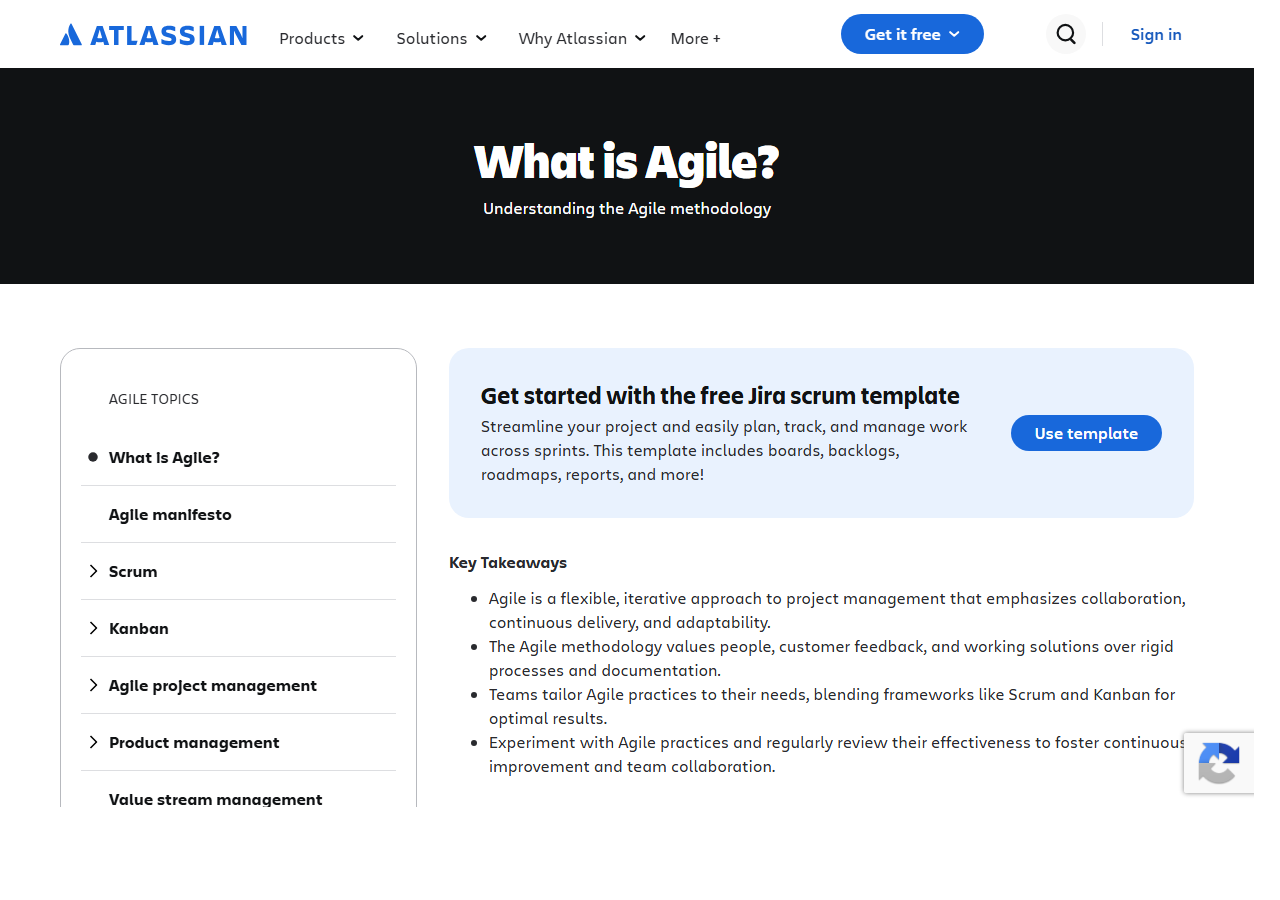
Notice what they did not do. There is no “ultimate 8,000-word guide to everything about agile” trying to rank for scrum, kanban and sprint planning at once. Each of those gets its own page, and the hub stays readable.
Why a topic cluster works
| Problem it fixes | What happens without the cluster | What happens with it |
|---|---|---|
| Keyword cannibalisation | Three posts chase “SEO reporting”, Google picks the weakest one | One pillar targets it, the rest support |
| Orphan pages | New posts sit unindexed for weeks | Links from the pillar get them crawled faster |
| Thin coverage | One page tries to answer six intents and satisfies none | Each intent gets a page that fully answers it |
| Unclear topical authority | Scattered posts read as a general blog | Depth on one subject reads as a specialist |
The cannibalisation fix is the one that usually shows up fastest. If you have never checked for it, open Search Console, filter by a query and look at which pages get impressions for it. Two or three of your own URLs trading places week to week is the signal.
How to build a topic cluster in six steps
1. Pick a subject you can own
Pick something close to what you sell and narrow enough that twelve pages cover it properly. “Marketing” is not a subject, it is a category. “Invoice automation for agencies” is a subject.
2. Find the head term for the pillar
The pillar targets the broadest term where the results are still guides rather than product pages. Check the results for the term first. If page one is all vendor homepages, the term belongs to a product page, not a pillar.
3. Collect the questions around it
Pull related searches, People Also Ask, your own Search Console queries and your support inbox. Group them by intent, not by wording. Our guide to keyword clustering covers how to group a few hundred terms without doing it by hand.
4. Assign one page per intent
If two questions would be answered by the same page in the results, they are one page. If they would not, they are two. For the limits on how many terms one page can carry, see how many keywords per page.
5. Write the cluster pages first, the pillar last
This is the part most teams do backwards. Writing the narrow pages first tells you what the pillar should summarise and link to. A pillar written first usually ends up padded. Each narrow page still needs its own brief, and the template we use to create SEO content keeps the cluster link plan inside it.
6. Wire the links both ways
Every cluster page links to the pillar with descriptive anchor text, and the pillar links to every cluster page. Cluster pages can link sideways to each other where it genuinely helps a reader.
A topic cluster mapped for a fictional SaaS
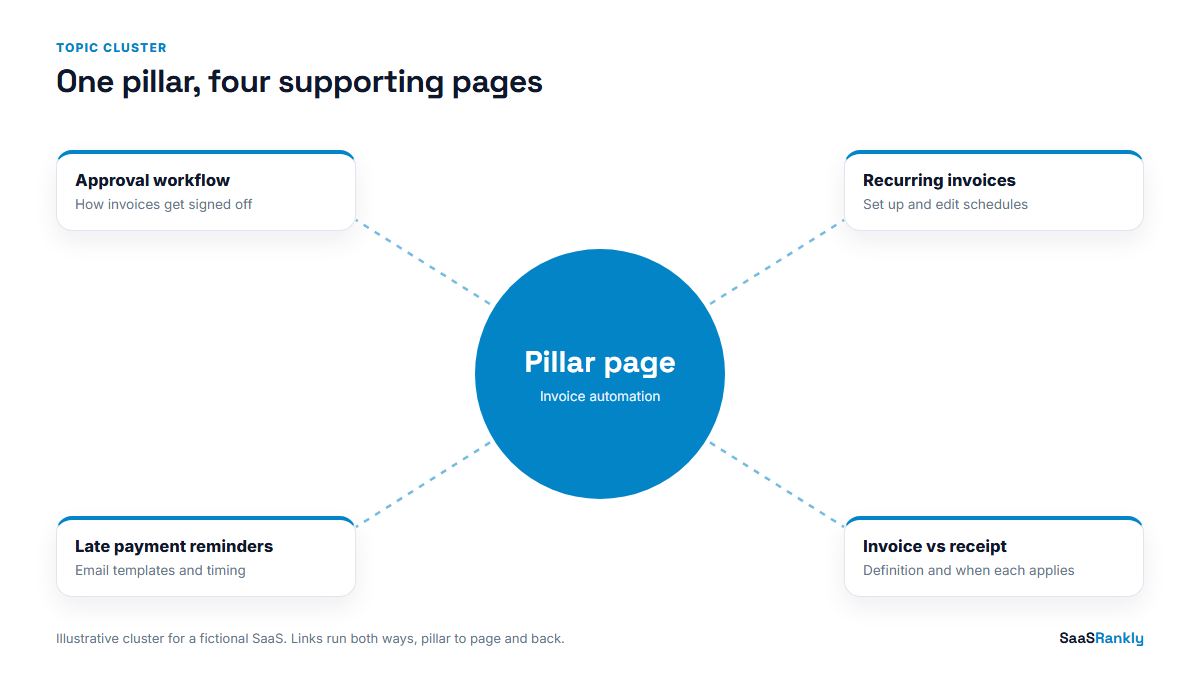
Here is an illustrative map for “Ledgerly”, a made-up invoicing tool. The volumes are invented to show the shape of a cluster, not real research output.
| Page | Role | Target term | Links to |
|---|---|---|---|
| /invoice-automation/ | Pillar | invoice automation | All six cluster pages |
| /blog/invoice-approval-workflow/ | Cluster | invoice approval workflow | Pillar, late payment post |
| /blog/recurring-invoices/ | Cluster | how to set up recurring invoices | Pillar |
| /blog/late-payment-reminders/ | Cluster | late payment reminder email | Pillar, approval workflow |
| /blog/invoice-vs-receipt/ | Cluster | invoice vs receipt | Pillar |
| /blog/invoice-fraud-checks/ | Cluster | invoice fraud prevention | Pillar |
| /invoice-automation-vs-spreadsheets/ | Cluster, commercial | invoice automation vs spreadsheets | Pillar, pricing page |
Seven pages, one subject, one clear entry point. Add the commercial page and the cluster now has a route from an informational search to a trial, which is the part a pure blog cluster often forgets.
Three mistakes that break a topic cluster
Mistake 1: the pillar is an 8,000-word dump. If the pillar tries to answer everything, the cluster pages have nothing left to say and they compete with it. Keep the pillar as a map, not a library.
Mistake 2: links only point up. Cluster pages link to the pillar, the pillar never links back. Google crawls down from the pillar, so a one-way pattern leaves the new pages orphaned. Our post on fixing SaaS indexing problems shows what that looks like in the Pages report.
Mistake 3: the cluster is built for the tool, not the reader. Twelve pages that all say the same thing with different keywords is still thin content. If two pages would give a reader the same answer, merge them and redirect one.
How long does a topic cluster take to work?
On a site with some authority, the cluster pages start picking up impressions within a few weeks and the pillar follows once the internal links are in place. On a new domain, expect three to six months before the pillar moves on its head term, because head terms are where the competition sits. Watch impressions and query count first, not position. Our notes on measuring SaaS SEO in GA4 and GSC cover which of those to trust early.
For the strategy layer above this, how clusters fit into a content calendar and which subjects to build first, see our post on SaaS content strategy with topic clusters.
Quick recap: what is a topic cluster
- A topic cluster is a pillar page plus narrower supporting pages, linked in both directions.
- The internal links are the part that makes it a cluster rather than a folder of posts.
- Clusters fix cannibalisation, orphan pages and thin coverage of one subject.
- Write the cluster pages first, then the pillar that maps them.
- Include at least one commercial page so the cluster has a route to a trial.
- Judge it on impressions and query count for the first few months, not position.
FAQ
What is a topic cluster in SEO?
It is a set of pages covering one subject, with a broad pillar page linked to and from narrower pages that each answer a specific question inside that subject.
How many pages should a topic cluster have?
Usually five to fifteen. Fewer than five rarely covers a subject properly, and past fifteen it is often two subjects that should be split.
What is the difference between a topic cluster and a content hub?
In practice they describe the same structure. “Content hub” usually emphasises the landing page and its design, “topic cluster” emphasises the keyword and linking logic behind it.
Does the pillar page have to be long?
No. It has to be complete at a shallow depth and link to the pages that go deep. Many good pillars are shorter than the cluster pages they point at.
Can a page belong to two topic clusters?
Yes, and it often should when the subjects genuinely overlap. Just make sure it has one primary target term so it is not competing with itself.
Do topic clusters help with AI search?
They help indirectly. Clear, specific pages with a sensible link structure are easier for AI systems to read and quote, and the pillar gives them one page that summarises the subject.