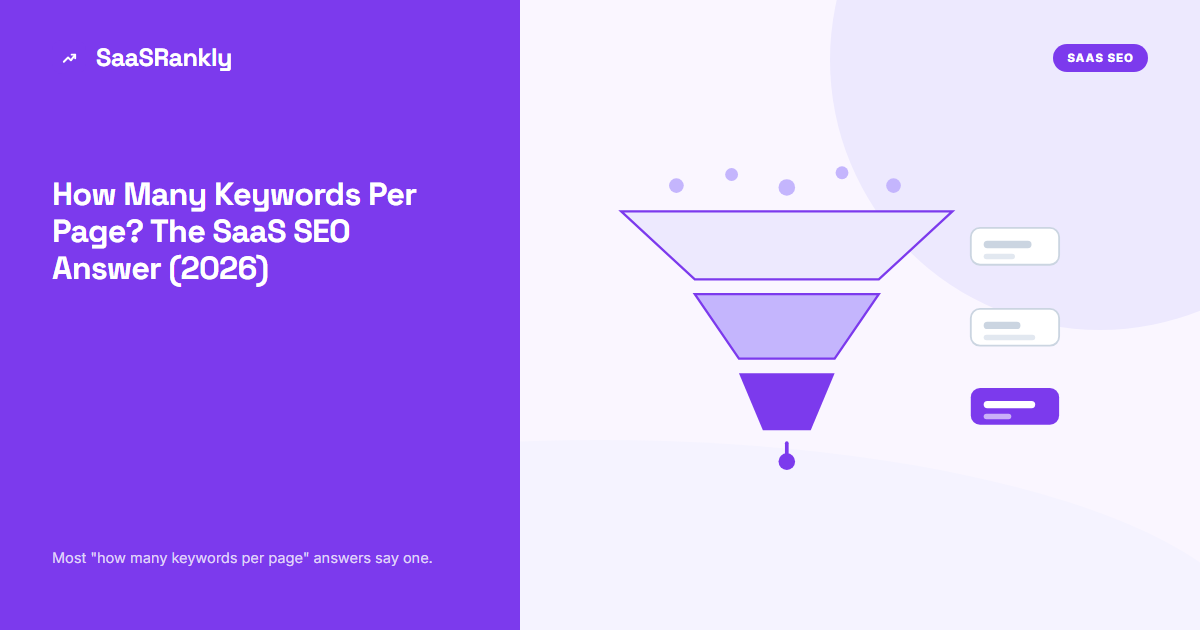
Most “how many keywords per page” answers say one. That is wrong for the way people actually search in 2026, and it is definitely wrong for SaaS pages that need to rank for a feature name, a use case, and a comparison query all at once.
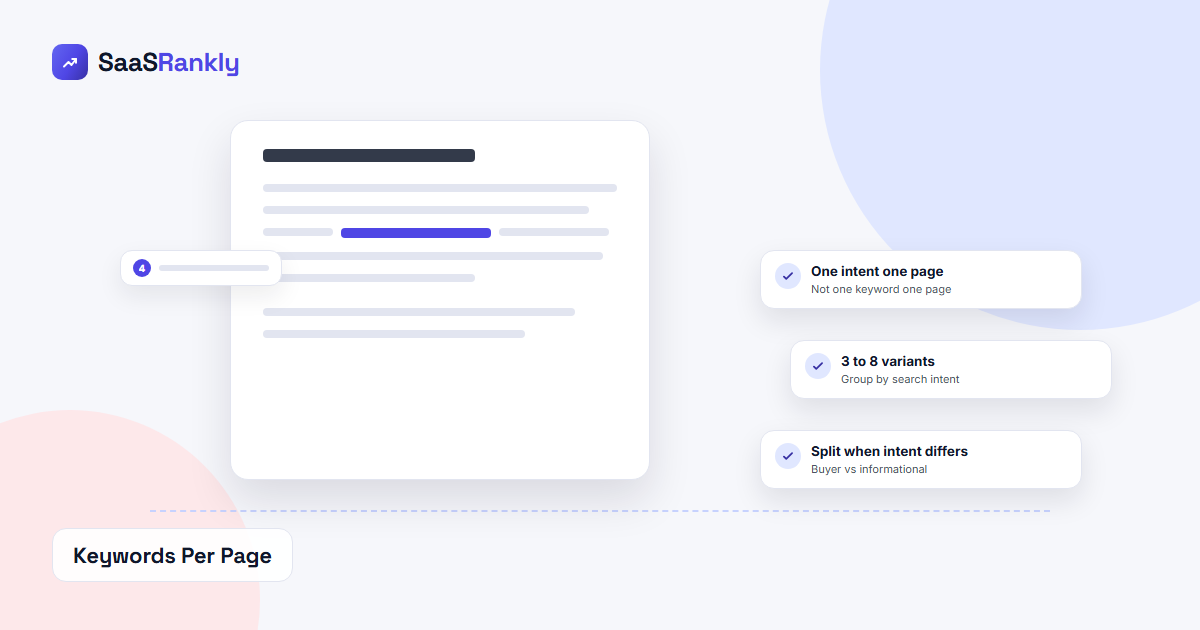
Short answer: target one primary keyword plus 3 to 8 closely related secondary keywords per page, as long as they share the same search intent. If a keyword needs a different intent (a “what is” answer versus a “vs” comparison versus a pricing question), it needs its own page, no matter how related the words look.
Why “one keyword, one page” is outdated advice
Google has clustered related queries under a single result for years. A page targeting “schema markup validator” will also pick up “schema checker”, “validate schema markup”, and “check structured data” without any extra work, because they are the same intent expressed differently. Writing four separate thin pages for those four phrases used to be normal SEO advice; today it reads as duplicate content and dilutes the ranking signal instead of multiplying it.
The real question is not “how many keywords” but “how many distinct intents”. One page, one intent, and as many keyword variants inside that intent as naturally fit.
How to group keywords into one page
Before writing, sort your keyword list into intent clusters. A simple test: if two keywords would satisfy the same searcher with the same page, they belong together.
| Primary keyword | Secondary keywords on the same page | Why they cluster |
|---|---|---|
| sitemap checker | sitemap validator, check xml sitemap, sitemap error checker | Same tool intent, same searcher |
| enterprise seo | enterprise seo strategy, seo for large websites | Same audience, same problem |
| how many keywords per page | keyword density per page, multiple keywords one page seo | Same question, different phrasing |
Anything that does not survive that test — like “sitemap checker” and “sitemap checker pricing” — is a signal for a separate page, not a section on this one.
How many subheadings should carry keyword variants
A page in the 1,200 to 2,000 word range naturally supports 5 to 8 H2 sections. Each H2 is a reasonable home for one secondary keyword phrase, used exactly as people search it rather than forced. If you find yourself writing an H2 just to fit in a keyword with no new information under it, that is the tell you have gone past the natural limit for this page and the keyword belongs elsewhere.
Keyword density is a distraction
Density targets like “keep it at 1 percent” are a rough guardrail against obvious stuffing, not a ranking lever. Write the sentence that answers the question, and the keyword shows up where it belongs on its own. If hitting a density number requires rewording a sentence to be worse, skip the number.
When to split into two pages instead
- The intent is different: informational (“what is X”) versus commercial (“X pricing”, “X vs Y”).
- The audience is different: a developer-facing setup guide versus a buyer-facing comparison.
- The page is already doing its job and adding more sections would push it past 2,500 words without adding new value.
Splitting protects both pages. A combined page targeting a “what is” query and a “pricing” query usually ranks for neither as well as two focused pages would for each.
A quick checklist
- One clear intent per page, checked against the cluster test above.
- One primary keyword in the title, first paragraph, and one H2.
- 3 to 8 secondary variants spread naturally across the remaining H2s.
- No H2 added purely to fit a keyword with nothing new to say.
- Run the finished page through the Schema Markup Validator to confirm the page is set up to be read correctly, and check technical SEO for SaaS if indexing is inconsistent across similar pages.
FAQ
Can one page rank for multiple keywords? Yes, and it should. A well-structured page regularly ranks for dozens of keyword variants inside one search intent, not just the exact phrase in the title.
Is there a maximum number of keywords per page? There is no hard number. The limit is intent, not count: once a keyword needs different content to satisfy the searcher, it needs a different page.
Does keyword density still matter for SEO in 2026? Only as a sanity check against obvious stuffing. It is not something to optimize toward; write for the question, not the percentage.
Quick recap: How many keywords per page
How many keywords per page usually comes down to a short, repeatable checklist. Use this whenever how many keywords per page comes up again:
- Diagnose how many keywords per page by checking the relevant report first, not assumptions.
- Confirm the current setup is actually causing how many keywords per page before you change anything.
- Re-check how many keywords per page again after the fix ships, not before.
Treat how many keywords per page as an ongoing signal rather than a one-time fix. For background on the platform rules behind this, see Google Search Central.