Grok vs Gemini is a question we get from SaaS marketers more often than we expected, usually from someone who already pays for one and wonders whether the other would do the job better. Our short answer: Gemini is the better daily tool for search and content work because it sits on Google’s index and Workspace, while Grok is the better tool when the question lives on X, in real time, or in the messy early hours of a news story. Most teams should pay for one and keep the other on the free tier.
That answer hides a lot of detail, so the rest of this post breaks it down by price, by job and by where each assistant gets its facts. We ran both through the same set of marketing tasks, and we will show you the scoring so you can disagree with it.
Grok vs Gemini: what you are actually comparing
Both names cover a family of products, which is why half the Grok vs Gemini threads online talk past each other. Grok is xAI’s assistant. It lives inside X, in its own app and at grok.com, and it has an API. At the time of writing the flagship API model is Grok 4.7, released in late September 2026, with Grok 4.6 and 4.5 still listed. Gemini is Google’s assistant. It runs in the Gemini app, inside Gmail, Docs and Sheets, and behind AI Mode in Search. The current models are Gemini 3.1 Pro for heavier reasoning and the 3.x Flash line for speed.
So when someone says “Gemini is better at research”, they may mean Deep Research in the Gemini app. When someone says “Grok is faster on news”, they usually mean Grok reading live posts on X. Those are different claims about different features, and we keep them apart below.
What each one costs at the time of writing
Prices move every few months, so treat this as a snapshot from late September 2026. Consumer prices are US list prices before tax. API prices come from the official model pages.
| Plan or model | Grok | Gemini |
|---|---|---|
| Free tier | Yes, with tight daily limits | Yes, Flash models plus limited Pro and Deep Research |
| Entry paid plan | SuperGrok Lite, about $10 a month | Google AI Plus, about $5 a month |
| Main paid plan | SuperGrok, about $30 a month | Google AI Pro, about $20 a month, with 5 TB storage |
| Top plan | SuperGrok Heavy, about $300 a month | Google AI Ultra, up to about $250 a month |
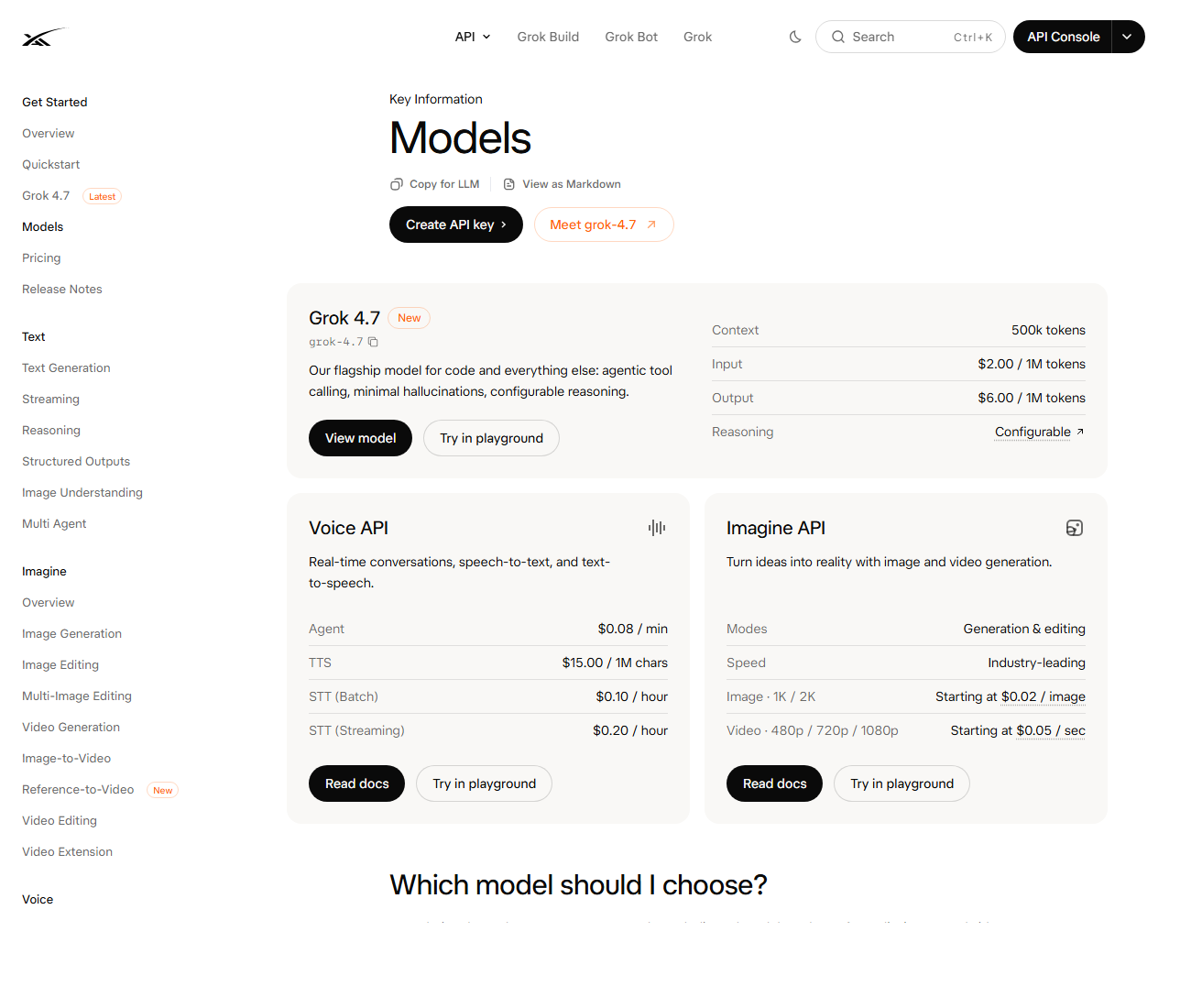
| Flagship API, per 1M tokens in / out | Grok 4.7: $2.00 / $6.00 | Gemini 3.1 Pro: $2.00 / $12.00 |
| Cheap API tier, per 1M tokens in / out | Grok 4.3: $1.25 / $2.50 | Gemini 3.8 Flash: $0.75 / $3.75 (rises in January 2027) |
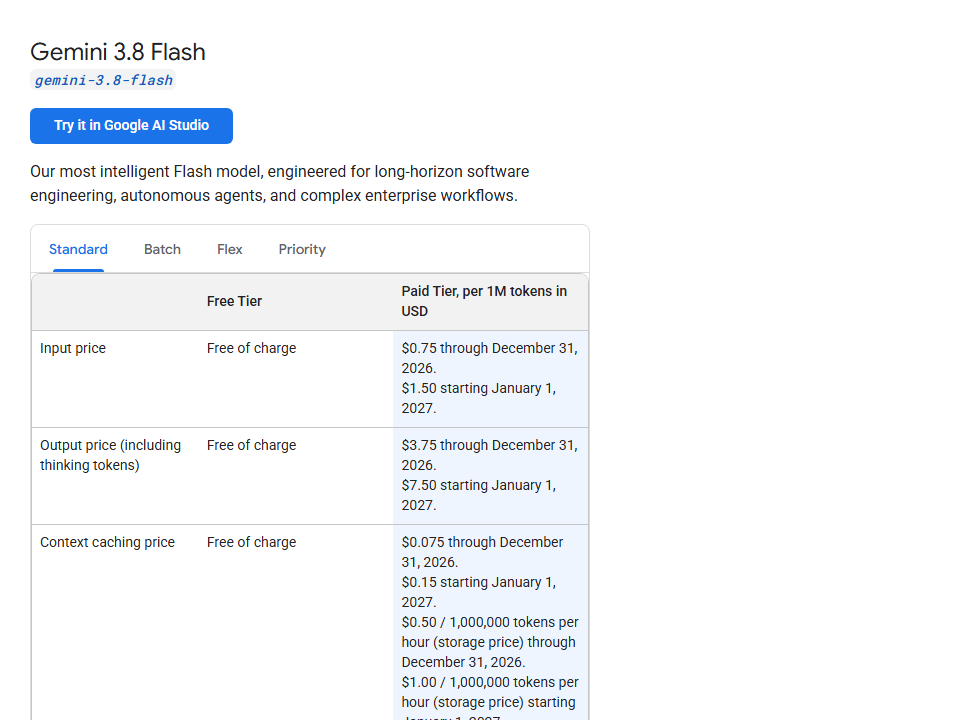
Two things stand out. On the consumer side, Gemini is cheaper at every step and bundles storage your team probably pays for already. On the API side, Grok’s flagship output price is half of Gemini Pro’s, which matters if you generate long drafts or run batch jobs. If you are wiring an assistant into a content pipeline, run a cost check on your own token volumes before you pick on vibes.
Grok vs Gemini on six marketing jobs
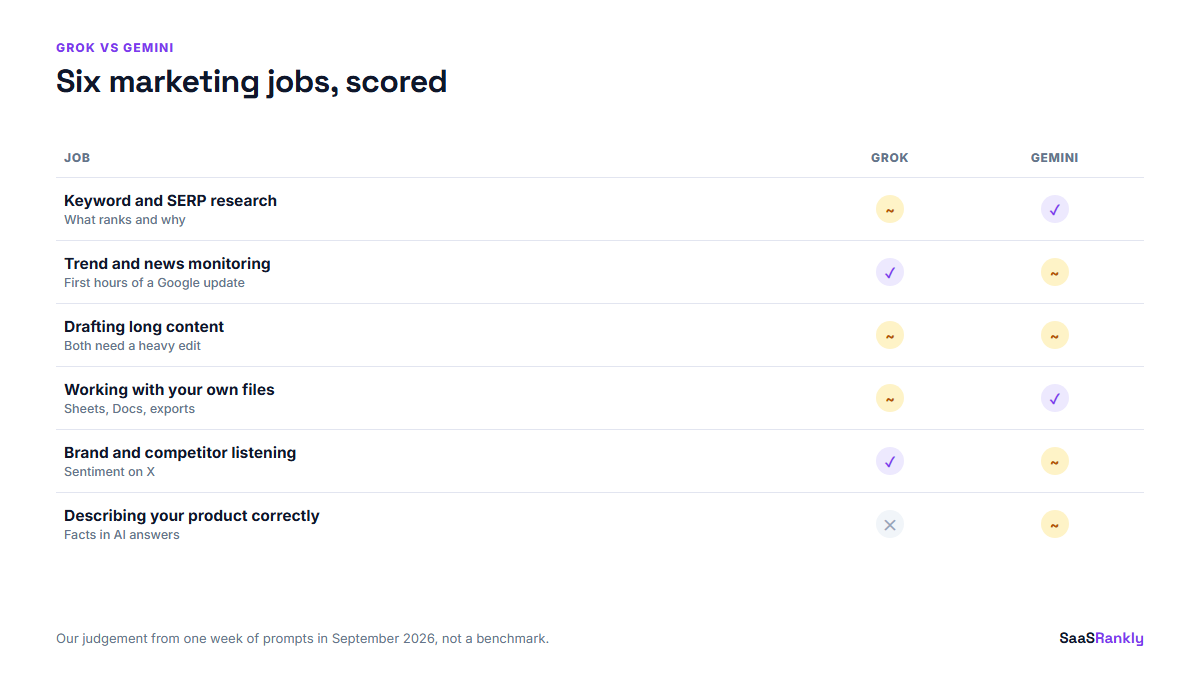
We think the fair way to settle Grok vs Gemini is by the jobs a SaaS marketing team actually does. We gave both paid tiers the same prompts over a week in September 2026 and scored each job as a clear win, a partial result or a miss. The scorecard below is our judgement, not a benchmark, and your prompts may shift a row or two.
1. Keyword and SERP research
Gemini wins, and it is not close. Ask it what ranks for a query and it answers from the same index that builds the results page, with links you can check. Grok can search the web, but its answers on “what ranks for X” drifted toward whatever was being discussed on X that week. For intent checks we still run terms through our keyword intent classifier and use the assistant for the explanation, not the verdict.
2. Trend and news monitoring
Grok wins. When a Google update rolls out, the first useful chatter shows up on X hours before any write-up, and Grok reads it directly. It is also blunt about uncertainty when you ask it to separate confirmed facts from rumours. Gemini caught up within a day in our tests, but a day is a long time when a client is asking why traffic dropped.
3. Drafting long content
Partial for both. Gemini produced tidier structure and fewer invented statistics. Grok’s drafts had more personality and more confident claims we could not source. Neither draft was publishable without a heavy edit, and we would not want either near a page without a human who knows the topic. Our SEO writing guide covers the edit pass we run on any assisted draft.
4. Working with your own files
Gemini wins for anyone on Google Workspace. It reads a Sheet of Search Console exports or a Doc of briefs where they already live. Grok handles uploads well, but uploading is a step, and steps get skipped.
5. Brand and competitor listening
Grok wins on X specifically. If your buyers argue about tools on X, Grok summarises the mood around a competitor launch better than anything else we tried. For review sites, Reddit and forums, Gemini’s broader web search was more even.
6. Checking how AI answers describe your product
Both matter, and neither wins. This is the job most teams forget. Buyers ask these assistants “best tool for X” questions, and the answer shapes the shortlist before anyone lands on your site. Gemini’s answers track Google rankings closely. Grok’s lean more on what people say on X and on the pages its crawler reads. We cover how to measure this across engines in our post on LLM visibility.
A worked example: one SaaS brand, 30 prompts
Here is an illustrative example built from the pattern we see in client tests. “Fieldnote” is a made-up meeting notes app with decent Google rankings and an active founder on X. We asked both assistants 30 buyer questions, ten in each group below, and logged whether Fieldnote was mentioned and whether the facts were right. The numbers are invented to show the method, not measured on a real product.
| Prompt group (10 each) | Grok mentions | Gemini mentions | Wrong facts (Grok / Gemini) |
|---|---|---|---|
| “Best meeting notes app for X” | 4 | 7 | 2 / 1 |
| “Fieldnote vs competitor” | 8 | 9 | 3 / 1 |
| “Fieldnote pricing and features” | 9 | 10 | 4 / 2 |
| Total out of 30 | 21 | 26 | 9 / 4 |
Read across the rows and the Grok vs Gemini gap turns into a to-do list. Gemini already knows Fieldnote because the pages rank, so the fix there is keeping pricing and feature pages current. Grok mentions it less and gets more facts wrong, mostly old prices it picked up from posts. The fix is a pinned post with current pricing and a clear, crawlable pricing page. Whether you allow xAI’s crawler at all is a separate decision, and our GPTBot post walks through the same allow or block logic for OpenAI.
Where each one gets its facts
This is the part that decides most SEO questions. Gemini grounds on Google Search. When it cites a page, that page is usually already ranking, so ordinary SEO work feeds straight into Gemini visibility. That is the same pattern we described in Google AI vs ChatGPT.
Grok has two sources that matter: live posts on X, and web search. The X side is its strength and its weakness. It is fast and unfiltered, which is great for sentiment and bad for facts that someone got wrong in a viral post. In our tests, Grok repeated a competitor’s outdated price three times because a popular thread quoted it.
For a SaaS brand the practical read is simple. If you want Gemini to describe you correctly, rank and keep your pages accurate. If you want Grok to describe you correctly, do that and also say the right things, often, on X.
Grok vs Gemini decision matrix
| If your situation is… | Pick | Why |
|---|---|---|
| Small team on Google Workspace, SEO is the main channel | Gemini | Cheaper, reads your files, grounds on Google |
| Your buyers live on X (dev tools, crypto, AI products) | Grok | Real-time sentiment and launch monitoring |
| You run PR or news-driven content | Grok, plus Gemini free | Speed on breaking stories, Gemini to fact-check |
| You build batch content or classification jobs by API | Test both | Grok’s flagship output is cheaper, Gemini Flash is cheaper still |
| You only want one subscription | Gemini | Broader coverage for most marketing jobs |
Our opinion, for what it is worth: the Grok vs Gemini choice matters less than whether you check the answers at all. Most teams we audit have never asked either assistant what it says about their own product. Do that first. If you want a tool to track it, our roundup of AI visibility software compares the options that cover both engines.
Quick recap: grok vs gemini
- Gemini is the better default for SEO and content work because it grounds on Google Search and Workspace.
- Grok is stronger for real-time news, launch monitoring and sentiment on X.
- Consumer plans: Google AI Pro about $20 a month vs SuperGrok about $30 a month at the time of writing.
- API: Grok 4.7 output is half the price of Gemini 3.1 Pro, but Gemini Flash is the cheapest option overall.
- Neither writes publishable content alone. Both need an expert edit.
- Check what both assistants say about your product, and fix pricing pages and X posts where they get it wrong.
FAQ
Is Grok better than Gemini?
For real-time questions and anything happening on X, yes. For research, documents and search-related work, Gemini is usually better. In a straight Grok vs Gemini choice for a marketing team, we lean Gemini.
Which is cheaper, Grok or Gemini?
Gemini is cheaper on consumer plans at every tier at the time of writing. On the API, Grok 4.7 has cheaper output than Gemini 3.1 Pro, while Gemini 3.8 Flash is the lowest price of the lot until its January 2027 increase.
Does Grok use Google search results?
No. Grok combines live X data with its own web search. That is why its answers can differ sharply from Google’s rankings and from Gemini on the same question.
Can I use Grok or Gemini for keyword research?
You can use them to brainstorm and explain intent, but not to size keywords. Neither gives reliable search volumes. Pull numbers from a keyword tool or Search Console and use the assistant to group and interpret them.
How do I get my brand mentioned by Gemini?
Rank for the underlying queries and keep your key pages accurate. Gemini leans on Google’s index, so the pages that already rank are the ones it cites.
How do I get my brand mentioned by Grok?
Make sure xAI’s crawler can reach your pricing and feature pages, and post clear, current facts on X. Grok weighs what people say there heavily, so an old viral post with a wrong price can outrank your own page in its answers.