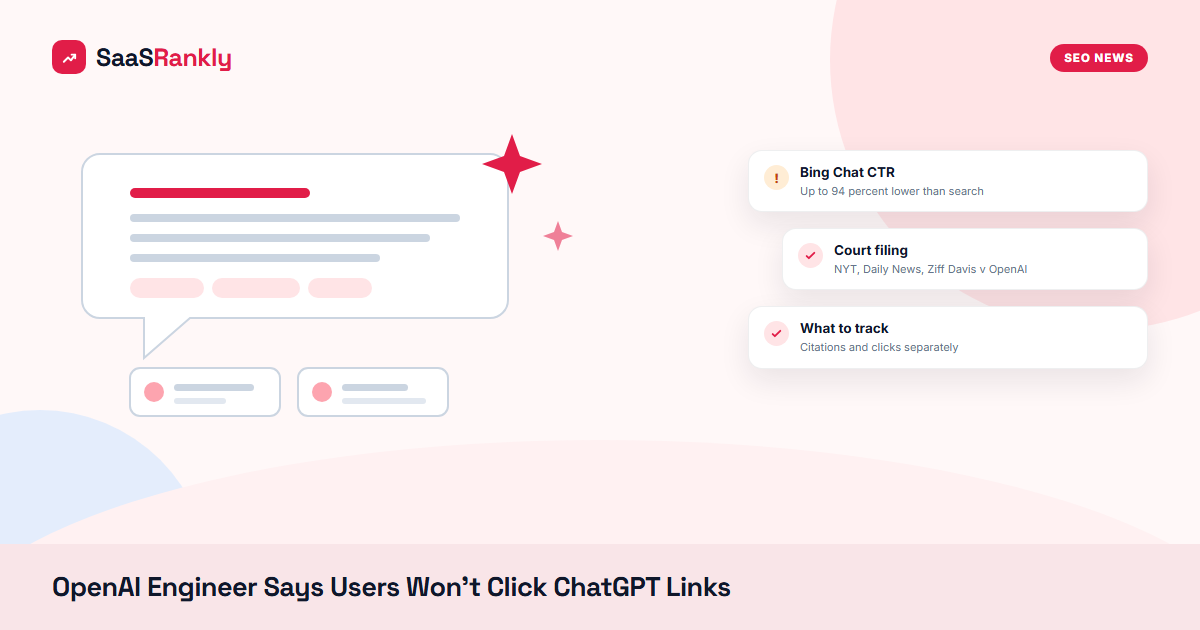
What happened: A court filing reported on September 28, 2026 quotes an OpenAI engineer writing, back in February 2023, that “no matter how prominently we show the links, users won’t click.” The line sits in a summary judgment brief that The New York Times, Daily News and Ziff Davis filed on September 17 in their consolidated copyright case against OpenAI and Microsoft. The same brief says Nick Turley, head of ChatGPT, told colleagues there was “no good reason to click” on a source once ChatGPT had answered. For anyone counting on ChatGPT links as a traffic source, that is the most candid statement we have seen from inside the company.
Source(s): Search Engine Journal report (Sept 28, 2026) and the publishers’ memorandum of law (PDF, filed Sept 17, 2026).
Why ChatGPT links matter for SaaS sites
Most SaaS teams we talk to have added “get cited by ChatGPT” to their plan this year. That is a fair goal. The problem is the quiet assumption underneath it: that a citation turns into a visit the way a blue link does. The filing says the people who built the product did not expect that, and wrote it down more than three years ago.
The publishers also put numbers on it. They compared click-through rates for their own pages in Bing Chat against Bing web search. The gap is not small.
| Publisher group | CTR drop in Bing Chat vs Bing web search |
|---|---|
| New York Times sites | 87% to 93% lower |
| Daily News sites | 83% to 91% lower |
| Ziff Davis sites | 51% to 94% lower |
These are news publishers, and a news answer is easy to consume without clicking. A SaaS query like “best onboarding tool for a 20-person team” is different, because the buyer still has to sign up somewhere. So ChatGPT links probably lose less value on commercial software prompts than on headlines. Still, if you are reporting AI visibility to leadership as if every mention equals a session, this filing is a good reason to stop.
OpenAI and Microsoft dispute the case and argue fair use. Both filed their own summary judgment motions on September 4. Nothing here is a ruling yet. What is new is the internal view of clicks, and that part does not depend on who wins.
What the filing says about ChatGPT links vs citations
- Appearing is not the same as being visited. The brief separates citation counts from actual clicks, which is the same split we keep seeing in LLM visibility tracking.
- Link placement did not fix it. The engineer’s point was that making ChatGPT links more prominent would not change behavior. That matches what we saw with external links in AI Overviews: more links shown, modest change in clicks.
- The answer is the product. “No good reason to click” describes the design goal. Your page is a source for the answer, not the destination.
- Timing. The quote is from February 2023, before ChatGPT search launched. OpenAI has added source cards since then, so treat the numbers as direction, not a current benchmark.
What to do with ChatGPT links in your reporting
- Split the metric in two. Track “cited in ChatGPT” and “sessions from chatgpt.com” as separate lines. In GA4, filter referral traffic for chatgpt.com and compare it month over month against your citation counts. Our GA4 and Search Console setup guide covers the channel grouping.
- Make the mention do the selling. If users rarely click ChatGPT links, the words ChatGPT repeats about you carry the weight. Put your product name, the category and one clear differentiator in the same sentence on your key pages, so the answer itself names you correctly.
- Give people a reason to click. Pages with something the answer cannot reproduce get clicked more: a calculator, a free tool, live pricing, a template. Answer-only pages are the ones that get summarized and skipped.
- Watch branded search. The real payoff from a ChatGPT mention often shows up later as a branded Google query or a direct visit. Watch branded impressions in Search Console alongside your AI citation tracking.
One more practical note. If you are deciding whether to block OpenAI’s crawlers because the traffic is not there, read our GPTBot guide first. Blocking training bots and blocking search retrieval are different decisions, and the second one removes you from answers entirely.
Quick recap: ChatGPT links
- A court filing quotes an OpenAI engineer saying users won’t click ChatGPT links, however prominent they are.
- Publishers measured 51% to 94% lower CTR in Bing Chat than in Bing web search for their own pages.
- ChatGPT links likely hold more value for software buying prompts than for news, but expect far fewer clicks than a Google ranking.
- Report citations and ChatGPT link clicks as two separate numbers.
- Write pages so the ChatGPT answer names your product correctly even when nobody clicks.
- Build tools and data on key pages so ChatGPT links have a reason to be clicked.