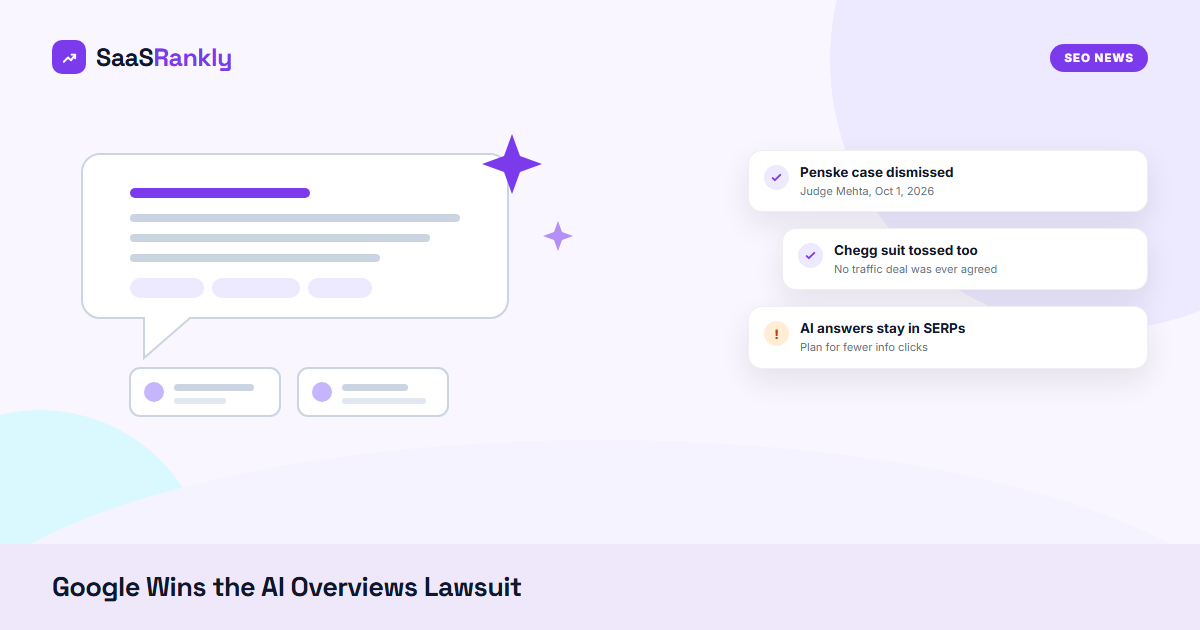
What happened: On October 1, 2026, US District Judge Amit Mehta dismissed the AI Overviews lawsuit that Penske Media (owner of Rolling Stone, Billboard, Variety and The Hollywood Reporter) brought against Google, and threw out a similar case from Chegg in the same ruling. The publishers argued that Google forces sites to hand over content in exchange for search traffic, then uses that content in AI Overviews so people never click. The judge did not buy the legal theory. His key line: “an expectation is not an agreement.”
Source(s): Press Gazette, TheWrap and Search Engine Roundtable.
Why the AI Overviews lawsuit failed
Penske’s case rested on two ideas. The first was a “reciprocal dealing” argument: publishers let Googlebot crawl their pages for free, Google sends traffic back, and that swap is a bargain Google broke when AI Overviews started answering queries on the results page. The second was a tying claim, treating classic search and AI Overviews as two products that Google bundles so publishers cannot opt into one without the other.
Judge Mehta rejected both. On the bargain point, he wrote that the publishers pleaded only an “expectation” that Google would send traffic if content was free to crawl, and that this is not a deal. There were no negotiated terms, no promised amount of traffic and no mutual commitments. Crawling plus normal search referrals do not add up to a contract that antitrust law can enforce.
That said, the ruling was not a love letter to Google. Mehta, the same judge who found Google holds an illegal monopoly in search, acknowledged “the knock-on consequences to journalists, educators, and other online creators” whose content Google repurposes without paying for it. He just said this lawsuit was the wrong tool to fix it.
The AI Overviews lawsuit at a glance
| Item | Detail |
|---|---|
| Ruling date | October 1, 2026 |
| Court | US District Court for the District of Columbia, Judge Amit P. Mehta |
| Plaintiffs | Penske Media Corporation, plus Chegg in a parallel case |
| Main theories | Implied traffic-for-content bargain (reciprocal dealing) and tying search to AI Overviews |
| Harm claimed | Penske said organic affiliate revenue fell by more than a third from its peak to the end of 2024 |
| Outcome | Both suits dismissed; no formal agreement was shown |
Why this matters for SaaS sites
Most SaaS marketers will never sue Google, so it is easy to file this under “media industry drama.” I think that is a mistake. The ruling settles, at least for now, one practical question: AI Overviews are not going anywhere because of a court, and Google has no legal duty to send you a set amount of clicks for the content it reads.
For a SaaS blog, that changes how you plan. If your traffic model assumes that ranking in the top three for “how to do X” will keep delivering the same visits, the AI Overviews lawsuit result says nobody is coming to rescue that model. Informational queries will keep getting answered on the results page. We already saw AI Overviews return on branded searches, with 93% of big brands now showing one (our report on that here), so even your own brand terms are in play.
There is a quieter point too. Google-Extended, the robots token many people reach for, controls Gemini training and grounding. It does not remove you from AI Overviews in Search. The only real levers today are snippet controls like nosnippet and max-snippet, which also shrink your normal search snippets. Press Gazette notes Google is rolling out further opt-out controls in some markets under UK regulator pressure, but nothing global has landed yet. For most SaaS companies, blocking is a worse deal than being cited.
What to do after the AI Overviews lawsuit ruling
- Measure AI Overview exposure by page type. In Search Console, compare impressions and CTR for your informational posts against product, pricing and comparison pages over the last six months. If clicks fell while impressions held, AI answers are likely eating them. Our GA4 and GSC measurement guide shows how to set up the split.
- Write to be cited, not just ranked. Put a clear, quotable answer near the top, back it with your own numbers or screenshots, and name your product where it fits. Our guide to AI Overviews visibility for SaaS covers the formats that get pulled in.
- Shift effort toward bottom-funnel pages. Comparison, alternatives, integration and pricing pages still earn clicks because the user needs to act, not just learn. Give them more internal links and fresher updates.
- Do not reach for nosnippet in a panic. Test it on a handful of low-value pages first and watch CTR for four weeks. On most SaaS sites, losing the snippet costs more than the AI Overview takes.
One more note while we are on Google news: the September 2026 spam update hit a second wave on September 30, according to site owners who reported sharp drops that day. If you see a dip around then, check that first before blaming AI Overviews.
Quick recap: AI Overviews lawsuit
- The Penske AI Overviews lawsuit was dismissed on October 1, 2026 by Judge Amit Mehta.
- Chegg’s similar AI Overviews case was thrown out in the same ruling.
- The court said an expected flow of traffic is not a contract, so the AI Overviews lawsuit had no deal to enforce.
- The judge still flagged real harm to creators whose work Google reuses without pay.
- After the AI Overviews lawsuit, SaaS teams should plan for fewer informational clicks and more value from being cited.
- Track CTR by page type, strengthen bottom-funnel pages, and test snippet controls carefully before using them site-wide.