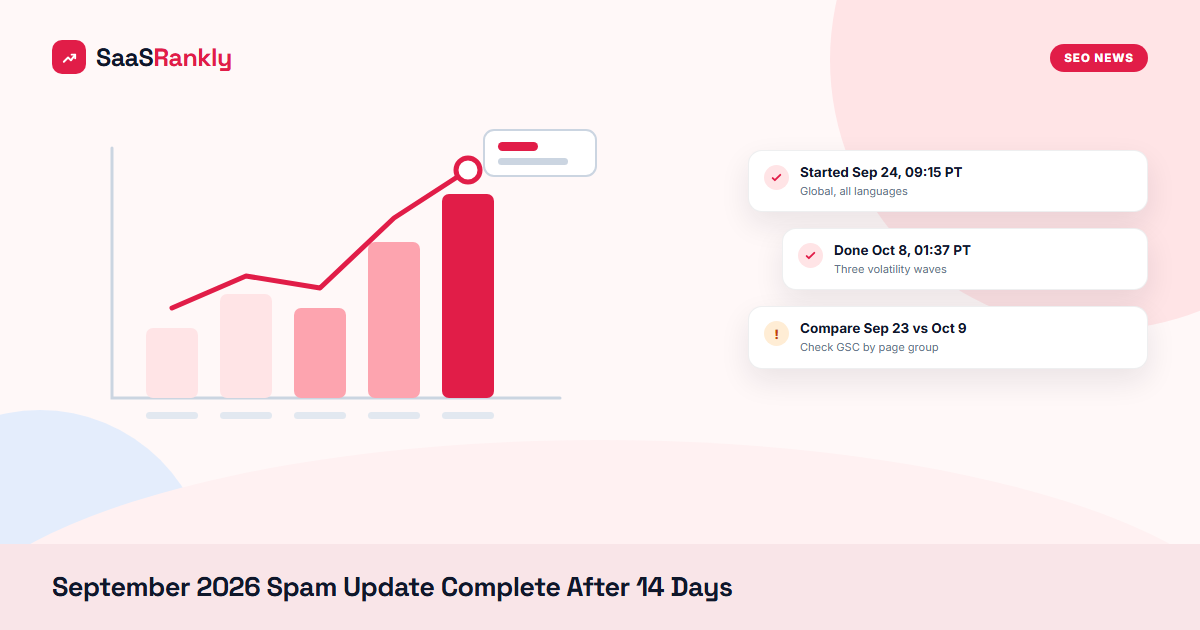
What happened: The September 2026 spam update is complete. Google marked the rollout finished on October 8, 2026 at 1:37 a.m. PT, with a one-line note on the Search Status Dashboard: “The rollout was complete as of October 8, 2026.” The update started on September 24 at 9:15 a.m. PT, so the September 2026 spam update complete notice lands exactly 14 days later. That matches the “up to two weeks” Google promised at launch, and it is far longer than the two to three days most recent spam updates took.
Source(s): Google Search Status Dashboard incident and Search Engine Roundtable’s completion report. We covered the start of the rollout in our original September 2026 spam update post.
Why the September 2026 spam update complete notice matters for SaaS sites
While a spam update is still rolling out, any traffic number you look at is a moving target. You can see a drop on Monday and a partial bounce on Thursday, and neither tells you where you will settle. Now that the September 2026 spam update is complete, the rankings you see this week are close to the new baseline. That is the first point where a real before-and-after comparison makes sense.
This one also behaved differently. Rank trackers showed three separate waves of movement instead of one spike, and some site owners in the forums described drops that felt closer to a core update than a spam update. If your SaaS blog or tool pages moved in late September or the first week of October, this is the most likely cause, and you can now measure it properly.
Spam updates hit things like scaled low-value content, expired domain abuse, site reputation abuse (third-party pages riding a strong domain) and link schemes. SaaS sites tend to get caught on two of those: programmatic pages built at scale with thin templates, and guest posts or “partner” pages on the main domain that have nothing to do with the product.
Rollout timeline at a glance
| Date | What happened |
|---|---|
| Sep 24, 9:15 a.m. PT | Google releases the September 2026 spam update, global, all languages |
| Sep 25 to 27 | First wave of volatility across trackers |
| Sep 30 | Second spike |
| Oct 4 to 6 | Third and final wave, reported widely in SEO forums |
| Oct 8, 1:37 a.m. PT | Google confirms the rollout is complete (about 14 days total) |
Search Engine Roundtable counted volatility on 13 tracking tools during the final phase, including Semrush, Mozcast, Sistrix, Advanced Web Ranking and AccuRanker. A few site owners reported very large losses (one news publisher said earnings were down 80%), but most SaaS sites we watch saw small or no movement.
What to do now that the rollout has finished
- Compare clean date ranges in Search Console. Use September 10 to 23 as “before” and October 9 onward as “after”. Skip the rollout window itself. Filter by page type (blog, comparison pages, integration pages, programmatic templates) instead of looking at the whole site. Our GA4 and GSC measurement guide shows how to set up those page groups.
- Look for a pattern before you touch anything. If the loss sits mostly in one template, like thousands of near-identical “X alternative” or “integration with Y” pages, that template is the problem. If it is spread evenly across the site, check links and any third-party content hosted on your domain.
- Fix the cause, not the symptom. Merge or noindex thin programmatic pages, remove or move off-topic sponsored sections, and stop any paid link deals that look like a scheme. Google says spam-related recovery can take months, because systems need to see the site follow the policies over time. A disavow file rarely helps here, since Google mostly ignores spammy links instead of counting them against you.
- Don’t confuse it with other changes. Google also published new crawl rate guidance this week. If your crawl stats dropped too, read our post on the Retry-After header to rule out a server-side cause.
If you did nothing wrong and still lost a few positions, give it a week. Some movement after a spam update is just other sites losing ground and the SERP reshuffling around them. Gains can work the same way: a competitor that relied on bought links may have dropped, and you moved up by default.
Quick recap: September 2026 spam update complete
- The September 2026 spam update is complete as of October 8, 2026, per the Google Search Status Dashboard.
- The September 2026 spam update took about 14 days, much longer than August’s two-day rollout.
- Volatility came in three waves: Sep 25 to 27, Sep 30 and Oct 4 to 6.
- With the September 2026 spam update complete, compare Sep 10 to 23 against Oct 9 onward in Search Console.
- Check programmatic templates, hosted third-party content and paid links first.
- Recovery from the September 2026 spam update is slow; fix the policy issue and wait for systems to re-evaluate.