People still type it as eat seo, from the years before Google added a second E, and the question behind the search has not changed: how does Google decide whether a page deserves to be believed, and what can a site do about it? For SaaS companies the honest answer is less mystical than most guides make it. E-E-A-T is not a score and there is no tag for it. It is a description of what a trustworthy page looks like, and most of the work is making visible the experience your team already has.
What EAT SEO Means Now That There Are Two Es
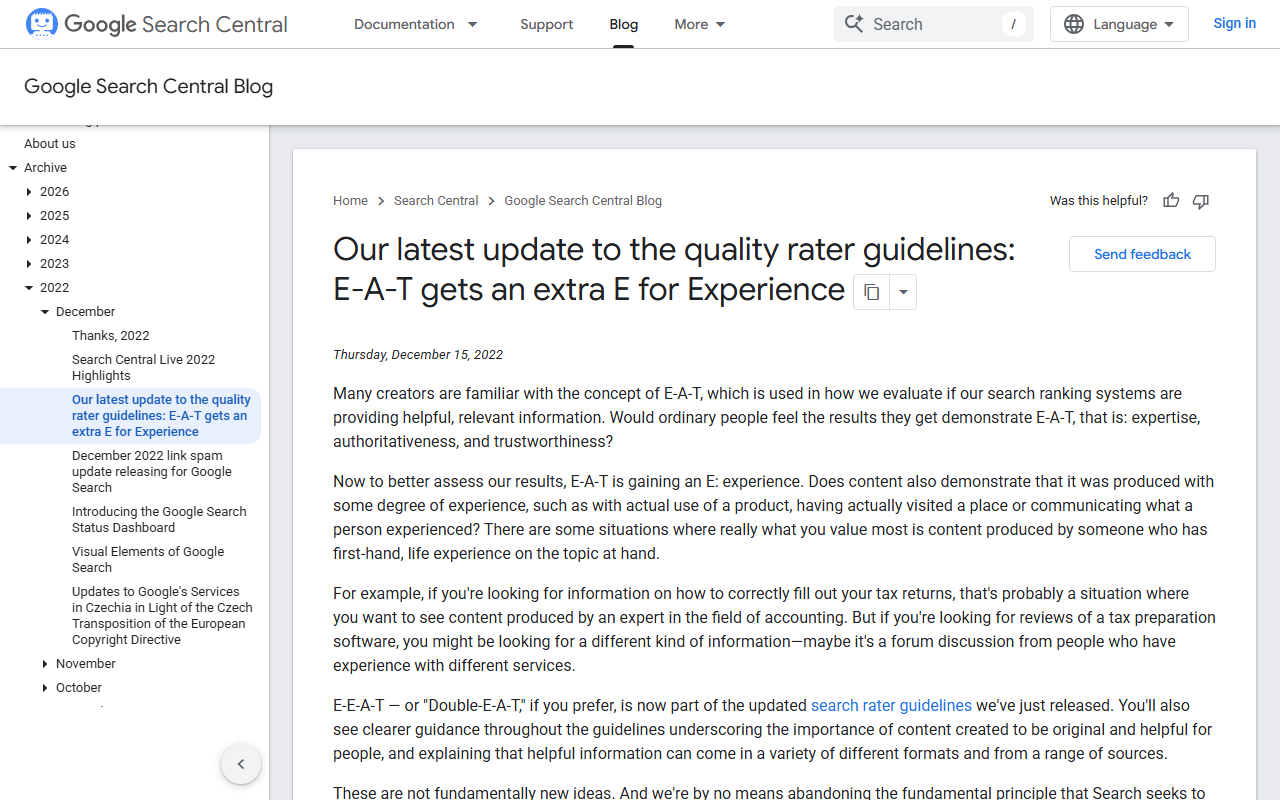
The letters stand for Experience, Expertise, Authoritativeness and Trust. They come from Google’s Search Quality Rater Guidelines, the handbook used by the human raters who evaluate search results. Experience was added in December 2022, and Google’s announcement was plain about the hierarchy: trust is the most important of the four, and the other three are ways of earning it.
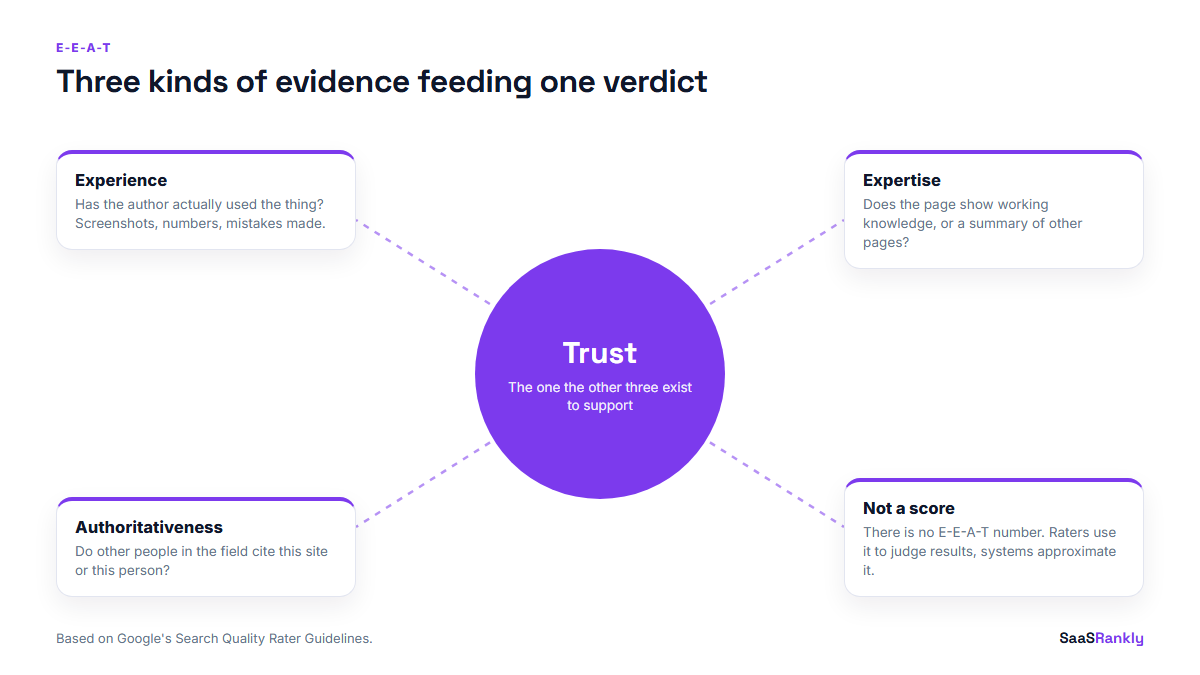
Two things follow from that for anyone doing eat seo work. First, you cannot “add E-E-A-T” to a page the way you add a meta description. Second, anything that makes a real reader trust the page more is pointed in the right direction, and anything that only imitates those signals is not.
EAT SEO for SaaS: What Counts as Experience
This is where EAT SEO gets practical. SaaS teams sit on first-hand experience and then publish pages that hide it. The table is the pattern we see, with the fix beside it.
| What the page claims | Thin version | Version that shows experience |
|---|---|---|
| We know this workflow | Generic five-step list | The same steps with a real screenshot of each screen and the setting people get wrong |
| Our tool is faster | “Blazing fast” in the hero | A timed comparison with the method stated, including where you lost |
| We understand the buyer | Persona paragraph | Three questions lifted from actual sales calls, answered straight |
| We compared the alternatives | Feature grid copied from pricing pages | Notes from signing up to each one, with the date you did it |
| This advice works | “Studies show” | The named study with a link, or your own numbers labelled as yours |
Look at the right-hand column again. None of it needs a bigger budget. It needs the writer to talk to someone who does the work, or to do the work. That is why we keep saying that a content team which never sits in a demo produces pages that read as if nobody was there, because nobody was. The briefing process that forces this is in our post on content SEO.
The Author Layer of EAT SEO: Bylines, Bios and a Team Page
Experience has to belong to someone. A post signed “Admin” or “Marketing Team” gives a reader nobody to believe. The fix is unglamorous site plumbing, and we rebuilt ours recently, so here is the checklist we worked from.
- A real name on every post, and that person is actually responsible for what it says.
- An author box under the post with one or two lines on what this person covers, not a career history.
- An author archive that lists everything they have written, so a reader can judge the body of work.
- A profile link that leaves your site, usually LinkedIn, so the person can be checked independently.
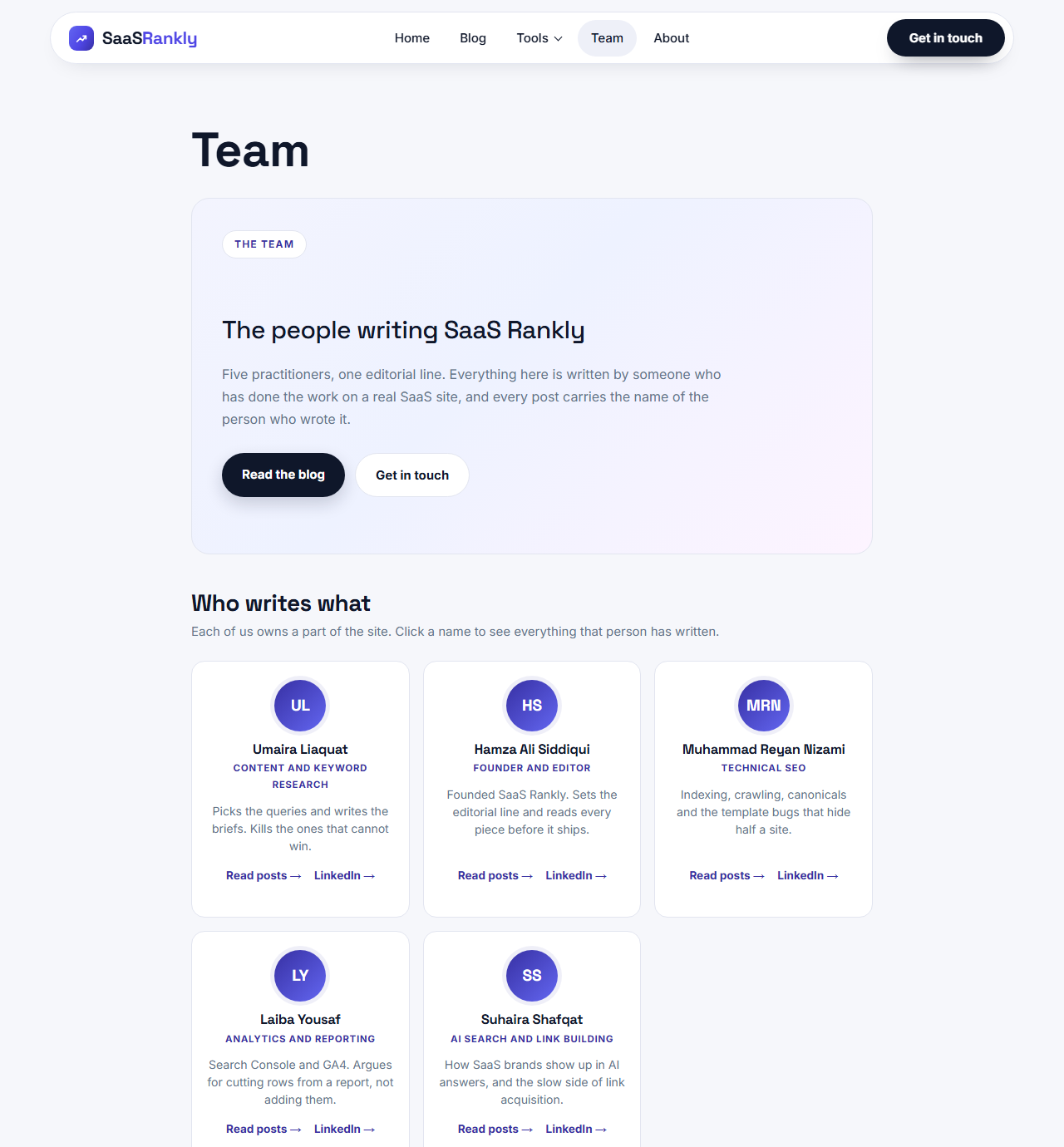
- A team page that says who covers what. Ours is at saasrankly.com/team.
- An editorial policy that states how examples, numbers and corrections are handled. Ours is here.
Add Person and Organization structured data if you can, because it helps machines connect the name on the page to the same name elsewhere. It is a label on the jar, not the contents. Our schema generator will produce the markup, and no amount of markup rescues a byline that belongs to nobody.
One warning, because we have seen it go wrong. Invented authors with stock photos are worse than no authors. They fail the moment anyone looks, and the people who look include journalists deciding whether to cite you.
EAT SEO Myths That Waste Time
“E-E-A-T is a ranking factor.” Not as a single measurable thing. Google has said its systems look for signals that line up with these qualities. There is no E-E-A-T score to raise, and tools that show you one have made it up.
“You need credentials.” For medical or legal content, formal expertise matters a great deal. For a guide to setting up webhooks, the person who has set up a hundred webhooks is the expert, degree or not. The guidelines say as much about everyday topics.
“An author bio fixes it.” A bio on top of a generic article is a costume. The experience has to be in the article.
“Only YMYL sites need to care.” Your Money or Your Life topics get the strictest standard, and plenty of SaaS sits closer to that line than it thinks. Payroll, invoicing, health data, security and anything touching compliance all affect someone’s money or safety. If that is your category, accuracy and sourcing deserve a review step, not just an edit.
A 30-Day EAT SEO Plan for a Small Team
- Week 1. Put real names on every post. Build author boxes, author archives and a team page. Write the editorial policy, even if it is five sentences.
- Week 2. Take your ten highest-traffic posts. For each, add one thing only you could add: a screenshot from your own product, a number from your own data, a mistake you made and what it cost.
- Week 3. Fix sourcing. Every statistic gets a named source and a date, or gets cut. Every illustrative example gets labelled as illustrative. The house rules we use are in our SEO writing post.
- Week 4. Work on being cited. Publish one piece of original data, however small, and tell the people who write about your category. Authoritativeness is other people’s opinion of you, so it cannot be built on your own site alone. The AI-search side of this is covered in how to get cited by ChatGPT.
None of this eat seo work shows up in rankings next Tuesday. It shows up as pages that survive quality updates instead of dipping with each one, and as more people willing to link to you, which is the slow version of the same thing. The on-page basics that sit underneath are in what is on-page SEO.
Quick recap: eat seo
- E-E-A-T is Experience, Expertise, Authoritativeness and Trust, with trust at the centre.
- It comes from the rater guidelines and is not a score you can measure or raise directly.
- For SaaS, experience means showing the work: real screens, real numbers, real mistakes.
- Give every post a real, checkable author, plus an archive, a team page and an editorial policy.
- Fake authors and bios on generic articles do more harm than having neither.
- Good eat seo work is mostly making visible the experience your team already has.
FAQ
What does eat seo stand for?
Originally Expertise, Authoritativeness and Trustworthiness. Since December 2022 it is E-E-A-T, with Experience added at the front. The shorter spelling survives because people still search for it that way.
Is E-E-A-T a direct ranking factor?
No. It is a framework human raters use to assess result quality. Google’s ranking systems use many signals that aim at the same qualities, but there is no single E-E-A-T value attached to your page or site.
How do I show experience in a blog post?
Include things only someone who did the work would have: your own screenshots, your own measurements with the method stated, specific settings and what goes wrong with them. If a paragraph could have been written without touching the product, it is not showing experience.
Do I need author pages for E-E-A-T?
They are not required by any rule, but they make it possible for a reader to check who is speaking, and that is the point. A name, a short coverage line, a list of their posts and one external profile link is enough.
Does eat seo matter for AI search results?
It appears to matter more. AI answers quote pages with specific facts, named sources and clear authorship far more readily than vague overviews, because those are the pages that are safe to quote.
Is my SaaS a YMYL site?
If wrong information on your pages could cost a reader money, health, safety or legal standing, treat it as one. Finance, payroll, healthcare, security and compliance tools usually qualify. Project management and design tools usually do not.