When a buyer asks ChatGPT “what are the best SEO tools for a B2B SaaS startup”, the answer names five or six products and links a sources panel with the pages it read. If your product is in that list you are in the consideration set before the buyer has opened Google. If it is not, you are invisible to a growing share of evaluations. This guide covers what ChatGPT actually reads, what makes it cite a page, and the work that moves the needle for a SaaS company.
This guide covers get cited by chatgpt for SaaS teams: what it means, why it matters, and the practical steps to get it right.
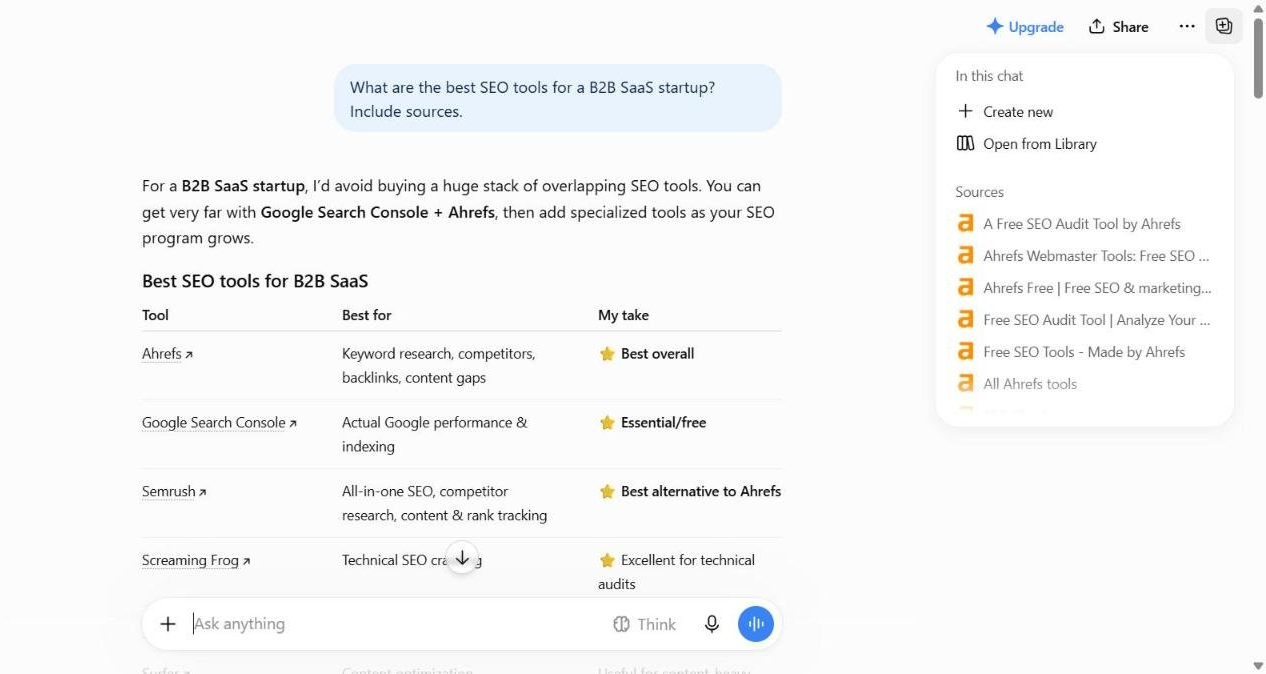
How ChatGPT decides what to cite
Two different things happen depending on the question.
- Answers from training data. For stable, well-known facts ChatGPT answers from what it learned during training. Brands that appear consistently across the web over years get named here. You influence this slowly, through entity consistency and third-party coverage.
- Answers with search. For anything recent, specific or comparative, ChatGPT runs web searches, reads a handful of pages and cites them. The retrieval layer uses Bing’s index. This is where a SaaS site can win within weeks, and it is where the playbook below is aimed.
Pages get cited when they are retrievable (indexed in Bing, crawlable by OpenAI’s bots), relevant to the query (the page answers the exact question), and extractable (the answer is stated plainly near the top, with specifics the model can quote). Authority matters, but in our tracking a well-structured page on a small SaaS site regularly beats a vague page on a big one.
Step 1: Fix Bing first
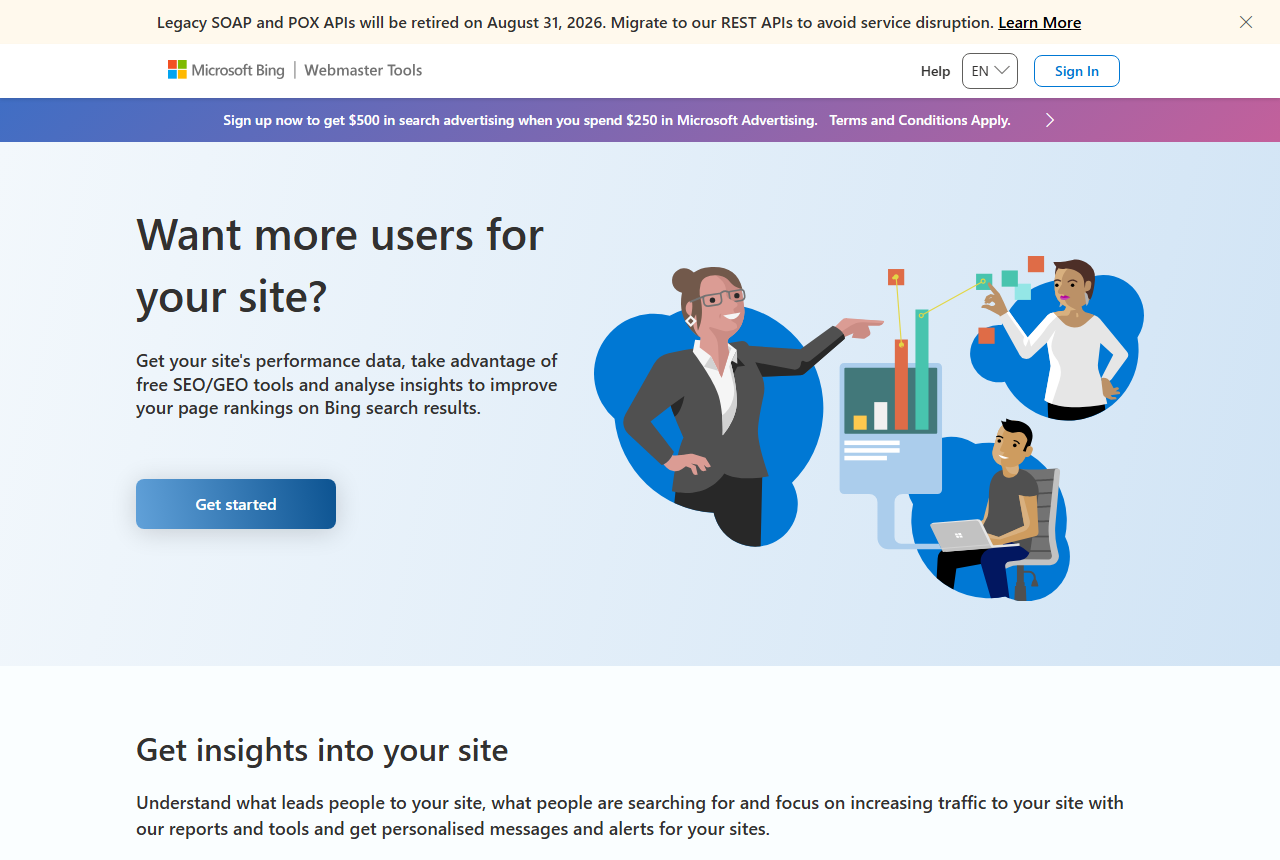
Most SaaS teams have never opened Bing Webmaster Tools. ChatGPT search does. Do this today:
- Verify your site in Bing Webmaster Tools (you can import from Search Console in one click) and submit your sitemap. Check it with the sitemap checker first.
- Check robots.txt allows
OAI-SearchBot(used for ChatGPT search results) andbingbot. BlockingGPTBotonly affects training, not search citations, but many sites blocked everything OpenAI in 2023 and never revisited it. - Use Bing’s URL inspection on your ten most important pages. If they are not indexed in Bing, nothing else in this guide matters yet.
Step 2: Make pages answer-shaped
ChatGPT quotes and paraphrases passages, so the page needs passages worth quoting. For each page that targets a buyer question:
- State the answer in the first 100 words. “Close is a CRM for inbound sales teams of 5 to 50 people; plans start at 49 USD per user.” Not a paragraph about how sales has changed.
- Use question headings. H2s phrased the way people ask: “How much does X cost?”, “Does X integrate with HubSpot?”
- Include specifics. Prices, limits, integration counts, dates, benchmark numbers. Models cite pages that contain facts, because the answer needs facts.
- Add comparison tables. “X vs Y” pages with a real table are cited constantly for “which should I choose” prompts. Our comparison pages guide covers the format.
- Keep a visible updated date and refresh pricing and feature claims quarterly. Stale numbers get corrected by another source, which then gets the citation.
Step 3: Get the entity right everywhere
The model has to be sure that “Acme” on your site, “Acme CRM” on G2 and “acme.io” on Reddit are the same thing. Consistency does that.
- One product name, one description sentence, one category label, used identically on your homepage, About page, G2, Capterra, Product Hunt, LinkedIn, Crunchbase and Wikipedia-style directories.
OrganizationandSoftwareApplicationschema on the homepage withsameAslinks to every profile. Check it with the schema validator.- An About page that says plainly what the product does, who it is for and who makes it. Models read About pages.
Step 4: Earn the third-party mentions that feed the answer
Look at any “best X for Y” answer’s sources: review sites, listicles on industry blogs, Reddit threads, and occasionally a vendor’s own comparison page. To be named in the answer, be present in those sources.
| Source type | What to do |
|---|---|
| G2, Capterra, TrustRadius | Claim the profile, keep the category and description consistent, collect reviews steadily. Category pages on these sites are cited for almost every “best X” prompt. |
| Independent listicles | Find the 10 “best X tools” articles Bing ranks for your category and pitch inclusion with a real angle (a feature they missed, a price change, a data point). See digital PR for SaaS. |
| Reddit and communities | Answer questions in your category honestly, as a named employee, without links in every post. Reddit threads are heavily cited by ChatGPT and Perplexity. |
| Your own comparison and alternatives pages | These get cited for competitor-named prompts. Be accurate about where you lose; models and readers both notice. |
Step 5: Measure citations, not vibes
Set up prompt tracking with one of the AI visibility tools, or run 20 prompts manually once a month. Record three things per prompt: mentioned (yes or no), cited URL (which page), and position in the answer. In GA4, build a referral filter for chatgpt.com and watch signups from it; that is the number that justifies the work. The LLM rank tracking setup guide has the full method.
What does not work
- Stuffing “best CRM” into your homepage. Retrieval is semantic; the model is looking for a page that answers the question, not one that repeats it.
- Publishing 500 AI-written “X vs Y” pages. Thin comparison pages get you filtered by Google’s spam systems, which also cost you the Google AI Overview citations. Mueller’s warning about low-value programmatic pages applies.
- Fake reviews or paid Reddit posts. Both platforms detect them, and models are increasingly trained to discount them.
- llms.txt as a magic file. Publish one if you like; there is no evidence yet that ChatGPT uses it for citations. Indexing and page structure do the work.
Frequently asked questions about ChatGPT citations
Does ChatGPT use Google or Bing?
ChatGPT’s web search retrieval is built on Bing’s index. Google’s own AI features use Google’s index. Perplexity uses its own crawler plus partner indexes. Check all three if you rely on AI citations.
How long does it take to get cited?
For search-backed answers, days to weeks after a page is indexed in Bing and answers the prompt well. For training-data answers, months to years of consistent third-party coverage.
Should I block GPTBot?
Blocking GPTBot stops training use of your content. It does not stop OAI-SearchBot from citing you, as long as that bot is allowed. Decide the two separately.
Do ChatGPT citations send traffic?
Yes, and it converts well because the buyer arrives with a recommendation. Volumes are still small compared with Google for most SaaS sites, which is why the referral signup count, not the session count, is the metric to watch.
Quick recap: Get cited by chatgpt
Get cited by chatgpt usually comes down to a short, repeatable checklist. Use this whenever get cited by chatgpt comes up again:
- Diagnose get cited by chatgpt by checking the relevant report first, not assumptions.
- Confirm the current setup is actually causing get cited by chatgpt before you change anything.
- Re-check get cited by chatgpt again after the fix ships, not before.
Treat get cited by chatgpt as an ongoing signal rather than a one-time fix. For background on the platform rules behind this, see Google Search Central.