SEO benchmarking is the habit of measuring your organic search numbers against a fixed set of competitors, on the same metrics, at the same time every month, so you can tell whether you are gaining ground or just moving with the market. That last part is the reason to do it. A 12 percent drop in clicks looks like a disaster until you see that every site in your category dropped 15 percent the same week.
We run SEO benchmarking for most of the SaaS sites we work on, and the version that survives is always smaller than the first draft. This post is the setup we use now: which rivals to pick, the eight metrics worth comparing, the free and paid tools that feed them, and a worked example with real looking numbers so you can see how the comparison changes a decision.
What SEO benchmarking is, and what it is not
A benchmark is a reference point. In search, the reference point is a short list of sites that compete with you for the same queries, not the companies you compete with in sales. Those two lists overlap less than founders expect. A project management tool might lose deals to Asana, but lose search clicks to a review site, a template marketplace and a university guide on Gantt charts.
SEO benchmarking is also not a one-off competitor audit. An audit asks “what are they doing that we are not?” and produces a to-do list. A benchmark asks “is the gap closing?” and produces a trend line. You need both, but they run on different clocks. We do the audit once a quarter and the benchmark once a month.
And it is not a vanity ranking table. If you have read our take on SERP metrics worth tracking, you already know we drop most of the numbers rank trackers put on the dashboard by default. The same filter applies here.
Step 1: pick five search competitors, not business competitors
We pick five. Fewer and one odd month from a single site skews the picture. More and nobody maintains the sheet past March.
- Export your top 200 non-branded queries from Search Console for the last 3 months.
- Take a sample of 30 of them, weighted toward commercial terms, and check who ranks in the top 5 for each.
- Count how often each domain appears. The five domains with the most appearances are your search competitors.
- Swap out any giant generalist (Wikipedia, Forbes, Reddit) for the next specialist down the list. You will not close the gap on Reddit, and benchmarking against it teaches you nothing.
- Keep one aspirational site that is two or three times your size. It shows you what the next stage looks like.
The sampling step takes about an hour by hand. A rank tracker with a “competitors” view does it faster, and our free SEO tools for keyword research roundup covers which free plans still allow a few competitor domains.
The eight metrics we compare, and where each one comes from
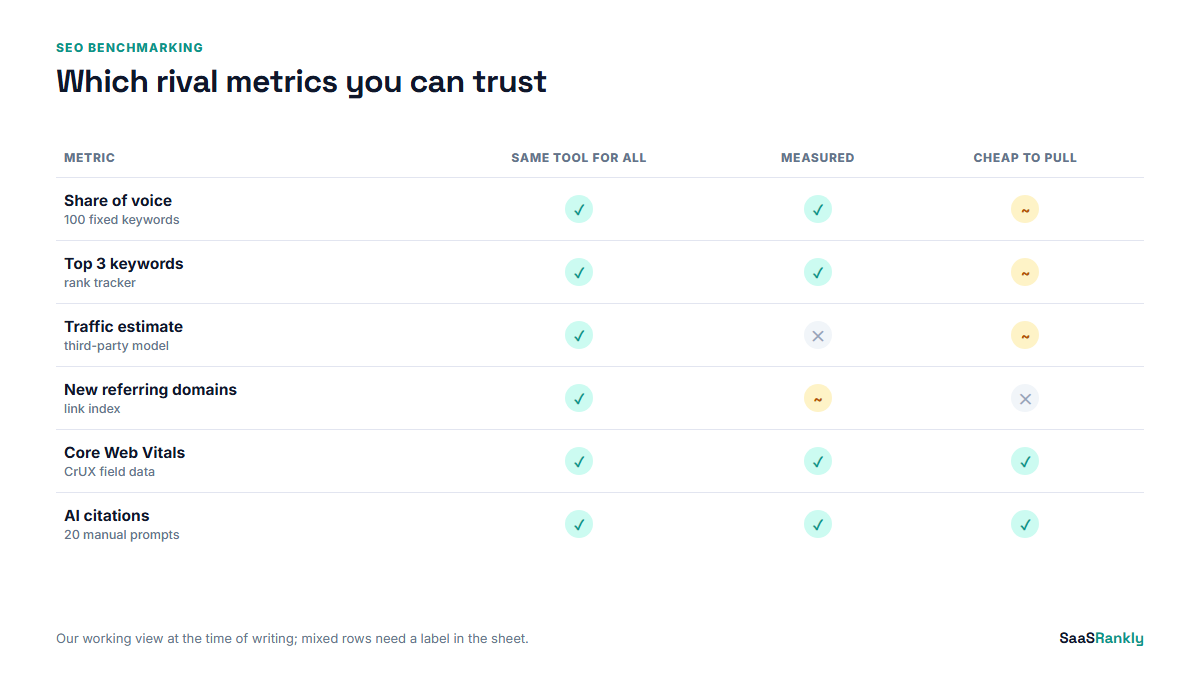
Every SEO benchmarking sheet we build has the same eight rows. The column that matters most is the last one: whether the number is measured or estimated. Mixing the two without labels is the most common mistake we see.
| Metric | Why it matters | Source for you | Source for rivals | Measured or estimated |
|---|---|---|---|---|
| Non-branded organic clicks | The real demand you capture | Search Console | Third-party traffic estimate | Estimated for rivals |
| Keywords in top 3 | Clicks concentrate here | Rank tracker | Same rank tracker | Measured (sampled) |
| Share of voice on a fixed keyword set | The cleanest head-to-head number | Rank tracker | Same rank tracker | Measured (sampled) |
| Referring domains gained per month | Link velocity, not totals | Ahrefs, Semrush or Moz | Same tool | Estimated |
| Indexed commercial pages | How many pages can win money queries | Search Console | Sitemap count | Mixed |
| Core Web Vitals pass rate | Tie-breaker on close SERPs | CrUX / PageSpeed | CrUX / PageSpeed | Measured |
| AI answer citations | Visibility in AI Overviews and chat tools | Manual prompt set | Same prompt set | Measured (sampled) |
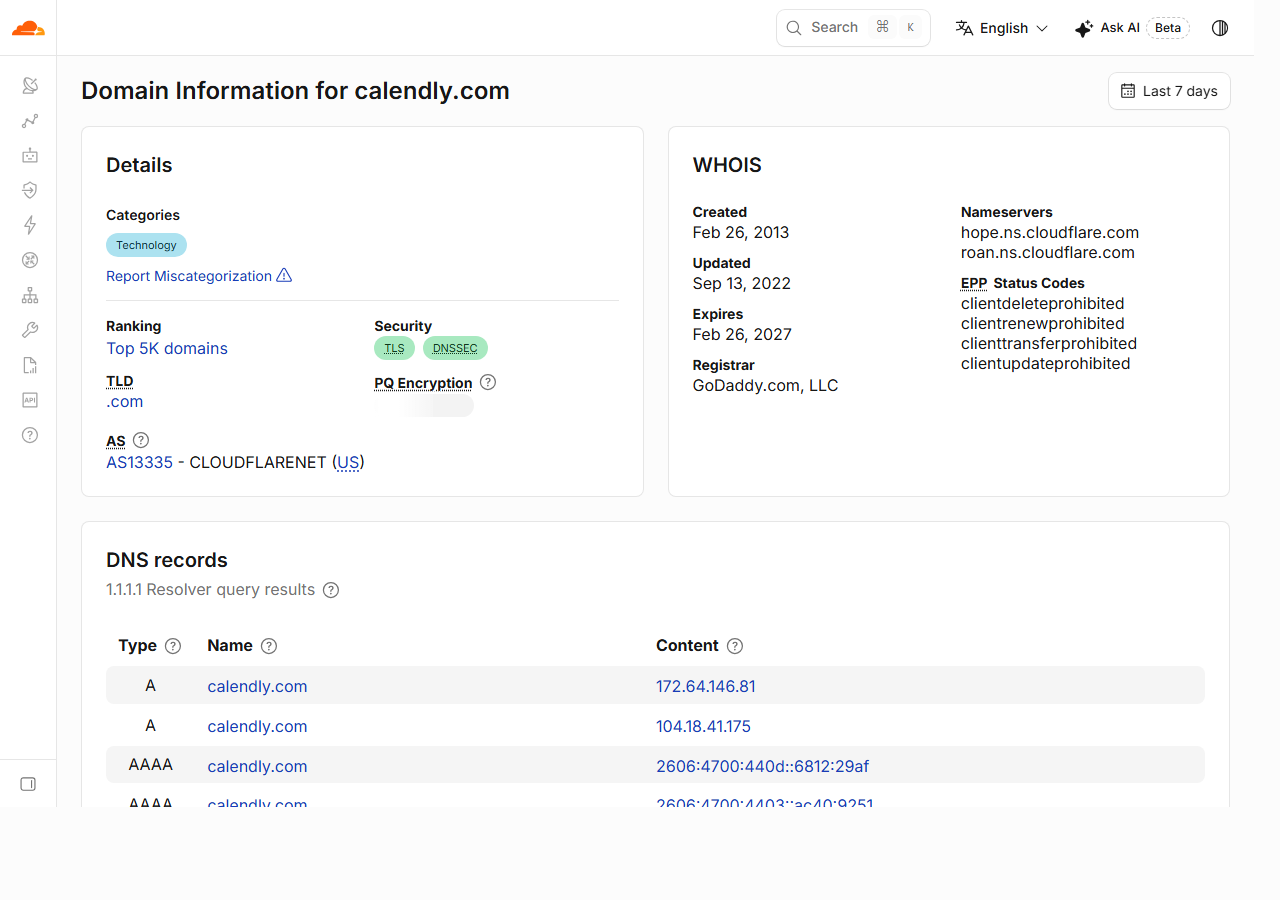
| Domain popularity rank | A rough size check | Cloudflare Radar, Tranco | Same | Measured (coarse) |
Share of voice is the one we would keep if we could keep only one. Pick 50 to 100 keywords that matter to revenue, track all six domains on them, and weight each position by an expected click-through rate. Because every site is measured on the same list with the same tool, the comparison is fair in a way that traffic estimates never are.
For the domain popularity row we use free public rankings. Cloudflare Radar publishes a popularity bucket for most domains, and the Tranco list gives a rank that is harder to game than the old Alexa number. Neither tells you anything about search specifically, but they catch the case where a “competitor” is ten times your size and should not be on the list at all.
The tools that feed an SEO benchmarking sheet
You do not need a dedicated benchmarking product. At the time of writing, this is what our stack costs for a single SaaS site with five rivals:
- Search Console and GA4: free. Your own numbers, measured.
- A rank tracker with competitor tracking: roughly $30 to $60 a month for 100 keywords across six domains. Our cheap rank tracker comparison lists the plans that allow it.
- A link index: Ahrefs Lite starts around $129 a month, Semrush Pro around $140. If that is too much, check rivals once a quarter on a trial or a free plan instead of monthly.
- Traffic estimates: the same suites, or one of the tools in our Similarweb alternatives list. Treat the output as a direction, not a number. We explain why in how to estimate website traffic.
- PageSpeed Insights: free, and it reads field data for any public URL, which makes it one of the few rival metrics that is actually measured.
- A prompt sheet for AI citations: free, 20 prompts run by hand once a month in ChatGPT, Gemini and Perplexity.
The whole thing sits in one Google Sheet with a tab per month. We tried Looker Studio dashboards for this and stopped, because the rival data is pasted in by hand anyway and a sheet makes it obvious which cells are estimates.
Worked example: a scheduling SaaS against five rivals
Here is an illustrative month for a fictional scheduling tool we will call Slotwise. The numbers are invented to show how the comparison works, but they are in the range we see for a site with about 20,000 organic sessions a month.
| Domain | Share of voice (100 kw) | Change vs last month | Top 3 keywords | New referring domains | CWV pass | AI citations (20 prompts) |
|---|---|---|---|---|---|---|
| Slotwise (us) | 9.4% | +1.1 | 14 | 11 | Yes | 3 |
| Rival A (category leader) | 27.8% | -0.6 | 41 | 58 | Yes | 14 |
| Rival B | 12.1% | -0.9 | 19 | 9 | No | 5 |
| Rival C (review site) | 15.3% | +0.4 | 22 | 30 | Yes | 8 |
| Rival D | 6.2% | -0.2 | 8 | 4 | No | 1 |
| Rival E | 4.9% | +0.3 | 6 | 7 | Yes | 0 |
Read on its own, Slotwise’s 9.4 percent share of voice looks small. Read as a benchmark, three things stand out. Slotwise gained more share than anyone else this month. Rival B, the closest site above it, is losing ground and fails Core Web Vitals. And the gap to the leader is mostly links: 58 new referring domains against 11.
That changes the plan. Instead of another month of top-of-funnel posts, the team should go after the 19 keywords where Rival B sits in the top 3 and Slotwise sits on page one but lower. Those are the cheapest positions to take, because the site holding them is already slipping. Our post on keyword ranking distribution shows how to find that position band in your own data.
Five SEO benchmarking mistakes we keep fixing
- Comparing your measured clicks to their estimated clicks. Third-party tools often miss real traffic by 30 to 60 percent in either direction. If your sheet shows Search Console clicks next to an Ahrefs estimate for rivals, put both sides on the estimate instead, or the gap is fiction.
- Changing the keyword set every month. Share of voice only works on a frozen list. Add keywords once a quarter, and when you do, restate the previous months so the trend stays honest.
- Benchmarking totals instead of rates. Total backlinks favour old domains. New referring domains per month tells you who is actually investing now.
- Ignoring the SERP itself. If an AI Overview appeared on half your keywords this quarter, everyone’s clicks fell. Note SERP changes in a comment column, or you will blame the team for a Google change.
- Reporting the benchmark without a decision. Every month should end with one sentence: “Because of this, we will do that.” If nothing changes, the benchmark is just a scoreboard.
How often to run it, and who should see it
Monthly for the marketing team, quarterly for the founder or board. The quarterly version keeps only three rows: share of voice, new referring domains and AI citations, each as a trend against the same five rivals. That fits neatly on the single page we describe in our SEO KPI report format.
Expect the first month to take about four hours, mostly picking keywords and confirming who the real search competitors are. After that, a monthly SEO benchmarking update takes us 60 to 90 minutes, and most of that time goes on writing the decision, not pulling numbers. If you want a quick sense of how your titles look next to a rival’s on the same query, our free SERP snippet preview tool is a fast side-by-side check.
Quick recap: SEO benchmarking
- SEO benchmarking compares your search metrics against a fixed set of rivals, monthly, so you can separate your performance from market moves.
- Pick five search competitors from who actually ranks for your keywords, not from your sales pipeline.
- Use eight metrics at most, and label each one as measured or estimated.
- Share of voice on a frozen list of 50 to 100 revenue keywords is the fairest head-to-head number.
- Look for rivals who are slipping on keywords where you already rank on page one; those positions are the cheapest to take.
- End every monthly update with one decision, or stop running it.
FAQ
What is SEO benchmarking?
It is the practice of comparing your organic search metrics, such as share of voice, top 3 rankings and new referring domains, against the same group of competitors on a regular schedule. The goal is to see whether your position is improving relative to the market, not just in absolute terms.
How many competitors should I benchmark against?
Five is the number we use. It includes one larger aspirational site and four sites that compete directly for your keywords. Fewer than four makes the picture noisy, and more than six is rarely maintained.
Which SEO benchmarking metric is most reliable?
Share of voice on a fixed keyword set, measured with one rank tracker for every domain. It is the only common metric where you and your rivals are measured the same way, which keeps the comparison fair.
Can I do SEO benchmarking for free?
Partly. Search Console, PageSpeed Insights, Cloudflare Radar and a manual AI prompt sheet are free. Ranking and link data for competitors usually needs a paid tool, though a free trial once a quarter covers a small site.
How often should I update an SEO benchmark?
Monthly for the working team and quarterly for leadership. Weekly updates mostly show noise, except during a site migration or after a major Google update.
Is SEO benchmarking the same as a competitor analysis?
No. A competitor analysis is a deeper, occasional audit of what rivals do differently. A benchmark is a lighter, repeated measurement that tracks whether the gap is closing over time.