Most people looking for Similarweb alternatives are not unhappy with the data. They are unhappy with the price. Similarweb’s free view shows a few headline numbers, and the paid plans that open up history and keyword detail sit in a budget bracket most small SaaS teams cannot justify for an occasional competitor check.
We estimate competitor traffic most weeks, for link building shortlists, category sizing and the odd “how big are they really?” question from a founder. Over the past two years we have used almost every tool in this space. Our honest view: no single tool replaces Similarweb on every job, but two cheap tools together cover what a SaaS team actually needs. This post shows which two, depending on the job, and where each one misleads you.
Short answer: the Similarweb alternatives we use, by job
Before the tool list, here is the decision matrix. Pick the row that matches the question you are trying to answer, not the tool with the longest feature page.
| Your question | Tool we open first | Cheap backup | What to watch |
|---|---|---|---|
| How much organic search traffic does a competitor get? | Ahrefs or Semrush | SE Ranking | Organic only, not total visits |
| Is this site alive, or a dead link farm? | Tranco list | Cloudflare Radar | Rank bands, not visit counts |
| Total visits including direct and social | Semrush Traffic Analytics | Similarweb free view | Weak on small sites |
| Which pages drive a competitor’s traffic? | Ahrefs Top Pages | Semrush Organic Research | Long-tail pages are missing |
| Rough size of a whole category | Keyword method with free data | Google Trends | Assumptions about CTR |
Notice that the “total visits” row is the only one where a Similarweb-style panel tool really matters. For most SaaS questions, organic search data is enough, and that is where the cheaper Similarweb alternatives are strongest.
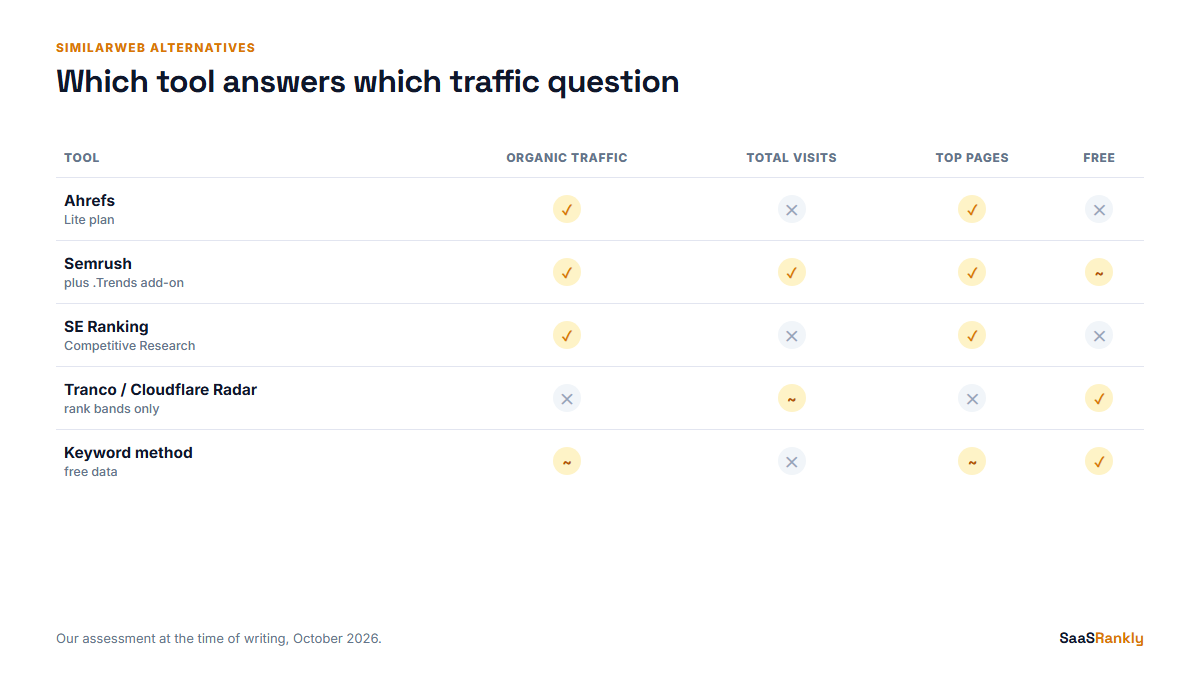
The seven Similarweb alternatives we have used
Prices below are list prices at the time of writing (October 2026), monthly billing, cheapest plan that does the job. They change often, so check each pricing page before you buy.
1. Ahrefs Site Explorer
Ahrefs estimates organic search traffic from its keyword database: it knows which keywords a domain ranks for, at what position, and applies a click curve. That makes it very good for one job, “how much search traffic and from which pages”, and blind to everything else. Direct, email, social and paid visits are not in the number at all. The Lite plan starts at $129 a month. We use it most for the Top Pages report, which shows where a competitor’s organic traffic really comes from.
2. Semrush Traffic Analytics
Semrush is the closest thing to a full Similarweb replacement, because its Traffic Analytics module adds clickstream data for total visits, sources and engagement. The catch is that Traffic Analytics is part of the .Trends add-on, priced separately on top of a base plan. Without it you still get organic estimates from Organic Research, which work much like Ahrefs. If you are deciding between the two suites, our Ahrefs vs Semrush comparison for SaaS goes deeper.
3. SE Ranking Competitive Research
SE Ranking gives you organic and paid traffic estimates for a domain, top pages and keyword lists, inside a platform that costs less than the two big suites. Its database is smaller, so estimates on niche B2B sites run lower than Ahrefs or Semrush. For a team that already uses it for rank tracking, it is the obvious first check. We covered its keyword side in our SE Ranking keyword research review.
4. Tranco list
Tranco is a free research ranking of the top domains on the web, combined from several source lists and averaged over 30 days. It will not give you a visit count, but it answers the most useful sanity question: is this site in the top million at all? If a tool claims 400,000 monthly visits for a domain that does not appear in the Tranco list, we trust the tool less.
5. Cloudflare Radar
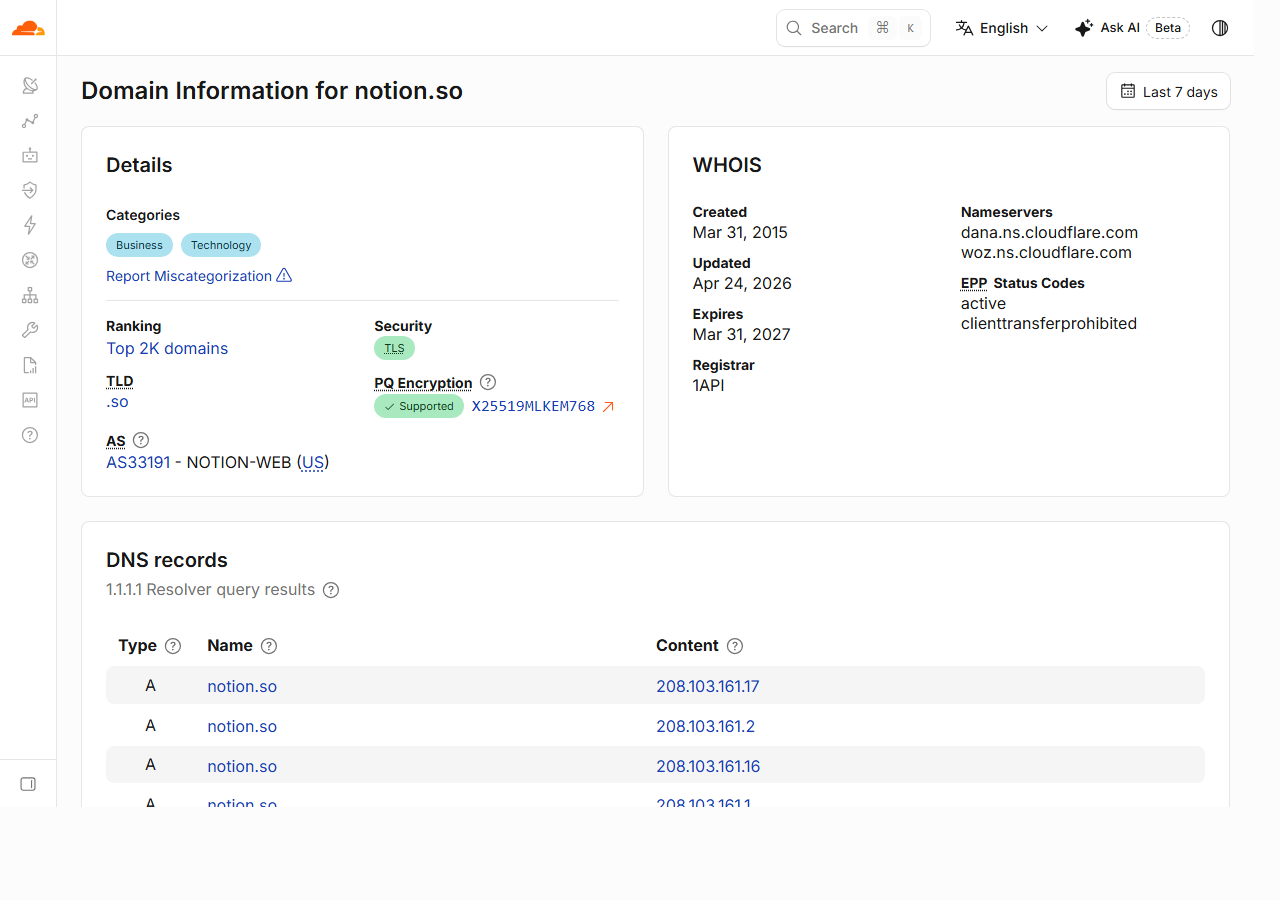
Cloudflare Radar shows a domain’s popularity rank band and category, based on traffic Cloudflare sees through its DNS resolver. Again, no visit numbers, but an independent signal that does not come from an SEO tool. It is free and needs no account. You can look up any domain on Cloudflare Radar.
6. Ubersuggest
Ubersuggest shows organic traffic estimates and top pages with a small free quota, and its paid plans are among the cheapest in the category. The estimates are rougher than the big suites, especially for small sites, but for a quick check of five link prospects it does the job. We would not use it to size a market.
7. The keyword method (free)
The last option is not a tool. You take the competitor’s main keywords, look up volumes in free sources, apply a conservative click curve, and add an allowance for branded and non-search traffic. It takes an hour, and it is the method we trust most for narrow SaaS categories where panel data is thin. We walk through the maths in how to estimate website traffic without fooling yourself.
How far apart the numbers really are
To show why we never quote one tool, here is an illustrative check of a fictional mid-sized SaaS domain, “Fieldnote.io”. The figures are invented, but the spread between tools matches what we see on real B2B domains with 20,000 to 80,000 monthly visits.
| Source | What it measures | Monthly figure shown | Our read |
|---|---|---|---|
| Similarweb free view | Total visits | 61,000 | Plausible, panel-based |
| Semrush Traffic Analytics | Total visits | 48,000 | Plausible, lower panel coverage |
| Ahrefs | Organic search only | 14,200 | Lower because it is organic only |
| Semrush Organic Research | Organic search only | 17,900 | Close to Ahrefs, as expected |
| SE Ranking | Organic search only | 9,800 | Smaller database, misses long tail |
| Tranco | Rank | Top 250,000 | Confirms a real, active site |
| Keyword method | Organic search, modelled | 11,000 to 19,000 | The range we would quote |
The tools are not lying to each other. Three of them measure total visits and four measure organic search, so the numbers were never going to match. The useful output is a range per type of traffic: roughly 45,000 to 60,000 total visits, of which roughly 11,000 to 18,000 come from organic search. That is a defensible answer. “Fieldnote gets 61,000 visits” is not.
Choosing between Similarweb alternatives: a checklist
Run through these before you pay for anything:
- Write the question first. If it is about search traffic, you do not need a panel tool.
- Check what you already pay for. Most SaaS teams have Ahrefs, Semrush or SE Ranking already. Its traffic estimates are included.
- Add one free reality check. Tranco or Cloudflare Radar, so you catch inflated numbers.
- Buy panel data for one month only. If you need total visits for a board deck or market sizing, pay for one month, export, and cancel.
- Always report a range with a date. Traffic estimates go stale within a quarter.
For link building, the bar is lower still. You only need to know whether a prospect site gets real visitors in your niche, and relevance matters more than size, as we explain in why backlinks still matter in SEO. A free Tranco check plus a glance at the site’s top pages in any SEO suite is enough.
If your shortlist is mostly about the big suites rather than traffic tools, our Semrush alternatives roundup covers the cheaper tier in more detail.
Where every Similarweb alternative falls short
Three blind spots are shared by all of them, Similarweb included. Small sites under a few thousand visits a month are guesswork for panel tools. B2B sites with traffic mostly from logged-in app users are undercounted, because product traffic often sits on a subdomain or behind a login. And brand-new sites take weeks to appear at all. If your competitor fits any of these, lean on the keyword method and treat every tool number as a loose guide.
Quick recap: Similarweb alternatives
- No single tool replaces Similarweb on every job, but two cheap Similarweb alternatives together cover most SaaS needs.
- For organic search traffic, use Ahrefs, Semrush or SE Ranking.
- For total visits, Semrush Traffic Analytics is the closest match, as a paid add-on.
- Tranco and Cloudflare Radar are free reality checks, not visit counters.
- The free keyword method is the most trustworthy option for narrow B2B categories.
- Always report traffic as a dated range, split by total and organic.
FAQ
What is the best free Similarweb alternative?
For a quick check, the Tranco list or Cloudflare Radar, because both are free and independent of SEO tools. For organic traffic estimates, the free tiers of Semrush or Ubersuggest give a few lookups a day.
Is Semrush more accurate than Similarweb?
Neither is accurate in absolute terms. They use different panels and models. In our checks they land within a similar range for large sites and disagree more on small ones, so compare competitors inside one tool.
Why does Ahrefs show much lower traffic than Similarweb?
Ahrefs estimates organic search traffic only. Similarweb estimates total visits, including direct, referral, social and email. The two numbers measure different things.
Can I see a competitor’s real traffic numbers?
No. Real analytics data is private unless the owner shares it. Every figure a third-party tool shows for another site is modelled, not measured.
Which Similarweb alternatives work for small SaaS sites?
The keyword method and an SEO suite’s organic estimate. Panel-based tools have too little data on sites under a few thousand monthly visits to be useful.
Do I need a traffic tool for link building?
Not a paid one. A free rank check like Tranco and a look at the prospect’s top pages tell you whether the site is real and relevant, which matters more than its exact size.