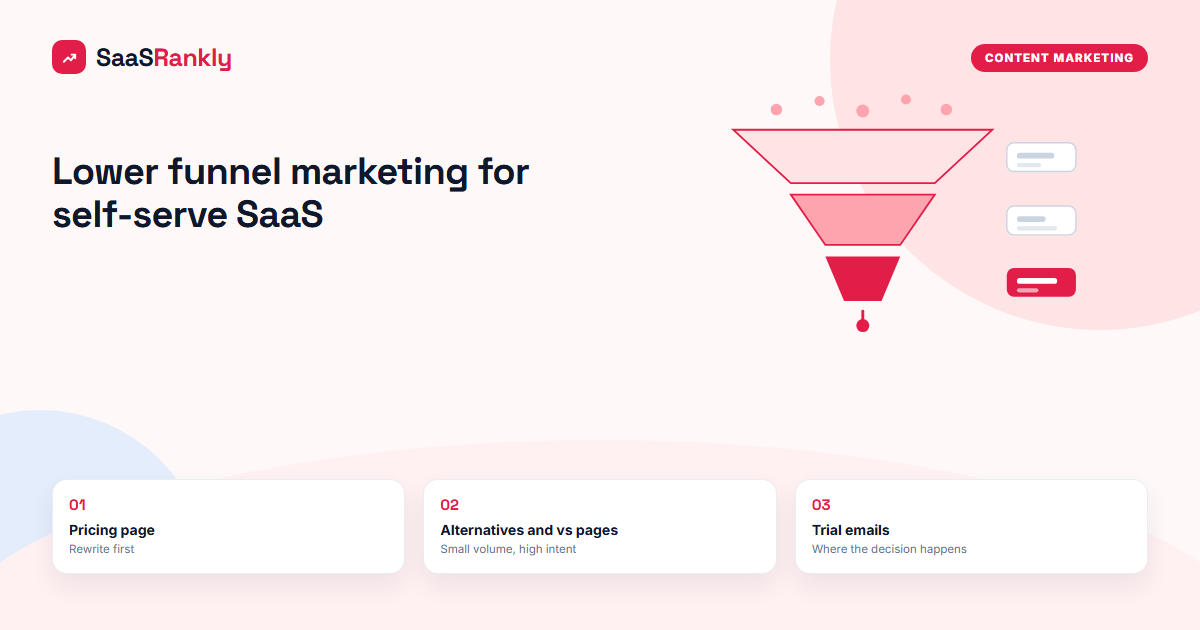
Lower funnel marketing is everything you do for the person who already knows they have the problem, already knows tools exist, and is now choosing one. For a self-serve SaaS product that usually means pricing pages, comparison pages, alternatives pages, integration pages, free trial onboarding and the emails that follow a signup. It is the least glamorous part of a marketing plan and, in our experience, the part with the fastest payback.
We have watched plenty of early SaaS teams spend six months on top-of-funnel blog posts, get decent traffic, and see almost no trials. The fix was rarely more content. It was building the eight or ten pages that a buyer looks at in the last week before paying.
What lower funnel marketing actually covers
The classic funnel has three stages: awareness, consideration and decision. Lower funnel marketing is the decision stage plus the first days of a trial, because for self-serve SaaS the purchase decision often happens inside the product, not before it.
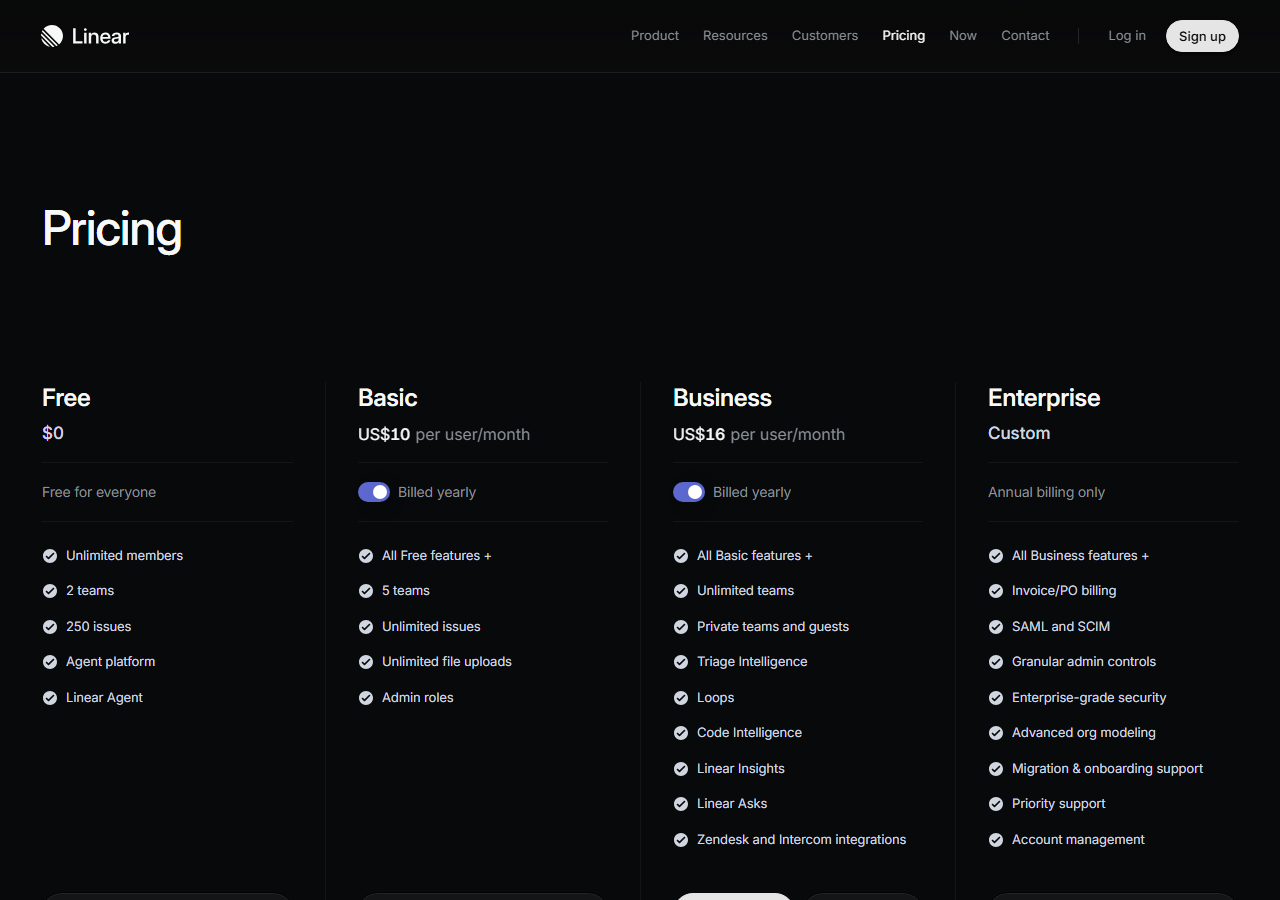
A useful test: if the searcher could type your brand name or a competitor’s brand name into the query, it is lower funnel. “Asana vs Monday”, “Hubspot alternatives for small teams”, “Notion pricing”, “does Linear integrate with GitHub”. Those queries have small volumes and very high intent. Our post on high-intent keywords goes into how to spot them in a keyword list, and the keyword intent classifier will sort a pasted list for you.
Lower funnel marketing assets, ranked by what they return
Here is the decision matrix we use with self-serve clients. Effort is build time for a two-person marketing team. Payback is how fast the page tends to produce trials once it ranks or ships.
| Asset | Effort | Typical payback | Search demand | Our call |
|---|---|---|---|---|
| Pricing page rewrite | Low | Weeks | Branded, steady | Do first |
| “X vs Y” comparison pages | Medium | 1 to 3 months | Small per page, adds up | Do first |
| Alternatives pages | Medium | 2 to 4 months | Highest in this group | Do first |
| Integration pages | Low per page | 2 to 6 months | Long tail | Do in batches |
| Use case pages | Medium | 3 to 6 months | Mixed intent | Do selectively |
| Trial onboarding emails | Medium | Weeks | None (owned channel) | Do first |
| Case studies | High | Slow, helps sales | Very low | Later |
| Retargeting ads | Low | Immediate, stops when spend stops | None | Test small |
Notice what is missing: thought leadership, webinars, glossary posts. Those are fine. They are just not lower funnel marketing, and they should not be judged on trial numbers in the first quarter. If your whole motion is self-serve, our piece on product-led growth and where SEO fits shows how these pages feed the trial flow.
Four myths about lower funnel marketing
Myth: comparison pages are just sales spin and Google will not rank them.
Fact: they rank well when they are honest. A comparison page that admits where the competitor is stronger reads as credible to buyers and to anyone reviewing quality. We write “choose them if” sections on every comparison page, and those pages convert better than the ones that pretend the rival has no strengths. Our n8n competitors post is a good example of the format applied to someone else’s product.
Myth: low search volume means low value.
Fact: an alternatives keyword with 150 searches a month can outperform a 10,000-volume definition term on signups. We had one client whose single “alternative to” page produced more trials in a quarter than their 40 most-visited blog posts combined.
Myth: lower funnel is the sales team’s job.
Fact: for self-serve SaaS there often is no sales team at the moment of decision. The pricing page, the comparison table and the day-three email are the sales team.
Myth: you need top-of-funnel traffic first.
Fact: you need it eventually, because lower funnel demand is finite. But launching with bottom pages first gives you revenue to fund the rest, and it tells you which messages convert before you write 50 blog posts around them. The B2B content marketing funnel post covers how the stages hand off to each other once both exist.
A worked lower funnel marketing plan for a small SaaS
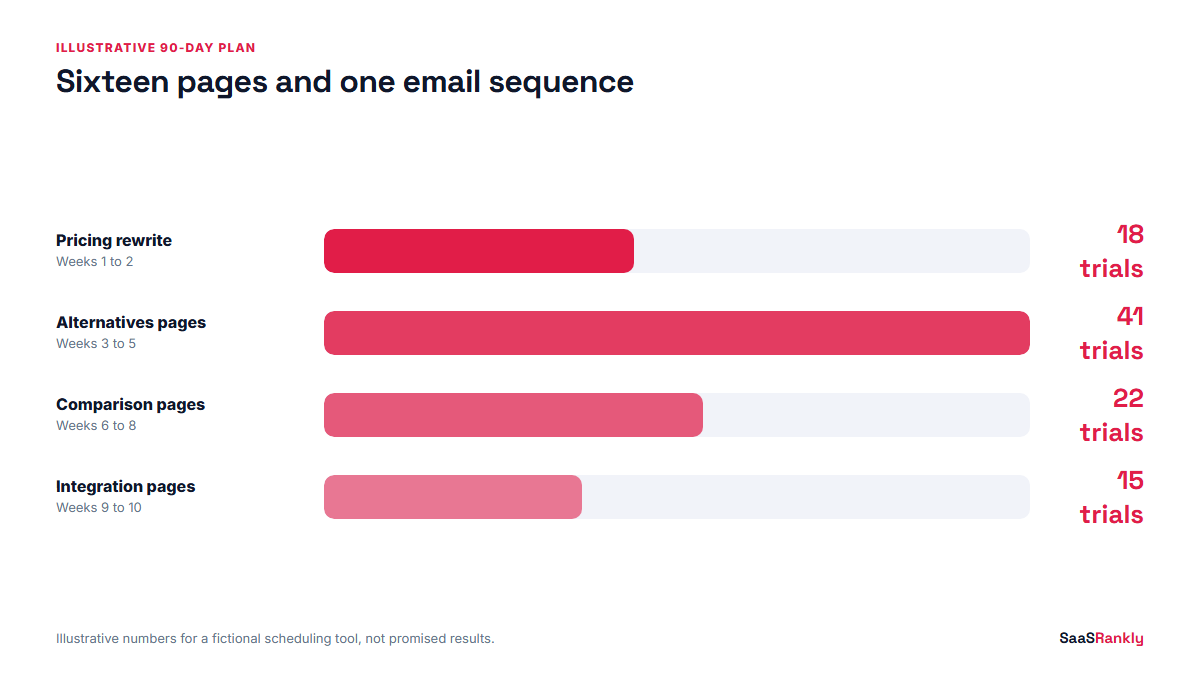
Here is an illustrative 90-day plan for a fictional scheduling tool, call it Slotwise, priced at $12 per seat per month. The numbers are invented to show the shape, not promised results.
| Week | What ships | Monthly searches targeted | Trials per month at day 90 |
|---|---|---|---|
| 1 to 2 | Pricing page rewrite with FAQ and plan comparison | Branded only | +18 |
| 3 to 5 | 3 alternatives pages (Calendly, Acuity, Doodle) | 2,400 | +41 |
| 6 to 8 | 4 comparison pages, Slotwise vs each rival | 900 | +22 |
| 9 to 10 | 8 integration pages (Zoom, HubSpot, Stripe…) | 1,100 | +15 |
| 11 to 13 | 5-email trial sequence rewritten around activation | None | Trial to paid rate up from 9 to 13 percent |
Roughly 96 extra trials a month by day 90, from 16 pages and one email sequence. At a 13 percent conversion and an average of three seats, that is about 12 new customers a month and roughly $450 in new monthly recurring revenue, compounding. Illustrative, again. The point is that none of these pages needed more than 1,500 words, and every one of them targets a person with a credit card nearby.
How to build one lower funnel page well
The format below works for alternatives and comparison pages, which are the core of most lower funnel marketing programmes.
- Answer the query in the first screen. “The best Calendly alternative for teams that need round-robin is X” beats three paragraphs of context.
- Show a comparison table with real prices. Plan names, monthly cost at the time of writing, the limits that matter. Date it.
- Include a “choose them if” section. Honest trade-offs earn trust and filter out buyers who would churn anyway.
- Use screenshots of your actual product. Not illustrations. Buyers at this stage want to see the screen they will use.
- Put the trial button next to the table, not just at the bottom.
- Link to the pricing page and two related comparisons. Buyers rarely compare only two tools.
For the on-page side, our product page SEO guide covers titles, schema and internal links for feature and comparison pages.
Checklist before you call it done
- Pricing page states who each plan is for in one line, not just feature ticks.
- Every top competitor has an alternatives page or a comparison page, ideally both.
- Comparison tables carry a “last checked” date.
- Integration pages exist for the five tools your customers mention most in support tickets.
- Trial emails are triggered by product behaviour, not just by days since signup.
- Each lower funnel page is tracked to trials in analytics, not just to sessions. If you need a way to report that, our content ROI post has the template.
How to measure lower funnel marketing
Do not judge these pages on traffic. A comparison page with 300 visits a month and a 6 percent visit-to-trial rate is worth far more than a guide with 8,000 visits and 0.1 percent. We report three numbers per page: trials started, trial-to-paid rate for those trials, and revenue attributed on a 30-day window. Assisted conversions are worth watching too, because many buyers read a comparison page, leave, and come back through a branded search two days later.
For the analytics setup, Google’s own documentation on attribution in GA4 explains the models available. We use data-driven attribution where volume allows and last non-direct click otherwise.
Quick recap: lower funnel marketing
- Lower funnel marketing targets people choosing a tool, not learning about the problem.
- For self-serve SaaS it includes the first days of the trial, because that is where the decision happens.
- Pricing, alternatives, comparison and integration pages are the core assets, in roughly that order.
- Low search volume is normal here and does not mean low value.
- Honest comparisons with real prices and “choose them if” sections convert better than spin.
- Measure trials and revenue per page, never sessions alone.
FAQ
What is lower funnel marketing?
Lower funnel marketing is the set of pages, emails and campaigns aimed at buyers who are close to a purchase decision. In SaaS that means pricing, comparison, alternatives and integration pages, plus trial onboarding.
What is the difference between upper and lower funnel marketing?
Upper funnel work builds awareness among people who may not know they have a problem yet. Lower funnel work helps people who already know their options pick yours. The goals, metrics and content formats are different.
What are examples of lower funnel content?
Comparison pages, “alternatives to” pages, pricing pages, integration pages, case studies, product demo videos, free trial landing pages and onboarding emails.
How do you measure lower funnel marketing?
By trials or demos started, conversion to paid, and revenue per page or campaign. Traffic and time on page are secondary signals at this stage.
Is lower funnel marketing worth it for a new SaaS product?
Usually it is the best place to start. The pages are few, the intent is high, and the revenue they produce funds the slower top-of-funnel content work that follows.
Should we write comparison pages about competitors?
Yes, as long as they are accurate and dated. Keep the claims checkable, give the competitor credit where it is due, and update prices at least every quarter.