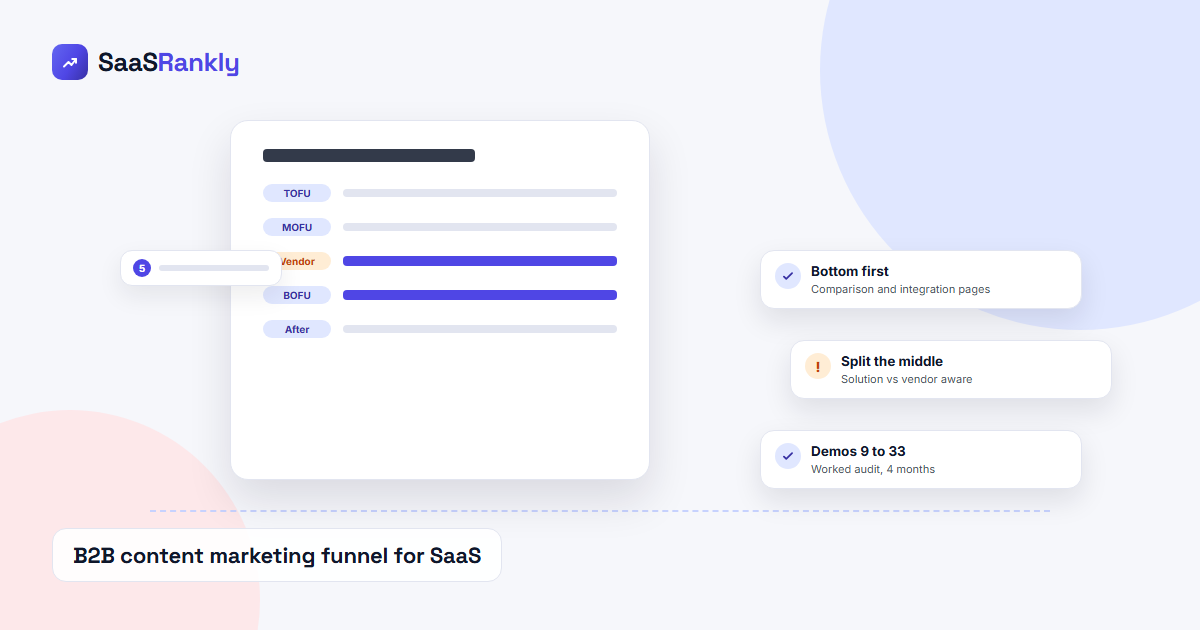
A b2b content marketing funnel is a plan for which content a buyer needs between “we have a problem” and “we signed the contract”, and how each piece hands them to the next one. That is the whole idea. The hard part in SaaS is that buyers do not move through it in order, there are four to seven of them per deal, and most of the research happens before anyone fills in a form.
Below is the version we build for SaaS clients: one matrix, six steps, and a worked audit of a 40-post blog so you can see where content teams usually go wrong.
Why the textbook funnel breaks for SaaS
The classic picture has awareness at the top, consideration in the middle, decision at the bottom and a tidy arrow to “closed won”. In practice a head of operations reads a comparison page first, goes back to a “what is” article to explain the category to their CFO, then books a demo from an integration page. LinkedIn’s marketing team made the same point in a piece titled the B2B marketing funnel isn’t a funnel at all.
We still use stages, because they help you spot gaps. We just stop pretending each page has one job. A good b2b content marketing funnel is closer to a set of connected rooms than a slide. Every page links to the next logical question, in both directions. The drafting habits that keep those pages readable are in our rules for SEO writing.
The other change is at the top. Look at the Google results for the keyword itself.
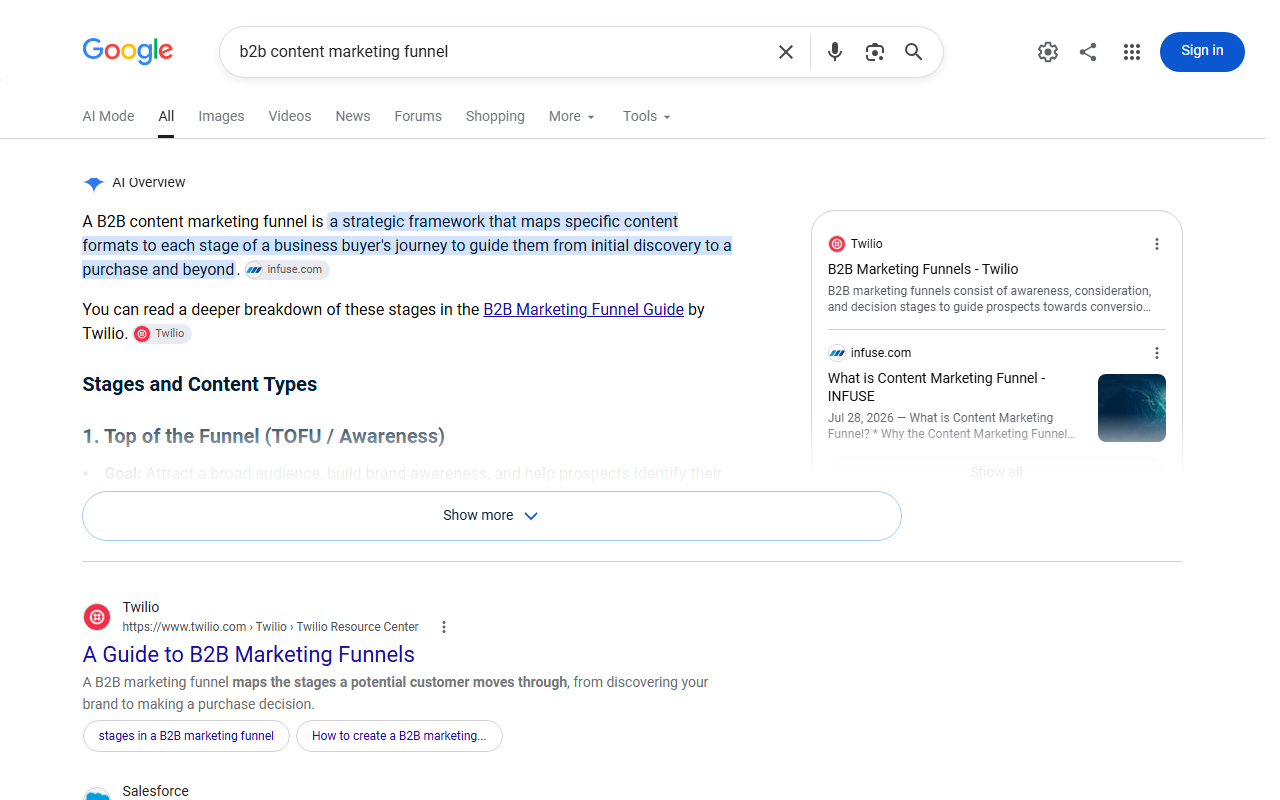
At the time of writing, an AI Overview answers the definition before the first organic result and cites two sources. That tells you where the clicks went. Definition content now earns citations more than visits, and the clicks move to pages that answer harder, more specific questions. We covered the same shift in PAA answers turning into AI Overviews.
The b2b content marketing funnel matrix, stage by stage
| Stage | Buyer question | Formats that work | SaaS page example | What we measure |
|---|---|---|---|---|
| Problem aware (TOFU) | “Why is this so painful?” | Problem guides, benchmarks, templates | How to reduce payroll errors | Organic clicks, email signups |
| Solution aware (MOFU) | “What kind of tool fixes this?” | Category explainers, buyer guides, checklists | Payroll software for startups: what to look for | Returning visitors, clicks to product pages |
| Vendor aware (MOFU) | “Which tools are worth a look?” | Alternatives pages, comparison pages, listicles | Gusto alternatives, Gusto vs Rippling | Trial or demo starts |
| Decision (BOFU) | “Will it work for us?” | Integration pages, pricing explainers, case studies, security docs | PayrollHQ + QuickBooks integration | Trials, demos, sales pipeline |
| After the sale | “How do I get value fast?” | Help docs, onboarding guides, templates | Run your first payroll in 20 minutes | Activation, expansion |
We split the middle into two rows on purpose. That split is where most SaaS content plans fail. Teams write plenty of problem content and a few product pages, and nothing for the buyer who knows the category but has not picked a vendor. Those vendor-aware pages give our clients their highest trial rates. Our playbooks for comparison pages and integration pages go into the page templates.
How to build a b2b content marketing funnel in 6 steps
Step 1: Read sales call notes before you open a keyword tool
Go through 20 to 30 call notes or recorded demos from the last 90 days and write down the exact questions buyers asked. You will end up with around 40 distinct questions, and about half of them never show up in keyword tools because the volume is too low to register. Those are often your best bottom-of-funnel pages.
Step 2: Put every question in one row of the matrix
If a question fits two stages, pick the later one. Buyers who ask it are usually further along than you think.
Step 3: Add search demand, but do not let it overrule step 1
Now run the questions through your keyword tool. We tag each one by intent with our free keyword intent classifier, then check volume and difficulty. A decision-stage question with 30 searches a month and a real buyer behind it beats a top-of-funnel term with 3,000 searches and students behind it. The high-intent keywords guide shows how we score them.
Step 4: Build from the bottom up
Publish decision and vendor-aware pages first. They convert the traffic you already have, and they give top-of-funnel articles somewhere useful to send readers. We see teams do the opposite every quarter: 30 blog posts, no pricing explainer, and a founder asking why content does not produce demos.
Step 5: Wire the handoffs between stages
Every problem-aware article gets one contextual link to a solution-aware page and one soft offer, such as a template, calculator or checklist. Every solution-aware page links to at least one comparison or integration page. Every decision page has a trial or demo button above the fold. This is the part of a b2b content marketing funnel that nobody notices, and it does most of the work.
Step 6: Judge each stage by its own number
Judging top-of-funnel posts on demo requests kills them. Judging integration pages on traffic kills them too. Use the “What we measure” column above and review it once a month.
Worked example: auditing a 40-post blog against a b2b content marketing funnel
PayrollHQ is a fictional payroll startup with 40 blog posts and about 6,200 organic clicks a month. Demo requests from content: 9 a month. Here is what we found when we mapped every post to a stage, and what changed after four months of filling the gaps.
| Stage | Posts before | Clicks/month before | Demos/month before | Pages added | Demos/month after |
|---|---|---|---|---|---|
| Problem aware | 31 | 5,300 | 2 | 2 | 3 |
| Solution aware | 6 | 700 | 2 | 3 | 4 |
| Vendor aware | 2 | 150 | 3 | 8 | 15 |
| Decision | 1 | 50 | 2 | 6 | 11 |
| Total | 40 | 6,200 | 9 | 19 | 33 |
Traffic went up only about 20 percent in those four months, from 6,200 to roughly 7,400 clicks. Demos went from 9 to 33. The 14 new vendor-aware and decision pages brought in fewer than 1,000 clicks between them and produced most of the gain.
That pattern repeats in almost every SaaS funnel we audit. The blog is top-heavy, 75 percent of posts sit in the problem-aware row, and the fix is not more blogging. It is eight comparison pages and six integration pages that nobody wanted to write because the keywords “looked too small”.
Checklist before you publish the next funnel page
- It answers one buyer question that came from a real sales conversation.
- It sits in one row of the matrix, and you know which number it is judged on.
- It links forward to the next stage and back to the previous one.
- The offer fits the stage. No “book a demo” banner on a glossary page.
- The keyword was checked for intent, not just volume.
- It belongs to a topic cluster. Our topic cluster guide shows how we group pages.
Quick recap: b2b content marketing funnel
- A b2b content marketing funnel maps content to buyer questions, from problem to purchase to onboarding.
- Split the middle into solution-aware and vendor-aware stages. The vendor-aware row is usually empty.
- Start from sales call questions, then add keyword data.
- Build decision and comparison pages before more top-of-funnel posts.
- Link every page forward and back, with an offer that fits its stage.
- Measure each stage by its own number and review monthly.
FAQ
What is a b2b content marketing funnel?
It is a map of the content a business buyer needs at each stage of a purchase, from spotting the problem to choosing a vendor and getting value after signing. Each piece links the buyer to the next question they are likely to ask.
What are the stages of a b2b content marketing funnel?
We use five: problem aware, solution aware, vendor aware, decision and after the sale. Most guides use three (top, middle, bottom), but splitting the middle is what exposes the gaps in a SaaS content plan.
Which stage should a SaaS startup build first?
The bottom. Comparison, alternatives, integration and pricing pages convert the traffic you already have. Top-of-funnel posts work much better once they have somewhere useful to send readers.
How is a B2B content funnel different from a B2C one?
B2B deals involve several people, longer cycles and more research before contact. So you need content for different roles (the user, the budget owner, IT) and more mid-funnel material that helps one person sell the tool internally.
How do you measure a b2b content marketing funnel?
Give each stage its own metric: clicks and email signups at the top, returning visits and product page clicks in the middle, trials and demos at the bottom, activation after the sale. One blended “content ROI” number hides which stage is broken.
How many pieces of content do you need per stage?
There is no fixed ratio, but for an early SaaS we aim for at least 8 to 10 vendor-aware and decision pages before scaling top-of-funnel posts past 20 or 30. The worked example above shows why.