SaaS product marketing and SEO usually live in different rooms. Product marketing owns positioning, launches and sales enablement. SEO owns keywords, pages and traffic. Then a new feature ships, the PMM writes “the intelligent way to manage approvals”, the SEO writes a blog post targeting “approval workflow software”, and the buyer who reads both wonders whether they are the same product. We see this on almost every SaaS site we audit.
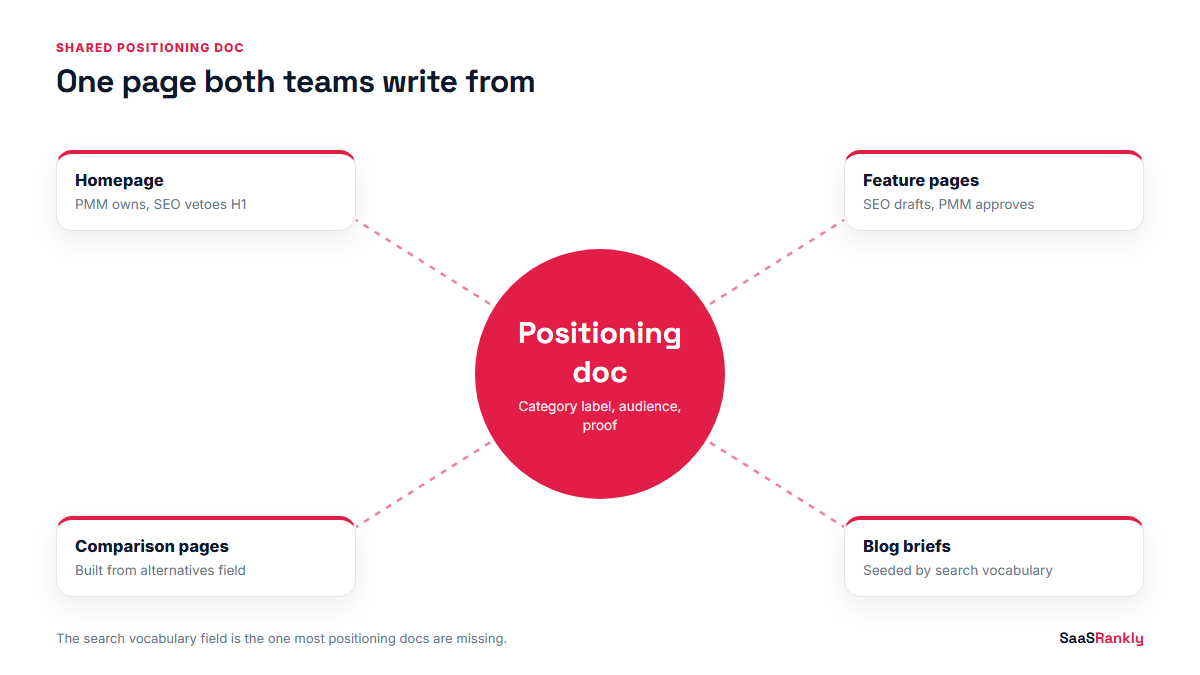
The fix is not a new meeting. It is one shared positioning document that both teams write from. This post covers what goes in that document, how each team uses it, a matrix for deciding who owns which page, and a worked example. If you want the wider channel picture first, our post on SaaS marketing channels ranked by payback sets the context.
What saas product marketing actually does
Strip away the job titles and saas product marketing does four things: decides who the product is for, decides what it should be compared against, turns features into reasons to buy, and gets that message into every place a buyer looks. Launches, pricing pages, battlecards and onboarding emails are all outputs of those four decisions.
Search is one of those places, and for most self-serve SaaS products it is the biggest one. A buyer who types “approval workflow software” into Google is answering the “compared against” question for you. They have already decided which category they are shopping in. If your positioning names a different category, your best pages will rank for searches nobody makes. This matters even more in a product-led growth model, where the page that ranks is often the first and only sales conversation.
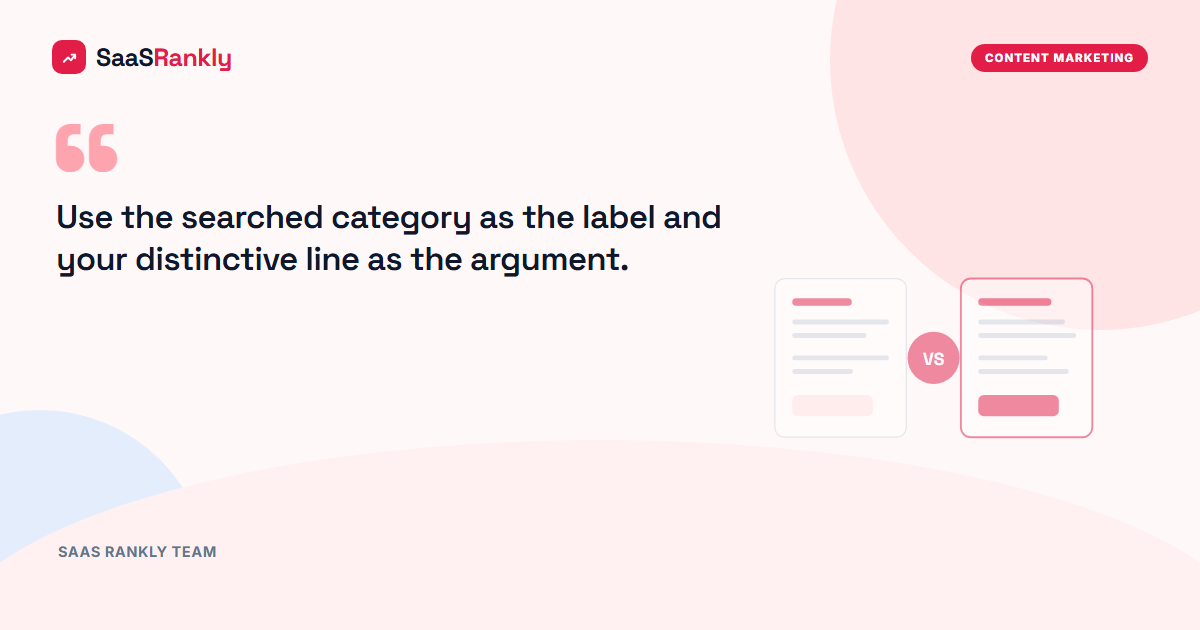
That is the tension in one sentence: product marketers want a distinctive frame, and search rewards the words buyers already use. Good saas product marketing keeps both, with the distinctive frame as the argument and the searched category as the label.
The shared positioning doc, field by field
We keep it to one page. Longer than that and nobody opens it before writing. Each field below has a product marketing use and an SEO use, which is the point.
| Field | What goes in it | How product marketing uses it | How SEO uses it |
|---|---|---|---|
| Category label | The phrase buyers search for your type of product | Analyst briefings, homepage subhead | Primary keyword for the main product page |
| Primary audience | Role and company size, e.g. finance leads at 50 to 500 person companies | Messaging, ad targeting | Modifiers: “for small business”, “for agencies” |
| Alternatives | What buyers use today: a spreadsheet, a named competitor, doing nothing | Battlecards, objection handling | Comparison and alternatives pages |
| Three proof points | Specific, checkable claims with numbers | Launch copy, sales decks | H2s and intros on feature pages |
| Banned phrases | Words the team agreed not to use | Keeps copy consistent | Stops slogan-style H1s that rank for nothing |
| Search vocabulary | The 10 to 20 queries buyers type, with monthly volume | Tells PMM which words buyers already know | Seed list for clusters and briefs |
The last row is the one most positioning docs lack, and it is where SEO earns its seat. Before the doc is signed off, run the candidate category labels through a keyword tool and through our free keyword intent classifier. If the label you love gets 20 searches a month and returns mostly guides, it can stay in the tagline, but it should not be the H1.
Who owns which page: a decision matrix
Arguments between saas product marketing and SEO are usually arguments about page ownership. We settle them with a simple rule: whoever is accountable for the page’s main goal owns the final copy, and the other team has a veto on one thing only.
| Page type | Main goal | Owner | Other team’s veto |
|---|---|---|---|
| Homepage | Explain the product in 5 seconds | Product marketing | SEO can veto an H1 with no category term |
| Feature pages | Rank for the feature query and convert | Shared, SEO drafts | PMM can veto claims that are off-message |
| Comparison and alternatives pages | Win buyers already shopping | Product marketing | SEO can veto titles that miss the searched phrase |
| Pricing page | Convert, reduce sales questions | Product marketing | SEO can veto blocking it from indexing |
| Blog and guides | Earn traffic and links | SEO and content | PMM can veto off-positioning advice |
| Launch announcement | Tell existing users and press | Product marketing | SEO can veto a URL that will be reused or deleted |
The single veto keeps reviews short. Without it, every page goes through two full rounds of edits and launches slip by a week.
A launch, run both ways (illustrative)
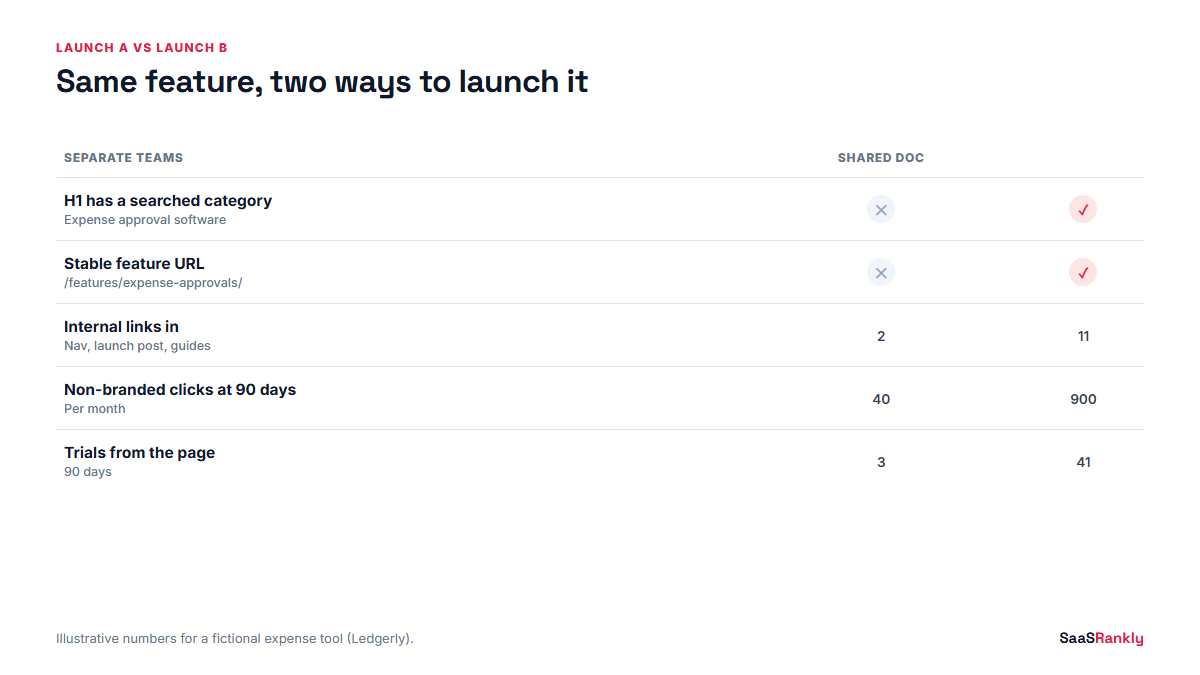
Here is a fictional expense tool we will call Ledgerly shipping an approvals feature. The numbers are illustrative, but the pattern is one we have watched play out several times.
| Launch A: separate teams | Launch B: shared positioning doc | |
|---|---|---|
| Feature page H1 | “Spend, approved in a click” | “Expense approval software for growing finance teams” |
| Feature page URL | /launch/clickapprove-2026/ | /features/expense-approvals/ |
| Blog post | “Introducing ClickApprove” | “How to set up an expense approval workflow” |
| Internal links to feature page | 2 (nav, launch post) | 11 (nav, launch post, 9 related guides) |
| Non-branded clicks after 90 days | about 40 a month | about 900 a month |
| Trials attributed to the page | 3 | 41 |
Launch B did not need a bigger budget. It needed the category label agreed before the copy was written, a stable URL, and the blog team linking in. The distinctive line (“approved in a click”) still appeared, as the subheading. Our post on product page SEO for SaaS goes deeper on how those feature pages are built.
Where SEO feeds saas product marketing back
The relationship runs both ways. Search data is some of the best buyer research a product marketer can get, and it is free. Three sources we pull into the positioning review every quarter:
- Search Console queries containing “vs”, “alternative” and “for”. They show which competitors buyers pair you with and which audiences find you. One client discovered a fifth of their non-branded impressions came from “for nonprofits” queries. That became a landing page and a pricing tier.
- Question queries. “Can I”, “does it”, “how to” searches reveal objections in the buyer’s own words. Sales enablement teams love these for FAQ and battlecard copy.
- Competitor pricing and feature page wording. If three competitors all lead with the same category label, that tells you what the market has been trained to search. You can fight it, but you should know you are fighting it.
For AI-first products this matters even more, because buyers often do not know the category name yet. Our post on AI SaaS positioning and search terms covers that specific problem.
Quarterly checklist for both teams
- Re-run the search vocabulary list. Has volume shifted to a new category label?
- Check that every feature page H1 still contains a searched phrase.
- Review comparison pages against current competitor pricing.
- Pull “vs” and “alternative” queries from Search Console and share them with sales.
- Audit launch URLs from the past quarter. Redirect or merge any that were one-off.
- Update the banned phrases list with anything that crept back in.
If you also run a content programme, the positioning doc should sit at the top of every brief. Our guide to SaaS content marketing shows where it plugs in.
Quick recap: saas product marketing
- SaaS product marketing decides audience, alternatives and proof; search shows the words buyers already use for them.
- Write one shared positioning doc with a search vocabulary field, and keep it to a page.
- Use the searched category as the H1 label and the distinctive line as the subheading.
- Assign each page type one owner and give the other team a single veto.
- Give launches stable feature URLs, not campaign URLs that die after a month.
- Feed Search Console “vs”, “for” and question queries back into positioning every quarter.
FAQ
What is saas product marketing?
It is the work of deciding who a software product is for, what it competes with, and why someone should buy it, then putting that message into launches, web pages, sales material and onboarding.
How is product marketing different from content marketing?
Product marketing sets the message and owns conversion-focused pages like the homepage, pricing and comparisons. Content marketing produces the guides and posts that attract buyers earlier, using that message as its brief.
Should SEO report to product marketing?
Not necessarily. Reporting lines matter less than the shared positioning doc and clear page ownership. We have seen both setups work when those two things exist, and both fail when they do not.
What if our positioning uses a category nobody searches for?
Keep it as your argument, but label pages with the category buyers do search. Creating a new category is possible, but it takes years of spend, and search volume arrives last.
Who should write feature pages?
We prefer SEO drafting and product marketing approving. The SEO knows the query and page structure; the product marketer catches claims that are off-message or out of date.
How often should the positioning doc change?
Review it every quarter and after any major launch or competitor move. Most quarters only the search vocabulary and proof points change; the category label should stay stable for years.