Most product page seo advice is written for online shops: unique descriptions, review stars, product schema. SaaS product pages have a different problem. They are written by product marketing for people who already know the brand, so they rank for the brand name and almost nothing else. The feature page for “approval workflows” never shows up when a buyer searches “invoice approval software”, even though it is the best answer on the web.
This post is about fixing that: how we pick the query a SaaS product or feature page should own, what goes on the page, and the mistakes we see on almost every audit.
What product page seo means for SaaS
For a store, a product page is one item with a price. For SaaS, “product pages” are usually three kinds of page:
- The main product page (or homepage): what the whole tool does.
- Feature pages: one capability each, such as reporting, automations, integrations.
- Use-case or solution pages: the product framed for a team or job, such as “for agencies” or “for finance teams”.
Each type should target a different kind of query. Mixing them up is the root of most product page seo problems we find. If you run an actual store, our WooCommerce SEO guide covers the ecommerce version.
Which query should each page own?
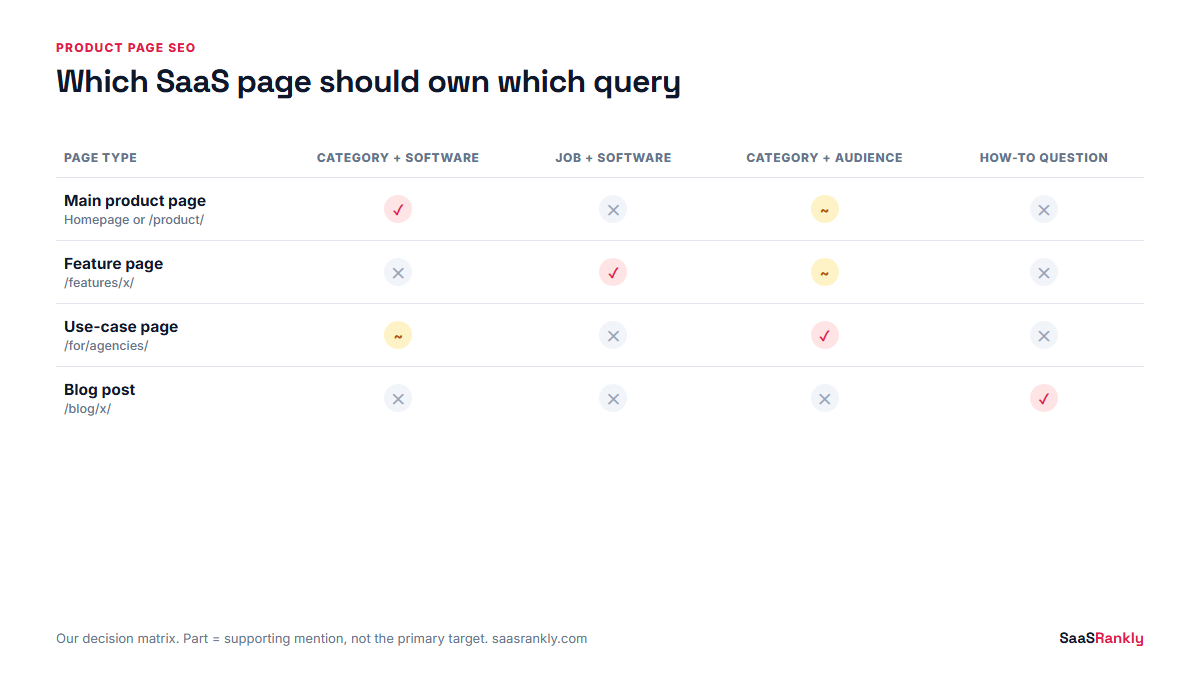
This is the decision matrix we use. It is deliberately blunt.
| Page type | Query pattern it should target | Example | Do not target |
|---|---|---|---|
| Main product page | Category term + software/tool | “project management software” | Feature terms, “how to” terms |
| Feature page | Job-to-be-done + software/tool | “time tracking software”, “gantt chart tool” | The category head term |
| Use-case page | Category + audience | “project management for agencies” | Generic feature terms |
| Blog post | Questions and how-tos | “how to make a gantt chart” | Anything with “software” in it |
Run your candidate terms through a quick intent check before you commit; our free keyword intent classifier will flag a term whose results are mostly guides, which means a product page will not rank for it no matter how good it is. More on picking commercial terms in our post on high-intent keywords.
Two real product pages, and what they get right
Looking at how established SaaS brands structure these pages is more useful than any checklist, so here are two.
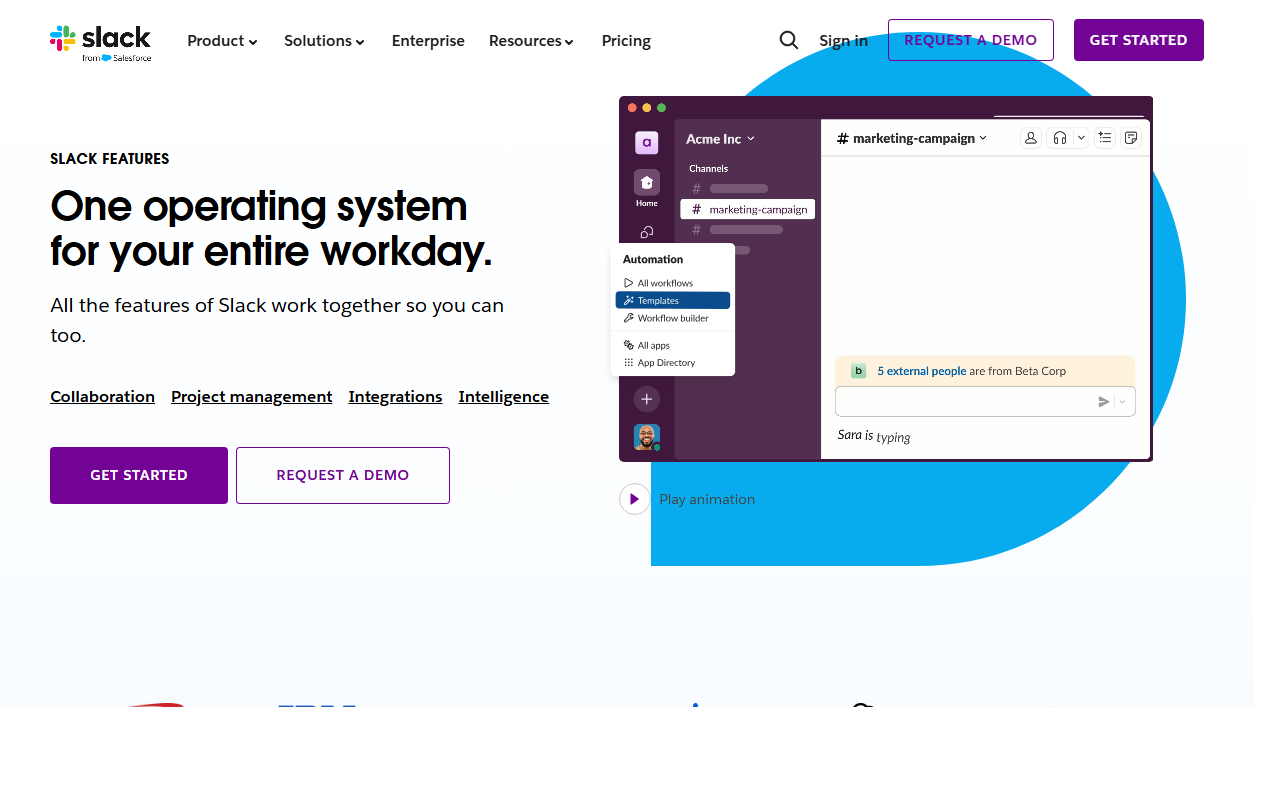
Slack’s features hub does the structural job well. One hub page lists feature areas (collaboration, project management, integrations, AI), and each links to its own deeper page. That gives every feature a URL that can rank for its own query, and gives the hub a clean set of internal links.
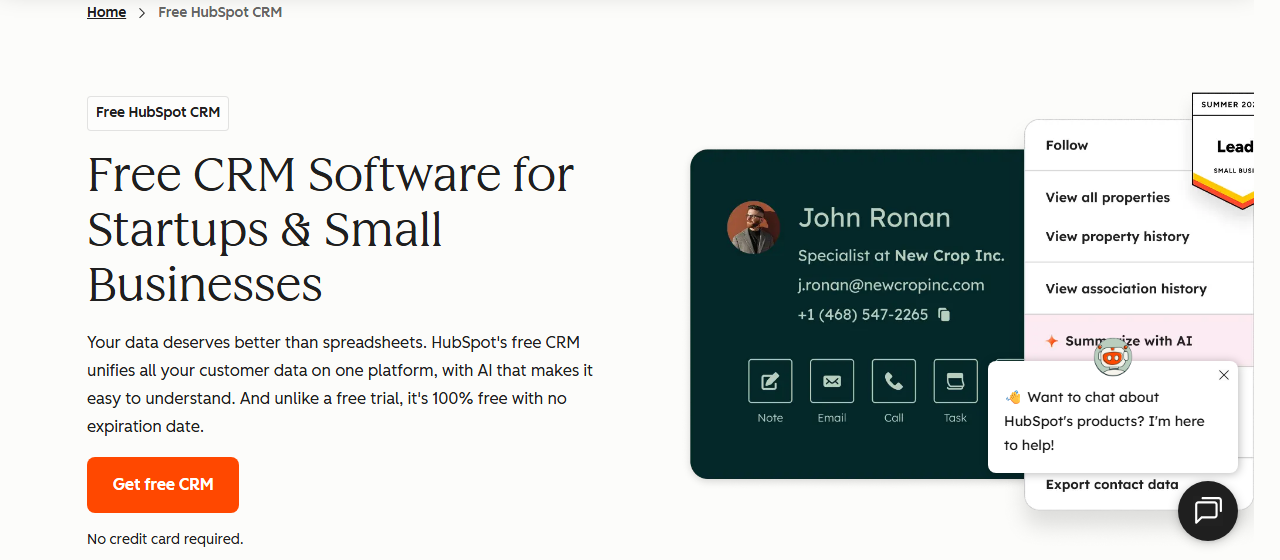
HubSpot’s free CRM page is a lesson in matching the query. The H1 targets the exact commercial phrase people search, adds the audience (“for startups and small businesses”), and answers the price question in the first screen. A buyer comparing CRMs gets the three things they need (what it is, who it is for, what it costs) without scrolling.
Neither page is long. What they share is focus: one query, one audience, one clear next step. Online stores face the same focus problem one level up, and our guide to SEO for ecommerce category pages shows how to give each category one query and one job.
The product page seo template we use
Here is the outline we hand to writers for a SaaS feature page. Adjust the order, but do not skip sections.
- H1 with the target phrase, written the way buyers search it, plus the audience if it fits. “Invoice approval software for finance teams”, not “Approvals, reimagined”.
- One-paragraph answer under the H1: what it does, for whom, in plain words.
- A real screenshot or short clip of the feature, captioned. Buyers want to see the UI.
- Three to five “how it works” blocks, each with its own H2 or H3 using a secondary phrase.
- Proof: a customer quote with a number, a logo strip, or a mini case study.
- Integrations this feature works with, linking to integration pages where they exist.
- Pricing hint: which plan includes it. “Available on Pro and above” saves a click and answers a real search.
- FAQ built from sales calls and support tickets, not invented questions.
- One primary CTA, repeated, and one secondary (demo or docs).
For product page seo on SaaS, word count lands somewhere between 600 and 1,200 for most feature pages. Long enough to answer the query, short enough that design does not have to fight it.
Five product page seo mistakes we find on almost every audit
1. Clever headlines instead of search terms. “Work, unblocked” means nothing to Google or a first-time visitor. Keep the brand line as a subheading if marketing insists, but the H1 and title tag need the phrase people type.
2. Everything in JavaScript tabs. Feature details hidden in tabs or carousels that only load on click are often not rendered in the first pass. Put the core copy in the HTML.
3. Feature pages competing with blog posts. A blog post titled “Best time tracking software” and a feature page for time tracking split the same query. Pick the feature page for the commercial term and point the blog post at it. This is the most common issue we see on this list.
4. No internal links in. Product pages often sit in the header menu and nowhere else. Link to them from every relevant blog post with descriptive anchors. Menu links alone do not tell Google much.
5. Duplicate use-case pages. “For agencies”, “for marketing agencies” and “for creative agencies” with the same copy and a swapped noun. Merge them or make each one genuinely different, and set canonical tags correctly while you do.
Schema and technical product page seo details
Use SoftwareApplication schema on the main product page with name, category, operating system and an offers block. Do not add self-serving review stars from your own testimonials; Google stopped showing those years ago and it is not worth the risk. Feature pages rarely need their own schema beyond breadcrumbs.
Keep product and feature URLs short and stable: /features/approvals/ beats /product/platform/features/approvals-workflow-v2/. Redesigns love to change these; every changed URL needs a 301 and costs you weeks.
A worked example: one feature page rewrite
Illustrative numbers from a typical rewrite. A B2B finance tool had a feature page titled “Approvals” with a 90-word hero and three tabs.
| Metric | Before | 90 days after rewrite |
|---|---|---|
| Target query | None (brand only) | “invoice approval software” |
| Words in HTML | 90 | 840 |
| Internal links pointing in | 1 (menu) | 9 |
| Non-brand queries with impressions | 4 | 61 |
| Average position for the target query | Not ranking | 7.4 |
| Trial sign-ups attributed to the page per month | 3 | 19 |
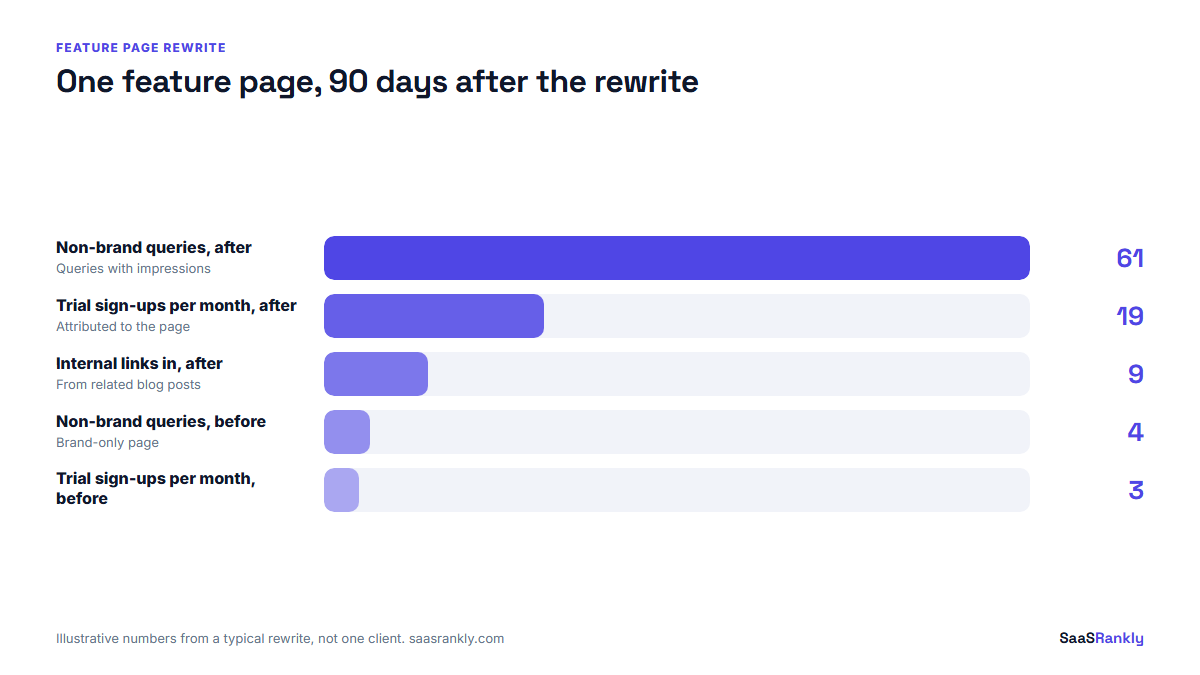
Most of the product page seo gain came from internal links out of nine existing blog posts. The rewrite made the page worth ranking; the links told Google it mattered.
Quick recap: product page seo
- SaaS product page seo covers the main product page, feature pages and use-case pages, each with its own query type.
- Main page targets the category term, feature pages target job-plus-software terms, use-case pages add the audience.
- Put the search phrase in the H1 and title; keep the brand line as a subheading.
- Keep core copy in HTML, not click-to-load tabs.
- Stop blog posts competing with feature pages for commercial terms.
- Internal links from related blog posts move feature pages more than extra copy does.
FAQ
What is product page seo?
It is optimising the pages that describe what you sell so they rank for the searches buyers make. For SaaS that means the main product page, feature pages and use-case pages, each targeting a different kind of query.
How long should a SaaS feature page be?
Usually 600 to 1,200 words in the HTML. Enough to explain what the feature does, how it works, who it is for and which plan includes it. Longer is fine if the topic needs it; padding is not.
Should feature pages or blog posts target “software” keywords?
Feature and product pages. Queries containing “software”, “tool” or “platform” usually show product pages and comparison lists. A blog post rarely beats a good product page there.
Do product pages need schema?
The main product page should use SoftwareApplication schema with an offers block. Feature pages mostly need breadcrumbs. Avoid marking up your own testimonials as review stars.
Why does my product page only rank for my brand name?
Usually because the H1 and title use a slogan instead of a search phrase, the copy is thin or hidden in tabs, and no other page links to it with descriptive anchor text.
How many keywords should one product page target?
One primary phrase plus a handful of close variants with the same intent. If a term needs a different page type to rank, give it its own page.