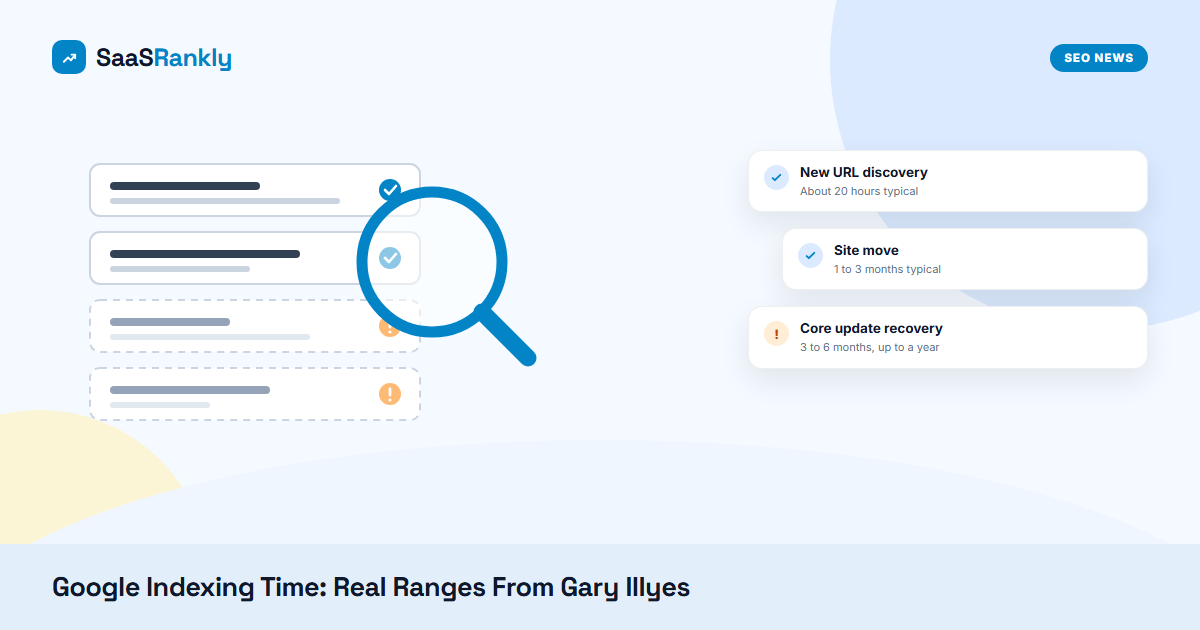
What happened: On October 2, 2026, at Search Central Live Deep Dive Europe in Barcelona, Google’s Gary Illyes put real numbers on Google indexing time. His slides gave a “typical” and a “slowest” range for each step of crawling, indexing and serving, from new URL discovery (about 20 hours) to core update recovery (3 to 6 months, sometimes a year). The full tables reached the public on October 4 through a recap by ROAST and coverage in Search Engine Journal. Illyes also said that “AI results are built on SEO infrastructure.”
Sources: ROAST day 3 recap and Search Engine Journal. Google has not posted the slides on its events page yet, so treat the figures as conference numbers, not official documentation.
Why Google indexing time matters for SaaS sites
Most SaaS teams ship pages in bursts. A new feature page, ten integration pages, a pricing change, a docs migration. Then someone asks on Slack why the new page is not ranking after two days. Until now the honest answer was “it depends”, and nobody likes that answer in a sprint review.
These ranges give you something better. If a new URL usually gets discovered in about 20 hours and indexed end to end in about 1.5 hours once Google picks it up, a page that is still missing after a week is a signal, not bad luck. On the other side, a site move that takes two months is normal. You do not need to panic and roll it back.
The slowest column matters just as much. For discovery, refresh and indexing, the slowest case is “never”. Google is telling you plainly that some URLs will not get crawled or indexed at all, and waiting longer will not fix that. Illyes also said Google filters out about 40 billion spam pages a day, which explains why thin or near-duplicate pages often sit in the “never” bucket.
The Google indexing time ranges, step by step
| Step | Typical | Slowest |
|---|---|---|
| Discovery of a new URL | About 20 hours | Weeks to never |
| Refresh of a known URL | About 30 days | Weeks to never |
| Sitemap processing | About 24 hours | Up to 14 days or never |
| robots.txt update | About 24 hours | 25 hours |
| Rendering | Seconds to render, hours in queue | Days to weeks |
| Indexing, end to end | About 1.5 hours | Months or never |
| Structured data updates | Hours to 1 to 2 weeks | Weeks or never |
| Canonical change | 1 to 3 weeks | Months |
| Title or snippet change | 1 to 2 days | Weeks to months |
| Site move | 1 to 3 months | 6 months to a year or more |
| Spam update change | 1 to 2 weeks | Months |
| Core update recovery | 3 to 6 months | 6 months to a year |
One point from the talk is easy to miss: the steps are chained. A slow render queue delays indexing, and a slow canonical decision delays the right URL showing up. When a page is late, find the step where it is stuck instead of looking at the total.
What these numbers mean for common SaaS situations
- New feature or integration pages: if they are linked from your nav or a hub page and listed in the sitemap, expect discovery within a day. Still “Discovered, currently not indexed” after two weeks? That points to quality or internal linking, not Google indexing time.
- Pricing and title changes: 1 to 2 days is normal for a new title or snippet to show. If it takes weeks, Google may be rewriting your title because it does not match the page.
- Docs or blog migrations: plan for 1 to 3 months of noise. Keep redirects in place for a year, since the slowest case runs that long. Our canonical tags guide covers the redirect and canonical setup that keeps this window short.
- Hit by the spam update: fixes can show in 1 to 2 weeks if the problem was spam signals. If your drop came from the September 2026 spam update, that is the window to watch.
- Hit by a core update: 3 to 6 months is the realistic recovery time. Do not judge a content rewrite after three weeks.
What to do
- Set expectations with these ranges. Add the table to your SEO reporting doc so product and leadership know that a site move taking two months is normal and a new page missing after a week is not.
- Check the URL Inspection tool at day 3 and day 14. If a new page is not discovered by day 3, fix internal links and the sitemap. If it is discovered but not indexed by day 14, look at quality, duplication and canonicals. Our guide to fixing SaaS indexing problems walks through each status.
- Do not resubmit the same URL every day. Discovery takes about 20 hours anyway. Spend that time on links from strong pages instead.
- Track recovery on the right clock. For core update drops, compare months, not weeks. Put a note in your dashboard on the date you shipped fixes, then review at 90 and 180 days. The technical SEO for SaaS checklist is a good place to audit before that clock starts.
Quick recap: Google indexing time
- Gary Illyes shared Google indexing time ranges at Search Central Live in Barcelona on October 2, 2026.
- Typical Google indexing time end to end is about 1.5 hours, after discovery that usually takes about 20 hours.
- The slowest case for discovery and indexing is “never”, so a missing page is often a quality or linking problem.
- Site moves take 1 to 3 months, and core update recovery takes 3 to 6 months or longer.
- Title and snippet changes show in 1 to 2 days, canonical changes in 1 to 3 weeks.
- Use these Google indexing time ranges to set deadlines in your SEO reports, and look for the stuck step when a page is late.