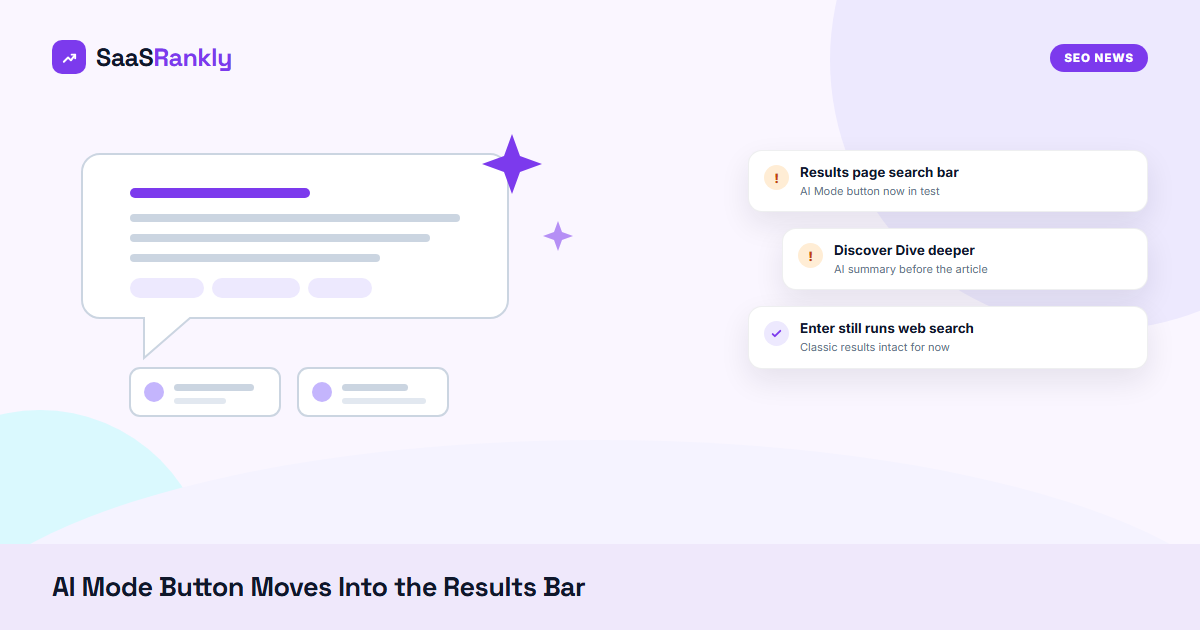
What happened: On September 18, 2026, Google was confirmed to be testing an AI Mode button inside the search bar on the results page, not only on the homepage. Dwayne Cubbins spotted the test on September 15 and asked, “Is Google trying to force people to use AI Mode when making a follow-up search from the results page?” Pressing Enter still runs a normal web search, so the ten blue links are not going anywhere this week. The same day, Google’s Robby Stein announced a Discover test called “Dive deeper” that opens “a short topic overview with prominent links to related stories, community reactions & original reporting” instead of sending the tap straight to a publisher page. Two different surfaces, one direction of travel.
Source(s): Search Engine Roundtable on the search bar test, Search Engine Roundtable on Discover Dive deeper, and Google’s own documentation on AI features in Search. Google has not put out a blog post on the search bar test.
Why the AI Mode button matters for SaaS sites
Most SaaS search demand is not a single query. Someone searches “invoicing software”, reads a few titles, then refines: “invoicing software for freelancers”, “invoicing software with stripe”. That refinement is where comparison pages and bottom-funnel posts earn their traffic. Putting an AI Mode button in the search bar on the results page targets exactly that second query. For how AI Mode compares with ChatGPT on that kind of follow-up research, see Google AI vs ChatGPT for product research.
If a meaningful share of those follow-ups get answered inside AI Mode, the pattern for your money pages changes. You keep the first impression and lose the second click. That is a worse trade than it sounds, because the refined query is usually the higher intent one.
The Discover test points the same way. A tap that used to land on an article now lands on a generated summary with links underneath. Publishers get cited rather than visited. Anyone running a content engine for a SaaS product should read that as a preview of how these answers treat editorial content everywhere else.
Where the AI Mode entry points sit now
| Surface | Status | Effect on your clicks |
|---|---|---|
| Homepage search box | Live, has been for months | Users pick AI Mode before typing |
| Results page search bar | In test since Sept 15 | Follow-up queries pulled into the AI answer |
| AI Overviews block | Live, expanding | One tap deeper into the AI answer |
| Google Discover | “Dive deeper” in test | Summary first, article second |
None of these kill organic traffic on their own. Together they mean the number of ways a user reaches an AI answer without touching a result keeps growing, and every one of them still needs sources to cite.
What to do about the AI Mode shift
- Split your Search Console data by AI surface. The generative AI performance report separates AI Overviews and AI Mode impressions from plain web results. Pull impressions and clicks for both and watch whether the gap widens over the next month. Our guide on measuring SaaS SEO in GA4 and GSC covers the reporting setup.
- Audit your top 20 commercial queries for follow-up coverage. Write down the second and third question a buyer asks after the head term, then check whether you have a page that answers each one directly in the first 100 words. Pages that answer cleanly get cited; pages that warm up for four paragraphs do not.
- Spot check AI Mode manually. Run your ten most valuable queries in AI Mode once a week and log whether your brand appears and which URL gets linked. It is tedious and it is the only reliable data you have right now. The AI Overviews visibility playbook has the tracking sheet.
- Protect the technical basics. Citation eligibility still runs through normal crawling and indexing, so a page blocked or slow to render is invisible there too. Run the schema validator on your comparison and pricing pages.
What we are not saying
This is a test, spotted by one person and replicated by a second, and it does not show for every query. Google runs and kills interface tests constantly. Do not rewrite your content plan over a button. The reason it is worth logging is the direction: every AI surface Google has shipped in the last year started as exactly this kind of quiet test, and the ones about follow-up queries hit SaaS funnels hardest. We covered a related shift when People Also Ask answers turned into AI Overviews.
Quick recap: AI Mode
- Google is testing an AI Mode button in the search bar on the results page, spotted September 15 and confirmed September 18, 2026.
- Enter still runs a standard web search, so it stays an option rather than a redirect.
- The test aims at follow-up queries, which is where SaaS comparison and bottom-funnel pages earn clicks.
- Google Discover is testing “Dive deeper”, an AI summary that sits in front of the publisher article, echoing the same pattern.
- Use the generative AI report in Search Console to separate those impressions from web results before the trend shows up in revenue.
- Citation still depends on clean crawling, indexing and direct answers near the top of the page.