Searching for the best software for AI visibility in search usually returns a list of 20 tools with identical feature grids. That does not help you choose. So we did it differently: we took one fictional SaaS brand, wrote 25 buyer prompts, and judged each type of tool on what it would tell us about those same prompts. The winner depends on team size and budget, and for some teams the right answer is a spreadsheet.
What “AI visibility in search” software measures
These tools send prompts to ChatGPT, Google AI Overviews, AI Mode, Perplexity, Gemini and similar engines on a schedule. They record the answers and report three things: whether your brand was mentioned, whether your site was cited as a source, and how you compare with named competitors. If you want the background on the metrics, our post on LLM visibility covers them in detail.
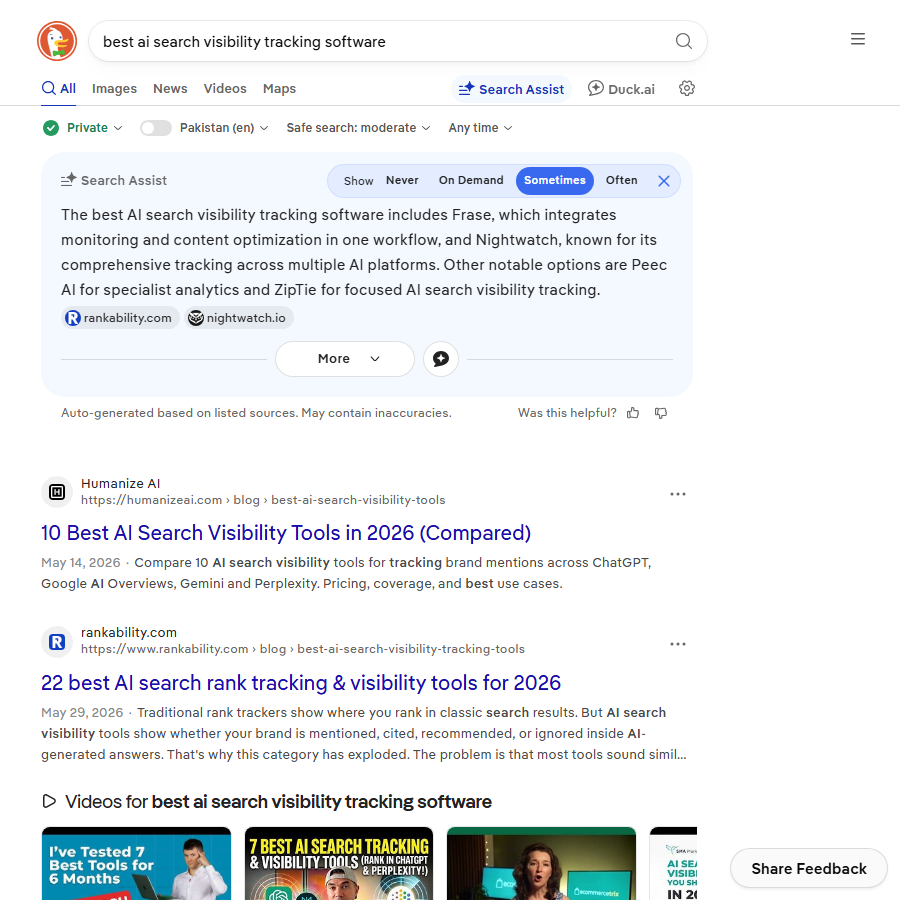
The category is crowded. One search on DuckDuckGo shows its own AI answer naming four products, followed by listicles comparing 10 and 22 tools.
How we tested software for AI visibility in search: 25 prompts, one brand
Our test brand is “Ledgerline”, a made-up invoicing tool for agencies. The prompt set looked like this:
| Prompt type | Count | Example |
|---|---|---|
| Category (“best X for Y”) | 10 | best invoicing software for small agencies |
| Comparison | 5 | Ledgerline vs FreshBooks for retainers |
| Problem-led | 6 | how do I automate late payment reminders |
| Brand | 4 | is Ledgerline any good |
25 prompts, 4 engines, run daily, comes to 3,000 answers a month. That number matters because almost every vendor prices by prompts, engines and run frequency. Work out your own figure before you open a pricing page.
Best software for AI visibility in search, by type
We group the market into four types. The differences between types are much bigger than the differences between products inside one type.
1. Dedicated trackers: Otterly.AI and Peec AI
These are built for this one job. Setup takes under an hour: add prompts, add competitors, pick engines. You get a share-of-voice chart, a list of cited domains and alerts when a mention appears or disappears.
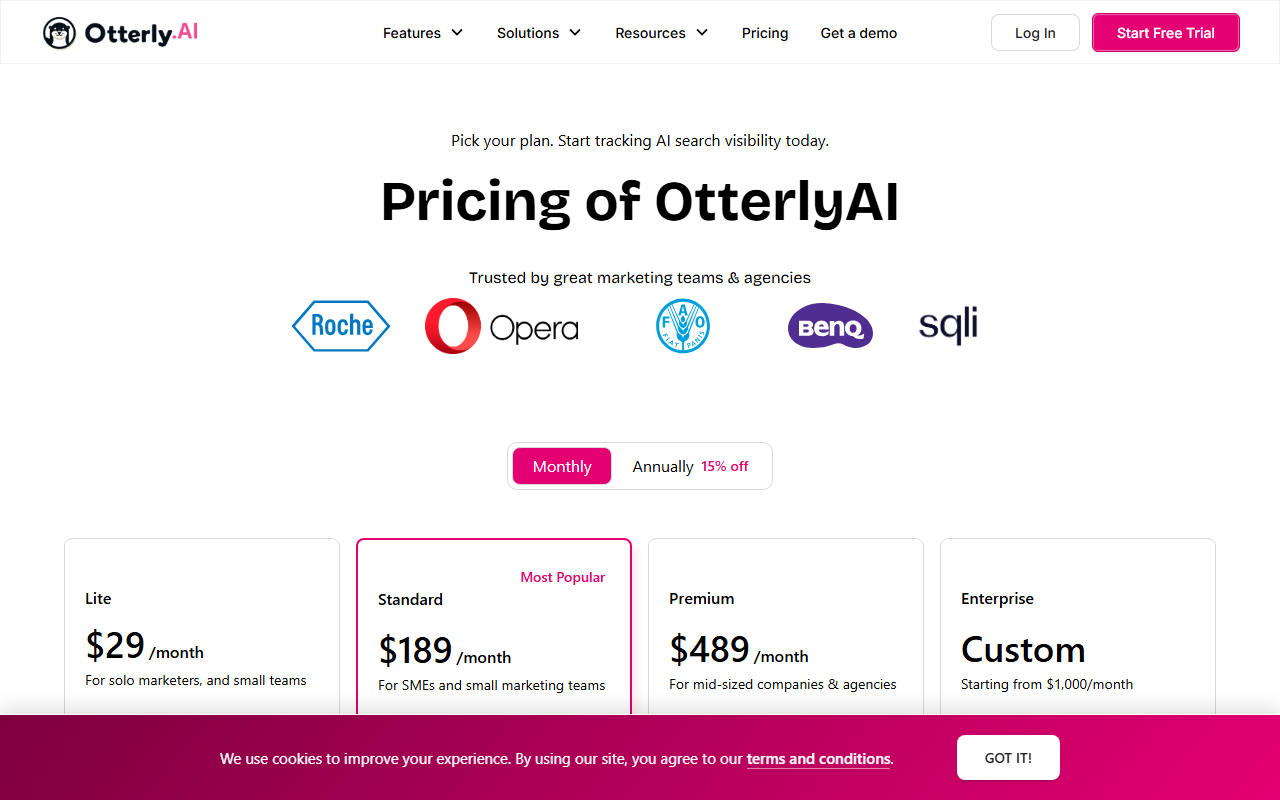
Otterly.AI is the cheapest credible entry point. At the time of writing its Lite plan is $29 a month, Standard is $189 and Premium is $489. Lite is tight on prompt volume, so our 25-prompt set would need Standard once we add more than a couple of engines.
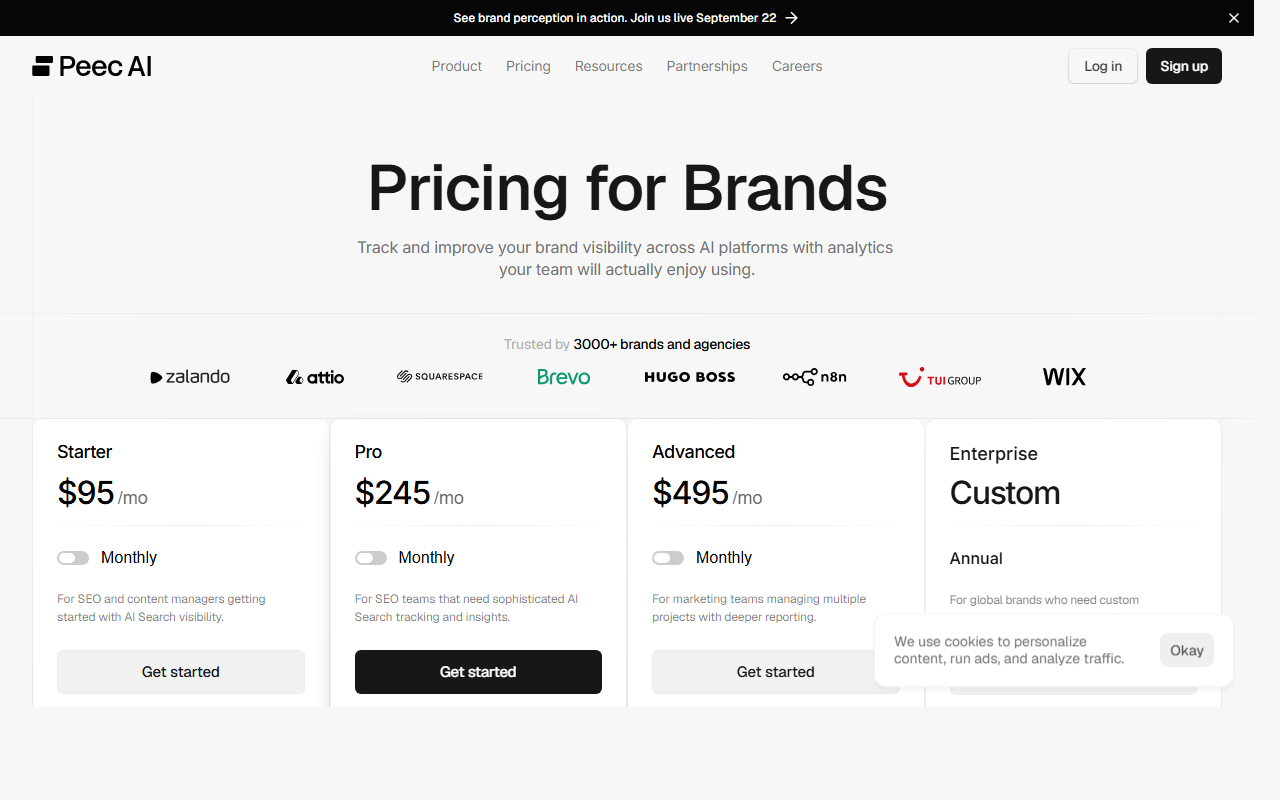
Peec AI starts higher, at $95 a month for Starter, $245 for Pro and $495 for Advanced, at the time of writing. In our experience Peec’s source analysis is the stronger of the two. It shows which third-party pages the engines lean on for your category, and that list is effectively your outreach list.
2. Add-ons inside SEO suites: Semrush and Ahrefs
Semrush sells an AI visibility toolkit and Ahrefs has Brand Radar. Both draw on very large prompt databases instead of only the prompts you type in. The benefit: you can see mentions for prompts you never thought to track. The drawback: you have less control over the exact wording, and the data refreshes more slowly than a daily tracker.
Stay on Semrush or Ahrefs for this if you already pay for the suite and your need is a monthly number for a board slide. If you need to watch 25 specific prompts day by day, a dedicated tracker does it better. We compared the two suites more broadly in Ahrefs vs Semrush for SaaS.
3. Enterprise platforms: Profound and similar
Sales-led, annual contracts, custom pricing. You get large prompt volumes, agent and crawler analytics from your server logs, and an account team. For a company with a brand team and 500 plus prompts across regions, this tier makes sense. For a 30-person SaaS it is overkill.
4. The manual method
A spreadsheet, 25 prompts, 4 engines, checked every two weeks by one person. It takes about 90 minutes per round. You lose daily variance, but you read every answer, which teaches you more than any dashboard. We describe the full process in our LLM rank tracking setup guide.
How each type handled the Ledgerline prompts
| Question we wanted answered | Dedicated tracker | Suite add-on | Enterprise | Manual |
|---|---|---|---|---|
| Are we mentioned for our 10 category prompts? | Yes, daily | Partly, similar prompts only | Yes, daily | Yes, fortnightly |
| Which sources do engines cite? | Yes | Yes | Yes, with log data | Yes, by hand |
| What prompts are we missing? | Weak | Strong | Strong | No |
| Sentiment of brand answers | Basic | Basic | Detailed | You read them |
| Monthly cost for our set | $95 to $245 | A paid add-on on top of the suite, check the current price | Four figures | 1.5 hours of time, twice |
The best software for AI visibility in search for your team size
- Pre-revenue or under $1M ARR: manual method. Spend the money on content instead.
- Small marketing team, one product: Otterly.AI Standard or Peec AI Starter. Pick Peec if outreach to cited sources is part of your plan.
- Already on Semrush or Ahrefs: try the add-on for one quarter before buying anything else.
- Multi-region brand with a PR team: take enterprise demos, and ask each vendor to run your prompts live.
Five checks before you buy
- Does it query the real interface or the API? API answers often differ from what a logged-in user sees, because the consumer apps add web search and personalisation. Ask the vendor directly.
- How many runs per prompt? AI answers vary between runs. One run a day is a sample, not a measurement. Look for tools that run each prompt several times and report a rate.
- Is Google AI Mode covered, or only AI Overviews? They behave differently.
- Can you export raw answers? Scores hide detail. The text of the answer is where you find out the engine thinks you lack a feature you shipped last year.
- What happens at the prompt limit? Some plans stop tracking, others bill overage. Know which.
The mistake we see most
Teams shortlist the best software for AI visibility in search, buy it, watch the score for two months, and change nothing. Tracking does not raise visibility. The work that does is unglamorous: get listed in the roundups the engines cite, publish clear comparison pages, keep product facts consistent across your site, G2 and documentation. Our guide on how to get cited by ChatGPT covers that side. If nobody has time for it, the cheapest plan is already too expensive.
For a wider product list with more vendors, see our roundup of AI search visibility tools.
Quick recap: best software for AI visibility in search
- Count prompts times engines times runs before comparing prices. Ours came to 3,000 answers a month.
- Dedicated trackers such as Otterly.AI ($29 to $489) and Peec AI ($95 to $495) suit small teams that watch specific prompts.
- Semrush and Ahrefs add-ons are better at finding prompts you did not know about, and worse at daily tracking.
- Enterprise platforms earn their price only with large prompt sets and a team to act on them.
- A fortnightly manual check is a legitimate option under $1M ARR.
- The best software for AI visibility in search is the one whose data you will act on. A score nobody uses is a cost.
FAQ
What is the best software for AI visibility in search for a small SaaS?
Otterly.AI or Peec AI on an entry plan. Both set up in under an hour and cost less than most rank trackers. If budget is zero, run the manual spreadsheet method every two weeks.
Can Google Search Console show AI visibility?
Only partly. AI Overview and AI Mode impressions are folded into normal Search Console totals with no separate filter, and ChatGPT or Perplexity are not covered at all. You need a separate tool or a manual check.
How many prompts should we track?
Start with 20 to 30 that map to real buying questions. More than 50 and most teams stop reading the answers, which defeats the purpose.
Why do two tools show different visibility scores for the same brand?
They use different prompts, different engines, different run counts and different formulas. Scores are only comparable over time within one tool. Never compare across vendors.
Is AI visibility software accurate?
It is a sample of a system that gives varied answers. Treat a move from 22 percent to 25 percent as noise. A move from 22 percent to 40 percent over a quarter is real.
Do we still need a normal rank tracker?
Yes. Classic results still send most SaaS organic traffic, and the pages that rank well are the ones AI engines tend to cite. Our list of the best rank tracker tools covers that side.