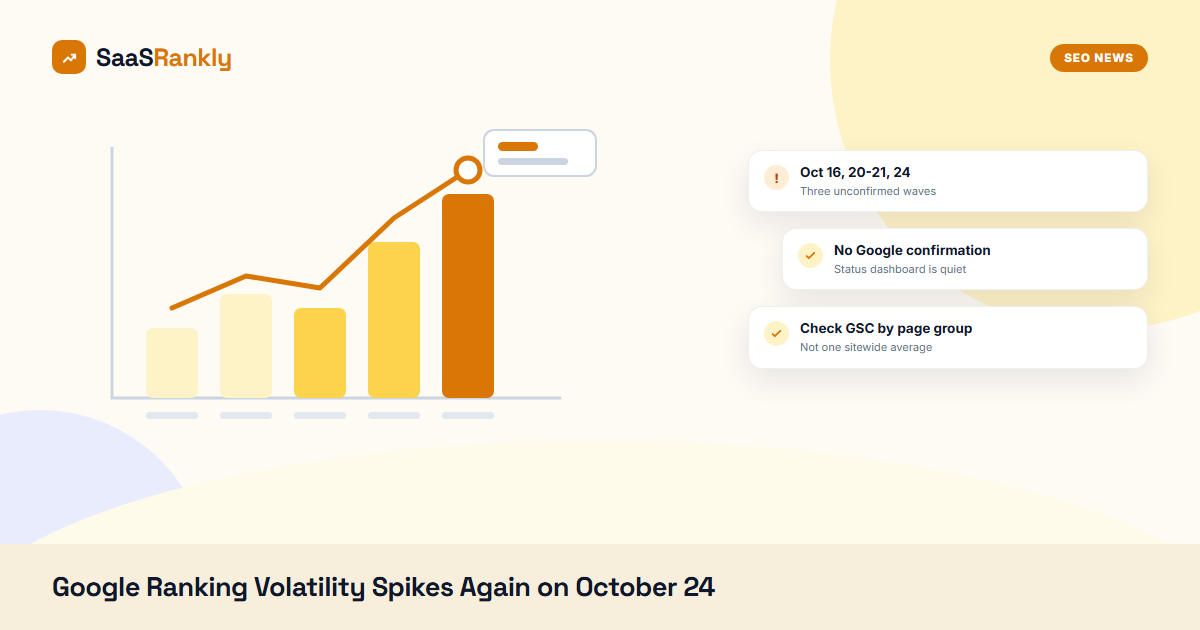
What happened: Google ranking volatility flared up again over the weekend. Rank trackers and SEO forums lit up from Friday, October 23 into Saturday, October 24, 2026, and Barry Schwartz at Search Engine Roundtable wrote that the movement, plus the chatter around it, suggests Google pushed out some kind of ranking change in that window. Google has not confirmed anything. This is the third wave of unconfirmed movement in about ten days, after October 16 and October 20 to 21, and it lands less than three weeks after the September 2026 spam update finished.
Sources: Search Engine Roundtable on the October 24 volatility, Search Engine Roundtable on October 20 and 21, and the Google Search Status Dashboard, which shows no new ranking update or incident for October.
If your SaaS dashboard looked strange this morning, you are not imagining it. But “the trackers are red” is not the same thing as “Google hit my site.” This post walks through what we actually know, what we do not, and how we would check a SaaS site this week without overreacting to a weekend of noise.
Google ranking volatility timeline: September to October 2026
The October 24 spike makes more sense when you see the whole run of events. Google search has been unusually restless for almost two months, and most of it has been unconfirmed.
| Date | What happened | Confirmed by Google? |
|---|---|---|
| Sept 4 to 13 | Unusual ranking activity reported across trackers and forums | No |
| Sept 15 | Another round of volatility | No |
| Sept 23 to 24 | Movement just before the spam update | No |
| Sept 24 to Oct 8 | September 2026 spam update, with waves around Sept 25 to 27, Sept 30 and Oct 4 to 6 | Yes |
| Oct 16 | Unconfirmed update that Barry Schwartz said “felt big” | No |
| Oct 20 to 21 | Chatter and tracker spikes, traffic complaints from Search and Discover | No |
| Oct 23 to 24 | Heated volatility across most third-party tools | No |
We covered the confirmed part of this story when it ended in our September 2026 spam update recap, and the early September swings in our unconfirmed September update post. Everything after October 8 sits in the unconfirmed bucket, which is where most Google ranking volatility lives. Google runs many small changes every year, and only a handful get a name and a dashboard entry.
What the trackers showed on October 24
The Roundtable post embedded charts from roughly fifteen tools. The ones dated October 24 or 25 include Semrush Sensor, Sistrix, Advanced Web Ranking, Wincher, Zutrix, SimilarWeb, Wireboard (which blends several tools), AccuRanker Grump, DataForSEO, CognitiveSEO, SERPrecon and Mozcast. A few charts in the same post were older, such as Mangools, Serpstat and Algoroo, so not every tool had fresh data.
Two things are worth keeping in mind before you treat any of these as proof.
- Trackers measure their own keyword sets. A sensor score of 8 or 9 tells you that the sample that tool watches moved a lot. It says nothing about your 400 product, comparison and integration keywords.
- Trackers have had a rough month. Schwartz noted that third-party rank tracking tools struggled over the past month and many have been patching their data collection. In the October 21 write-up, Glenn Gabe pointed out that Ahrefs showed a drop on the wrong date and missed a recovery, Semrush caught the drop with dates off, and Sistrix showed the September drop but nothing recent. So if your rank tracker shows a cliff, confirm it in Search Console before you believe it.
If you are picking or auditing a tracker after this, our rank tracker comparison covers how each tool samples SERPs and how often it refreshes.
What site owners are reporting
The forum chatter on WebmasterWorld and in the Roundtable comments follows a pattern we have seen all autumn:
- Discover traffic that burns out fast. Several publishers said Discover now sends traffic to an article for a few hours and then stops. One commenter said articles get less than six hours of Discover traffic at best.
- Impressions up, clicks down. One site owner on October 20 and 21 reported rankings and impressions rising while clicks fell 60 to 70 percent. That is a SERP layout or AI answer story more than a ranking story, and it matters a lot for SaaS blogs that rely on informational queries.
- Brand queries vanishing and coming back. Glenn Gabe reported two sites in a very YMYL niche that dropped out of results, even for their own brand names, and came back on the evening of October 16. He compared it to the unconfirmed September 4 movement.
- Big brands and broadcasters ranking higher. One commenter felt public broadcasters and large German publishers were taking more top spots.
- Odd bot traffic. One person saw heavy bot traffic from Singapore before the shift and blocked it.
Most of these reports come from publishers and affiliate sites, not B2B software companies. SaaS sites tend to feel Google ranking volatility differently because a big share of their value sits in brand, product, pricing and comparison pages, which are more stable than news and how-to content.
Is this a core update?
No, not as far as anyone can tell. Google announces core updates on the Search Status Dashboard and on its Search Central channels, and the dashboard lists nothing for October. The September 2026 spam update is still the most recent named ranking update.
That leaves a few likely explanations, none of them confirmed:
- Routine ranking system changes. Google makes thousands of changes a year. Some of them move enough results to show up on trackers without ever getting a name.
- Aftershocks from the spam update. Spam updates can be followed by reprocessing, as sites that were hit or cleaned up get re-evaluated.
- SERP feature and AI answer changes. Last week Brodie Clark spotted Google showing AI-written summaries inside AI Overview citation cards, text that does not appear on the cited page. Changes like that shift clicks without moving the blue-link position much.
- Tracker data fixes. When a tool repairs its collection, the “fixed” day can look like a volatility spike.
In practice it does not matter which one it was. What matters is whether your own numbers moved, on which pages, and whether the move holds for more than a few days.
Who is most exposed to Google ranking volatility right now
Based on the reports so far, these SaaS site types should look first:
- Content-heavy SaaS blogs with hundreds of top-of-funnel guides. These pages compete with publishers and are the first to feel reshuffles and AI answer changes.
- Programmatic pages such as integration directories, template galleries and “X vs Y” pages built at scale. If any of them are thin, a spam-adjacent re-evaluation can catch them. Our programmatic SEO for SaaS guide has a quality checklist for these templates.
- Sites that saw movement during the spam update. If you dropped or gained between September 24 and October 8, keep watching, because later waves often touch the same sites.
- Sites in YMYL-adjacent spaces like fintech, health tech, HR and payroll, and legal software, where Gabe’s examples suggest the swings have been sharp.
Product-led SaaS sites where most organic traffic is branded or bottom-funnel usually see much smaller effects from this kind of Google ranking volatility.
What to do this week, step by step
Here is the order we would work through it. None of these steps change your site. They are about getting a clear read first.
- Wait for clean data. Search Console performance data runs one to two days behind, and earlier this month it ran far later than that, as we covered in the Search Console delay post. Do not judge October 24 before Tuesday or Wednesday.
- Compare like with like. In Search Console, compare Friday to Sunday, October 23 to 25, against the same three days one week earlier. Weekends are always lower for B2B, so a week-over-week weekend comparison avoids a false alarm.
- Split by page group, not sitewide. Filter the Pages report by URL patterns such as /blog/, /integrations/, /vs/, /pricing/ and /templates/. A sitewide average hides the real story. If only /blog/ moved, that points to informational queries and AI answers, not a site-level problem.
- Separate position changes from CTR changes. If average position is flat but clicks fell, the SERP changed around you. Look at the queries in a private window and note whether an AI Overview, video carousel or forum block now sits above you.
- Check brand queries. Filter queries that contain your brand name. If brand clicks dropped, that is serious and rare, and it is worth checking for indexing problems, manual actions and security issues right away.
- Check indexing and crawl health. Look at the Page indexing report and Crawl stats. A spike in server errors or a fall in crawl requests can look like a ranking drop. The PHP2Shell exploit Google talked about last week is a good reminder to confirm your server and plugins are patched.
- Tie it back to signups. Open GA4 and look at organic sessions and trial or demo conversions for the same windows. Our guide on measuring SaaS SEO with GA4 and GSC shows how to line these up. A traffic dip with flat signups is a reporting note, not an emergency.
- Write it down. Add an annotation for October 16, October 20 to 21 and October 24 in your SEO reporting. When a confirmed update arrives later, you will want to know what happened before it.
What not to do: do not rewrite titles across the site, delete pages, disavow links or change internal linking in a panic this week. Changing things during unconfirmed volatility makes it nearly impossible to tell what caused what.
How to read your own data after a volatile weekend
A simple way to sort what you see in Search Console:
| What you see | Likely meaning | Next move |
|---|---|---|
| Clicks and impressions flat, trackers red | The volatility did not touch your keyword set | Note it and move on |
| Impressions flat or up, clicks down, position flat | SERP layout or AI answer change | Check live SERPs, test titles and snippets later |
| Position down on one page group only | Re-ranking for that query type | Review those pages against the current top results |
| Position down sitewide, including brand | Possible site-level issue | Check indexing, manual actions, security, server logs |
| Drop that recovers within 3 to 5 days | Test or rollback by Google | Keep the annotation, no changes needed |
For a recurring view of this, a page-group dashboard saves a lot of time. We walk through one in our SaaS SEO reporting dashboard guide.
What this means for SaaS content strategy
Step back from this one weekend and the bigger pattern is clear. Google results have been shifting every week or two since early September, with only one named update in that time. For SaaS teams, that means a few things.
First, top-of-funnel traffic is the least stable thing you own. Pages that answer broad “what is” questions are exposed to both ranking reshuffles and AI answers that summarize them. They still have value for topical authority, but they should not be the main source of your pipeline forecast.
Second, pages close to the buying decision hold up better. Comparison pages, alternatives pages, pricing explainers, integration pages and use-case pages tend to keep their positions because the query intent is narrow and the answer needs specific product facts. If you have been putting off that part of your content plan, this is a good month to move it forward.
Third, clicks and positions are drifting apart. The report of clicks falling 60 to 70 percent while impressions rose is extreme, but the direction matches what many SaaS sites see on informational queries. Report impressions, clicks and conversions side by side, and stop treating average position as the main health metric.
It is also worth noting the AI search studies that came out the same week. Marie Haynes looked at GA4 data from 100 sites and found Google organic still drove 96.5 percent of the conversions in her sample, with ChatGPT traffic at well under 1 percent of Google’s volume. Our read: AI visibility is worth tracking, but Google ranking volatility still moves far more SaaS revenue than any AI assistant does right now.
What to watch next
- The Search Status Dashboard. If Google starts a named core update in the coming weeks, it will appear there first. A late-year core update would not be unusual.
- Whether the October 24 moves stick. Several of this autumn’s swings reversed within days. Recheck your page groups next Monday.
- Discover behavior. If you get Discover traffic from product news or launch posts, watch whether the shorter traffic windows publishers describe show up for you too.
- AI Overview citation changes. The AI-written citation summaries are still a test. If they roll out widely, expect more pages where impressions stay up and clicks fall.
- Rank tracker fixes. Expect some tools to revise their volatility charts as they repair data. Treat any single chart with caution until two or three tools agree.
Quick recap: Google ranking volatility, October 24
- Google ranking volatility spiked from October 23 into October 24, 2026, across most third-party trackers.
- Google has not confirmed an update, and the Search Status Dashboard shows nothing new for October.
- This is the third unconfirmed wave of Google ranking volatility since October 16, following the September 2026 spam update.
- Check Search Console by page group and compare weekend to weekend before reacting to Google ranking volatility.
- Falling clicks with steady positions point to SERP and AI answer changes, not a ranking loss.
- Bottom-funnel SaaS pages usually ride out Google ranking volatility better than broad blog content.
FAQ
Did Google confirm the October 24, 2026 update?
No. As of October 26, Google has not confirmed any ranking update after the September 2026 spam update, which finished on October 8. The October 24 movement is unconfirmed and based on tracker data and site owner reports.
Why do rank trackers show volatility when my traffic looks normal?
Each tracker watches its own keyword sample, often weighted toward broad and commercial queries across many niches. Your keyword set may not overlap with it at all. Several trackers also had data problems this month, which can exaggerate or misdate spikes.
How long should I wait before reacting to Google ranking volatility?
Give it at least a week. Search Console data lags by a day or two, and many of this autumn’s swings reversed within three to five days. If a drop holds for two weeks on a specific page group, then start reviewing those pages.
Should I change my content after this volatility?
Not yet. Changing titles, deleting pages or reworking internal links during unconfirmed volatility makes it hard to know what helped or hurt. Collect the data first, then make targeted changes to the page groups that actually lost ground.
Is this related to AI Overviews?
Possibly in part. Google is testing AI-written summaries in AI Overview citation cards, and some site owners report clicks dropping while impressions rise. That pattern usually comes from SERP and AI answer changes rather than a pure ranking shift.