Organic results are the unpaid listings Google ranks by relevance: the blue link, the URL line, the snippet underneath. Everything else on a search page is something else. Ads are bought, AI Overviews are generated, map packs pull from Business Profiles, and shopping grids come from merchant feeds. That sounds like a definition you learned years ago, but in 2026 the gap between “position 1” and “the first thing a searcher sees” is wider than it has ever been, and most SaaS reporting still pretends it is not.
We audit a lot of SaaS search reports. The single most common mistake we see is a team celebrating a top-three ranking while the page gets fewer clicks than it did a year ago. The ranking is real. It is just sitting under four other things.
What counts as organic results, and what does not
Here is the working split we use when we annotate a SERP for a client. The question for every block is simple: did someone pay for it, did Google generate it, or did Google rank a page for it?
| Block on the page | Organic? | How it gets there | Shows in Search Console? |
|---|---|---|---|
| Classic blue links | Yes | Ranked by relevance and quality signals | Yes, as Web |
| Featured snippet | Yes | An organic page promoted into a box | Yes, counted as one position |
| People Also Ask answers | Yes, mostly | Organic pages answering a related question | Yes, when expanded and clicked |
| AI Overview links | Partly | Generated answer citing organic pages | Yes, folded into Web |
| Text ads | No | Auction | No |
| Shopping ads | No | Merchant feed plus auction | No |
| Local pack | Separate system | Business Profile ranking | Only if the profile links to your site |
| Video and image packs | Yes, but vertical | Video and image indexes | Yes, partly under other search types |
The interesting rows are the middle ones. A featured snippet is an organic result wearing a costume. AI Overview citations are the messy case: the source pages earned their place organically, but the block itself is generated, and the link often sits behind a small icon rather than a headline. When people argue about whether organic results are “dying”, they are usually arguing about how to classify that one row.
Why organic results matter less per position than they used to
Position is a rank inside the organic list. Visibility is about pixels. Those used to be roughly the same thing, and on many SaaS queries they no longer are.
Take a commercial query such as “invoicing software for freelancers”. At the time of writing, a desktop search for terms like that commonly shows two or three text ads, sometimes an AI Overview, a People Also Ask box, and a review-site listicle before any vendor’s own page. On mobile the first organic result can start well below the first screen. We measured a set of 40 SaaS commercial queries for a client last quarter and the first true organic result began, on average, around 900 pixels down on a desktop viewport. On informational queries it was closer to 500.
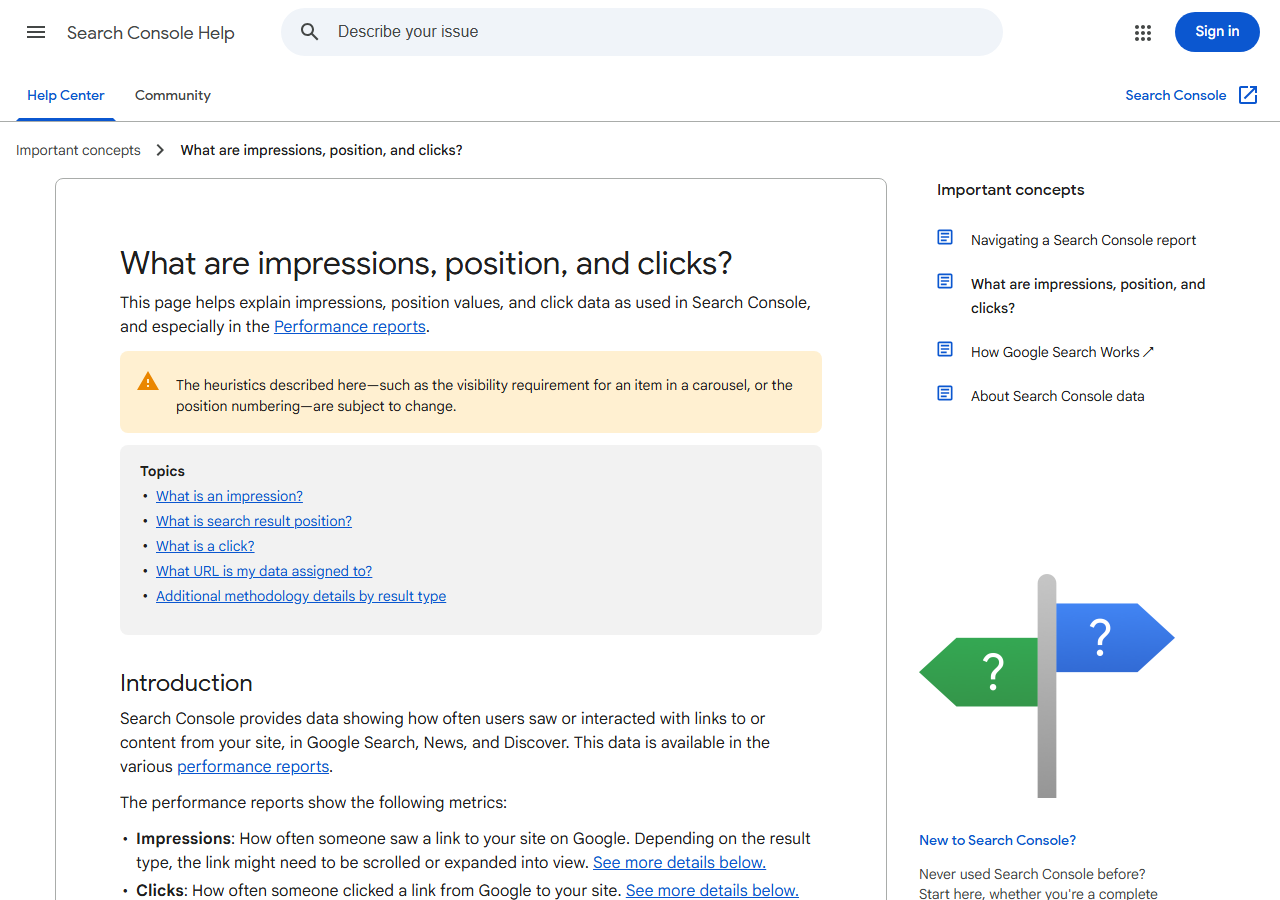
That matters because click-through rate tracks what people see, not what a tool calls “position 1”. Our breakdown of what counts as a click covers the Search Console side of this, but the short version is that an impression is logged when your result is on the page, not when it is on the screen.
A worked example: same rank, different traffic
Here is an illustrative case, built from a pattern we have seen several times. A project management SaaS ranks third in organic results for three different keywords. Same rank, same month. The numbers are invented but realistic.
| Keyword | Monthly impressions | Blocks above organic | Organic position | CTR | Clicks |
|---|---|---|---|---|---|
| gantt chart template | 9,000 | Image pack, PAA | 3 | 7.1 percent | 639 |
| project management software | 14,000 | 3 ads, AI Overview, listicle | 3 | 1.8 percent | 252 |
| what is a burndown chart | 5,500 | AI Overview, featured snippet (not ours) | 3 | 2.4 percent | 132 |
Illustrative numbers. The rank column is identical and the click column differs by a factor of almost five. If your monthly report shows “average position 3.0” for these three terms, it is telling you almost nothing about traffic. This is the reason we stopped putting average position at the top of client dashboards; the SERP metrics worth tracking post explains what we replaced it with.
Two things jump out. The highest-volume term produces the fewest clicks per impression because ads and a listicle sit above it. And the informational term is being answered before anyone scrolls, so the organic results below it get leftovers. Neither problem is fixed by moving from position 3 to position 2.
How to measure organic results honestly
You cannot see ads in Search Console, so you need two views: the data Google gives you, and a manual look at the page. Here is the routine we run once a quarter for a SaaS site’s top 30 money keywords.
- Export the queries. Search Console Performance report, last 3 months, filtered to your commercial pages. Keep clicks, impressions, CTR and position. If you hit the row limits, our guide to getting keyword data out of Search Console has the workarounds.
- Look at each SERP in a clean browser. Logged out, private window, the country you sell to. Note every block that sits above your listing.
- Record pixel depth, roughly. We use a simple scale: above the fold, one scroll, two scrolls or more. Precision is not the point; the pattern is.
- Tag the blocker. Ads, AI Overview, listicle from a review site, video pack, or nothing. One tag per query, the biggest one.
- Compare CTR inside each tag. A position 2 result under an AI Overview should be compared with other position 2 results under AI Overviews, not with your site average.
- Decide per tag. Each blocker has a different response, covered in the next section.
This takes about two hours for 30 keywords. It is the most useful two hours in a quarterly SEO review, because it turns “rankings are fine but traffic is down” into a list of specific causes.
What to do when organic results sit below the fold
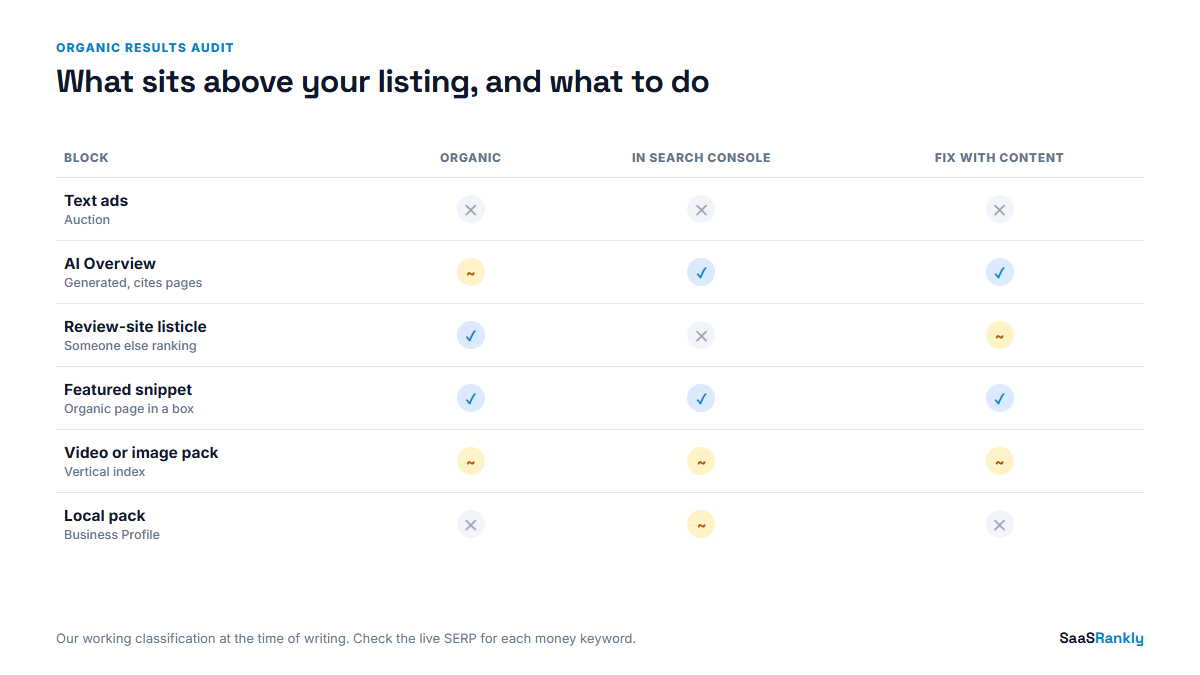
Our opinion: do not fight the layout, work with it. The response depends on what is pushing your organic listing down.
If it is ads. You have two honest options. Accept a lower CTR and judge the keyword on conversion rate rather than clicks, or run a small branded and competitor ad budget so you occupy both spots. For a SaaS product with a trial worth $300 or more in expected revenue, a $4 click on your own money keyword is often cheap. We are not an ads shop, but pretending ads do not exist is how SEO reports lose credibility.
If it is a review-site listicle. Get into the listicle. The G2, Capterra or “best X tools” article above you is itself an organic result, and it is usually easier to earn a mention there than to outrank it. Treat it as a link-building and PR target.
If it is an AI Overview. Be one of the cited sources. Pages that answer the exact question in the first two sentences, then go deeper, get cited more in our tracking. Clean headings, a direct definition, and a table help. We cover the reporting side in our post on SERP features for SaaS.
If it is a featured snippet owned by someone else. This is the one case where a small content edit can move you above everything. Match the format the snippet uses (paragraph, list, or table) and answer in under 50 words directly under a heading that mirrors the query.
If it is nothing. Then your snippet is the problem. A weak title and description lose clicks even on a clean page. Run the title through our SERP snippet preview and check that it fits, leads with the keyword and gives a reason to click.
Organic results versus paid: the numbers people quote
You will see claims that organic results get around 90 percent of all clicks, or that the first organic result gets a 30 to 40 percent CTR. Both numbers come from studies of broad query sets, heavy on informational and navigational searches where ads rarely appear. They are fair averages for the web. They are poor predictions for a SaaS commercial query with four ads on it.
What we see across client accounts is closer to this: on informational queries, organic results still take the large majority of clicks that leave Google. On high-intent commercial queries in competitive SaaS categories, paid results can take a third or more of the clicks, and a position 1 organic CTR in the single digits is not unusual. If your forecast uses a generic CTR curve, adjust it per query type before you show it to a founder. You can read Google’s own explanation of how Search Console counts these numbers in its Performance report help page.
Quick recap: organic results
- Organic results are the unpaid, relevance-ranked listings; featured snippets count, ads and shopping grids do not.
- Position measures rank inside the organic list, not what a searcher actually sees.
- Search Console only reports organic and AI Overview activity, so you need a manual SERP check to see ads.
- Tag each money keyword by the biggest block sitting above your listing, then compare CTR within each tag.
- Answer ads with conversion focus or a small budget, listicles with outreach, AI Overviews with clear answers.
- Replace generic CTR curves with per-query-type curves before you forecast traffic.
FAQ
What are organic results in Google?
Organic results are the listings Google ranks by relevance and quality without payment: the standard title, URL and snippet entries, plus featured snippets and expanded People Also Ask answers that come from organic pages.
Is a featured snippet an organic result?
Yes. It is an organic page that Google has lifted into a box at the top of the results. In Search Console it is counted as a single position, usually position 1.
Do AI Overviews count as organic results?
The overview itself is generated, but the pages it cites earned their place through organic ranking. Google reports AI Overview impressions and clicks inside the Web search type in Search Console, without a separate filter at the time of writing.
Why do my organic results get fewer clicks even though rankings are stable?
Usually because something new sits above you: more ads, an AI Overview, a video pack, or a listicle from a review site. Check the live SERP for each affected query and tag the blocker before changing the page.
How many organic results are on a Google page now?
It varies. Many queries still show about ten classic organic results per page, but continuous scrolling and extra blocks mean the count per screen is far lower, and some commercial queries show fewer than eight blue links.
Should a SaaS company care more about organic results or ads?
Both, for different jobs. Organic results compound and cost nothing per click, which makes them the better long-term channel. Ads buy guaranteed placement on the few queries where organic listings sit too far down to matter.