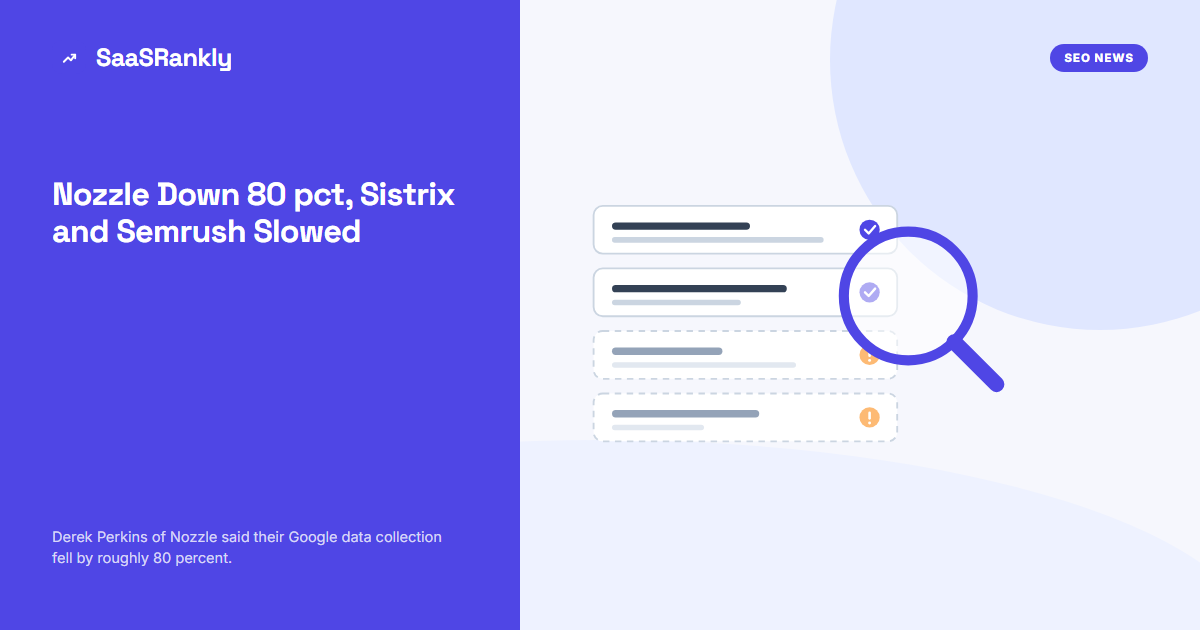
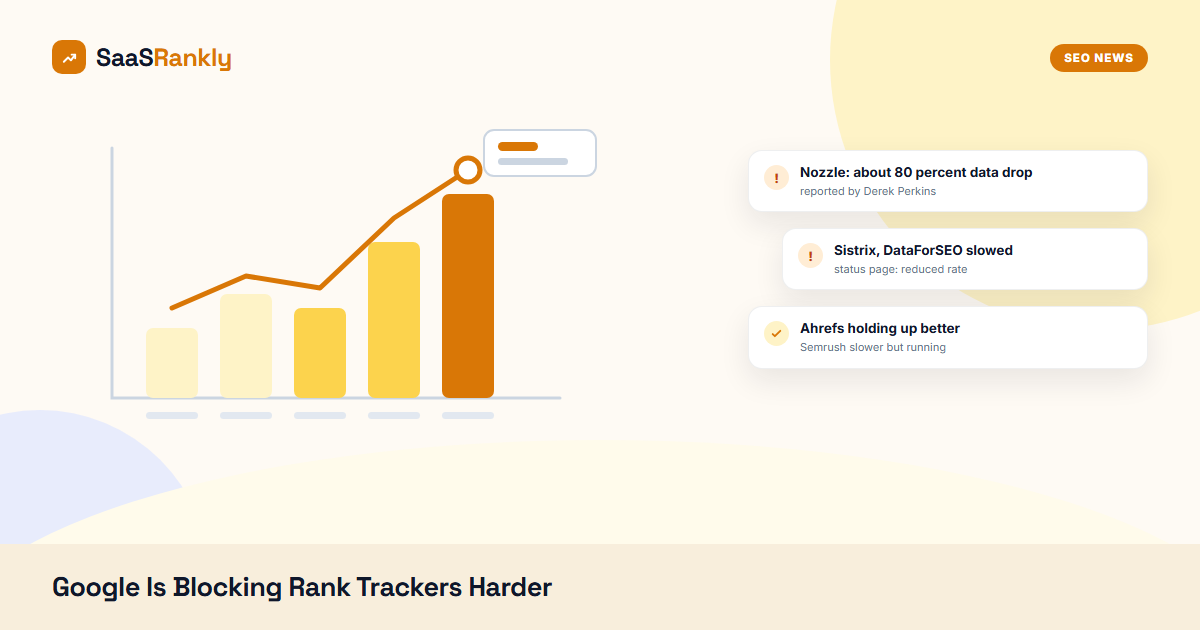
What happened: On September 18, 2026, Search Engine Roundtable reported that Google blocking rank trackers and SERP scrapers has become a lot more effective. Derek Perkins of Nozzle said their Google data collection fell by roughly 80 percent. Sistrix put a notice on its status page: “Google has made further changes to the way search results are delivered. As a result, our data collection is currently running at a reduced rate.” DataForSEO reported reduced access, Semrush is still collecting but slower, and Ahrefs looks like the tool holding up best so far. The squeeze got sharp around September 13, right after the September 4 ranking changes were reversed and two days before the September 15 volatility spike.
Source(s): Search Engine Roundtable: Google May Be More Successful In Blocking Scrapers & Tracking Tools, Sistrix status page, and Steve Paine of Sistrix, who said Google has been changing how results are delivered “for about a year now”.
Why Google blocking rank trackers matters for SaaS sites
Almost every SaaS SEO report starts with a position number that came from a scraper. When Google blocking rank trackers cuts the data feed by 80 percent, your tracker has a choice: show gaps, show stale positions from the last good crawl, or show a sample that is too small to trust. Most tools pick the second or third option quietly, so the chart looks fine while the number behind it is days old.
This lands on top of two things we already covered. In September, Google started wrapping result links in google.com/goto redirects that broke rank trackers, and rankings have been swinging since the unconfirmed September 4 and September 15 updates. Glenn Gabe checked tool reports against real traffic changes and found the two did not line up. So if your dashboard says you dropped 6 positions on September 14, you now have to ask whether that was the update or the scraper.
Steve Paine’s line is the one to remember. Google has been tightening SERP delivery for about a year, with JavaScript requirements, num=100 removal, human verification prompts and now this. Google blocking rank trackers is not a one-week incident. It is the direction.
Which tools are affected by Google blocking rank trackers
| Tool | Status as of Sept 18, 2026 | What it means for your data |
|---|---|---|
| Nozzle | About 80% drop in Google data collection | Big gaps, many keywords not refreshed |
| Sistrix | Collection “running at a reduced rate”, recovery lagging | Visibility index updates slower, trend lines smoothed |
| DataForSEO | Reduced access reported | Any tool built on its API inherits the gaps |
| Semrush | Still scraping, slower | Positions refresh less often than the plan promises |
| Ahrefs | Holding up better than competitors | Most complete picture right now, still not immune |
Three of these are shared upstreams. A lot of the smaller trackers in our rank tracker comparison buy SERP data from DataForSEO or a similar provider, so their gaps will match. Check which one your tool uses before you blame the tool. Free-tier tools tend to feel it first, so read the limits in our free SERP rank tracker comparison before you trust one for weekly reporting.
What to do about Google blocking rank trackers
- Mark September 13 to 18 on every ranking chart. Add an annotation in your SEO reporting dashboard so nobody reads a scraper gap as a ranking loss. If your tracker shows “last checked” dates per keyword, export them and count how many keywords are older than 3 days.
- Make Search Console the source of truth for this month. Impressions and average position in GSC come from Google’s own logs, not a scraper. Google blocking rank trackers does not touch that data. Our guide to measuring SaaS SEO with GA4 and GSC shows how to pull position data from the API so you are not stuck with the 1,000 row UI limit.
- Cross-check the big keywords by hand. Pick your 20 revenue keywords, run them in a clean incognito window in your main market, and compare with the tracker. If the tracker is off by more than 2 positions on most of them, its data for that week is not usable.
- Ask your vendor two questions. Which SERP provider do you use, and what is your current success rate per query? A vendor that gives you a number is a vendor you can plan around. One that says “everything is fine” while Nozzle is down 80 percent is guessing.
Longer term, Google blocking rank trackers pushes SaaS teams toward what Google itself gives you: GSC, the new AI Overviews and AI Mode reports, and first-party conversion data. Position 3 versus position 5 matters less than it used to anyway, since Mueller already said the old position 1 to 10 is hard to map onto a page full of AI Overviews and PAA blocks.
Quick recap: Google blocking rank trackers
- Google blocking rank trackers intensified around September 13, 2026, per Search Engine Roundtable on September 18.
- Nozzle lost about 80 percent of its Google data; Sistrix and DataForSEO run at a reduced rate; Semrush is slower; Ahrefs is holding up better.
- Google blocking rank trackers overlaps with the September 4 and September 15 ranking volatility, so tool drops and real drops are mixed together.
- Treat Search Console as the primary position source until rank tracker data stabilises.
- Annotate the dates, check keyword freshness, and spot-check top keywords by hand.
- Google blocking rank trackers is a year-long trend, not a blip: plan reporting around Google’s own data, not only scrapers.