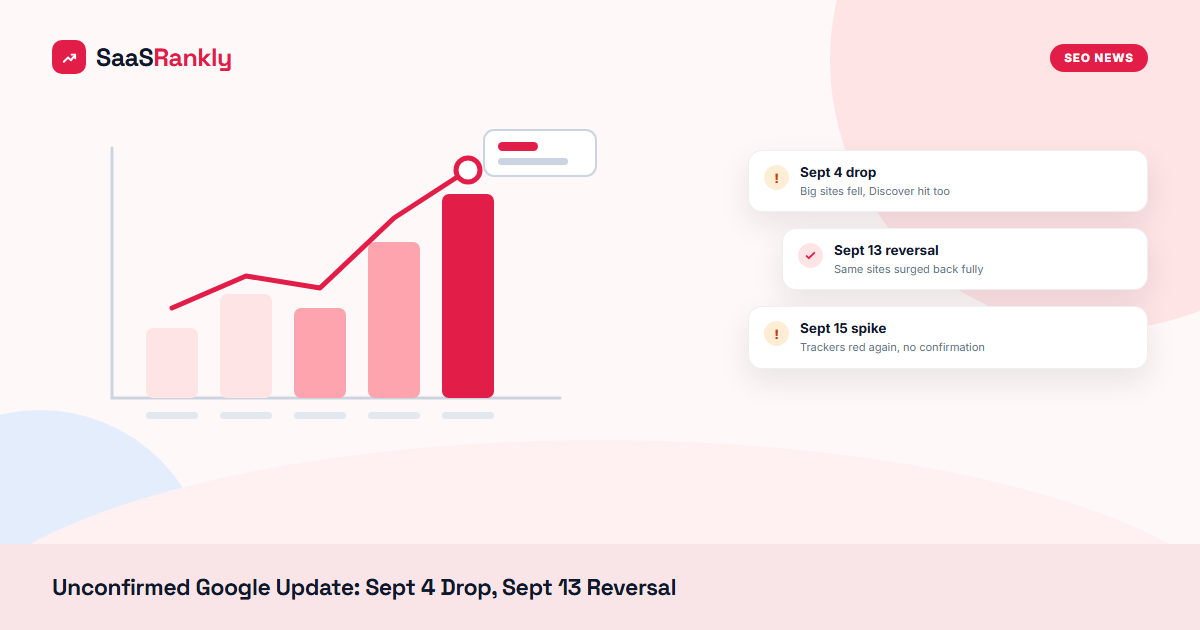
What happened: An unconfirmed Google update has been swinging rankings for almost two weeks, and it spiked again on September 15, 2026. Sites that lost rankings around September 4 saw those losses fully reverse on September 13, then a fresh wave of volatility hit the next morning. Glenn Gabe summed up the reversal: “A number of the sites that fell off a cliff around 9/4 completely surged back yesterday. The recovery is wild.” Barry Schwartz reported “a huge spike in chatter in the past few hours” on the morning of September 15. Google has confirmed nothing, and the Search Status Dashboard still shows the August 2026 spam update as the last ranking event.
Source(s): Search Engine Roundtable on the September 15 volatility spike, Search Engine Roundtable on the September 4 drop and September 13 reversal, and the Google Search Status Dashboard, which lists no ranking incident for September.
Why this unconfirmed Google update matters for SaaS sites
A confirmed core update gives you a start date, an end date and a policy document. An unconfirmed Google update gives you none of that, so every drop looks like it might be your fault. That is where teams waste money: they see a 20% traffic dip on a Friday, spend the weekend rewriting pages, and then the rankings come back on their own because the change was reverted on Google’s side.
That is exactly what happened here. Sites that tanked on September 4 recovered fully on September 13 without touching anything. Site owners confirmed the recovery in their own analytics, not just in third-party trackers, which is the detail that makes this worth paying attention to. If your SaaS blog or comparison pages dropped in early September and you already shipped a “fix”, you now have no idea whether the fix worked or whether Google simply rolled something back.
Discover was hit harder than classic search in this one. One publisher reported Discover traffic down about 20% and then recovering over a weekend. For SaaS sites running a high-volume content program, Discover is usually a bonus channel rather than a pipeline channel, so the bigger risk is misreading a Discover swing as a core search problem.
What the trackers and site owners reported
| Date | What was observed | Confirmed by Google? |
|---|---|---|
| Sept 3 to 4, 2026 | Large sites lost rankings, several also lost Discover traffic; volatility tools spiked | No |
| Sept 5 to 12, 2026 | Unsettled results, ongoing chatter, no recovery for affected sites | No |
| Sept 13, 2026 | Sites that dropped on Sept 4 surged back; recovery visible in first-party analytics | No |
| Sept 15, 2026 | Fresh spike across CognitiveSEO, Semrush Sensor, Mozcast, AccuRanker Grump, Algoroo, Sistrix, AWR, Serpstat and others | No |
Forum reports on September 15 were blunt. One site owner wrote that “many I used to rank for dropped and now new completely different pages ranking”. Another reported UK results looking “absolutely crazy since Saturday night” with more spam showing up. A third saw traffic and conversions stop together at 4 PM the previous day, which is the pattern you get from a ranking shift rather than a tracking bug.
Worth noting what this unconfirmed Google update is not. There is no spam policy change behind it, no Search Central blog post, and no dashboard entry. The last confirmed ranking event is still the August 2026 spam update, which finished on August 21.
What to do during an unconfirmed Google update
- Freeze content and technical changes for 10 days. Given that the September 4 drops reverted on September 13, any edit you ship mid-swing becomes impossible to attribute. Keep shipping product pages and new posts on schedule, but hold off on mass rewrites, redirect cleanups and template changes until the trackers calm down.
- Segment Search Console by page type before you panic. Pull clicks and impressions for your comparison pages, alternatives pages, docs and blog separately. In this unconfirmed Google update, movement was concentrated in editorial and Discover traffic rather than across the board. Our guide to measuring SaaS SEO in GA4 and GSC covers the segments worth saving.
- Check whether your rank tracker is measuring the same SERP you are. Several trackers have been reporting inflated movement since the google.com/goto redirect change. Compare tracker deltas against Search Console average position before you write the incident up. If they disagree, trust Search Console and see our rank tracker comparison for which tools handle this cleanly.
- Write down a dated baseline now. Record impressions, clicks and average position for your top 20 URLs as of today, September 16. When the next unconfirmed Google update lands, that snapshot is the only thing that will tell you whether a dip is real or a rollback in progress.
Quick recap: unconfirmed Google update
- The unconfirmed Google update started around September 4, 2026, hitting large sites in both search and Discover.
- On September 13 the September 4 losses fully reversed for many affected sites, confirmed in first-party analytics.
- A second volatility spike landed on the morning of September 15 across more than a dozen tracking tools.
- Google has not confirmed anything, and the Search Status Dashboard shows no September ranking entry.
- For SaaS teams the practical move during an unconfirmed Google update is to freeze large changes, segment GSC by page type and keep a dated baseline.
- Do not treat a Discover swing as a core search problem; check the two channels separately before acting.
If your indexing numbers moved at the same time rather than just rankings, that is a different problem with a different fix. Start with the indexing checklist instead of chasing an algorithm story.